Summary
Cambodia Independence Day falls on 9 November every year and marks the day in 1953 when Cambodia ended about 90 years of French protectorate rule and became fully independent. 2026 is the 73rd anniversary; Monday 9 November is a one-day public holiday.
But 1953 was not the first time Cambodia declared independence. The 1945 declaration lasted seven months. The 1953 one came after the king wrote from Paris, spoke out in New York and waited near Angkor while France handed back the police, the courts and the army, one by one.
Last updated: 28 October 2026
1. When is Cambodia Independence Day 2026, and is it a public holiday?
Cambodia Independence Day falls on 9 November every year and marks independence from France in 1953. 2026 is the 73rd anniversary: Monday 9 November is a one-day public holiday, and in 2027 the day falls on a Tuesday.
| Item | Details |
|---|---|
| Date | 9 November every year (fixed Gregorian date) |
| What it marks | Cambodia's full independence from France on 9 November 1953 |
| 2026 | Monday 9 November, 73rd anniversary, one-day holiday |
| 2027 | Tuesday 9 November, one-day holiday |
| Main venue | Independence Monument, Phnom Penh (roundabout at Norodom Boulevard and Sihanouk Boulevard) |
| On the day | Flag-raising and lighting of a memorial torch in the morning; fireworks over the river in front of the Royal Palace at night; smaller celebrations in the provinces |
| Length of French rule | About 90 years, from the 1863 protectorate |
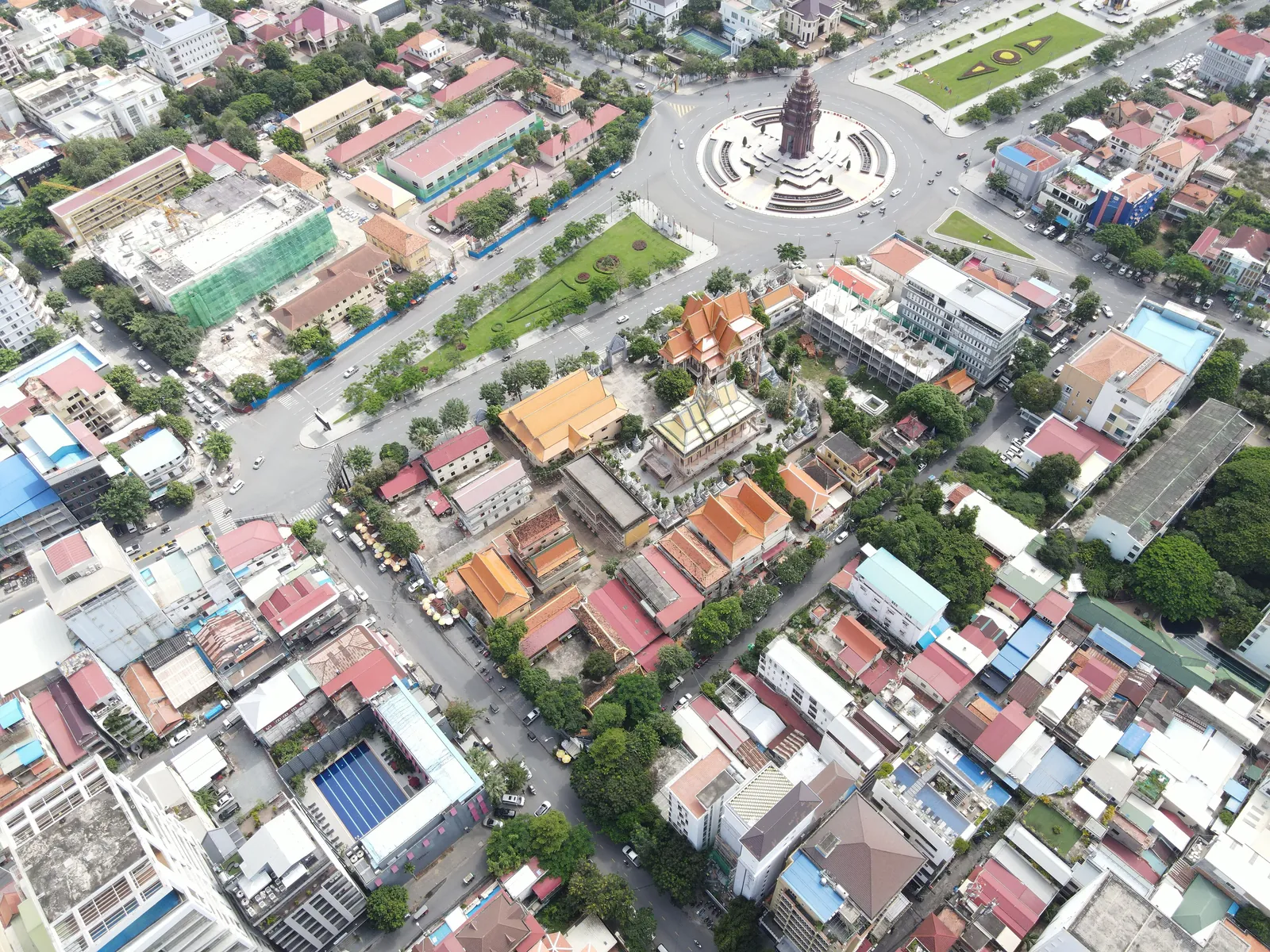
On the morning of 9 November, the roundabout where Norodom Boulevard meets Sihanouk Boulevard in central Phnom Penh is closed to traffic. The King, as Supreme Commander of the armed forces, presides over the flag-raising and lights a memorial torch at the Independence Monument; in 2025 that flame was set to burn for three days. In the evening, fireworks go up over the river at Chaktomuk in front of the Royal Palace, and the riverfront and the Chroy Changvar area on the opposite bank fill with people.
To see why the day is marked this way, you have to go back 90 years before 1953.
2. Why did France rule Cambodia for 90 years?
In 1863 King Norodom asked for French protection and signed a treaty that made Cambodia a French protectorate. In 1887 Cambodia was absorbed into French Indochina, and French rule lasted until 1953.
Why would a king invite a foreign power to “protect” his kingdom? By the early 19th century Cambodia had become a vassal state, squeezed between Siam (now Thailand) and Vietnam. Facing pressure from the Vietnamese side, King Norodom turned to France. He signed the treaty on 11 August 1863, and around the same time Siam gave up its claim of suzerainty over Cambodia and recognised the French protectorate.
The treaty kept the Cambodian monarchy in place, but real power largely passed to a French resident general in Phnom Penh, and France took charge of foreign relations, trade and military protection. In 1887 Cambodia was incorporated into the Union of French Indochina. Counting from 1863, France stayed for about 90 years.
3. Why not 1945? The first independence that lasted seven months
In March 1945 Japan overthrew the French administration in Indochina, and at Japan’s request King Norodom Sihanouk declared Cambodia independent. Allied forces entered Phnom Penh that October and France restored its rule, so that independence lasted about seven months and is not the official Independence Day.
The episode was short, but it left a mark you can still see today. The declaration of 13 March 1945 changed the country’s French name from Cambodge to Kampuchea. The new government also dropped the romanisation of Khmer that the French administration had begun to enforce and officially restored the Khmer script; no Cambodian government has tried to write Khmer in the Latin alphabet since.
Japan surrendered on 15 August 1945, Allied forces entered Phnom Penh in October, and French rule was restored on 16 October. Over the next few years Cambodia won back powers step by step: a constitution was proclaimed on 6 May 1947, and a Franco-Khmer treaty took effect in November 1949, giving Cambodians control of most administrative functions. Sihanouk called it “fifty percent independence”: Cambodia still had to coordinate foreign policy with the High Council of the French Union, France kept a significant measure of control over the judicial system, finances and customs, and wartime military operations outside the autonomous zone of Battambang and Siem Reap provinces remained in French hands.
The other half would only come back in 1953.
4. What happened in 1953? From Paris and New York to Phnom Penh
In February 1953 King Norodom Sihanouk went to France to demand full independence. Turned down, he took his case to the United States and Canada, then returned in June to Siem Reap near Angkor to rally the public. France agreed in July, handed over the police, the judiciary and command of the army between August and October, and on 9 November the king declared independence in Phnom Penh.
The king left for France on 9 February 1953 and wrote to French President Vincent Auriol three times, on 5 March, 18 March and 3 April. French officials rejected his case each time. On 11 April he left France for the United States and Canada, where he gave radio interviews; on 19 April a royal declaration in favour of independence appeared in The New York Times, and Western opinion began to shift.
On 13 June he went to Bangkok, saying he would return only to a free Cambodia. Thailand would not take him in, so he went to his royal residence near Angkor Wat, in an autonomous zone controlled by his ally Lieutenant Colonel Lon Nol. From Siem Reap he held rallies and formed a citizens’ militia that drew about 130,000 recruits.
By then France’s war in Vietnam was going badly. On 3 July the French government said it was ready to grant full independence to Cambodia, Vietnam and Laos. The handover came piece by piece: Cambodia took over its police and judiciary on 29 August and gained full command of its army on 17 October.
The king travelled some 290 kilometres from the Angkor area back to Phnom Penh, cheered along the way. On 9 November he declared Cambodia’s independence at the Royal Palace, and the same day the last French high commissioner, Jean Risterucci, stood down, marking the withdrawal of French power. Cambodians have called Sihanouk the “Father of Independence” ever since.
5. What did the 1954 Geneva Conference confirm?
The Geneva Conference agreements of 21 July 1954 affirmed Cambodia’s independence and required foreign troops to leave by October that year. At a conference in Paris that December, France agreed to hand over its remaining economic and financial powers.
| Year | What happened | Relation to Independence Day |
|---|---|---|
| 13 March 1945 | After Japan removed the French administration, the king proclaimed independence | France restored its rule that October; not the national holiday |
| 9 November 1953 | After France handed over the police, judiciary and army, Cambodia declared full independence | Celebrated every year as Independence Day |
| 21 July 1954 | The Geneva agreements affirmed Cambodia's independence; foreign troops were to leave | International affirmation |
| December 1954 | France agreed to hand over its remaining economic and financial powers | Completion of the handover |
In May 1954 Cambodia sent two cabinet ministers to the Geneva Conference, and the resulting agreements affirmed its independence and allowed it to seek military aid from any country without restriction. So 9 November 1953 is the day Cambodia declared its own independence; 1954 was the international confirmation.
6. Why does the Independence Monument look like a stupa?
The Independence Monument in Phnom Penh was begun in 1958 and opened in 1962. It is 37 metres tall, was designed by the Cambodian architect Vann Molyvann and takes the form of a lotus-shaped stupa in the style of Banteay Srei and other Khmer historical sites.
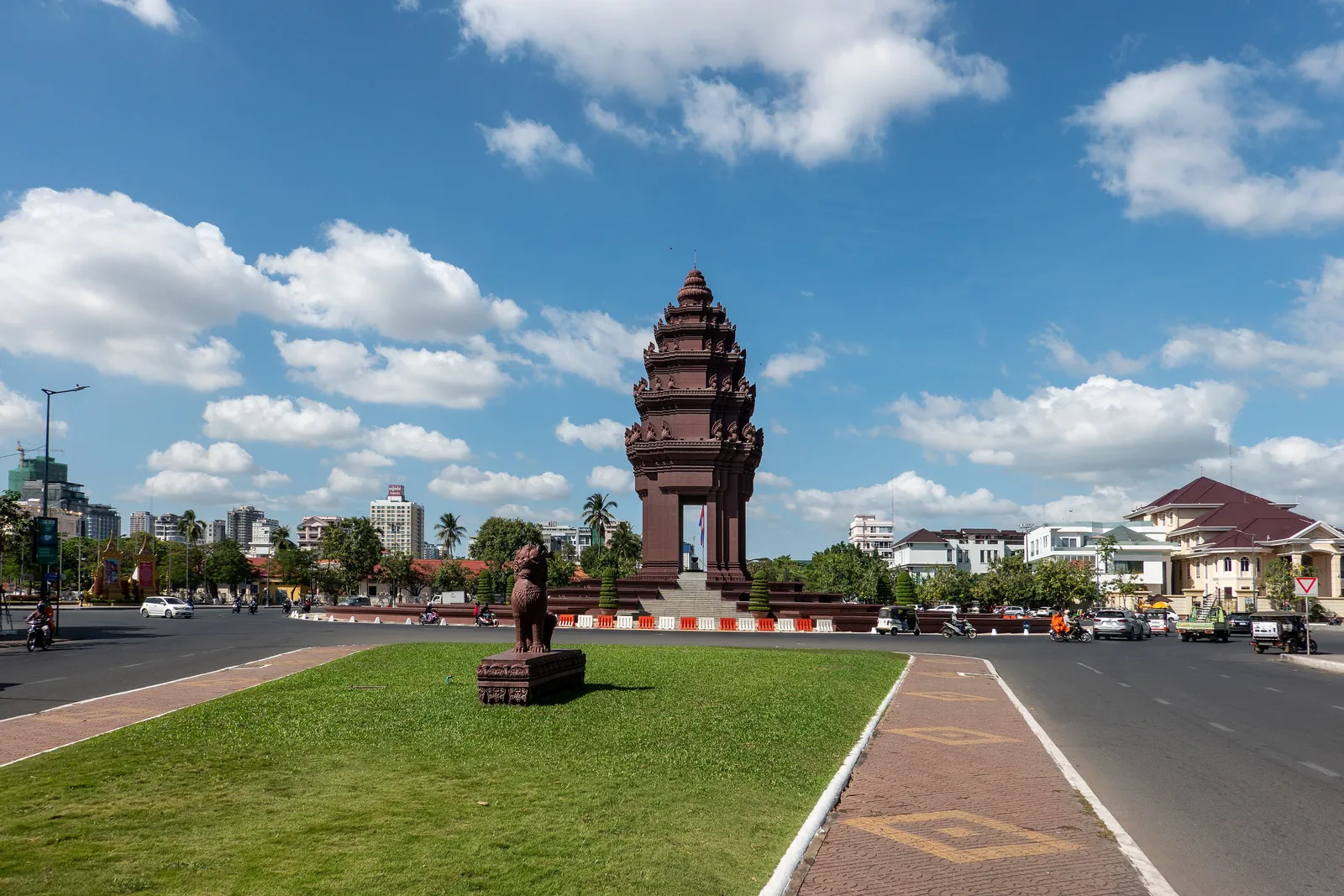
Why would a monument to political independence take the shape of a religious building? Vann Molyvann was personally chosen by Prince Sihanouk, and the prince’s brief was clear: combine the religious and the secular in one structure. A newly independent country chose the stupa and the architectural language of the Angkor era to commemorate its freedom. Scholars have since compared it with the Patuxai in Vientiane, Laos, as a symbol of how new nations in Cold War-era Southeast Asia looked for their own identity.
The torch mentioned at the start is lit on the pedestal inside the monument. On national occasions the monument is the centre of activity: the flame is usually lit by a member of the royal family or a senior official, and floral tributes line the stairs. Behind it stands the Norodom Sihanouk Memorial, built in 2013.
7. How is Independence Day celebrated?
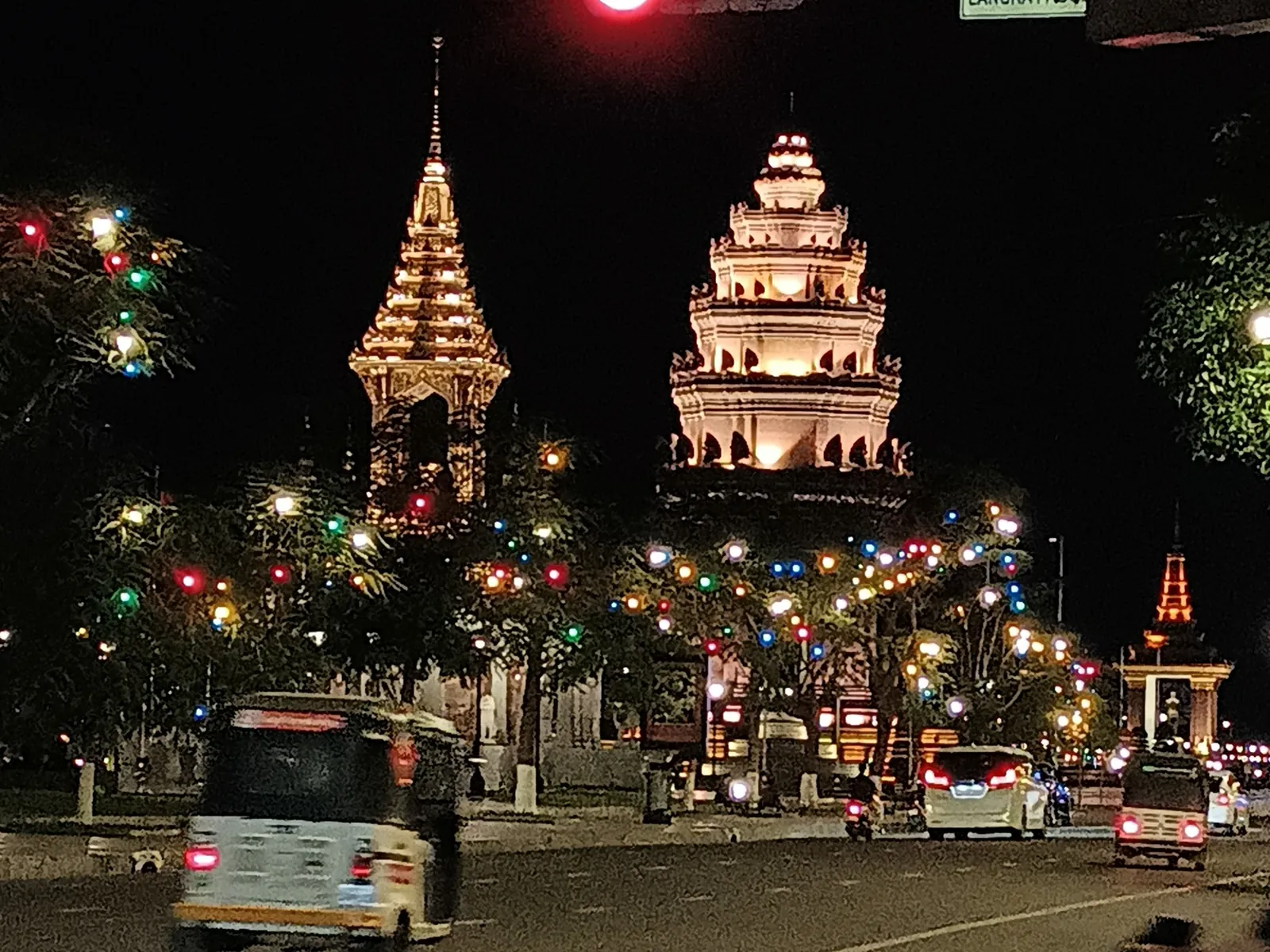
A state ceremony is held at the Independence Monument in the morning, where the King presides over the flag-raising and lights a memorial torch. Ministries lay wreaths the afternoon before, fireworks are set off over the river at Chaktomuk in the evening, and the provinces hold smaller celebrations.
For the 72nd anniversary in 2025 the schedule ran like this: on the afternoon before the ceremony, ministries and institutions took turns laying wreaths at the Independence Monument and the nearby statue of the late King Father Norodom Sihanouk; on the morning of the 9th, King Norodom Sihamoni lit the “victory flame”, set to burn for three days; and fireworks went up in front of the Royal Palace at 7 p.m. on 9 and 11 November. 9 November is also the founding anniversary of the Royal Cambodian Armed Forces.
National leaders and representatives of government departments attend the morning ceremony, which is broadcast on national television and radio, and government offices put up independence slogans and lights. The programme for the 73rd anniversary in 2026 will follow the government’s announcement before the day.
Less than two weeks after the flame goes out comes the three-day Water Festival holiday (in 2026 the main celebrations in front of the Royal Palace in Phnom Penh are suspended, and provinces may hold their own). For its origins and 2026 arrangements, see Cambodia Water Festival.
8. Independence Day and companies in Cambodia
Independence Day is a paid public holiday. Companies that need staff to work on a public holiday must meet the Ministry of Labour’s conditions and notification procedure (see table). Between 29 October and 25 November 2026 there are three holidays, in the middle of the year-end shipping period.
| Date (2026) | Day | Holiday |
|---|---|---|
| 29 October | Thursday | Coronation Day of King Norodom Sihamoni |
| 9 November | Monday | Independence Day |
| 23–25 November | Monday–Wednesday | Water Festival |
| 29 December | Tuesday | Peace Day |
| Item | Rule or fact | Source |
|---|---|---|
| When holiday work is allowed | Only where work cannot be interrupted, and only with employees' voluntary agreement | Prakas No. 112/25 (6 May 2025) |
| Notification | At least three working days in advance, through the Ministry's LACMS system, with an employee confirmation letter | Prakas No. 112/25 |
| Pay | Work on the holiday may be paid at the employee's normal daily wage | Summary by Tilleke & Gibbins (28 May 2025) |
| Rotation and time off in lieu | Businesses that must run continuously may rotate staff; where that is not possible, holiday work can be agreed with time off later, and records must be kept | Sub-Decree No. 167 |
| No Sunday substitution | A public holiday falling on a Sunday is not moved to another day | Article 162, 2021 Labour Law amendment |
Cambodia has 21 days of public holidays in 2026 and 22 in 2027, and both years include 9 November. When staff are needed on a holiday, companies must submit documents through the Ministry of Labour’s Labour Automated Central Management System (LACMS) at least three working days before the work begins, together with a confirmation signed or thumbprinted by two-thirds of employee representatives or more than half of the employees concerned. Each violation can be fined 3.36 million riel (about USD 840).
For the full labour rules, see our guide to Cambodia’s employment and labour laws. Manhattan Special Economic Zone is in Bavet, Svay Rieng Province, and has a government one-stop service office on site. To learn more about factories and facilities in the zone, contact our investment team. For more on Cambodia’s festivals, history and customs, see the Cambodian Culture hub.
9. Frequently asked questions
Q1: When is Cambodia Independence Day?
9 November every year. It marks Cambodia's full independence from France on 9 November 1953.
Q2: Is Cambodia Independence Day 2026 a public holiday?
Yes. 9 November 2026 is a Monday and a one-day national public holiday. It is the 73rd anniversary.
Q3: Which country did Cambodia gain independence from?
France. Cambodia became a French protectorate in 1863 and part of French Indochina in 1887; French rule lasted about 90 years.
Q4: Did Cambodia become independent in 1945 or 1953?
The official Independence Day is 9 November 1953. The Japanese-backed independence proclaimed on 13 March 1945 lasted only until that October, when France restored its rule; the 1954 Geneva agreements affirmed Cambodia's independence.
Q5: Who is Cambodia's Father of Independence?
King Norodom Sihanouk. In 1953 he travelled to France, the United States and Canada to press for independence, and declared independence in Phnom Penh on 9 November that year.
Q6: Why does the Independence Monument look like a stupa?
Its architect, Vann Molyvann, was asked by Prince Sihanouk to combine the religious and the secular, so it takes the form of a lotus-shaped stupa in the style of Banteay Srei and other Khmer sites. It was begun in 1958, opened in 1962 and is 37 metres tall.
Q7: What happens on Independence Day?
In the morning the King presides over a flag-raising and the lighting of a memorial torch at the Independence Monument. In the evening there are fireworks over the river in front of the Royal Palace, and the provinces hold their own celebrations.
Q8: Is the holiday moved if 9 November falls on a Sunday?
No. A public holiday that falls on a Sunday is not moved to another day in Cambodia; in 2026 and 2027, 9 November falls on a working day.
References
- Wikipedia (accessed 28 October 2026) | Independence Day of Cambodia | https://en.wikipedia.org/wiki/Independence_Day_of_Cambodia
- Wikipedia (accessed 28 October 2026) | Independence Monument (Cambodia) | https://en.wikipedia.org/wiki/Independence_Monument_(Cambodia)
- Wikipedia (accessed 28 October 2026) | French protectorate of Cambodia | https://en.wikipedia.org/wiki/French_protectorate_of_Cambodia
- Wikipedia (accessed 28 October 2026) | Kingdom of Kampuchea (1945) | https://en.wikipedia.org/wiki/Kingdom_of_Kampuchea_(1945)
- Wikipedia (accessed 28 October 2026) | Norodom Sihanouk | https://en.wikipedia.org/wiki/Norodom_Sihanouk
- EBSCO Research Starters | Cambodia Gains Independence from France | https://www.ebsco.com/research-starters/history/cambodia-gains-independence-france
- Agence Kampuchea Presse (7 November 2025) | Cambodia to Celebrate 72nd Independence Day This Weekend | https://akp.gov.kh/post/detail/352595
- Andersen Cambodia (8 October 2025) | Cambodia Sets Official 2026 Public Holiday Schedule | https://kh.andersen.com/publications/cambodia-sets-official-2026-public-holiday-schedule/
- Thmey Thmey (5 September 2025) | 2026 public holidays (Khmer) | https://thmeythmey.com/detail/151164
- Commerce Cambodia (6 October 2026) | Sub-Decree on Public Holiday for Civil Servants, Workers and Employees for 2027 | https://commerce-cambodia.com/2026/10/06/sub-decree-on-public-holiday-for-civil-servants-workers-and-employees-for-2027-kh-en/
- Tilleke & Gibbins (28 May 2025) | Cambodia Issues New Work Regulations on Overtime, Paid Holidays, and Weekly Days Off | https://www.tilleke.com/insights/cambodia-issues-new-work-regulations-on-overtime-paid-holidays-and-weekly-days-off/
- KPMG Cambodia (January 2022) | Amended Cambodia Labour Law | https://assets.kpmg.com/content/dam/kpmgsites/kh/pdf/technical-update/2022/kpmg-tu-amended-cambodia-labour-law.pdf