Summary: Auto parts makers moving capacity to Cambodia often combine Chinese inputs with processing in Cambodia and export to RCEP members such as ASEAN, China, Japan and Korea. Whether that set-up qualifies for RCEP preferential rates depends on three tests in sequence. Auto parts (HS 8708) qualify under a change in tariff heading (CTH) or a 40% regional value content (RVC40); only originating materials from members that come with RCEP proof of origin can be cumulated, and Chinese inputs without proof count as non-originating. When exporting to members that apply tariff differentials, if Cambodia’s domestic value added is below 20%, the RCEP country of origin may be reassigned to the member contributing the highest value.
Cambodia exported US$294 million of auto parts in 2025, up 11.34%. The US is not an RCEP member, and the Section 232 tariff on auto parts applies to Cambodian and Chinese products alike, so US-bound goods need a separate calculation. This article covers the Cambodia auto parts RCEP rules, how cumulation works, the documents required and how to choose markets.
1. Do Chinese Inputs Processed into Auto Parts in Cambodia Still Count as RCEP-Originating?
Yes, but with conditions. Under RCEP (the Regional Comprehensive Economic Partnership, whose members are the ten ASEAN states plus China, Japan, Korea, Australia and New Zealand), Chinese inputs can be “cumulated” as originating in Cambodia only if they come with RCEP proof of origin and already qualify as originating themselves. Chinese inputs without proof are treated as non-originating materials in the calculation.
Imagine a brake pad maker that sets up in Cambodia, buying steel backing plates, friction material ingredients and binders mostly from China, then pressing, heat-treating and finishing them in Cambodia for export to aftermarket buyers in Thailand and Japan. The company expects to declare the goods as RCEP-originating, only to discover at the application stage that its Chinese suppliers provided no RCEP proof of origin, so those inputs cannot be counted as originating.
RCEP still has these 15 members. Hong Kong, Chile, Sri Lanka and Bangladesh have applied to join, and in September 2026 RCEP ministers agreed to set up an ad hoc accession working group to advance the process; once new members join, the sources of originating materials a Cambodian factory can cumulate will widen too.
For the overall RCEP framework, see 〈Export Advantages under RCEP: Cambodia Manufacturing Benefits and Filing Requirements〉. The questions auto parts makers face when they calculate and prove origin have to be unpacked rule by rule.
2. Which RCEP Rules of Origin Apply to Auto Parts? HS 8708: Change in Tariff Heading or 40% Regional Value Content
RCEP Annex 3A sets the product-specific rule for heading 87.08 (parts and accessories of motor vehicles) as “CTH or RVC40”: either all non-originating materials undergo a change at the four-digit tariff heading, or the regional value content is at least 40%. Meeting either one is enough.
| Heading | Product | RCEP rule of origin |
| 87.08 | Parts and accessories of motor vehicles (brakes, transmissions, suspension, body parts, etc.) | CTH or RVC40 |
| 87.07 | Bodies (including cabs) for motor vehicles | RVC40 |
| 85.44 | Insulated wire and cable (including automotive wiring harnesses) | CTH or RVC40 |
| 8511.90 | Parts of ignition and starting equipment | CTH or RVC40 |
| 8512.20 | Vehicle lighting and signalling equipment | CTSH or RVC40 |
| 40.11 | New pneumatic rubber tyres | CTH or RVC40 |
Table 1: RCEP product-specific rules of origin for common auto parts headings (compiled from RCEP Annex 3A, HS 2022).
CTH (change in tariff heading) means the first four digits of each non-originating material’s tariff code differ from those of the finished product. Take brake pads: the finished product falls under 8708.30. If imported steel plate falls in Chapter 72 and friction material ingredients in Chapter 68 or 38, none of them is in 87.08, so CTH is met. But if the company imports semi-finished brake components that are themselves classified in 87.08, CTH is not met and only RVC40 remains. CTSH is the looser six-digit change.
RVC40 can be calculated in two ways, and the company may choose either. The indirect method takes the FOB value minus the value of non-originating materials, divided by the FOB value; the direct method adds up originating materials, direct labour, direct overheads, profit and other costs, divided by the FOB value. Companies using CTH have one further flexibility: non-originating materials that fail the tariff change still count as compliant if their value does not exceed 10% of the FOB value.
3. What Exactly Does RCEP Cumulation Accumulate? Originating Materials vs “Full Cumulation”
Cumulation under RCEP Article 3.4 treats “goods or materials that already qualify as originating in one member” as originating in the member where they are used in production. What it accumulates is originating materials, not all processing and value added that takes place in the region.
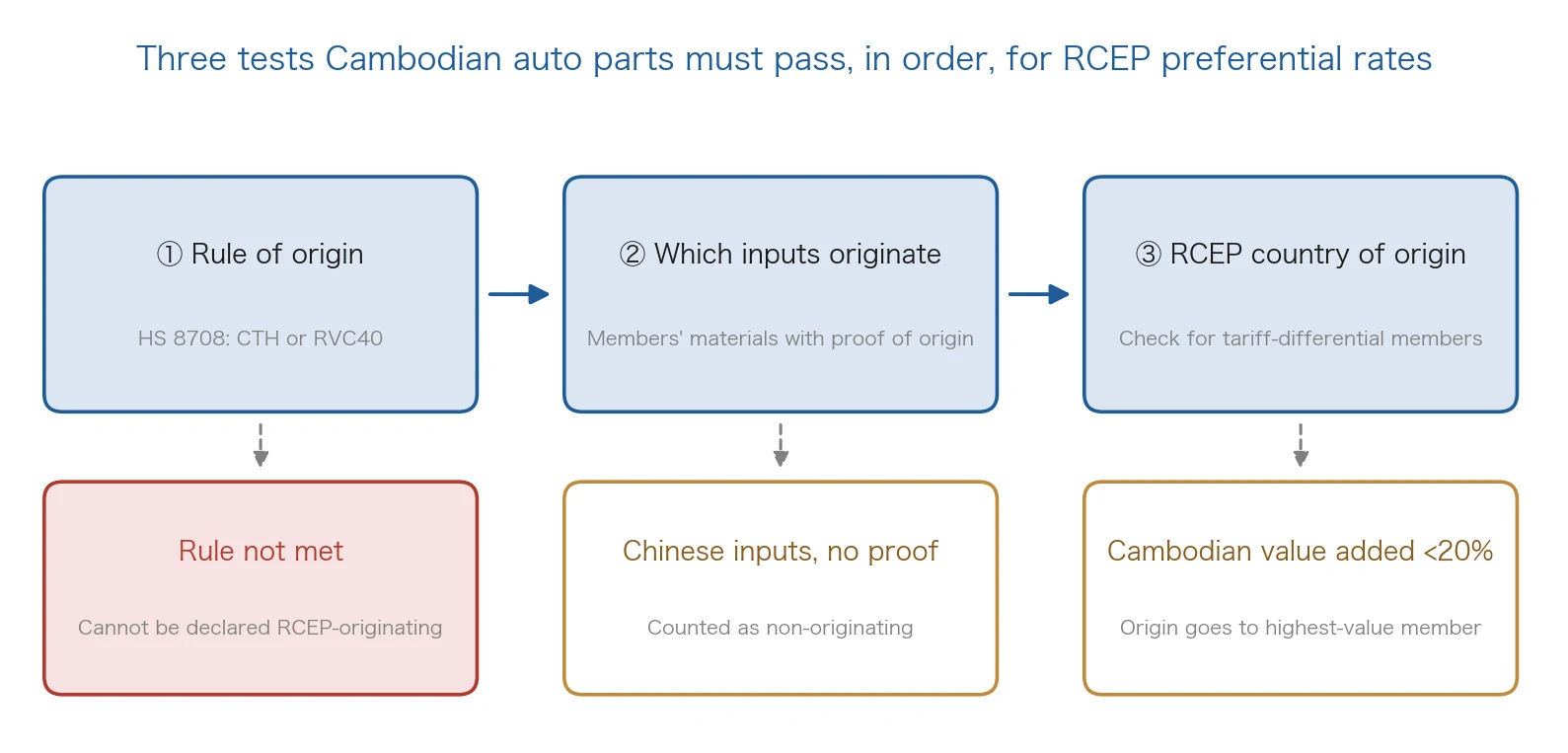
Figure 1: The three tests Cambodian auto parts must pass before RCEP preferential rates apply (compiled from RCEP Chapter 3, Annex 3A and Article 2.6).
In essence, the agreement says that originating goods and materials used as materials in another member are deemed to originate in the member where the final processing took place. For auto parts makers the key is the first half. A batch of Chinese steel with RCEP proof of origin can be counted in full as originating material when calculating regional value content in Cambodia; the same steel without proof, or where the Chinese supplier cannot show it meets the origin rules, can only be counted as non-originating.
Can regional processing be accumulated too? That is what “full cumulation” means: even when materials do not themselves qualify as originating, the processing and value added in each member would count toward the final product’s regional value. Article 3.4(2) requires the parties to start a review on the date the agreement enters into force for all signatories, considering whether to extend cumulation to all production and value added in the region, and to conclude it within five years. As of October 2026 no outcome of that review had been announced, and full cumulation is not yet a rule in force.
The difference matters especially for auto parts, whose inputs often pass through several countries: Japanese specialty steel stamped in China and assembled in Cambodia, for example. Under the current rules, earlier value can be cumulated only if every stage leaves proof of origin behind; if any link in the chain of proof breaks, the earlier value drops to zero.
The numbers show the difference. Suppose a brake assembly has an FOB value of US$100, including US$30 of Chinese steel and friction material, US$15 of Japanese bearings and US$5 of electronics from a third country, with the rest being Cambodian labour, overheads and profit. If both the Chinese and Japanese inputs come with RCEP proof of origin, non-originating materials total only US$5 and the indirect-method regional value content is 95%. If neither has proof, non-originating materials rise to US$50 and the regional value content falls to 50%, still above 40%. If inputs were a larger share, say US$60 of Chinese and Japanese parts, then without proof non-originating materials reach US$65 and regional value content falls to 35%, below the threshold; with proof for the same inputs it would still be 95%.
4. Exporting Cambodian Auto Parts to China, Japan and Korea: Tariff Differentials and the 20% Domestic Value Test
Even when goods qualify as RCEP-originating, exports to China, Japan, Korea and other members that apply different rates to different members require identifying the “RCEP country of origin”. If Cambodia’s domestic value added is below 20% of the goods’ value, the country of origin may be reassigned to the member contributing the highest value.
RCEP tariff concessions are not identical for all members. Seven members, namely China, Indonesia, Japan, Korea, the Philippines, Thailand and Vietnam, give different preferential rates for some items depending on which member is exporting, which the agreement calls tariff differentials. Under Article 2.6, if a good is listed in the importing party’s tariff differential appendix and the exporting party’s domestic value added is below 20%, the RCEP country of origin is not the exporting party but the member that contributed the highest value to the good.
Apply this to the “Chinese inputs, Cambodian processing” model. If more than 80% of an auto part’s value comes from Chinese-originating inputs and Cambodian processing and labour account for only a little over 10%, Japanese customs may treat the good as Chinese-originating when it is exported to Japan, applying Japan’s rate for China rather than for Cambodia. Whether this matters depends on whether the item is listed in the importing country’s tariff differential appendix; check each item against the published appendix before shipping.
5. Where Can Cambodian Auto Parts Use RCEP? Regional Markets and the US Market Are Calculated Differently
RCEP applies only among its members. Cambodian auto parts sold to ASEAN, China, Japan, Korea, Australia and New Zealand can use it; sales to the US cannot. The Section 232 tariff the US imposes on auto parts on national security grounds applies to Cambodian and Chinese products alike and must be calculated separately.
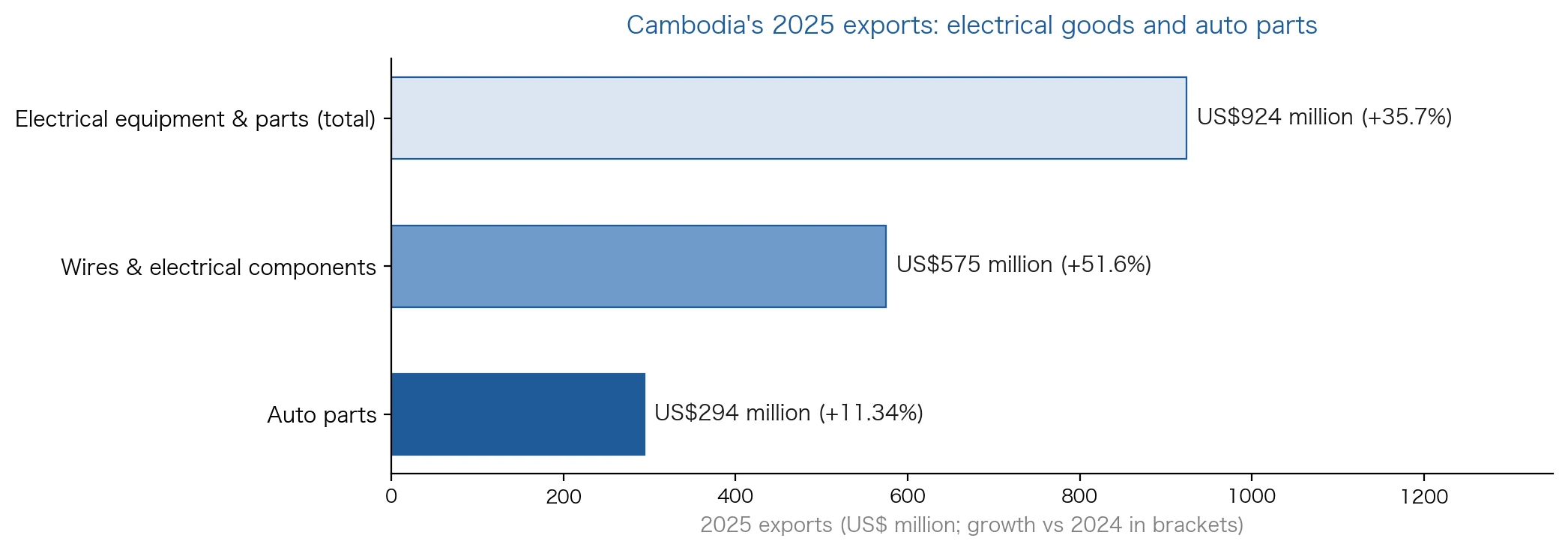
Figure 2: Cambodia’s 2025 exports of electrical equipment and parts, wires and electrical components, and auto parts (compiled from public reports of Cambodian official statistics).
Cambodia’s auto parts exports are still at an early stage but growing steadily: auto parts exports reached US$294 million in 2025, up 11.34%. In the related electrical category, wires and electrical components reached US$575 million, up 51.6%, and total electrical equipment and parts reached US$924 million, up 35.7%. Wiring harnesses, electrical components and auto parts often belong to the same supply chain, and these figures show Cambodia’s electrical and auto parts industries taking shape.
The regional market and the US market follow completely different logic. Sales to RCEP members turn on the rules of origin and proof described in sections 1 to 4. Sales to the US turn on US Customs’ substantial transformation test and three stacked layers: country-specific additional tariffs, product-specific anti-dumping and countervailing duties, and material and sector measures such as Section 232 on autos and parts. The Section 232 auto parts measure applies broadly to all source countries, with lower rates possible only for economies that have separate agreements with the US, so moving capacity from China to Cambodia does not avoid it. For current country-specific rates and stacking rules, see 〈US Tariff Observatory for Cambodia〉.
Companies whose main market is the US should therefore not treat RCEP as the main reason to build in Cambodia; for companies targeting ASEAN vehicle assemblers or the Japanese or Chinese aftermarket, RCEP is at the heart of the calculation.
6. What Documents Does RCEP Cumulation Require? Supplier Proof, Back-to-Back Proof and Record Keeping
For cumulation to stand, a company needs its upstream suppliers’ RCEP proof of origin, its own export proof of origin and cost records, and back-to-back proof of origin when goods transit a third country. All records must be kept for at least three years.
Upstream proof is the easiest to overlook. When Chinese or Vietnamese suppliers ship, they need an RCEP certificate of origin or a declaration of origin from an approved exporter before the company can count those inputs as originating; purchase contracts should require suppliers to provide proof with each shipment and cooperate with verification.
Export-side proof is valid for one year from issue. When goods move through another member or ship in split consignments, the intermediate member can issue back-to-back proof without re-determining origin.
Records must be kept for at least three years from the date the proof of origin is issued, and some members require longer, Australia for example five years. If the importing country opens a verification, whether the full records can be produced determines whether preferential duty is clawed back.
7. What Other Hurdles Does an Auto Parts Plant Face in Cambodia? EIA Classes and When RCEP Does Not Help
An auto parts plant in Cambodia usually needs an Initial Environmental Impact Assessment (IEIA). Under Ministry of Environment Prakas 3591 of 2025, vehicle and machinery parts plants, brake pad plants and automotive wiring harness plants are all classed as IEIA regardless of size, with a review period of 60 working days.
| Annex item | Project type (translated from the Khmer original) | EIA class |
| No. 44 | Factories for automotive wiring and electronic assemblies | IEIA (any size) |
| No. 48 | Factories for all types of vehicle tyres | IEIA (any size) |
| No. 51 | Factories for vehicle and machinery spare parts | IEIA (any size) |
| No. 52 | Factories for car brake pads and motorcycle and tricycle brakes | IEIA (any size) |
| No. 53 | Factories manufacturing and assembling all types of vehicles | IEIA (any size) |
Table 2: Auto-parts-related project classes in the annex to Prakas 3591 (compiled from the annex issued by Cambodia’s Ministry of Environment on 6 May 2025).
It is just as important to recognise where RCEP will not help. For companies whose main market is the US, the reasons are set out above. Where inputs depend heavily on sources that cannot provide RCEP proof, such as precision parts from non-members, or Chinese suppliers unwilling to issue proof, RVC40 is often hard to reach. And if the Cambodian side does only simple assembly with domestic value added below 20%, exports to members applying tariff differentials will have their origin revert to the input source country. If the RCEP parties complete their review and adopt full cumulation, regional processing would count, the calculations in both of these cases would change, and this article will be updated.
8. How Do Vietnamese Inputs Count Toward Origin? Manhattan SEZ’s Land Border Access and On-Site Origin Services
Vietnam is an RCEP member, so Vietnamese inputs supplied with RCEP proof of origin can be cumulated as originating in Cambodia. For an auto parts plant, being closer to the Vietnamese supply chain means more sources of originating materials to cumulate.
At factory level, several links in the proof-of-origin chain have to connect: which border crossing Vietnamese and Chinese inputs enter through and how far they travel by road; whether suppliers’ proof of origin can be filed with the import documents at customs clearance; and where the Cambodian proof of origin needed for export is issued. If similar auto parts companies in the zone already export, there is precedent to check how smoothly these links work.
Manhattan Special Economic Zone is in Bavet, Svay Rieng Province, about 6 km from the Cambodia–Vietnam border and about 90 km from the Ho Chi Minh City port area. Steel, plastic parts and electrical inputs from southern Vietnam can reach the factory by road through the land border crossing, and Vietnamese container trucks can drive straight to factory loading docks; Chinese, Japanese and Korean inputs imported through Ho Chi Minh City port use the same route. The zone has a government one-stop service office that includes the Ministry of Commerce and customs, so import, export and certificate-of-origin procedures can be handled on site. Auto parts companies making RV brakes and brake pads already operate in the zone.
Whether a product qualifies as RCEP-originating still depends on the company’s own input structure, processing depth and supplier proof; what the zone can shorten is the distance for inputs to reach the factory and for origin documents to be processed. If your company is assessing auto parts capacity in Cambodia, please use the Manhattan SEZ advisory team contact form to share your products and HS codes, the source countries of key inputs and whether proof of origin is available, target export markets and planned output. The zone will then explain the import and export clearance routes, how proof of origin is handled, and what it can help coordinate at the land and EIA stages.
9. Cambodia Auto Parts and RCEP Origin FAQ: Rules, Cumulation and Export Markets
Q1: What are the RCEP rules of origin for auto parts?
| Heading 87.08, parts and accessories of motor vehicles, is “CTH or RVC40”: either all non-originating materials change at the four-digit tariff heading, or regional value content reaches 40%. Heading 85.44 (wiring harnesses) and 40.11 (tyres) follow the same rule, while 87.07 (vehicle bodies) can only use RVC40. |
Q2: Do auto parts assembled in Cambodia from Chinese inputs count as Cambodian-originating?
| It depends on whether the inputs carry proof and on processing depth. Chinese inputs with RCEP proof of origin can be cumulated as originating, while those without proof count as non-originating; the finished product must also meet the tariff change or 40% regional value content rule to be declared as RCEP-originating. |
Q3: Can RCEP full cumulation be used now?
| Not yet. Article 3.4 currently accumulates only materials that already qualify as originating. For full cumulation, which would count all regional processing and value added, the agreement only requires the parties to start a review and conclude it within five years; as of October 2026 it is not a rule in force. |
Q4: Could the RCEP country of origin of Cambodian auto parts exported to Japan become China?
| Possibly. If the item is listed in Japan’s tariff differential appendix and Cambodia’s domestic value added is below 20% of the goods’ value, the RCEP country of origin is reassigned to the member contributing the highest value, which could be China as the input source. Keeping high-value processes in Cambodia avoids this. |
Q5: Can Cambodian auto parts sold to the US use RCEP?
| No. The US is not an RCEP member, and US-bound goods are subject to US origin rules and tariff measures; the Section 232 tariff on autos and parts applies to Cambodian and Chinese products alike. For current country-specific rates, see our US Tariff Observatory for Cambodia. |
10. Sources and References
📚 References
- Australian Border Force (2024-12-18) | RCEP Annex 3A Product-Specific Rules (HS 2022): 87.08 CTH or RVC40; 87.07 RVC40; 85.44 CTH or RVC40; 8511.90 CTH or RVC40; 8512.20 CTSH or RVC40; 40.11 CTH or RVC40.
https://www.abf.gov.au/free-trade-agreements/files/rcep-chapter-3-annex-3a-HS2022.pdf - Australian Border Force (2024-12-18) | Regional Comprehensive Economic Partnership (RCEP) Rules of Origin: Article 3.4 cumulation text and review clause; de minimis of 10% of FOB value; Article 2.6: for goods listed in the importing party’s tariff differential appendix, if the exporting party’s domestic value added is below 20%, the RCEP country of origin is the member with the highest value contribution; proof of origin valid for one year.
https://www.abf.gov.au/free-trade-agreements/files/RCEP-rules-of-origin.pdf - Singapore Customs (undated; accessed 2026-10-14) | Back to Back Form RCEP Declaration Letter: seven RCEP members apply tariff differentials, namely Indonesia, the Philippines, Thailand, Vietnam, China, Japan and Korea.
https://isomer-user-content.by.gov.sg/174/c8ceb79c-f866-4f6d-ae02-2e32fba9f6e4/rcepdeclarationletterv2.pdf - Ask.gov.sg (undated; accessed 2026-10-01) | RCEP record keeping: exporters, producers and issuing authorities must keep records for at least three years from the date the proof of origin is issued.
https://ask.gov.sg/customs/questions/clz9bs3ym02kif966y9gr8q55 - Asian Development Bank (2022-05) | The Regional Comprehensive Economic Partnership Agreement: RCEP Article 3.4 provides only for regional cumulation of originating materials; full cumulation is left to review.
https://www.adb.org/sites/default/files/publication/792516/rcep-agreement-new-paradigm-asian-cooperation.pdf - ASEAN Secretariat (2026-09-21) | Joint Media Statement of the 5th RCEP Ministers’ Meeting: ministers agreed to establish an ad hoc accession working group to advance the accession of Bangladesh, Chile, Hong Kong (China) and Sri Lanka; RCEP has 15 members.
https://asean.org/wp-content/uploads/2026/09/Joint-Media-Statement-of-the-5th-RCEP-Ministers-Meeting_Adopted.pdf - Vietstock, citing Cambodian official statistics (2026-01) | Cambodia’s electrical goods exports surge in 2025: electrical equipment and parts US$924 million, up 35.7%; wires and electrical components US$575 million, up 51.6%; auto parts US$294 million, up 11.34%.
https://en.vietstock.vn/2026/01/cambodias-electrical-goods-exports-surge-in-2025-52000-628834.htm - Cambodia Ministry of Environment (2025-05-06) | Prakas No. 3591 on the classification of development projects for environmental impact assessment: annex items 44, 48, 51, 52 and 53 (auto-parts-related) are all IEIA regardless of size.
https://data.opendevelopmentcambodia.net/laws_record/prakas-no-3591-on-the-classification-of-development-projects-for-environmental-impact-assessm - Manhattan SEZ Industry Knowledge Base | Related articles: 〈Export Advantages under RCEP: Cambodia Manufacturing Benefits and Filing Requirements〉, 〈US Tariff Observatory for Cambodia〉, 〈Cambodia Certificate of Origin and Local Content Practice〉, 〈Cambodia Electroplating and Surface Treatment Supply〉.