Summary
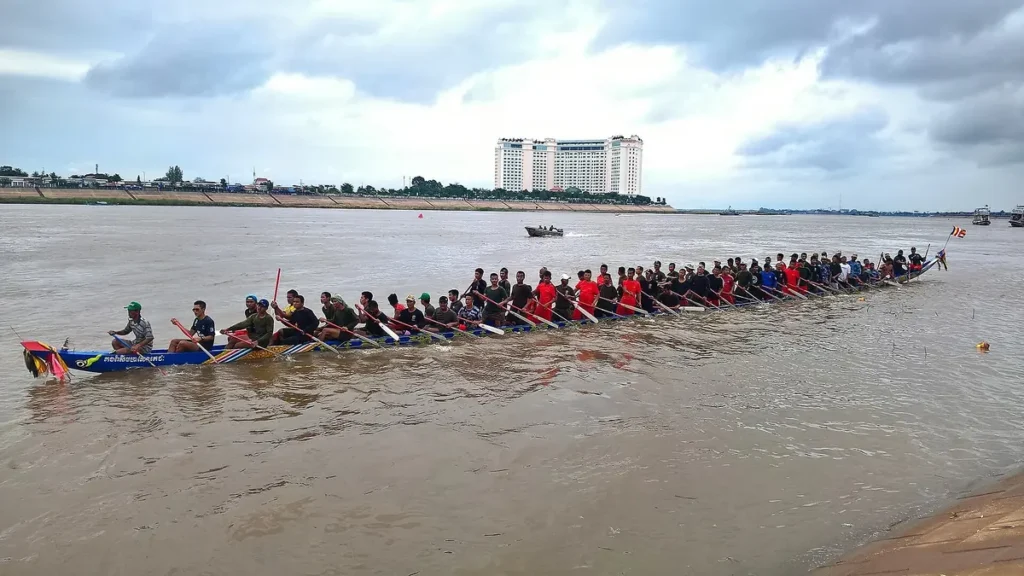
Cambodia has seven elements on UNESCO’s intangible cultural heritage lists: five on the Representative List (the Royal Ballet, Sbek Thom shadow theatre, tugging rituals and games, Kun Lbokator martial arts and krama) and two on the Urgent Safeguarding List (Chapei Dang Veng and Lkhon Khol Wat Svay Andet). A nomination for the traditional Khmer wedding is listed for 2026.
These arts very nearly disappeared. Between 1975 and 1979, under the Khmer Rouge, almost all of Cambodia’s dance and music masters were killed and many shadow puppets were destroyed. After 1979 a handful of surviving artists rebuilt them from memory, one troupe at a time. Each of the seven elements now on the UNESCO lists carries a story of being handed on.
Last updated: 28 October 2026
1. Cambodian traditional arts at a glance
Cambodia has seven UNESCO intangible heritage elements. The earliest are the Royal Ballet and Sbek Thom shadow theatre (on the Representative List since 2008); the newest is krama, inscribed in 2024.
| Element | Type | List | Year inscribed |
|---|---|---|---|
| Royal Ballet of Cambodia (Khmer classical dance) | Dance | Representative List | 2008 (proclaimed a Masterpiece in 2003) |
| Sbek Thom, Khmer shadow theatre | Shadow theatre | Representative List | 2008 (proclaimed a Masterpiece in 2005) |
| Tugging rituals and games | Farming ritual | Representative List (joint with the Philippines, Republic of Korea and Viet Nam) | 2015 |
| Chapei Dang Veng | Music and sung storytelling | Urgent Safeguarding List | 2016 |
| Lkhon Khol Wat Svay Andet | Masked dance drama | Urgent Safeguarding List | 2018 |
| Kun Lbokator | Martial art | Representative List | 2022 |
| Cultural practices linked to krama | Textile | Representative List | 2024 |
The list runs from a court dance with more than a thousand years behind it to the checked cloth Cambodians wear over their shoulders every day. What kept them alive was not a museum but people who still dance, sing and weave them.
2. Why did these arts nearly disappear? Revival after the Khmer Rouge
Under the Khmer Rouge (1975–1979) almost all of Cambodia’s dance and music masters were killed and many puppets were destroyed. After 1979 a few surviving artists led the rebuilding of troupes, but several of these arts are still at risk today.
These traditions pass from master to student by word of mouth and example; when the masters are gone, steps, lyrics and techniques go with them. After 1979 dance troupes re-formed and the old repertoire was recovered piece by piece, and a few surviving artists brought shadow theatre back, rebuilding three troupes.
| Element | Under the Khmer Rouge | Revival and current situation |
|---|---|---|
| Royal Ballet | Almost all dance and music masters were killed | Troupes re-emerged after 1979 and restored the ancient repertoire; challenges include lack of funding and venues, competition from modern media and the risk of becoming a mere tourist show |
| Sbek Thom | Many puppets destroyed; the art nearly vanished | Revived from 1979 by a few surviving artists; three troupes have been rebuilt |
| Chapei Dang Veng | Transmission severely disrupted | Very few performers and fewer masters remain; on the Urgent Safeguarding List since 2016 |
| Lkhon Khol | Most seriously threatened | Still transmitted by the Svay Andet pagoda community; on the Urgent Safeguarding List since 2018 |
Once revived, the arts faced new problems: too little money and too few venues, competition from modern media, and the risk that sacred rituals are cut down into tourist shows. That is why two Cambodian elements sit on the Urgent Safeguarding List, which is reserved for traditions whose transmission is in serious danger.
3. The Royal Ballet: inscribed in 2003 or 2008?
Both dates are correct. UNESCO proclaimed the Royal Ballet a Masterpiece of the Oral and Intangible Heritage of Humanity in 2003, and in 2008 those Masterpieces were incorporated into the new Representative List, so UNESCO records the year of inscription as 2008.
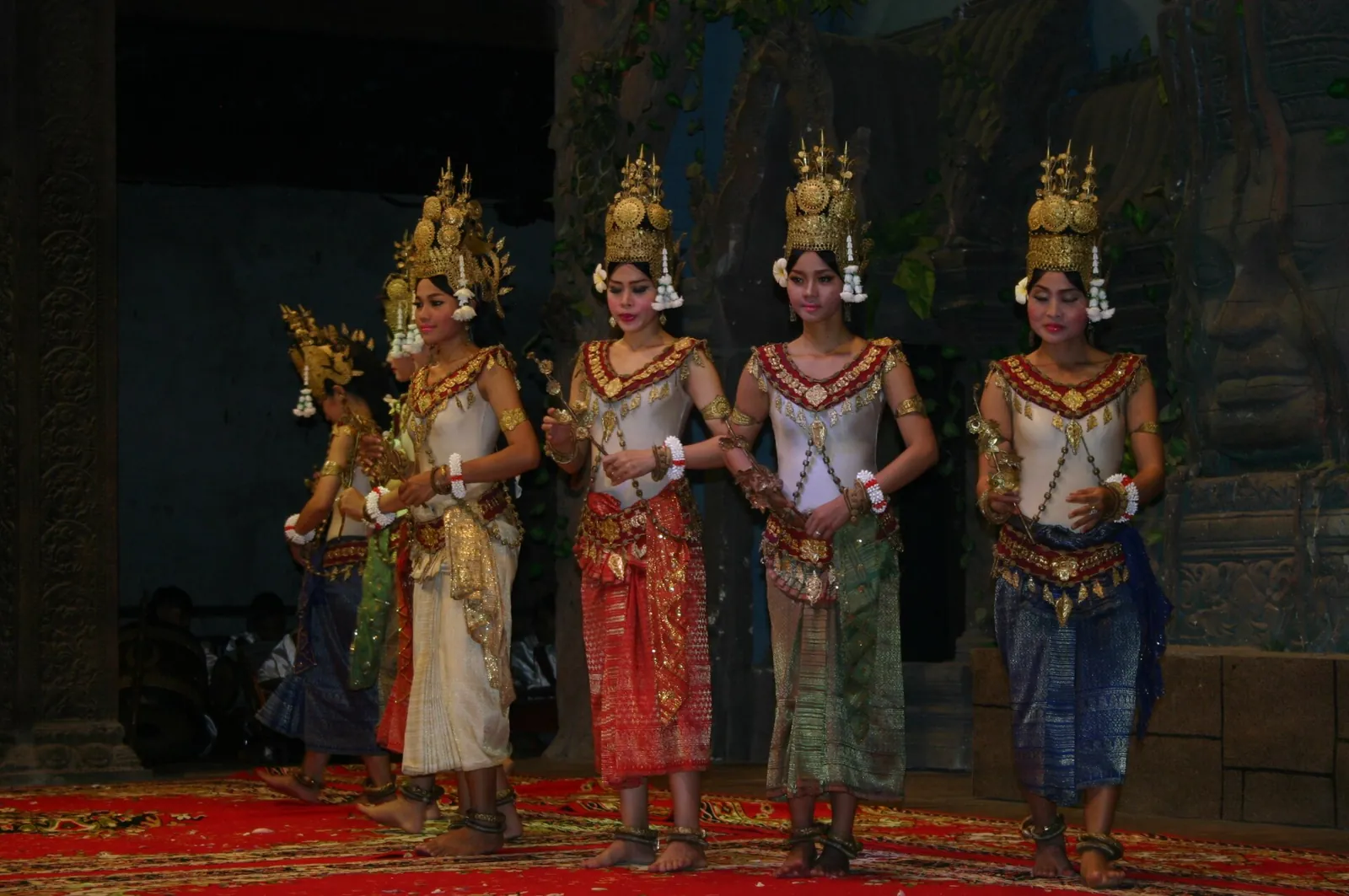
The dance has been tied to the Khmer court for more than a thousand years. It was performed at coronations, marriages, funerals and Khmer holidays, and its dancers were seen as messengers between the king and the gods and ancestors. Its repertoire carries legends about the origins of the Khmer people, and there are only four character types: Neang (female), Neayrong (male), Yeak (giant) and Sva (monkey), each with its own colours, costumes, make-up and masks.
Every gesture and pose takes years of intensive training. An orchestra accompanies the dance and a female chorus narrates the story, singing the emotions the dancers express through movement. The pieces performed most often today are the blessing dance (Robam Chuon Por) and the apsara dance (Robam Tep Apsara).
4. Sbek Thom: how do you perform with two-metre puppets?
Sbek Thom uses two-metre-high, non-articulated puppets cut from a single piece of openwork leather. Performances tell the Reamker, the Khmer version of the Ramayana, and a single show can use up to 160 puppets.
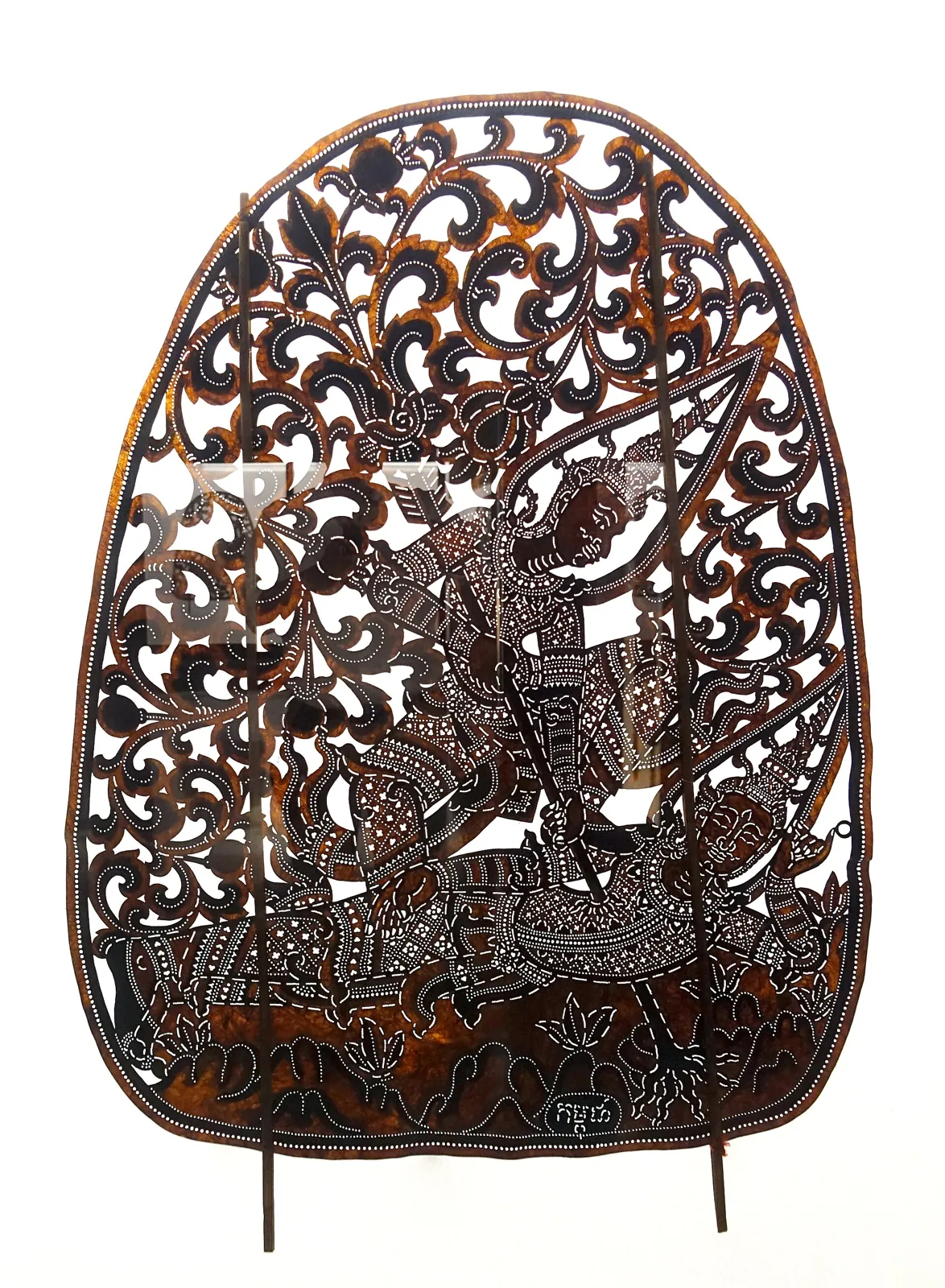
Traditionally the show begins after dark beside a rice field or a pagoda. A white screen is stretched between two tall bamboo poles and a fire is lit behind it, throwing the puppets’ shadows onto the screen; today spotlights are more common. Because the puppets cannot bend, it is the puppeteers who move, dancing set steps as they hold the figures up, while an orchestra and two narrators tell the story. A single tale can run over several nights.
Each character’s puppet is made in a dedicated ritual, the leather dyed with Kandaol bark and fixed to two bamboo sticks. Sbek Thom existed before the Angkor period and, like the Royal Ballet and Lkhon Khol, is considered a sacred art. It was once performed for the gods only three or four times a year, at Khmer New Year, the king’s birthday and similar occasions; after Angkor declined in the 15th century it gradually moved from ritual towards performance, while keeping its ritual character.
5. Lkhon Khol: why is it tied to one pagoda?
Lkhon Khol Wat Svay Andet is a masked dance drama performed only by men, telling only the Reamker, and kept alive by the community around Svay Andet pagoda in Kandal Province, about 10 km east of Phnom Penh. It was inscribed on the Urgent Safeguarding List in 2018.
It belongs to one pagoda because it was always performed for the local spirits. Its purpose is to honour Neak Ta, the guardian spirits of a place and its people, asking for a safe village and a good harvest; one episode, Kumbhakarna blocking the water, is believed to bring enough rain for the farming season. This tradition was the one most seriously threatened under the Khmer Rouge. For Neak Ta and Cambodia’s other faiths, see Religion in Cambodia.
6. Chapei Dang Veng: Cambodia’s art of sung storytelling
Chapei Dang Veng is singing accompanied by the chapei, a plucked lute. Its lyrics combine education, social commentary and satire with traditional poetry, folk tales and Buddhist stories. It was inscribed on the Urgent Safeguarding List in 2016.
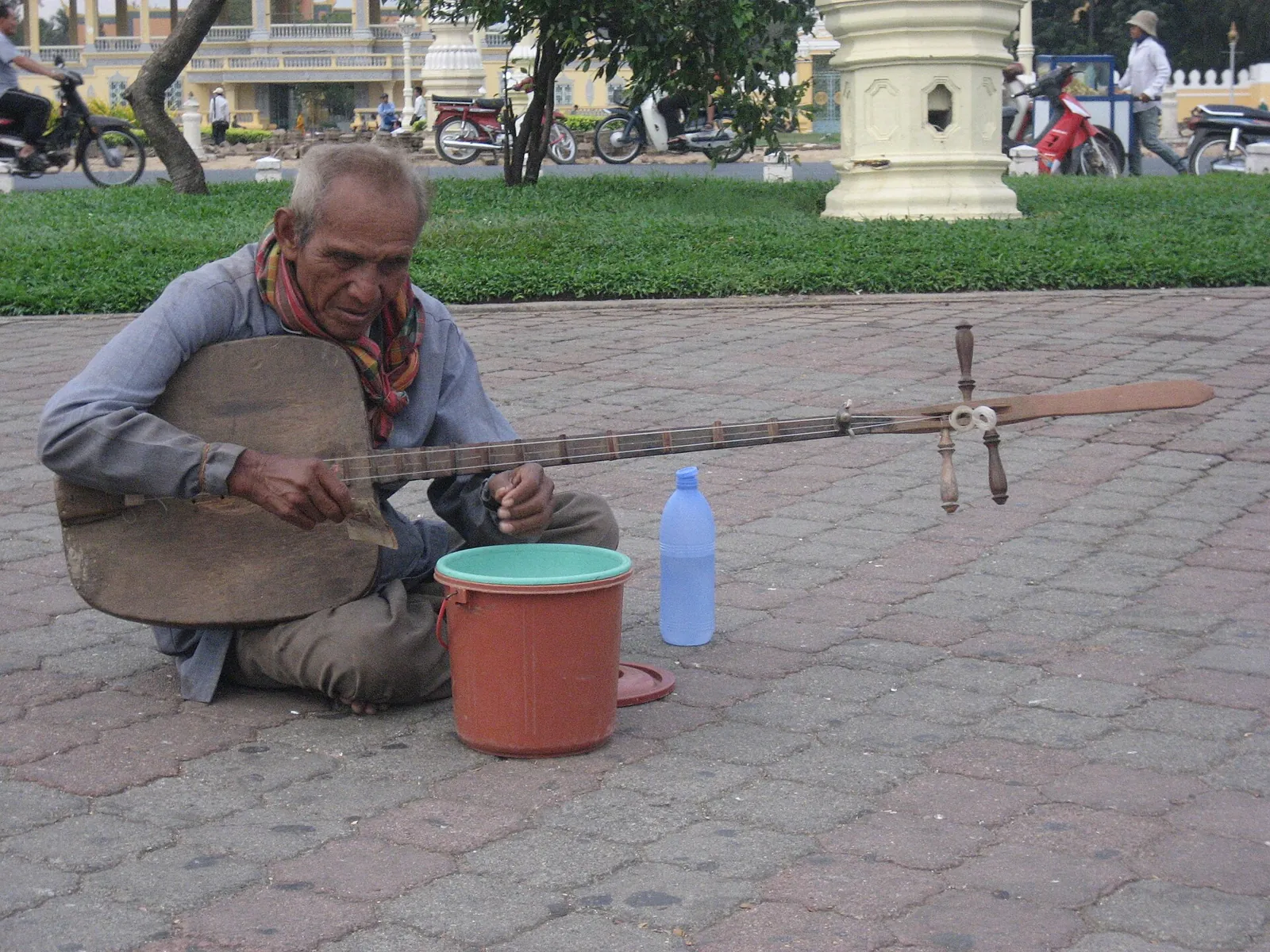
A good chapei performer has to play, sing and think on his feet, improvising verses that comment on the day’s events and poke fun at society; along the way listeners hear old Khmer words they might not meet elsewhere. Most performers are men, though there is no rule that they must be, and they often appear at cultural festivals. The skill passes down within families or from master to apprentice. The Khmer Rouge years broke that chain badly, and today performers are few and masters fewer still.
7. Kun Lbokator: a martial art dating back to the first century
Kun Lbokator is Cambodia’s traditional martial art, dating back to the first century. It aims to build physical and mental strength and discipline through self-defence techniques and a philosophy of non-violence, and was inscribed on the Representative List in 2022.
A martial art built on non-violence sounds like a contradiction, but in Kun Lbokator the master teaches more than technique: respect for nature, courtesy towards others, and the duty to protect vulnerable communities and the environment. Some masters are believed to have powers of healing and protection. It is still performed as a ritual offering to local spirits and is practised regardless of age, gender, education or status.
8. Krama: the heritage Cambodians use every day
Krama is a rectangular checked cloth woven from cotton or silk. It is used as a scarf, belt, head cover or blanket, and even as a hammock for children. “Cultural practices and expressions linked to krama” was inscribed on the Representative List in 2024.
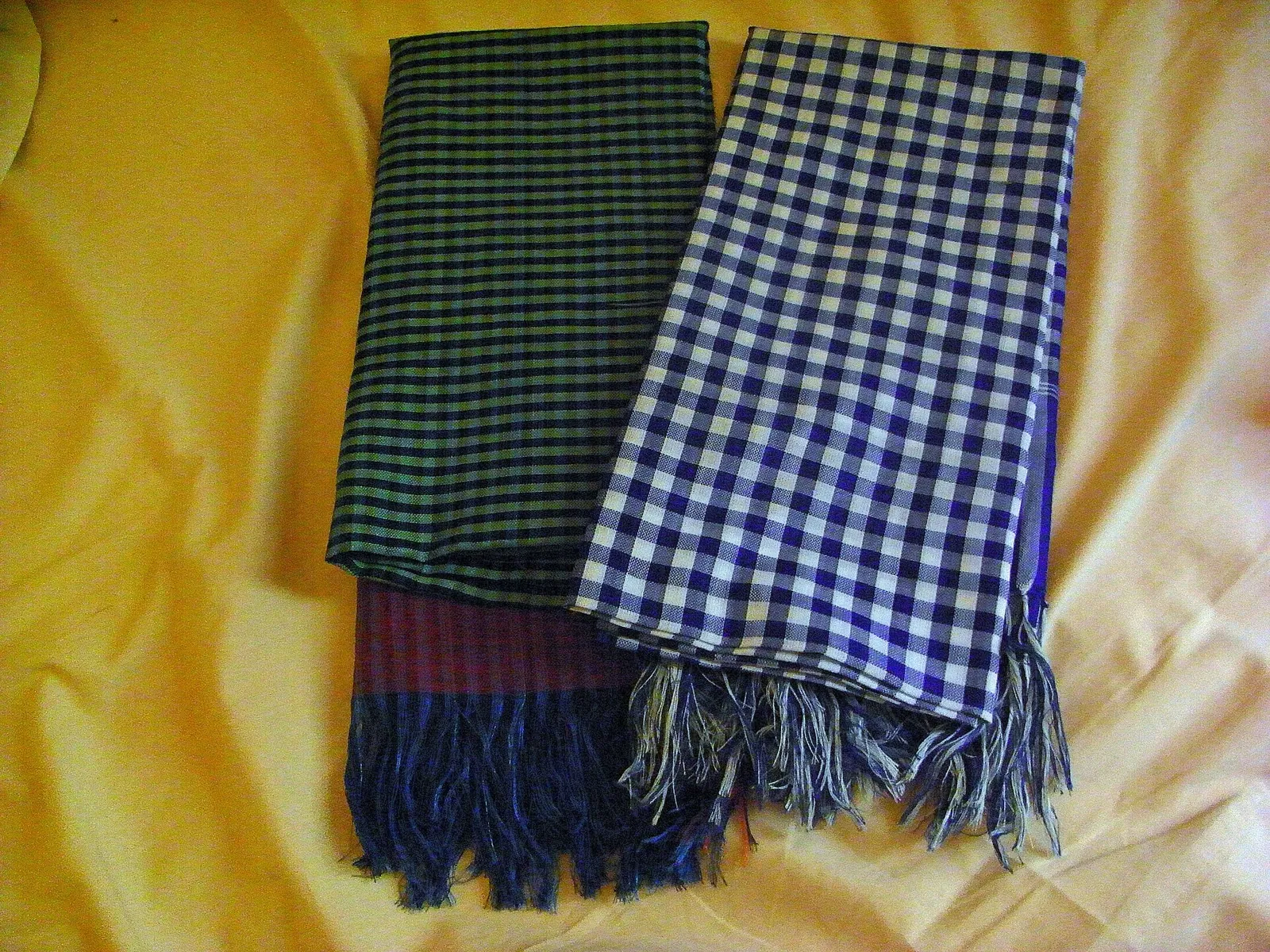
Of everything on the list, krama is the closest to daily life: people from all walks of life use it every day, and it turns up in rituals, festivals, cooking and caring for the sick. The checks vary, but the dyes come in just four colours, white, yellow, red and blue, made from plants and insects, and the cloth is woven on traditional looms.
Weavers are mostly women, while men grow and harvest cotton, collect dye materials and repair looms. Daughters once learned from their mothers; today professional weaving groups and producers make most krama, and schools teach the craft. When the Cambodian government submitted the nomination in March 2023, it also cited archaeological evidence that krama existed in the pre-Angkorian period.
9. Tugging rituals and games: a farming rite without winners
Tugging rituals and games, a joint nomination by Cambodia, the Philippines, the Republic of Korea and Viet Nam, was inscribed on the Representative List on 2 December 2015. In rice-farming cultures the tug of war is held to pray for a good harvest and to mark a new farming cycle, and it deliberately avoids an emphasis on winning.
A contest without winners hardly sounds like a contest, and that is the point: what is being pulled for is the year’s harvest, not who is stronger.
10. Which Cambodian traditions are nominated next?
Nominations in progress include the traditional Khmer wedding (for examination in 2026) and Khmer New Year (pending priority treatment).
UNESCO lists specific elements rather than whole art forms. Lkhon Khol, for example, is inscribed as “Lkhon Khol Wat Svay Andet”, the branch kept alive by the Svay Andet pagoda community.
11. How does intangible heritage differ from World Heritage?
World Heritage protects monuments and places such as Angkor; intangible cultural heritage protects living traditions such as dance, crafts and rituals. Cambodia has five World Heritage Sites and seven intangible heritage elements.
| World Heritage Site (UNESCO name) | Year inscribed |
|---|---|
| Angkor | 1992 |
| Temple of Preah Vihear | 2008 |
| Temple Zone of Sambor Prei Kuk | 2017 |
| Koh Ker: Archaeological Site of Ancient Lingapura | 2023 |
| Cambodian Memorial Sites | 2025 |
The apsaras carved into the walls of Angkor Wat and the apsara dance on today’s stage are two records of the same image, one kept in stone and one kept by people. For the history of Angkor Wat and Zhou Daguan’s account of the city, see Angkor Wat and Zhou Daguan.
12. The coconut dance of Svay Rieng
The coconut dance (Robam Kuos Traloak) began around 1960 in Romeas Haek District, Svay Rieng Province. It is performed at wedding processions and festivals to lift the mood, and portrays courtship between young villagers.
Like the other arts in this article, the coconut dance was badly damaged under the Khmer Rouge and has gradually been revived. Svay Rieng is also home to the Manhattan Special Economic Zone, in the border city of Bavet; see our Bavet investment guide. For more on Cambodia’s festivals, history and customs, see the Cambodian Culture hub.
13. FAQ
Q1: What are Cambodia's UNESCO intangible heritage elements?
Seven: the Royal Ballet, Sbek Thom shadow theatre, tugging rituals and games, Chapei Dang Veng, Lkhon Khol Wat Svay Andet, Kun Lbokator and cultural practices linked to krama.
Q2: When was the Royal Ballet of Cambodia inscribed by UNESCO?
It was proclaimed a Masterpiece in 2003 and incorporated into the Representative List in 2008, which UNESCO records as its year of inscription.
Q3: What are the characters in Khmer classical dance?
Four types: Neang (female), Neayrong (male), Yeak (giant) and Sva (monkey), each with its own colours, costumes, make-up and masks.
Q4: How big are Sbek Thom puppets?
About two metres high, cut from a single piece of leather and not articulated; one performance can use up to 160 puppets.
Q5: How old is Kun Lbokator?
It dates back to the first century and was inscribed on the Representative List in 2022.
Q6: What is a krama?
A rectangular checked cotton or silk cloth used as a scarf, belt, head cover or blanket; the practices linked to it were inscribed by UNESCO in 2024.
Q7: Which Cambodian traditions are nominated for UNESCO?
The traditional Khmer wedding (for examination in 2026) and Khmer New Year (pending priority treatment).
Q8: How many World Heritage Sites does Cambodia have?
Five: Angkor (1992), Temple of Preah Vihear (2008), Sambor Prei Kuk (2017), Koh Ker (2023) and the Cambodian Memorial Sites (2025).
References
- UNESCO (accessed 27 October 2026) | Cambodia – Intangible Cultural Heritage (country page) | https://ich.unesco.org/en/state/cambodia-KH
- UNESCO (accessed 27 October 2026) | Royal ballet of Cambodia | https://ich.unesco.org/en/RL/royal-ballet-of-cambodia-00060
- UNESCO (accessed 27 October 2026) | Sbek Thom, Khmer shadow theatre | https://ich.unesco.org/en/RL/sbek-thom-khmer-shadow-theatre-00108
- UNESCO (accessed 27 October 2026) | Lkhon Khol Wat Svay Andet | https://ich.unesco.org/en/USL/lkhon-khol-wat-svay-andet-01374
- UNESCO | Decision 13.COM 10.A.3 (Lkhon Khol Wat Svay Andet) | https://ich.unesco.org/en/decisions/13.COM/10.A.3
- UNESCO (accessed 27 October 2026) | Chapei Dang Veng | https://ich.unesco.org/en/USL/chapei-dang-veng-01165
- UNESCO (accessed 27 October 2026) | Kun Lbokator, traditional martial arts in Cambodia | https://ich.unesco.org/en/RL/kun-lbokator-traditional-martial-arts-in-cambodia-01868
- UNESCO (accessed 27 October 2026) | Cultural practices and expressions linked to Krama, a traditional woven textile in Cambodia | https://ich.unesco.org/en/RL/cultural-practices-and-expressions-linked-to-krama-a-traditional-woven-textile-in-cambodia-02115
- UNESCO | Decision 10.COM 10.B.12 (Tugging rituals and games) | https://ich.unesco.org/en/decisions/10.COM/10.B.12
- Le Petit Journal | Le krama bientôt au patrimoine culturel immatériel de l'UNESCO | https://lepetitjournal.com/cambodge/krama-bientot-au-patrimoine-culturel-immateriel-de-unesco-396319
- Wikipedia (accessed 27 October 2026) | Dance in Cambodia | https://en.wikipedia.org/wiki/Dance_in_Cambodia
- IntoCambodia (accessed 27 October 2026) | Robam Kuos Traloak (Coconut Dance) | https://intocambodia.org/content/robam-kuos-traloak-coconut-dance
- Wikipedia (accessed 27 October 2026) | List of World Heritage Sites in Cambodia | https://en.wikipedia.org/wiki/List_of_World_Heritage_Sites_in_Cambodia
- Press OCM | Another Cambodian Archaeological Site Registered on World Heritage List | https://pressocm.gov.kh/en/archives/8270