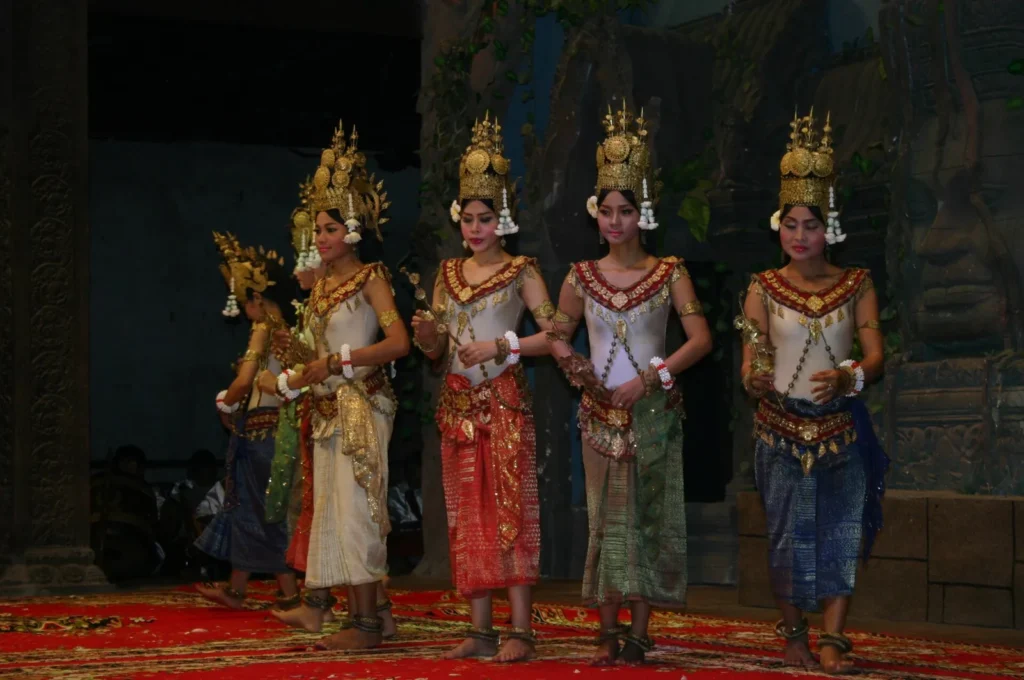
Summary: Cambodian food (Khmer cuisine) is built on rice and fish. Rice is eaten at almost every meal and Cambodia has some 2,000 native rice varieties, while prahok fish paste and kroeung spice paste season many dishes. Signature dishes include fish amok, num banhchok and samlor kako.
This article lists eight Khmer dishes to try and explains how prahok is made, Cambodia’s two EU geographical indications, Kampot pepper and Kampong Speu palm sugar, how Cambodian rice has fared in the World’s Best Rice award, how Cambodians eat, what they eat at festivals, and what the 13th-century Chinese envoy Zhou Daguan wrote about food at Angkor.
(Last updated: 27 October 2026)
1. Cambodian food at a glance
Cambodian food centres on rice and fish, with prahok fish paste and kroeung spice paste as the most common seasonings. Fish amok is regarded as a national dish, and num banhchok and kuy teav are everyday breakfasts.
| Item | Details |
|---|---|
| Staple | Rice, eaten at almost every meal; about 2,000 native rice varieties |
| Main protein | Fish and fish products, eaten two or three times a day |
| Signature seasonings | Prahok (fish paste) and kroeung (spice paste) |
| Signature dishes | Fish amok (amok trey), num banhchok, samlor kako |
| EU geographical indications | Kampot pepper (2016) and Kampong Speu palm sugar (2019) |
| World's Best Rice | In 2025 Cambodia's Phka Rumduol shared first place with Vietnam's ST25 |
| Utensils | Spoon and fork for rice and soup; chopsticks only for noodles |
2. The foundations of Khmer cuisine: rice, fish and kroeung
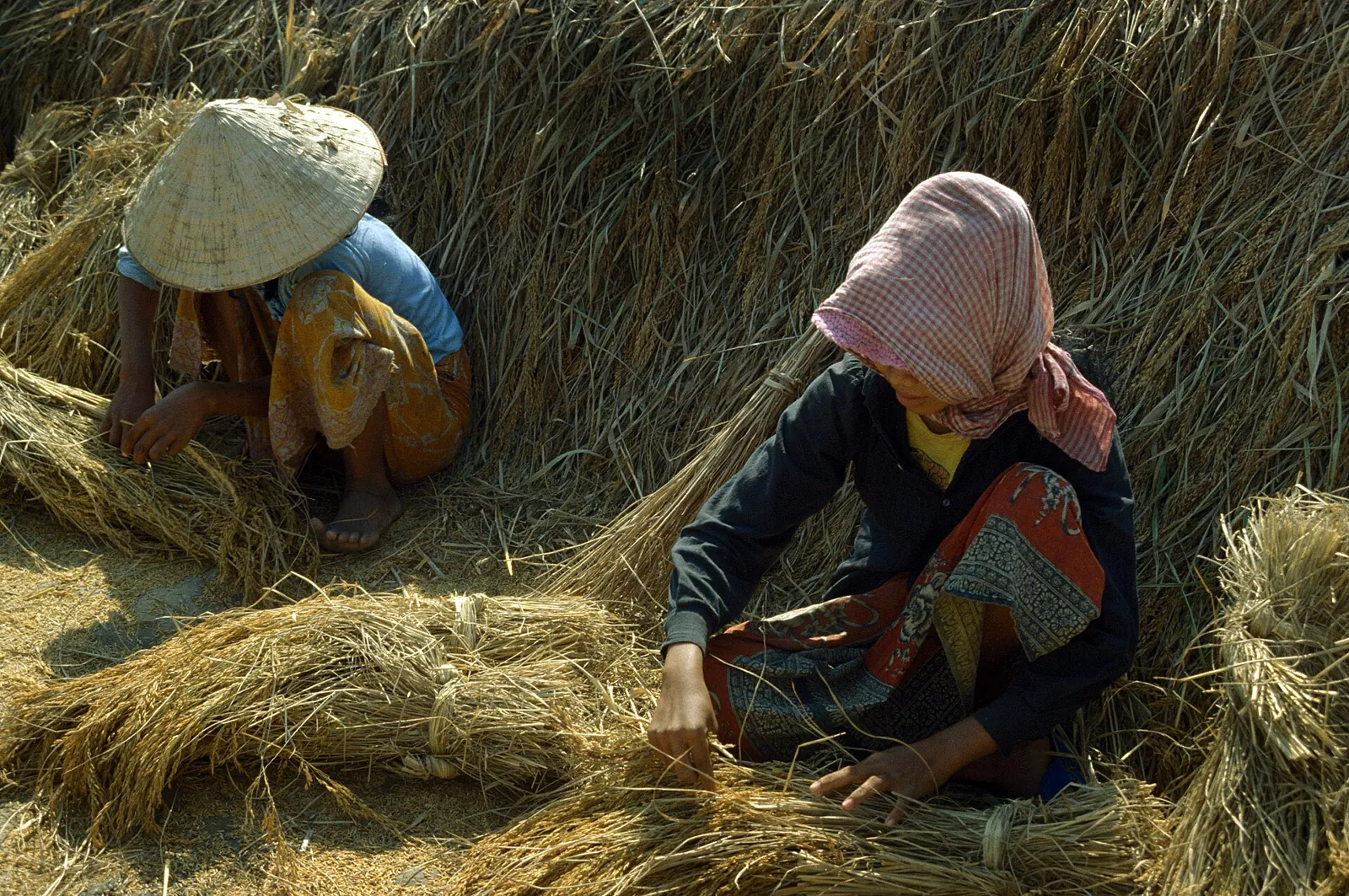
Rice is Cambodia’s staple, eaten at almost every meal. Rice and fish are the two most important sources of nutrition, and fish and fish products are eaten two or three times a day. Flavour comes from kroeung spice paste and prahok fish paste.
According to Wikipedia, Cambodia has some 2,000 native rice varieties. Kroeung is a fresh spice paste used in curries, soups and stir-fries, made by pounding lemongrass, galangal, garlic, shallots, kaffir lime leaves and turmeric. “Samlor” is the Khmer word for the stews, soups and curries that are the backbone of a Cambodian meal.
3. Prahok: why is it called “Cambodian cheese”?
Prahok is a salted, fermented fish paste, usually made from snakehead or small carp-family fish. It seasons almost every Khmer dish, and its strong smell has earned it the nickname “Cambodian cheese”.
Prahok began as a way to preserve fish for the seasons when catches were small. The traditional method described on Wikipedia: the fish are beheaded and descaled by treading on them, packed into banana-leaf-lined baskets and pressed under stones for a day, then mixed with coarse salt, sun-dried for a day, pounded in a wooden mortar and left to ferment in clay jars. The liquid ladled off each day is used as fish sauce, and the paste is ready after about a month, once it stops releasing liquid.
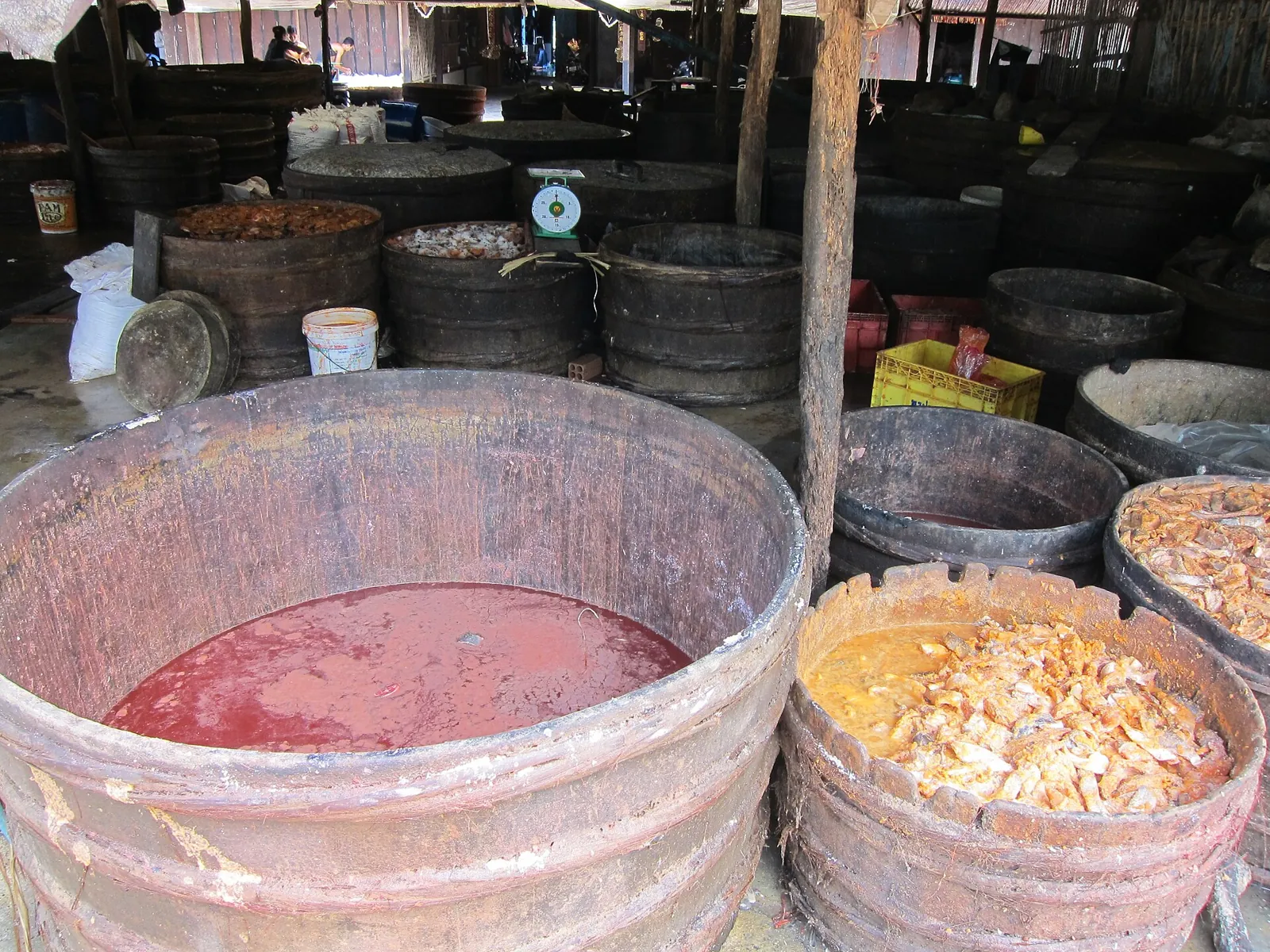
Prahok can be eaten with rice or made into a dip. Wikipedia also notes that tourist restaurants in Siem Reap often use less prahok, or none, in case foreign visitors find it too strong.
4. Eight Cambodian dishes to try
The Khmer dishes visitors meet most often, and the most representative, are fish amok, num banhchok, samlor kako, kuy teav, bai sach chrouk, beef lok lak, num ansom and kralan.
| Dish | What it is | When it is eaten |
|---|---|---|
| Fish amok (amok trey) | A mousse-like steamed fish curry served in a banana-leaf cup | Regarded as a national dish; eaten with rice |
| Num banhchok | Lightly fermented rice noodles, usually with a fish broth made with yellow or yellow-green kroeung | Often breakfast, sometimes lunch |
| Samlor kako | A soup with green kroeung, prahok, roasted ground rice and many vegetables | Regarded as a national dish |
| Kuy teav | Rice noodles in a clear pork broth with toppings | A popular breakfast across Cambodia |
| Bai sach chrouk | Pork with rice | A common breakfast |
| Beef lok lak | Marinated beef cubes stir-fried and served on lettuce with tomato and cucumber | A dish shared with Vietnam |
| Num ansom | Sticky rice wrapped in banana leaf, filled with banana, pork or mung beans | Pchum Ben, Khmer New Year and traditional weddings |
| Kralan | Rice, beans and coconut roasted in bamboo tubes | A Khmer New Year food |
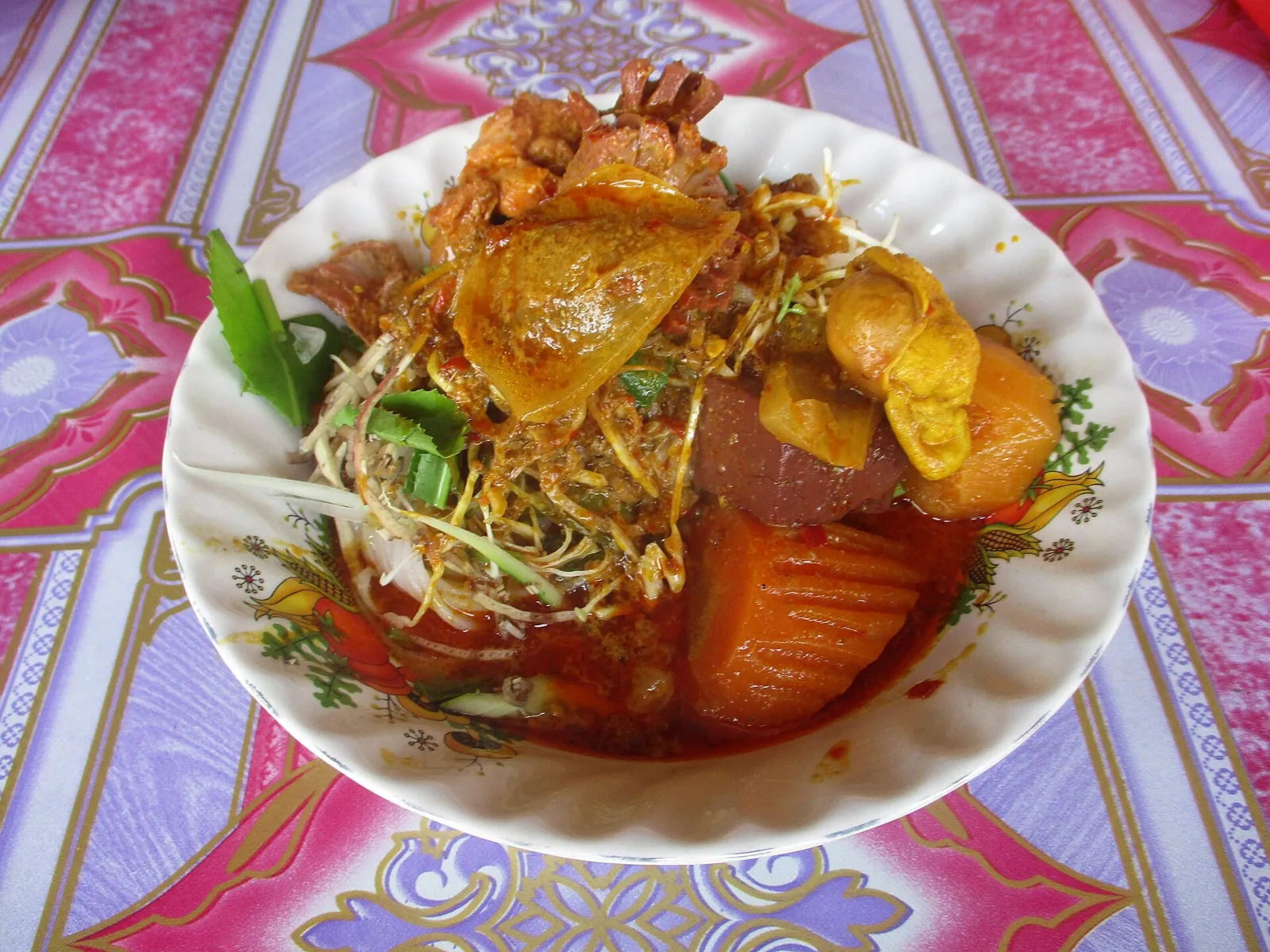
Num banhchok broth varies by region. The most common is a fish soup made with yellow or yellow-green kroeung, freshwater fish (usually snakehead), prahok and coconut milk. Siem Reap’s version leaves out the coconut milk and is thinner, while Kampot’s adds peanuts, dried shrimp and Kampot fish sauce and is usually eaten cold.
5. How is fish amok made, and is it Cambodia’s national dish?
Fish amok is regarded as one of Cambodia’s national dishes. Pieces of fish are coated in kroeung, mixed with coconut milk and egg, poured into a banana-leaf cup lined with noni leaves and steamed for 20 to 30 minutes.
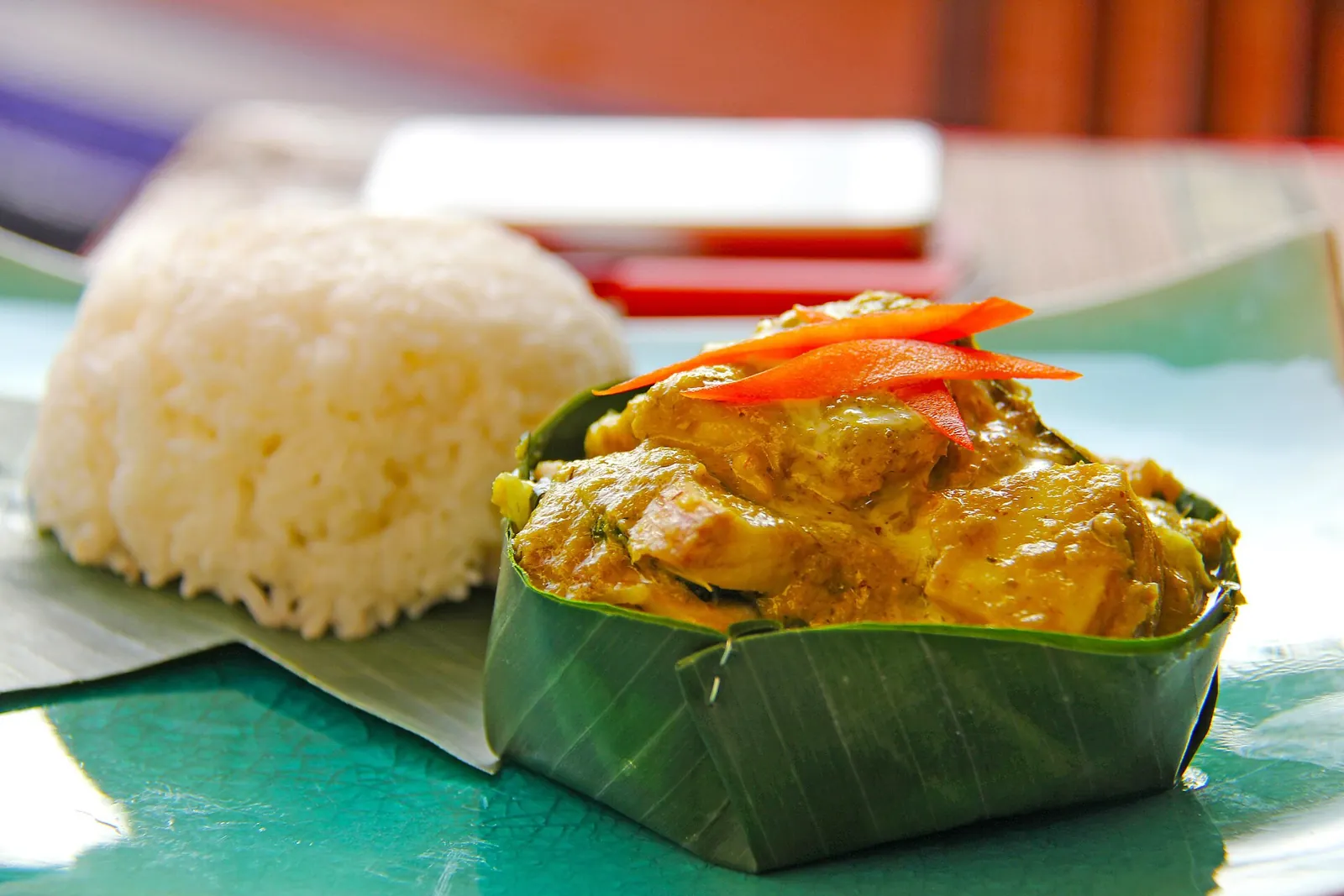
Amok is generally thought to have been a royal dish of the Khmer Empire, but its origins are debated across the region: Thailand has the similar hor mok, and Malaysia and Indonesia have otak-otak. The finished amok is served in a banana-leaf cup or coconut shell with white rice.
6. Kampot pepper and Kampong Speu palm sugar: Cambodia’s two EU geographical indications
Kampot pepper received EU geographical indication protection in February 2016, the first Cambodian product to do so; Kampong Speu palm sugar followed in April 2019 as the second.
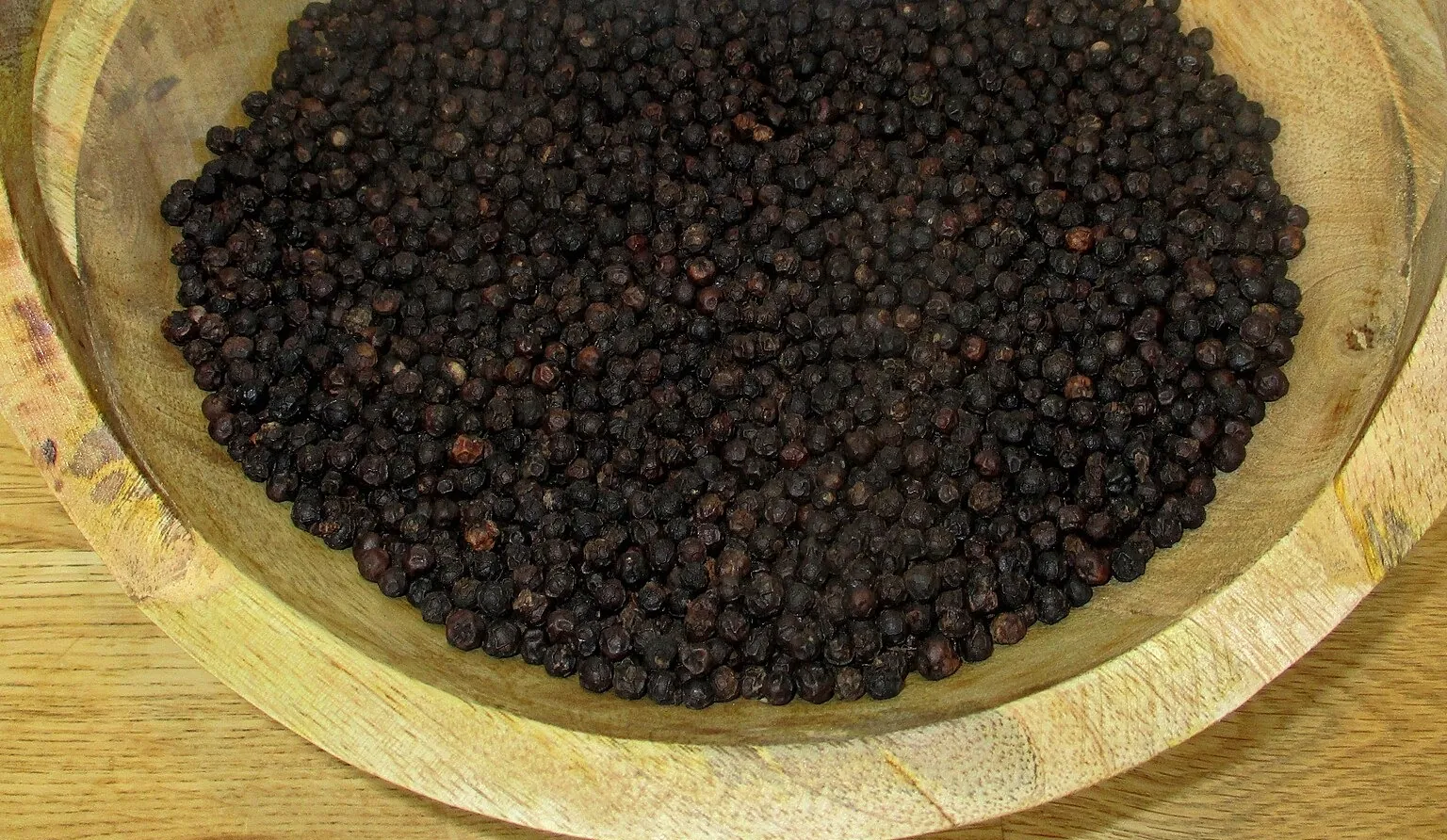
According to Wikipedia, pepper growing in Kampot dates back at least to the 13th century. Large-scale production began under French rule in the 1870s, and by the early 20th century Cambodia harvested about 8,000 tonnes a year; in the 1960s Kampot had about a million pepper poles producing some 3,000 tonnes a year. The industry almost disappeared during the civil war, falling to just 4 tonnes a year by the late 1990s, and recovered after farmers returned in the 2000s, reaching about 80 tonnes in 2020. Kampot pepper gained Cambodian geographical indication status in 2010, and the green, black, white and red pepper on sale all come from the same plant.
| Period | Kampot pepper output |
|---|---|
| Early 20th century | About 8,000 tonnes a year (Cambodia) |
| 1960s | About 3,000 tonnes a year from about a million poles |
| Late 1990s | About 4 tonnes a year |
| 2020 | About 80 tonnes |
VOA Khmer reported that the European Commission recognised Kampong Speu palm sugar as a protected geographical indication in a letter dated 2 April 2019. Cambodia applied in 2017, and a Swiss company had lodged an objection along the way.
7. Cambodian fragrant rice and the World’s Best Rice award
At the World Rice Conference in Phnom Penh in November 2025, Cambodia’s Phka Rumduol shared the World’s Best Rice title with Vietnam’s ST25. At the October 2026 contest in Manila, the winner was Myanmar’s Pawsan.
The World’s Best Rice award is judged by The Rice Trader during each year’s World Rice Conference. Phka Rumduol is marketed under the Malys Angkor certification, and Cambodge Mag counts seven World’s Best Rice titles for it, including 2025. In 2026 Myanmar’s Pawsan took first place, Vietnam’s ST25 second and the Philippines’ Dinorado third.
8. How do Cambodians eat?
Cambodians traditionally ate with their hands; today they mostly use a spoon and fork for rice and soup and chopsticks only for noodles. All dishes are served at once and shared.
According to Wikipedia, the spoon and fork came with the French and chopsticks with the Chinese. All dishes arrive together with a few side dishes, and courses are served one at a time only for French-style meals. Common breakfasts are rice porridge with salted dried fish, rice with salted fish and vegetables, French bread with condensed milk, or noodles with meat and greens; lunch and dinner centre on rice and soup.
Khmer cuisine has also absorbed neighbouring influences: oyster sauce and stir-frying came with Chinese immigrants, dishes such as beef lok lak are thought to be borrowed from Vietnam, and French rule brought butter and other French elements.
9. What do Cambodians eat at festivals?
Khmer New Year brings kralan, bamboo-tube sticky rice; the Water Festival brings freshly pounded flattened rice (ambok); at Pchum Ben, rice balls and sticky rice cakes are taken to the pagoda; and num ansom is a must at traditional weddings.
| Festival | Festival food |
|---|---|
| Khmer New Year | Kralan; num ansom |
| Pchum Ben | Rice balls thrown for hungry ghosts (bay ben); cooked food, rice, sticky rice cakes and Khmer sweets taken to the pagoda |
| Water Festival | Freshly pounded ambok eaten with bananas and coconut during the moon salute |
| Traditional wedding | Num ansom |
For the moon salute and ambok, see Cambodia Water Festival; for offerings to monks at Pchum Ben, see Religion in Cambodia.
10. Cambodian food 700 years ago, in Zhou Daguan’s account
In A Record of Cambodia, the Yuan envoy Zhou Daguan described food at Angkor at the end of the 13th century: pepper was already grown, black carp was the most common fish, and since local people did not make vinegar, sourness in soup came from leaves, pods or seeds.
In our translation, Zhou wrote under “Products”: “Pepper is also found here; it grows on climbing vines, hanging in clusters like green seeds, and is hottest when fresh and green.” Under “Fish and reptiles”: “Of fish and turtles, black carp are the most numerous; carp, crucian carp and grass carp are also plentiful.” Under “Salt, vinegar and sauces”: “The local people cannot make vinegar; to make a soup sour they add the leaves of the xianping tree, or its pods once it has pods, or its seeds once it has seeds.”
Zhou reached Angkor with a Yuan embassy in 1296; for the story of his book, see Angkor Wat and Zhou Daguan. For more on Cambodia’s festivals, history and customs, see our Cambodian Culture section.
11. FAQ
Q1: What is Cambodian food like?
It is built on rice and fish, and most dishes are seasoned with prahok fish paste or kroeung spice paste; signature dishes include fish amok, num banhchok and samlor kako.
Q2: What is the national dish of Cambodia?
Fish amok (amok trey) is regarded as one of Cambodia's national dishes, and samlor kako is also often listed as one.
Q3: What Cambodian dishes should I try?
Fish amok, num banhchok, samlor kako, kuy teav, bai sach chrouk, beef lok lak, num ansom and kralan.
Q4: What is prahok?
A salted, fermented fish paste, usually made from snakehead or small carp-family fish, eaten with rice or as a dip; its strong smell earned it the nickname "Cambodian cheese".
Q5: What makes Kampot pepper special?
It became the first Cambodian product with EU geographical indication protection in 2016, and green, black, white and red Kampot pepper all come from the same plant.
Q6: Is Cambodian rice the best in the world?
Cambodia's Phka Rumduol has won the World's Best Rice award several times and shared first place with Vietnam's ST25 in 2025; the 2026 winner was Myanmar's Pawsan.
Q7: Do Cambodians eat with chopsticks?
Mostly a spoon and fork for rice and soup; chopsticks are used only for noodles. Traditionally Cambodians ate with their hands.
Q8: What do Cambodians eat for breakfast?
Common breakfasts include num banhchok, kuy teav, bai sach chrouk, rice porridge with salted dried fish, and French bread with condensed milk.
References
- Wikipedia (accessed 27 October 2026) | Cambodian cuisine | https://en.wikipedia.org/wiki/Cambodian_cuisine
- Wikipedia (accessed 27 October 2026) | Prahok | https://en.wikipedia.org/wiki/Prahok
- Wikipedia (accessed 27 October 2026) | Fish amok | https://en.wikipedia.org/wiki/Fish_amok
- Wikipedia (accessed 27 October 2026) | Num banhchok | https://en.wikipedia.org/wiki/Num_banhchok
- Wikipedia (accessed 27 October 2026) | Samlar kako | https://en.wikipedia.org/wiki/Samlar_kako
- Wikipedia (accessed 27 October 2026) | Kuyteav | https://en.wikipedia.org/wiki/Kuy_teav
- Wikipedia (accessed 27 October 2026) | Bay sach chruk | https://en.wikipedia.org/wiki/Bai_sach_chrouk
- Wikipedia (accessed 27 October 2026) | Shaking beef (lok lak) | https://en.wikipedia.org/wiki/Lok_lak
- Wikipedia (accessed 27 October 2026) | Num ansom | https://en.wikipedia.org/wiki/Num_ansom
- Wikipedia (accessed 27 October 2026) | Cambodian New Year | https://en.wikipedia.org/wiki/Cambodian_New_Year
- Wikipedia (accessed 27 October 2026) | Kampot pepper | https://en.wikipedia.org/wiki/Kampot_pepper
- VOA Khmer (8 April 2019) | Kampong Speu Palm Sugar Given GI Status by EU | https://khmer.voanews.com/a/kampong-speu-palm-sugar-given-GI-status-EU/4866715.html
- Cambodge Mag | Cambodia Hits Major Milestone in Promoting Premium Fragrant Rice Globally | https://www.cambodgemag.com/en/post/cambodia-hits-major-milestone-in-promoting-premium-fragrant-rice-globally
- Tuoi Tre News (9 November 2025) | Vietnam's ST25 rice wins World's Best Rice Award 2025 | https://news.tuoitre.vn/vietnams-st25-rice-wins-worlds-best-rice-ward-2025-103251109163704541.htm
- Myanmar Rice Federation (October 2026) | Myanmar's Pawsan Rice Wins World Best Rice 2026 in Manila | https://www.myanmarricefederation.org/myanmars-pawsan-rice-wins-world-best-rice-2026-in-manila/
- VOV World (October 2026) | Vietnam's ST25 rice ranks second in World's Best Rice contest 2026 | https://vovworld.vn/news/vietnams-st25-rice-ranks-second-in-worlds-best-rice-contest-2026-2471681.vov5
- The Cambodia Daily (8 November 2014) | Clergy Strives to Keep Festival Traditions Alive | https://english.cambodiadaily.com/2014/11/08/clergy-strives-to-keep-festival-traditions-alive/
- The Cambodia Daily (16 October 2015) | The Cycle of Rice: Rice for the Spirits | https://english.cambodiadaily.com/cycleofrice3/
- Cambodianess (12 October 2026) | Sweet Offerings Turn Sour for Monks' Health | https://cambodianess.com/article/sweet-offerings-turn-sour-for-monks-health
- Wikisource (accessed 27 October 2026) | Zhenla Fengtu Ji (Zhou Daguan), original Chinese text | https://zh.wikisource.org/wiki/%E7%9C%9F%E8%87%98%E9%A2%A8%E5%9C%9F%E8%A8%98