Article Summary :
Lighting (LED lighting) is a highly concentrated export industry in China. The industrial cluster centered on Guzhen, Zhongshan accounts for roughly 70% of China’s capacity and about 50% of global capacity. In recent years, the relocation of lighting production has differed from hardware in one important respect: lighting products exported to the United States are mainly affected by the U.S. Section 301 tariff on China(List 3, 25%). Therefore, “moving out of China” can indeed avoid this layer of tariff. This is also the main reason orders have shifted in large volume to Vietnam, Cambodia, and Mexico. China’s share of U.S. lighting imports fell from 46.1% in 2022 to 36.7% in 2024.As early as around the 2017-2018 China-U.S. trade friction, a group of Christmas light manufacturers exporting to North America had already moved to the Bavet area on the Cambodia-Vietnam border. But three points must be understood at the outset. First, Cambodia’s lighting industry still mainly follows an “imported components + local assembly” model, with most components imported from China.
Second, companies must properly address “China-content” scrutiny, and substantial transformation must genuinely take place in Cambodia. Third, U.S. tariffs on Cambodia are still being adjusted: a 10% Section 301 tariff has applied since July 24, 2026, and a separate excess-capacity investigation is still pending. This article analyzes the logic of lighting industry relocation and tariffs, the realities of components and assembly, operating costs, which types of lighting companies are suitable for Cambodia, and how they should evaluate the move.
Under U.S. Tariffs on China, Why Are Lighting Companies Considering Cambodia for Factory Setup?
A company in Guzhen, Zhongshan that manufactures LED lighting products mainly for export to the United States has often been trapped by the same equation over the past two years: in addition to the base tariff, products exported to the U.S. must bear another 25% China tariff, wiping out the price advantage in one bite. Moving part of production capacity outside China has become a calculation that can no longer be avoided.
Unlike hardware, the tariff problem for lighting often has an answer that is “mostly solved by changing the country of origin,” because the main tariff pressure on lighting products is China-specific. The real questions are where to move, and what new issues arise after the move. To understand this clearly, we first need to look at where this wave of lighting industry relocation is heading and why Cambodia appears on the list.
Why Is the Lighting Industry Relocating? How Cambodia Can Absorb LED Lighting Capacity
Lighting is a highly concentrated export industry in China, and the United States is its largest market. As tariffs on exports to the U.S. rise, relocation has become a shared industry response, with Cambodia among the receiving locations.
China’s lighting capacity is highly concentrated. The industrial cluster centered on Guzhen, Zhongshan accounts for roughly 70% of China’s share and about 50% of the global share, employs more than 200,000 people, and includes over 30,000 upstream and downstream enterprises, making it the world’s most complete lighting supply base. The United States is the largest export market for China’s LED lighting. In 2024, U.S. imports of lighting products (HS 9405) reached approximately USD 9.17 billion, of which LED lighting products accounted for more than 55%.
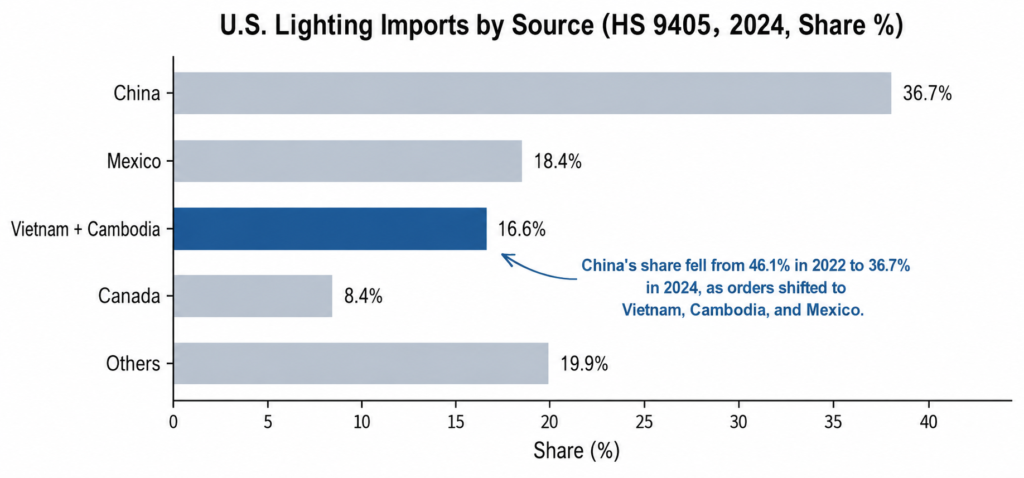
Figure 1: Sources of U.S. lighting imports (Source: U.S. Census Bureau/USITC, 2024; shares vary slightly depending on statistical scope).
When tariffs push up the landed cost of Chinese products, orders shift more quickly. China’s share of U.S. lighting imports fell from 46.1% in 2022 to 36.7% in 2024. In two years, about USD 1.67 billion in lighting business moved out of China, mainly to Vietnam, Cambodia, and Mexico. For Cambodia, this is not new. As early as around the 2017-2018 China-U.S. trade friction, a group of Christmas light and festive light-string manufacturers originally concentrated in Dongguan and Taizhou and exporting to North America had already moved capacity to the Bavet area on the Cambodia-Vietnam border, while another group settled around Phnom Penh. These existing clusters make Cambodia one of the ready-made options for lighting industry relocation.
How Much Can Cambodia Factory Setup Reduce Tariffs? Section 301 and Rules of Origin
The core driver of lighting industry relocation is the U.S. Section 301 tariff, which targets China rather than the world. Therefore, if substantial processing is moved out of China and non-Chinese origin is obtained, this tariff layer can be avoided. This is the biggest difference between lighting and hardware.
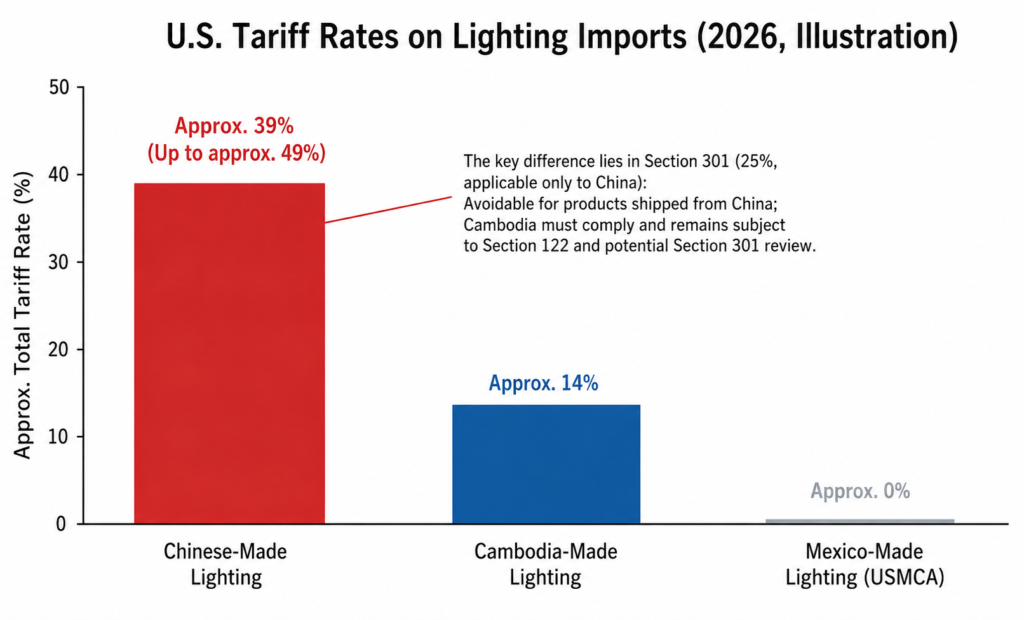
Figure 2: Tariff layers for lighting products exported to the United States (2026, illustrative; the legally disputed surcharge shown became a Section 301 country tariff on July 24, 2026: 12.5% for China, 10% for Cambodia; rates depend on HS code and the latest notices).
First, break down the tariff burden on lighting products made in China. Taking common LED lighting products (HS 9405) as an example, U.S. import tariffs are broadly composed of the base MFN rate (around 3.9%) + Section 301 (List 3, 25%) + the country tariff under the Section 301 measures in force since July 24, 2026 (12.5% for China). Combined, the rate is about 41%, of which the “base + Section 301 (List 3)” portion of roughly 29% is the more durable core. The key point is that Section 301 is a China-specific tariff. As long as substantial transformation occurs outside China, it does not apply. This stands in sharp contrast to Section 232 for hardware, which targets steel and aluminum, applies globally, and cannot be avoided simply by relocating production.
For this reason, moving lighting production to Cambodia, Vietnam, or Mexico can indeed avoid the 25% China-specific Section 301 tariff. As shown in Figure 2, tariffs on Cambodia-origin lighting products exported to the United States are around 14% (base rate + 10% country tariff), significantly lower than those on China-origin products. Mexico-origin products that qualify under the USMCA may even approach zero tariff. This is why “where production takes place” now affects lighting companies more fundamentally than “how much production costs.”
However, two variables must be considered at the same time. First, U.S. tariffs on Cambodia are still being adjusted: the reciprocal tariff originally imposed under IEEPA was invalidated by the Supreme Court in February 2026, and the interim 10% Section 122 tariff expired on July 24, 2026. Since then, Cambodia has been subject to a 10% country tariff under Section 301 measures, while a separate Section 301 investigation into industrial excess capacity in 16 economies including Cambodia, launched in March 2026, has not yet been decided.
Second, avoiding China tariffs requires that “substantial transformation truly occur in Cambodia.” U.S. scrutiny of “China content” is becoming stricter, and minimal assembly or relabeling in Cambodia is not enough to obtain origin. In other words, moving to Cambodia can help solve the tariff problem, but only if it is supported by genuine local processing and complete traceable documentation.
LED Lighting Supply Chain: The Operating Model of Imported Components and Local Assembly
Cambodia’s lighting industry still mainly follows an “imported components + local assembly” model. LED chips, drivers, housings, and electronic parts are mostly imported from China, while Cambodia undertakes assembly and certain accessory processes.
Like most Southeast Asian countries, Cambodia lacks upstream manufacturing of lighting components. Key parts such as LED chips, driver ICs, power supplies, and aluminum or plastic housings are mainly imported from China. The common operating model is “imported light sources/semi-finished products + local assembly,” with Cambodian factories completing labor-intensive processes such as insertion, assembly, burn-in testing, and packaging. This reality has two implications. First, raw material procurement and import logistics are key cost drivers. Second, the depth of localization on the production line directly affects whether the product can pass rules-of-origin and China-content scrutiny.
For origin purposes, the model of “Chinese components + Cambodian assembly” can use the accumulation rules under RCEP and the China-Cambodia Free Trade Agreement (CCFTA, effective in 2022, under which China grants zero tariffs to about 97.5% of Cambodian tariff lines) for Asia-Pacific markets, provided the origin requirements are met.
Geographically, Bavet is about one day’s drive from the Ho Chi Minh City supply circle in Vietnam, making it convenient to replenish components and consumables nearby and shorten replenishment cycles. See the article on Cambodia-Vietnam cross-border logistics for details. It should be noted that RCEP/CCFTA accumulation applies to member markets. For the U.S. market, the key remains substantial transformation and China-content scrutiny, not FTA accumulation.
Costs and Product Fit for Lighting Factories in Cambodia: Which Lighting Products Are Suitable?
Cambodia is attractive in operating cost for labor-intensive lighting assembly, but industry fit is critical. It is more suitable for lighting products that are labor-intensive and relatively standardized in process; complex or high-end products may not necessarily fit.
| Cost Item (2026) | Cambodia | Notes |
| Minimum wage for general workers | Approx. USD 210/month | Statutory for the GFT sector; electronic assembly and other industries often refer to it or negotiate separately |
| Employer social security burden (NSSF) | Approx. 5.4% | Significantly lower than Vietnam’s approximately 21.5% |
| Industrial electricity tariff | Request the latest quotation from the industrial park | Historically high, but declining in recent years; power-intensive processes such as burn-in testing should be costed separately |
| Components and raw materials | Mostly imported from China | Landed costs such as ocean freight, inland transport, and customs declaration must be included |
On industry fit, one phenomenon deserves attention. In this wave of relocation, larger LED companies such as Leedarson, Yankon Lighting, and Ri Shang have mostly established overseas bases in Thailand, such as Chachoengsao, while MLS has chosen Mexico. Cambodia has absorbed more labor-intensive and relatively standardized products such as Christmas lights, festive light strings, and basic lighting products.
The reason is that Thailand has a more mature electronics supply chain and technical workforce, making it more suitable for complex or high-end production lines, but costs are higher. Cambodia has the lowest cost base and an existing Bavet cluster, making it suitable for assembly that uses many workers and has a lower process threshold. Therefore, lighting companies should judge Cambodia’s suitability based on “product process complexity” and “main target market.” This is very different from looking only at cost.
Evaluation Framework for Lighting Companies Setting Up in Cambodia: Tariffs, Compliance, and Cost Decisions
When evaluating factory setup in Cambodia, lighting companies should consider three issues together: tariff attributes, origin compliance, and product fit.
- First, assess tariff attributes. If the main market is the United States, confirm the product’s exposure to China-specific Section 301 tariffs and use “moving out of China to avoid Section 301” as the core logic, while also factoring in the change risk from the pending excess-capacity Section 301 investigation.
- Make origin and China-content compliance real. Ensure that substantive processes such as insertion, assembly, and testing are genuinely completed in Cambodia, and retain traceable documentation on component sources and costs so the product can withstand U.S. China-content scrutiny.
- Match the product process. Labor-intensive and standardized lighting products, such as Christmas lights and basic models, are more suitable for Cambodia. High-end products with high electronic integration should also evaluate locations with more mature supply chains, such as Thailand.
- Prepare the necessary certifications. Products exported to the United States must meet UL requirements, while products exported to Europe must meet safety and environmental certifications such as CE/RoHS. These should be incorporated at the factory planning stage.
- Calculate total landed cost. Include wages, social security, electricity, component import logistics, and certification, rather than looking only at wages or factory rent.
MSEZ Location, Logistics, and Park Support for Lighting Companies
For lighting companies landing in Cambodia, the main difficulties often lie in logistics and customs clearance for imported components, power supply for assembly lines, and compliance with rules of origin and China-content requirements. MSEZ’s conditions align closely with these needs, and its location in Bavet is precisely where an existing lighting cluster has formed.
Manhattan Special Economic Zone (MSEZ) is located in Bavet on the Cambodia-Vietnam border and covers approximately 600 hectares. The Bavet area has been one of the main gathering places for Christmas light and other lighting companies moving to Cambodia since 2017.
For new lighting companies entering the market, the local industrial atmosphere and labor base already exist, so they do not have to start from zero. The park is about 70 to 140 kilometers from the Ho Chi Minh port cluster, making it convenient to import LED chips, drivers, housings, and other components from China and Vietnam nearby, while flexibly choosing Vietnamese or Cambodian ports for export. The park also provides stable power and utility support, which is especially important for power-consuming or emissions-related processes such as burn-in testing and injection molding.
At the execution level, the park’s administrative and customs teams use Chinese as their main working language, supplemented by English and Khmer. Having operated since 2005 for more than 20 years, the park can assist lighting companies with customs clearance for component imports, RCEP/CCFTA certificates of origin, preparation of supply chain and cost documents required for China-content review, linkage to QIP tax incentives, and utilities connection. If your company is evaluating an overseas layout for lighting capacity, you are welcome to contact the park team for a preliminary assessment based on your product process, main target market, and component structure.
FAQs on Lighting Companies Setting Up Factories in Cambodia
Q1:FAQs on Lighting Companies Setting Up Factories in Cambodia
| For products affected by Section 301, usually yes. The main tariff on lighting products exported to the United States is the China-specific Section 301 tariff (List 3 is 25%). As long as substantial transformation truly occurs in Cambodia and non-Chinese origin is obtained, this 25% tariff can be avoided. China-origin lighting products exported to the United States face about 41% tariffs, while Cambodia-origin products face about 14%; the gap mainly comes from Section 301. However, this depends on genuine local processing and complete documentation, given stricter China-content scrutiny, and companies must also watch the outcome of the pending excess-capacity Section 301 investigation. |
Q2:Why is the Cambodia tariff logic different for lighting and hardware?
| Because the applicable tariffs are different. Hardware made of steel or aluminum is constrained by Section 232, which targets steel and aluminum, applies globally, and is not country-specific, so moving to Cambodia cannot avoid it. Lighting is constrained by Section 301, which targets China, so moving production out of China can avoid it. This is the biggest difference: lighting has a real “relocation to avoid tariffs” logic, while hardware, at least the steel and aluminum portion, does not. |
Q3:Can Cambodia produce lighting components?
| Basically no. Cambodia lacks local upstream manufacturing of components such as LED chips, drivers, and housings. Key parts are mainly imported from China, while Cambodia undertakes labor-intensive processes such as assembly, testing, and packaging under an “imported components + local assembly” model. Raw material procurement and import logistics design are critical to cost and compliance for lighting production in Cambodia. |
Q4:What types of lighting companies are suitable for Cambodia?
| Lighting products that are labor-intensive, relatively standardized in process, and mainly target the United States, where Section 301 applies, or that also serve non-U.S. markets, are more suitable for Cambodia. Examples include Christmas lights, festive light strings, and basic lighting products. High-end products with high electronic integration and strong dependence on upstream support should also evaluate locations with more mature supply chains, such as Thailand. In this round of relocation, most larger LED companies have chosen Thailand or Mexico. |
Q5:What compliance and certifications should companies watch when moving to Cambodia?
| There are two categories. The first is origin and China-content compliance: substantial transformation must be completed in Cambodia, and traceable documentation must be retained; otherwise, the product cannot obtain non-Chinese origin and will not pass U.S. review. The second is product safety and environmental certification: exports to the United States must meet UL requirements, while exports to Europe must meet CE/RoHS and similar standards. Both should be incorporated at the factory planning stage. |
References: Data Sources on Cambodia Lighting Factory Setup, Tariffs, and Supply Chains
- Securities Times/Zhongshan Municipal Government | The industrial cluster in Guzhen, Zhongshan, China’s lighting capital, accounts for about 70% of China’s share and 50% of the global share, employs more than 200,000 people, and includes more than 30,000 upstream and downstream enterprises
https://www.stcn.com/article/detail/1437549.html - U.S. Census Bureau/USITC HTSUS | U.S. imports of lighting products (HS 9405) in 2024 were approximately USD 9.17 billion, with LED lighting accounting for more than 56%; China’s share fell from 46.1% in 2022 to 36.7% in 2024, Mexico accounted for about 18.4%, Vietnam + Cambodia about 16.6%, and Canada about 8.4%
https://www.census.gov/foreign-trade/data/ - USTR Section 301 List 3/USITC | Lighting products (HS 9405) mostly fall under List 3, subject to an additional 25% tariff (List 4A is 7.5%); LED bulbs under HS 8539.50 have a base rate of about 2%, and common HS 9405 lines have a base rate of about 3.9%
https://ustr.gov/issue-areas/enforcement/section-301-investigations/tariff-actions - U.S. Supreme Court EO 14389, “Ending Certain Tariff Actions” (2026/2/20)/CFR, Atlantic Council | IEEPA reciprocal/fentanyl tariffs were invalidated by judgment and replaced by a temporary 10% Section 122 tariff, which expired on 2026/7/24; from that date Cambodia has been subject to a 10% Section 301 tariff and China to 12.5% (US Federal Register, 2026/7/28); the excess-capacity Section 301 investigation launched in March 2026 is still pending
https://www.supremecourt.gov/opinions/25pdf/24-1287_4gcj.pdf - U.S. Department of Commerce BIS | Section 232 tariffs on steel, aluminum, and copper apply to relevant metal products and derivatives; metal lamp bodies, heat sinks, and similar lighting parts may involve partial Section 232 exposure and should be confirmed by HS code
https://www.bis.gov/about-bis/bis-leadership-and-offices/SIES/section-232-investigations - Guangya Lighting Research Institute/CILCA | Cambodia lighting capacity layout: Christmas light companies moved to the Bavet area on the Vietnam-Cambodia border in 2017-2018, with other clusters around Phnom Penh
https://b2b.alighting.com/exh/9H2YS8QDN1/newsdetail-12214.html - Yicai/Sina Finance | Overseas bases of Leedarson (Chachoengsao, Thailand), Yankon Lighting (Thailand, annual output of 5 million sets for the U.S.), MLS (Mexico, USMCA), and others; Southeast Asia lacks local component manufacturing and mostly follows an import-and-assembly model
https://www.yicai.com/news/102612178.html - European Commission GSP/RCEP Agreement | Cambodia-origin lighting products exported to Europe may use EBA; RCEP and CCFTA cumulative origin rules apply to their member markets and do not apply to U.S. China-specific Section 301
https://policy.trade.ec.europa.eu/development-and-sustainability/generalised-scheme-preferences_en