

Summary: On US tariffs Cambodia currently sits at a country-level surcharge of 10%, under the forced-labor Section 301 measures that took effect on 24 July 2026. The same package covers 60 economies: China, Vietnam, Brazil and 35 others are at 12.5%, while Cambodia sits in the 10% band alongside Bangladesh, India, Indonesia and Malaysia. Once most-favoured-nation rates are included, AMRO, the ASEAN+3 Macroeconomic Research Office, estimates Cambodia’s trade-weighted effective tariff rate at 12.2%, below Vietnam at 12.6% and Thailand at 13.9%. This is the first time in years that Cambodia has been below both of its larger neighbours on effective rates.
That position is not stable. Cambodia has been granted duty-free treatment on 154 tariff lines and is listed, with Bangladesh, Indonesia and Malaysia, for a tariff-rate quota mechanism tied to purchases of US cotton and textiles. At the same time a second Section 301 investigation into industrial overcapacity is under way; the Council for Development of Cambodia expects any additional rate to be no more than 9 percentage points, and says the US has undertaken to match lower rates if neighbours secure them, with the total burden expected to be capped at 19%. This page records the current rate, the four rewrites since 2025, the investigations and quota work still pending, and what a company should actually do when rates change.
This is a continuously updated page: last updated August 2026; revised whenever measures change and reviewed quarterly otherwise. It is the reference of record on this site for US tariff rates applying to Cambodia.
1. What are US tariffs on Cambodia right now? Current rate and how it is calculated
As of August 2026, Cambodian goods entering the United States carry a country-level surcharge of 10%, imposed under the forced-labor Section 301 measures effective 24 July 2026 and applied on top of the existing most-favoured-nation rate.
The distribution of that band is worth remembering. The Office of the US Trade Representative covered 60 economies in this package, with Cambodia in the 10% band alongside Argentina, Bangladesh, Canada, India, Indonesia, Malaysia, Mexico, Pakistan, Sri Lanka and the United Kingdom, while China, Vietnam, Brazil and the other economies investigated are at 12.5%. Cambodia’s placement in the lower band follows its adoption, after consultations with the US, of rules prohibiting imports made with forced labour.
The arithmetic of the actual burden is the MFN rate plus this 10%. Applied to Cambodia’s export mix, AMRO’s tariff risk dashboard puts the trade-weighted effective rate at 12.2% as of 24 July 2026. Two stacking rules also matter: the new Section 301 measures stack with the existing Section 301 measures on China and Brazil, but do not stack with Section 232 material-based measures on steel, aluminium and copper; and exclusions granted under the earlier Section 122 surcharge continue to apply. Cambodia has separately obtained duty-free treatment on 154 tariff lines, with the published US list governing. How to verify a tariff line and handle clearance in practice is covered in the Cambodia customs import and export guide.
2. How have tariffs on Cambodia been rewritten? The full record, 2025 to 2026
In little over a year the country-level surcharge on Cambodian exports was rewritten four times, from 49% down to 10%, with a judicial reversal in between. That record is itself the reason not to write a tariff rate into a long-term assumption.
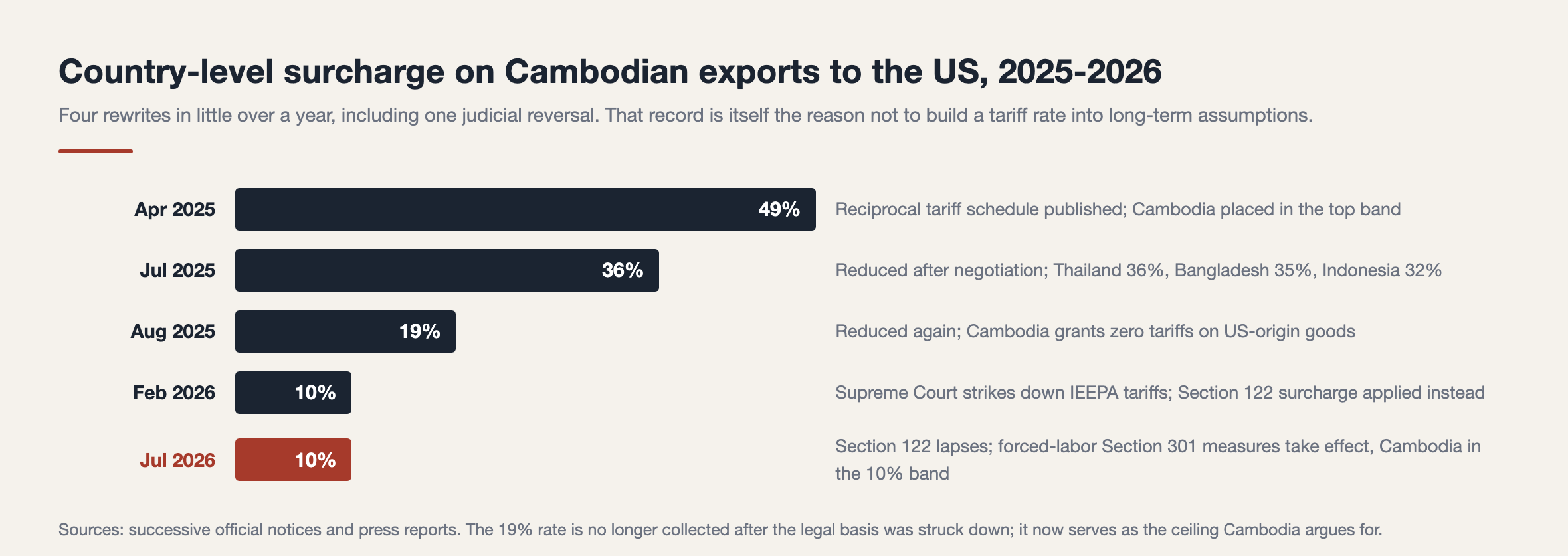
Figure 1: evolution of the country-level surcharge on Cambodian exports to the US, 2025-2026, compiled from successive notices and press reports.
| Date | Event | Applied to Cambodia | Notes |
| Apr 2025 | Reciprocal tariff schedule announced, with Cambodia in one of the highest bands | 49% | Around 30% of Cambodia’s exports go to the US, with the impact concentrated in garments, footwear and travel goods |
| 7 Jul 2025 | Reduced following consultations | 36% | In the same round Thailand was also at 36%, Bangladesh 35% and Indonesia 32% |
| 1 Aug 2025 | Reduced again; Cambodia grants zero tariffs on US-origin goods | 19% | Cambodia implemented zero tariffs on 8 August through Sub-Decree No. 139 and related instruments |
| Oct 2025 | US and Cambodia sign a reciprocal trade agreement maintaining 19% with a zero-rate product list | 19% | Characterised by the US as legally binding, though its tariff commitments are limited to reciprocal tariffs under the IEEPA |
| 20 Feb 2026 | Supreme Court strikes down tariffs imposed under the IEEPA | — | Reciprocal tariffs lose their legal basis; refunds of duties already collected handled separately |
| 24 Feb 2026 | Global surcharge imposed instead under Section 122 of the Trade Act of 1974 | 10% | A provisional measure with a statutory time limit |
| 24 Jul 2026 | Section 122 lapses; forced-labor Section 301 measures take effect the same day | 10% | Covers 60 economies, with China, Vietnam and others at 12.5% |
Table 1: record of changes in the country-level surcharge on Cambodian exports to the US, April 2025 to July 2026.
One number needs clarifying: where 19% stands today. The reciprocal trade agreement signed in October 2025 did provide for a 19% reciprocal rate, but the US tariff commitments in it were limited to reciprocal tariffs under the IEEPA. After the Supreme Court struck down that legal basis in February 2026, 19% ceased to be a rate actually collected and became the ceiling on total burden that Cambodia argues for in continuing consultations. When citing a rate in a quotation or a contract, use the tariff line and rate applicable on the day of clearance.
3. Beyond the country rate, what else lands on the goods? Three layers and how they stack
The country-level surcharge is only one of three layers. A single shipment can face three measures of entirely different character, differing in what they apply to, how fast they change and whether they reach backwards. Each has to be checked separately.
| Layer | What it is | Cambodia’s current status | How to verify |
| Country-level surcharge | Covers all goods, banded by economy, moving with overall trade policy | 10% (forced-labor Section 301, effective 24 Jul 2026) | Check the applicable column of the US Harmonized Tariff Schedule by tariff line |
| Product-specific trade remedies | Anti-dumping and countervailing duties aimed at a specific product and origin; retroactive once filed and set company by company | No case on tires; mattresses and solar cells already covered | Search Commerce and USITC records by product and origin for orders in force and review status |
| Material-based and compliance measures | Section 232 on steel, aluminium, copper and vehicles, applying globally regardless of origin; supply chain compliance turns on inputs and labour | Steel, aluminium and copper at 25% to 50%, not stacking with Section 301 | Judge by material and product, and confirm that input sources and labour compliance are traceable |
Table 2: the three layers and Cambodia’s status as of August 2026.
The relationship among these layers produces one practical rule: an origin is only usable once all three have been checked. Solar cells are the clearest illustration. However low the country-level rate, it does not stop product-specific AD/CVD measures, and Cambodian solar cell exports to the US fell 98.9% in the first half of 2025 as a result. Conversely, tires are a category where none of the three layers restricts Cambodia yet, which is exactly why nine Chinese tire companies chose the country; the full analysis is in Cambodia tire manufacturing. Verification starts from the product’s tariff line, not from the country: treatment can differ completely between lines within the same product family.
4. How much lower is Cambodia than Vietnam and Thailand? Effective rates compared
On effective rates Cambodia is currently below both Vietnam and Thailand, the first time this has happened in years, and the gap comes from how the Section 301 bands fell.
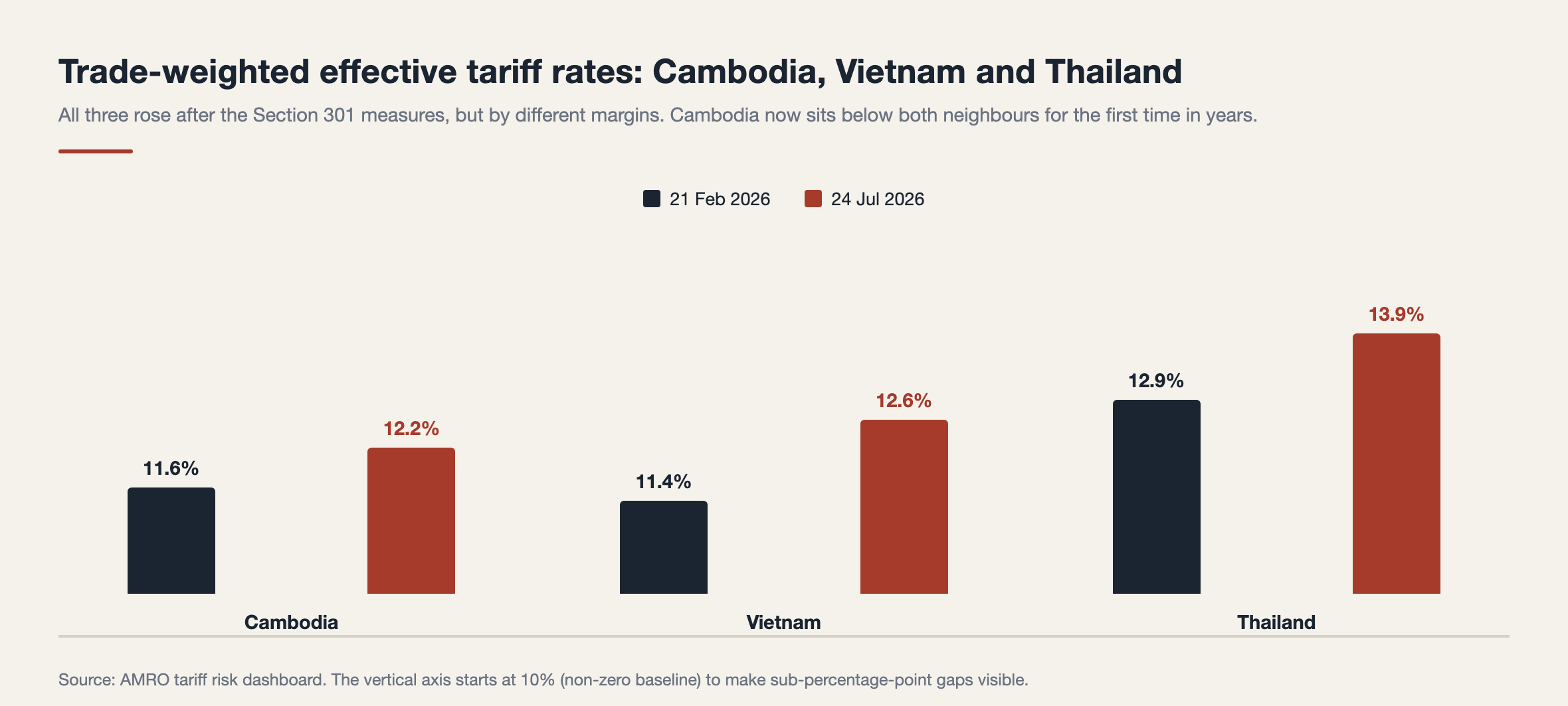
Figure 2: trade-weighted effective tariff rates on exports to the US for Cambodia, Vietnam and Thailand (source: AMRO tariff risk dashboard, February and July 2026).
AMRO’s estimates show that after the measures took effect on 24 July 2026, Cambodia’s trade-weighted effective rate rose from 11.6% to 12.2%, Vietnam’s from 11.4% to 12.6%, and Thailand’s from 12.9% to 13.9%. All three rose, but by different margins: Cambodia by 0.6 percentage points against Vietnam’s 1.2 and Thailand’s 1.0, which is how Cambodia came out below Vietnam. On the country surcharge alone, Cambodia’s 10% is 2.5 points below the 12.5% applying to the other three; on effective rates, Cambodia is 0.4 points below Vietnam and 1.7 below Thailand.
The significance of that gap for site selection has to be kept in proportion. A single-digit percentage point difference between countries is rarely enough on its own to justify relocating a plant across borders. What creates real distance is product-specific measures: with tires, for instance, China, Thailand and Vietnam are all covered by AD/CVD duties measured in tens of percentage points, while Cambodia has no case filed, and that gap dwarfs a few tenths of a point on effective rates. The right way to compare the three is therefore to check all three layers for your own product first, then compare the results. The full evaluation sequence is set out in global manufacturing strategy under US tariffs.
5. What changes are coming? The overcapacity investigation and textile quotas
Two known changes are in train: the second Section 301 investigation, into industrial overcapacity, and a tariff-rate quota mechanism for textiles and garments tied to purchases of US-origin inputs.
| Item to watch | Status | Possible impact | How to monitor |
| Section 301 overcapacity investigation | USTR opened investigations on 11 March 2026 covering Cambodia, China, India, Indonesia, Malaysia, Thailand and Vietnam; the Council for Development of Cambodia expects conclusions within two to three months | Cambodia expects any additional rate to be no more than 9 percentage points, and says the US has undertaken to match lower rates secured by neighbours, with total burden expected to be capped at 19% | Watch USTR announcements and the Federal Register |
| Textile and garment tariff-rate quota | Cambodia is listed with Bangladesh, Indonesia and Malaysia; quotas tied to the share of US-origin cotton and textiles purchased, with details pending | Will directly reshape order acceptance and input sourcing decisions; the share of US-origin material may become the basis for quota allocation | Watch USTR quota announcements |
| Transshipment and origin determination | Most framework agreements retain anti-transshipment clauses; reports suggest Customs and Border Protection may tighten transshipment and origin rules, potentially reaching Southeast Asian plants under Chinese control or ownership | Higher evidentiary requirements on origin, raising the importance of real value added and documentary trails | Watch CBP rules and ruling announcements |
| New product-specific cases | Categories where Cambodian capacity is expanding quickly may attract investigations | Retroactive collection once filed; the risk is managed through compliance records | Check Commerce and USITC filings regularly |
Table 3: measures in progress or pending announcement, August 2026.
For garment companies the design direction of the quota mechanism is worth preparing for early: because quotas are tied to the share of US-origin cotton and textiles purchased, input sourcing shifts from being purely a cost question to being a variable that affects available quota. The related origin mechanics and the 2029 timetable are covered in apparel supply chain restructuring: Cambodia’s three-year window and the road after 2029.
6. When tariffs change, what should a company actually do?
When tariff news breaks, most companies first ask what the rate has become. What actually determines the result is whether a handful of specific tasks are completed in the following two weeks.
The first is confirming whether your tariff lines fall within the change. Measures are announced by tariff line, not by common product name, and it is normal for some lines within a product family to be covered while others are not, so the comparison has to be line by line rather than drawn from a headline. Cambodia’s 154 duty-free lines likewise have to be checked against the list to see whether your product is among them.
The second is establishing the rule for goods in transit: whether the effective date turns on the clearance date, the loading date or the bill of lading date, which decides directly whether in-transit inventory should be rushed through or rescheduled. This round of measures includes a loading provision, and the published text governs. The third is reviewing quotations and contracts: if the price terms do not allocate the effect of tariff changes, the entire movement is absorbed by one side, which matters most in long-term and annual contracts.
The fourth is checking whether origin documentation would survive tightened scrutiny. After tightening, customs looks not at a certificate of origin alone but at whether input sources, processing steps and cost allocation reconcile with one another, and records of that kind have to accumulate through daily operations, since a version assembled after the fact rarely survives comparison. The fifth is assessing whether the origin mix needs adjusting: if the risk at one origin rises, whether part of the order book can move depends on whether another base already has usable capacity, not on how fast the decision is made.
7. When tariffs change, what practical support can Manhattan SEZ provide?
When a tariff change lands on a company, three things need to move immediately: confirming whether your goods are affected, bringing origin documentation to a standard that survives examination, and, where necessary, moving orders to a line that can still ship.
The support Manhattan SEZ provides concentrates on executing those three. The first is immediate clarification of tariff lines and documentation. The zone’s administrative and customs teams sit in the same execution chain and work in Chinese among other languages, so once a measure is announced a company can verify inside the zone whether its tariff lines fall within the list, whether goods in transit fall under the new or the old regime by the loading provision, and whether any of its products appear on the duty-free list. Those determinations usually decide whether to rush clearance or reschedule, and the earlier the answer, the more room there is to adjust.
The second is a daily documentary trail for origin. When transshipment and origin rules tighten, the burden of proof sits with the company and last-minute assembly of documents is close to impossible. Inside the zone, import clearance of materials, processing steps and export clearance are carried by the same chain, so records of input sources, processing stages and cost allocation are generated continuously in normal operations and can be retrieved when an examination arrives rather than reconstructed. For companies importing inputs from China and exporting from Cambodia, the completeness of this layer determines directly whether substantial value added can be established. The wider administrative picture is set out in the Cambodia factory setup process and SEZ one-stop service.
The third is the capacity to absorb a shift in the origin mix. When risk rises at one origin and part of the order book has to move, whether it can be absorbed depends on whether the destination is ready. The zone offers standard factory buildings available for immediate lease and both lease and purchase land options, and has built its own power, water and wastewater systems, so connections for a new plant are planned by the zone rather than waiting on external networks. That lets a company arrange a transfer in months rather than years.
In addition, the zone ships more than three thousand containers a month across textiles, footwear, luggage and the heavier projects established in recent years, so practical classification and clearance experience for comparable products is already available. The zone is in Bavet, Svay Rieng province, about 6 km from the Vietnamese border and about 90 km from the Ho Chi Minh City port complex, with inputs arriving through Vietnamese ports and finished goods leaving by the same route, which preserves flexibility when a change in measures forces logistics to be rearranged.
What this support reduces is the coordination cost between confirming the impact of a change, adjusting documentation and resuming shipments. The tariff itself still depends on product category, tariff line, input origin and processing method. If your company would like to evaluate how its current origin mix responds to tariff changes, you are welcome to learn about the overall conditions for investing in Cambodia, or contact the Manhattan SEZ advisory team with your product categories and tariff lines, target markets, current capacity configuration and the scale of any planned adjustment. The zone will respond with what it can assist on, the boundaries of responsibility and the expected key milestones.
8. US tariffs Cambodia FAQ: rates, quotas and how to verify
Q1: What are US tariffs on Cambodia at the moment?
| A 10% surcharge on top of the most-favoured-nation rate, under the forced-labor Section 301 measures effective 24 July 2026, which places Cambodia in the lower band of that package. Including MFN rates, AMRO estimates the trade-weighted effective rate at 12.2%. That figure answers only the country layer: solar cells and mattresses are separately covered by product-specific AD/CVD measures, while steel, aluminium and copper fall under material-based measures that apply regardless of origin and do not stack with Section 301. Both have to be checked against your own tariff lines. |
Q2: Does the 19% figure still apply?
| It is no longer a rate actually collected but a ceiling. It comes from the reciprocal trade agreement of October 2025, but the US concessions in that agreement were limited to tariffs under a legal basis that has since been struck down, so it is not collected today. Its function now is as the ceiling on total burden that Cambodia argues for in consultations: even if the overcapacity investigation adds a further rate, Cambodia expects the total to stop there. In practice, quote using the tariff line and rate applicable on the day of clearance rather than budgeting from this figure. |
Q3: How much cheaper is Cambodia than Vietnam and Thailand?
| The country surcharge is 2.5 percentage points lower. On effective rates, Cambodia is at 12.2%, Vietnam 12.6% and Thailand 13.9%, gaps of 0.4 and 1.7 points respectively. Differences of that magnitude are usually not what decides a relocation. What creates real distance is product-specific measures: tires, for example, are covered by AD/CVD duties in China, Thailand and Vietnam while Cambodia has no case filed, a gap measured in tens of percentage points. Comparisons should follow a line-by-line check of all three layers. |
Q4: How will the garment tariff-rate quota work?
| Cambodia is listed with Bangladesh, Indonesia and Malaysia, with quotas tied to the share of US-origin cotton and textiles purchased and details pending from USTR. The intent is to encourage manufacturers to buy more US cotton and textiles and to reduce dependence on higher-risk supply chains. The practical implication for garment companies is that input sourcing shifts from a cost question to a variable affecting available quota, so it is worth mapping current input sources before the rules are published. |
Q5: Will rates change again?
| Yes. The second Section 301 investigation, into industrial overcapacity, is still under way and covers Cambodia along with China, India, Indonesia, Malaysia, Thailand and Vietnam. The Council for Development of Cambodia expects any additional rate to be no more than 9 percentage points and says the US has undertaken to match lower rates secured by neighbours. Quota details for textiles and garments and the rules on transshipment and origin may also change. This page is updated once measures are announced. |
9. Sources and references
- Office of the US Trade Representative (USTR) | Final determinations and measures in the forced-labor Section 301 investigations (announced 23 Jul 2026, effective 24 Jul 2026): 60 economies covered; 10% applies to Argentina, Bangladesh, Cambodia, Canada, Ecuador, El Salvador, Guatemala, Honduras, India, Indonesia, Jordan, Malaysia, Mexico, Pakistan, Sri Lanka, Trinidad and Tobago and the United Kingdom; 12.5% applies to the other economies investigated, including China, Vietnam and Brazil.
https://ustr.gov/about/policy-offices/press-office/press-releases/2026/july/ustr-takes-action-forced-labor-section-301-investigations - Zonos | US import tariff tracker: the Section 301 forced-labor measures took effect on 24 Jul 2026, effectively replacing the Section 122 global surcharge; includes the final rate list by country of origin.
https://zonos.com/docs/guides/us-tariff-changes - Khmer Times | US imposes 10% tariff on Cambodia, below ASEAN rivals (Jul 2026): USTR first published the proposed measures on 6 June; Cambodia was among the economies that adopted rules prohibiting imports made with forced labour following consultations with the US.
https://www.khmertimeskh.com/501950622/us-imposes-10-tariff-on-cambodia-below-asean-rivals/ - Khmer Times | Cambodia’s effective US tariff rate rises to 12.2% (Jul 2026): the AMRO tariff risk dashboard shows Cambodia rising from 11.6% on 21 Feb 2026 to 12.2% on 24 Jul; Vietnam from 11.4% to 12.6%; Thailand from 12.9% to 13.9%; AMRO notes the overcapacity Section 301 investigation could still change the regional pattern.
https://www.khmertimeskh.com/501973663/cambodia-us-tariff-rises-to-12-2/ - Cambodianess | Cambodia says the US will match lower regional tariffs if rivals win better deals (27 Jul 2026): CDC First Vice-Chairman Sun Chanthol states that the second Section 301 investigation into overcapacity is expected to conclude within two to three months with any additional rate estimated at no more than 9 percentage points; from 24 July Cambodian exports carry a further 10% on top of MFN rates; 154 Cambodian tariff lines have been granted duty-free treatment; Cambodia is listed with Bangladesh, Indonesia and Malaysia for tariff-rate quotas tied to purchases of US-origin inputs.
https://cambodianess.com/article/cambodia-says-us-to-match-lower-regional-tariffs-if-rivals-win-better-deals - Reed Smith | Trump 2.0 tariff tracker: on 20 Feb 2026 the Supreme Court struck down IEEPA tariffs with refunds unresolved; on 11 Mar 2026 USTR opened Section 301 investigations covering Cambodia, China, India, Indonesia, Malaysia, Thailand and Vietnam.
https://www.tradecomplianceresourcehub.com/2026/07/27/trump-2-0-tariff-tracker/ - Dimerco | 2026 US tariff update: the new Section 301 measures stack with the existing Section 301 measures on China and Brazil but not with Section 232; exclusions under the earlier Section 122 surcharge continue to apply; the US-Cambodia framework maintains a 19% reciprocal rate with zero rates extended for certain Annex III items.
https://dimerco.com/us-tariff-update-2026/ - Cassidy Levy Kent | US-Cambodia reciprocal trade agreement (Oct 2025): the agreement maintains a 19% ad valorem reciprocal rate with an exclusion list and is characterised by the US as legally binding; US tariff commitments are limited to reciprocal tariff concessions under the IEEPA and do not modify HTS most-favoured-nation rates.
https://www.cassidylevy.com/news/u-s-agreement-with-cambodia-to-enhance-certainty-enforcement-in-bilateral-trade/ - USTR | Fact sheet on the US-Cambodia reciprocal trade agreement (Oct 2025): maintains the 19% reciprocal rate, with zero rates for items listed in Annex III of Executive Order 14346; Cambodia removes tariffs on 100% of US products.
https://ustr.gov/about/policy-offices/press-office/fact-sheets/2025/october/fact-sheet-united-states-and-cambodia-reach-agreement-reciprocal-trade - CamboJA News | US tariff on Cambodia cut from 49% to 36% (letter of 7 Jul 2025, effective 1 Aug); in the same round Thailand was at 36%, Bangladesh 35% and Indonesia 32%. Cambodianess | subsequently reduced to 19% (Aug 2025).
https://cambojanews.com/u-s-imposes-36-tariff-on-all-cambodian-exports-but-concerns-of-shifting-manufacturing-remains/ - KPMG Cambodia | Cambodia implements zero tariffs on US-origin goods: formally implemented on 8 Aug 2025 through Sub-Decree No. 139, Notification No. 632 and Instruction No. 3724/25.
https://kpmg.com/kh/en/home/insights/2025/08/capital-gain-tax/technical-update-in-august.html - Tariffs Tool | 2026 country tariff guide: Section 232 material-based measures on steel, aluminium, copper and vehicles range from 25% to 50% and apply regardless of origin.
https://www.tariffstool.com/guides/us-tariff-rate-by-country-list-2026 - MOFCOM Economic and Commercial Office in Cambodia | Ministry of Economy and Finance half-year report (Aug 2025): solar cell exports fell 98.9% in the first half of 2025 as US market tariffs rose.
http://cb.mofcom.gov.cn/jmdt/art/2025/art_7c831c097ef14a5a8dd520908ebf92b4.html - Manhattan SEZ industry knowledge base | Related articles: Cambodia tire manufacturing, global manufacturing strategy under US tariffs, apparel supply chain restructuring, the Cambodia customs import and export guide, and the Cambodia factory setup process and SEZ one-stop service.
https://www.manhattansez.com/