

Article Summary:
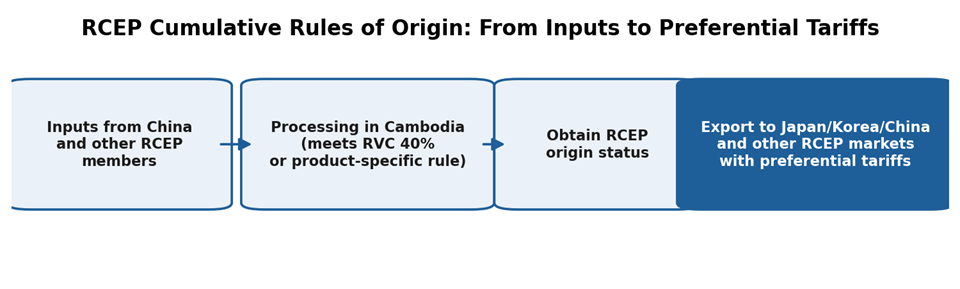
The Regional Comprehensive Economic Partnership (RCEP) is the world’s largest free trade area. It entered into force in January 2022 and covers 15 members: China, Japan, South Korea, Australia, New Zealand, and the ten ASEAN member states. Together, the bloc accounts for around 30% of global GDP and population, and about 28% of global trade. For manufacturers operating in Cambodia, RCEP’s most important value lies in its cumulative rules of origin: inputs from China and other member countries can be counted toward origin after processing in Cambodia, making it easier to meet the regional value content (RVC 40%) threshold required for preferential tariffs.
Cambodia’s trade with RCEP members has grown from US$29.3 billion in 2023 to about US$40.2 billion in 2025, representing roughly 60% of Cambodia’s total foreign trade. Major beneficiary export categories include garments, footwear, electrical machinery, leather products, cereals, rubber, and furniture. This article explains RCEP’s core advantages, beneficiary sectors and export markets, certificate-of-origin filing requirements, and its complementarity with the EU’s Everything But Arms (EBA) scheme and the U.S. market. In particular, after Cambodia’s expected graduation from Least Developed Country (LDC) status in 2029, RCEP will continue to apply and therefore represents a more durable export advantage.
If Goods Use Imported Inputs, Can They Still Qualify as “Cambodia-origin”?
A company that sets up a factory in Cambodia and uses Chinese fabric to produce garments often asks the same question: if the inputs are imported, can the finished product still be treated as made in Cambodia and enjoy preferential tariffs at export? Under many free trade agreements, the answer can be uncertain. Under RCEP, however, the answer is often yes.
The key is one institutional feature of RCEP: it allows inputs originating in member countries to be accumulated and counted toward origin. This makes the common configuration of Chinese inputs plus Cambodian processing eligible, in many cases, for preferential tariff treatment in RCEP markets. To understand how this advantage works and how it should be declared, it is necessary to first clarify what RCEP is and where Cambodia stands within it.
What RCEP Is and Where Cambodia Stands
RCEP is the world’s largest free trade area and entered into force in 2022. For Cambodia, it has become one of the country’s most important trade frameworks, accounting for about 60% of foreign trade in 2025.
RCEP consists of the ten ASEAN member states plus China, Japan, South Korea, Australia, and New Zealand, for a total of 15 members. It covers about 2.2 billion people, or roughly 30% of the world’s population, and GDP of about US$26.2 trillion, or around 30% of global GDP. Together, the members account for about 28% of global trade. Through tariff reductions and more unified rules, RCEP connects the broader Asia-Pacific market into a more integrated trade framework.
Cambodia has already benefited visibly from RCEP. Its total trade with RCEP members increased from US$29.3 billion in 2023 to US$34.5 billion in 2024, a year-on-year increase of 17.7%, and was estimated to reach about US$40.2 billion in 2025, up about 16%, accounting for roughly 60% of Cambodia’s total foreign trade. On the export side, Cambodia exported about US$9.06 billion to RCEP members in 2024, up around 13% year on year. Its five largest trade partners were China, Vietnam, Thailand, Japan, and Singapore.
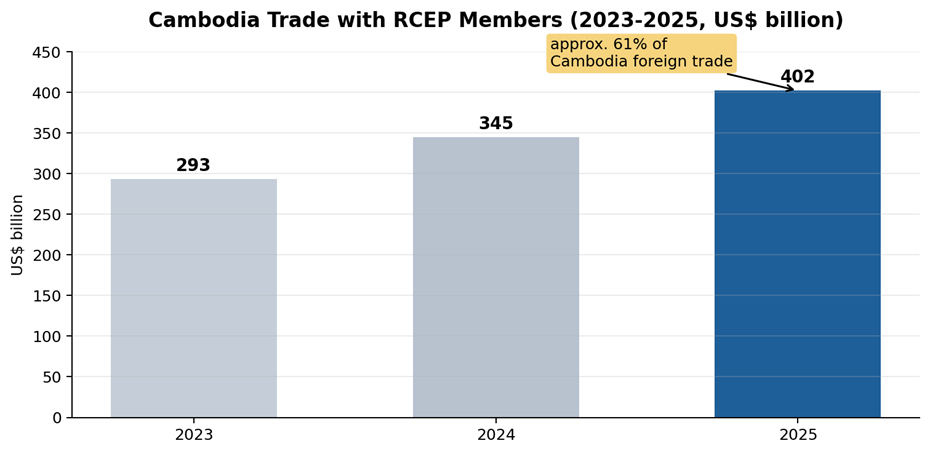
It is also important to note objectively that Cambodia still runs an overall trade deficit with RCEP members. In 2025, Cambodia imported more than US$30 billion from RCEP members, reflecting its high reliance on regional inputs and machinery. In other words, RCEP is both an export market and an input source for Cambodia. This structure is exactly why cumulative rules of origin are especially valuable for Cambodia.
Advantage: Cumulative Rules of Origin
For Cambodia-based manufacturing, the most important value of RCEP is cumulative rules of origin. Inputs from China and other member countries can be counted together after processing in Cambodia, making it easier to meet the regional value content threshold of RVC 40% or other product-specific requirements needed to enjoy preferential tariffs.
| Scenario | Problem Without Cumulation | RCEP Opportunity |
| Chinese fabric + Cambodia garment processing | Non-Cambodian fabric may weaken origin qualification | Chinese inputs may count as RCEP-origin inputs under the rules |
| ASEAN components + Cambodia assembly | Multi-country cost attribution is complicated | Regional inputs can contribute to RVC |
| Cambodia agricultural products | Origin proof must be documented | Wholly obtained or product-specific rules may apply |
“Cumulation” means that when a supply chain spans multiple RCEP member countries, the value contributed by each member may be added together, as long as the finished product meets the relevant rules of origin. For Cambodia’s manufacturing model, which often relies on cut-make-trim (CMT) production and imports many inputs from China, this is critical. Under RCEP, the use of Chinese fabric, hardware, or components does not prevent origin qualification. On the contrary, because these inputs come from an RCEP member, they can be counted toward RVC.
This creates a clear contrast with some other agreements. For example, under the EU-Vietnam Free Trade Agreement (EVFTA), textiles exported from Vietnam to the EU are subject to stricter rules such as the fabric-forward requirement, meaning the fabric must be woven in Vietnam or in specified countries.
By contrast, RCEP’s cumulation rules make it more feasible for Chinese inputs plus Cambodian processing to meet origin requirements. For companies that want to retain the backing of the Chinese supply chain while diversifying production capacity and export markets, Cambodia plus RCEP offers a practical and declarable compliance route.
Beneficiary Sectors and Export Markets
The sectors that benefit most from RCEP are Cambodia’s existing labor-intensive and agricultural export industries. Key export markets include China, Japan, South Korea, and other RCEP members.
According to Cambodia’s Ministry of Commerce, major exports to RCEP markets include garments, footwear, electrical machinery, leather goods, fur products, cereals, rubber and rubber products, and furniture. Garments, footwear, and leather bags are the core labor-intensive beneficiary sectors, while agricultural products such as rice, bananas, and mangoes are primarily exported to China. The following table summarizes key beneficiary sectors and their corresponding markets.
| Beneficiary sector | Main RCEP export markets | Main RCEP advantage |
| Garments, footwear, leather bags | Japan, South Korea, China | Cumulative rules of origin: Chinese inputs plus Cambodian processing are easier to qualify |
| Electrical machinery and components | China, ASEAN, Japan and South Korea | Regional supply-chain inputs can be accumulated and counted toward origin |
| Cereals and agricultural products (including rice) | Primarily China | Tariff reductions expand export opportunities to China |
| Rubber and furniture | China, Japan, ASEAN | Cross-border inputs and processing benefit from cumulation rules |
RCEP should be viewed as an additional advantage rather than a replacement for existing markets. The United States and the European Union remain Cambodia’s two largest markets for garments. RCEP’s value lies in opening access to Asia-Pacific markets such as Japan, South Korea, and China, while allowing existing Chinese supply-chain inputs to be converted into export advantages. This helps reduce reliance on any single market.
Filing Requirements: How to Obtain Preferential RCEP Tariffs
To obtain preferential RCEP tariffs, a shipment must satisfy two requirements: the goods must meet the applicable rules of origin, and the exporter must prepare valid proof of origin.
Rules of origin generally fall into three categories: wholly obtained (WO), such as certain agricultural products; produced entirely from originating materials; or produced using non-originating materials but meeting the applicable product-specific rules (PSR), usually through regional value content (RVC) of at least 40% or a change in tariff classification (CTC). As noted above, RCEP cumulation allows inputs from RCEP members to be counted toward RVC, making qualification more achievable.
| Filing item | Key points |
| Origin criteria | Wholly obtained (WO), RVC 40%, or change in tariff classification (CTC). Accumulated inputs can be counted toward RVC. |
| Proof of origin | Apply to the Ministry of Commerce for a Form RCEP Certificate of Origin (CO), or use an origin declaration issued by an approved exporter. |
| Key documents | Commercial invoice and packing list. For RVC claims, cost breakdown and bill of materials (BOM) are required. For cumulation, upstream suppliers’ origin declarations should be retained. |
| Tariff differentials | RCEP tariff rates differ by importing country for the same goods. The RCEP country of origin must be indicated correctly, and tariff differential provisions may apply in some cases. |
| Application channel | Cambodia Ministry of Commerce Certificate of Origin issuance system, including online channels. Park one-stop service teams or freight forwarders may assist. |
In practice, companies should build traceable cost and supply-chain documentation from the start of production. They should record the country of origin and value of each input, retain supplier declarations for accumulated inputs, and choose the correct origin criterion and proof method for each destination market. The more complete the documentation, the stronger the company’s origin claim will be during customs verification, and the more smoothly preferential tariffs can be applied.
RCEP, EBA, and the US market
RCEP complements the EU’s EBA scheme and the U.S. market. Together, the three channels form a diversified export structure for Cambodia. More importantly, RCEP does not disappear after Cambodia graduates from LDC status, making it a more durable advantage.
Cambodia’s export channels currently consist of three major pillars. The European Union provides access through the Everything But Arms (EBA) arrangement, which offers single-transformation rules and duty-free treatment but is expected to shift toward the Generalized Scheme of Preferences (GSP/GSP+) after Cambodia’s LDC graduation in 2029, with higher tariffs and stricter rules. The U.S. market remains important, with reciprocal tariffs cited at around 19%. RCEP provides access to the Asia-Pacific market. Each channel serves a different role and helps reduce dependence on any one market or rule system.
RCEP’s unique value is durability. EBA is a unilateral preference granted to Least Developed Countries and will be adjusted when Cambodia graduates from LDC status in 2029. RCEP, by contrast, is a reciprocal free trade agreement and does not depend on LDC identity. It will continue after graduation. For companies preparing for the post-2029 environment, incorporating RCEP cumulation into supply-chain and market planning now means securing an export advantage that is not affected by the end of LDC status.
How MSEZ can operationalize RCEP
To turn RCEP advantages into actual preferential tariff treatment, the key lies in origin planning and filing execution. Manhattan Special Economic Zone (MSEZ) can provide support at the park level.
MSEZ is located in Bavet on the Cambodia-Vietnam border and covers about 600 hectares. The park has supplier clusters in textiles, footwear, bags and luggage, and electronics assembly, and it maintains a multilingual administrative and customs team using Chinese, English, and Khmer.
The park can assist companies with Form RCEP Certificate of Origin (CO) applications, organize supply-chain and cost documents for accumulated inputs, coordinate cross-border customs clearance, and connect RCEP benefits with QIP tax incentives. This helps companies apply RCEP’s cumulative rules of origin to actual export transactions more smoothly.
If your company is evaluating how to use RCEP to optimize tariff exposure and market layout, the MSEZ team can provide an initial assessment based on your product category and target export markets.
FAQ
Q1:If a company uses Chinese inputs and produces in Cambodia, can it enjoy RCEP preferential tariffs?
| Usually yes. RCEP’s cumulative rules of origin allow inputs from China and other member countries to be counted toward origin. As long as the processing in Cambodia allows the finished product to meet the applicable origin criteria, such as RVC 40% or change in tariff classification, the shipment can apply for preferential treatment in RCEP markets. This is the most important value of RCEP for Cambodia’s import-input-based manufacturing model. |
Q2:Which countries does RCEP cover, and how important is it to Cambodia?
| RCEP covers 15 members: the ten ASEAN countries plus China, Japan, South Korea, Australia, and New Zealand. It is the world’s largest free trade area. For Cambodia, trade with RCEP members was estimated at about US$40.2 billion in 2025, representing roughly 60% of Cambodia’s total foreign trade. Its five largest partners were China, Vietnam, Thailand, Japan, and Singapore, making RCEP one of Cambodia’s most important trade frameworks. |
Q3:Which sectors benefit the most from RCEP?
| The main beneficiaries are Cambodia’s existing labor-intensive and agricultural export sectors: garments, footwear, leather bags, electrical machinery and components, cereals and agricultural products, rubber, and furniture. Garments and footwear benefit particularly from the Chinese inputs plus Cambodian processing model under the cumulative rules of origin. |
Q4:How does a company apply for RCEP origin preferential treatment, and what documents are needed?
| A shipment must first meet the applicable rules of origin, such as wholly obtained, RVC 40%, or change in tariff classification. The exporter must then prepare valid proof of origin, such as a Form RCEP Certificate of Origin from Cambodia’s Ministry of Commerce or an origin declaration by an approved exporter. Key documents include commercial invoice, packing list, cost breakdown, and bill of materials for RVC claims. For accumulated inputs, upstream supplier origin declarations should be retained. Companies should establish traceable supply-chain records from the start of production. |
Q5:Will RCEP benefits be affected when Cambodia graduates from LDC status in 2029?
| No. RCEP is a reciprocal free trade agreement and does not depend on Cambodia’s LDC status. It will continue to apply after Cambodia’s expected LDC graduation in 2029. By contrast, the EU’s EBA preference is a unilateral LDC arrangement and is expected to transition toward GSP/GSP+, with higher tariffs and stricter rules. RCEP is therefore a more durable export advantage and should be incorporated into long-term planning early. |
References
- General Department of Customs and Excise of Cambodia (GDCE) and Ministry of Commerce (MoC): Cambodia-RCEP trade volume of US$34.52 billion in 2024, up 17.7%; exports of US$9.06 billion, up about 13%; imports of US$25.46 billion; five largest partners were China, Vietnam, Thailand, Japan, and Singapore (Xinhua and NDRC, January 2025).
https://english.news.cn/asiapacific/20250120/fd484851e45f460eac45784800c4fe8e/c.html - Khmer Times: Cambodia-RCEP trade in 2025 estimated at about US$40.2 billion, up around 16%, representing about 61% of Cambodia’s total foreign trade; imports from RCEP exceeded US$30 billion (April 2026).
https://www.khmertimeskh.com/501824230/rcep-continues-to-drive-cambodias-trade-success-four-years-in/ - The Better Cambodia / Cambodge Mag: Cambodia exported about US$3.61 billion to RCEP markets in the first four months of 2025, up 7.6%; bilateral trade was about US$13 billion, up 15.47%, exceeding 65% of total trade; major exports included garments, footwear, electrical machinery, leather, cereals, rubber, and furniture (June 2025).
https://english.news.cn/20250606/b379b63f2e4245818afdf1b1436a46b7/c.html - RCEP Agreement, effective January 1, 2022: 15 members, about 2.2 billion people, GDP of about US$26.2 trillion, and about 28% of global trade.
https://asean.org/rcep-agreement-enters-into-force/?utm_source=chatgpt.com - Asian Development Bank (ADB), An Assessment of Rules of Origin in RCEP, and RCEP Agreement Chapter 3: origin criteria include wholly obtained, RVC 40%, and change in tariff classification (CTC); cumulative rules of origin apply.
https://www.adb.org/publications/rules-origin-rcep-asean1-free-trade-agreements - Form RCEP Certificate of Origin samples and completion instructions: proof of origin may be a Certificate of Origin (CO) or an approved-exporter origin declaration; tariff differential provisions apply under RCEP Article 2.6.
https://www.abf.gov.au/free-trade-agreements/files/rcep-sample-coo.pdf?utm_source=chatgpt.com - Emerhub and U.S. Department of State, 2025 Investment Climate Statements: Cambodia: Cambodia has four FTAs in force (CCFTA, CKFTA, CEPA, and RCEP) and a total of 11 FTAs; FTAs allow member-country inputs to be accumulated.
https://emerhub.com/cambodia/ftas-in-cambodia/?utm_source=chatgpt.com