


Summary: In the current wave of apparel supply chain restructuring, Cambodia is one of the largest recipients of relocating capacity. Garment, footwear and travel goods (GFT) exports hit a record USD 15.8 billion in 2025, more than half of the country’s merchandise exports, across 1,867 factories employing roughly 1.1 million people — around 65% of them at Chinese-invested firms. Yet this success rests on a structure that is easy to overlook: Cambodia produces only about 5% of its own fabric and imports roughly 60% from China. It became an apparel base without a textile upstream because of one rule — the single transformation origin criterion under the EU’s Everything But Arms (EBA) scheme. Turning imported fabric into a finished garment in Cambodia confers origin, which is precisely what Vietnam cannot do under the double transformation rule of the EU-Vietnam Free Trade Agreement (EVFTA).
The difficulty is that this rule benefit is tied to least developed country (LDC) status, and Cambodia formally graduates in December 2029, entering a three-year transition in which preferences taper and origin rules tighten. For a company deciding to enter in 2026, then, the real question is not whether Cambodia is cheap today but what the remaining three-year window will be used for. This article sets out the two separate origin calculations for the EU and the US, the actual duty burden under the tariff regime that took effect in July 2026, the timeline and consequences of LDC graduation, and the trade-offs among three restructuring paths: pure CMT, vertical deepening, and a dual-base footprint.
1. Brands Want Capacity Outside China. What Do Apparel Companies Get Wrong First?
A woven outerwear manufacturer receives notice from its brand customer: from next year, this category needs a source of capacity outside China. Management convenes, and the first question on the table is whether to go to Cambodia or Vietnam — where are wages lower, where is land cheaper.
That question comes too early. Of all the light industries, apparel is the one that should least be compared on cost first, because its tariff treatment does not follow wages. It follows where a garment is deemed to originate. On that point there is a structural difference between Cambodia and Vietnam — and, more importantly, the Cambodian side of that rule has a known expiry date. Discussing land prices before understanding both facts makes it easy to stake a five- or ten-year investment on a condition with three years left to run.
2. Where Cambodian Apparel Stands: What Sits Behind USD 15.8 Billion of Exports
Garment, footwear and travel goods are the unambiguous backbone of Cambodian manufacturing, exceeding every other sector in both scale and concentration. That is simultaneously the reason Cambodia can absorb relocating capacity and the structural risk it carries.
In 2025, GFT exports reached a record USD 15.8 billion, or 50.7% of total merchandise exports — textiles and apparel 37.5%, footwear 6.7%, bags and travel goods 6.5%. The number of factories grew from around twenty in 1996 to 1,867 in 2025, employing about 1.1 million people, close to a tenth of national employment, at an average sector wage of roughly USD 350 to 400. Notably, Chinese-invested firms account for about 65% of the total: for a Chinese apparel manufacturer, Cambodia is not an unfamiliar market but a mature channel where a large number of peers have already gone ahead (for the wider context of manufacturing relocation, see China’s manufacturing shift to Southeast Asia).
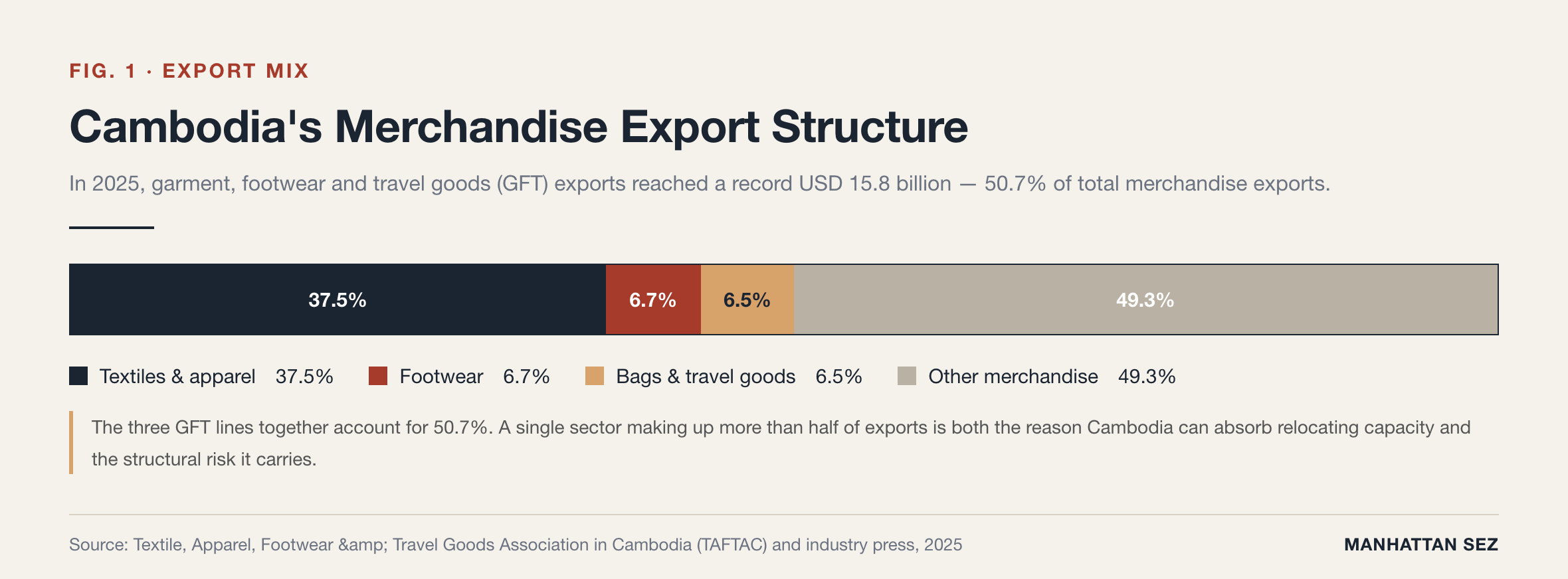
Figure 1: Cambodia’s merchandise export structure. Source: TAFTAC and industry press, 2025.
It should be said plainly that part of the 2025 surge came from front-loading — shipments pulled forward ahead of US reciprocal tariffs taking effect, which pushed the annual increase into double digits. The industry expects growth to fall back to around 8.6% in 2026. The figure therefore reflects genuine capacity and market access, but it should not be extrapolated as a long-term trend.
3. Only 5% of Fabric Is Made Locally. Why Is Cambodia Still a Global Apparel Base?
The most counter-intuitive feature of Cambodian apparel is that it ranks among the world’s larger garment exporters while having almost no textile upstream — roughly 5% of fabric is produced domestically and about 60% is imported from China. That combination works because of one rule of origin.
The key is the single transformation rule applied to least developed countries under the EU’s Everything But Arms scheme: as long as the conversion from fabric to finished garment takes place in Cambodia, the origin requirement is met, and the source of the imported fabric does not affect the determination. This allows Cambodia to take EU orders on the strength of its sewing operations alone, without spinning, weaving or dyeing. Vietnam, by contrast, exports to the EU under the EVFTA’s double transformation rule, which requires production from the fabric stage within the agreement area — meaning that Vietnamese output using Chinese fabric cannot claim EVFTA preference. This is the structural difference between the two countries, and the real reason many brands place their EU orders in Cambodia.
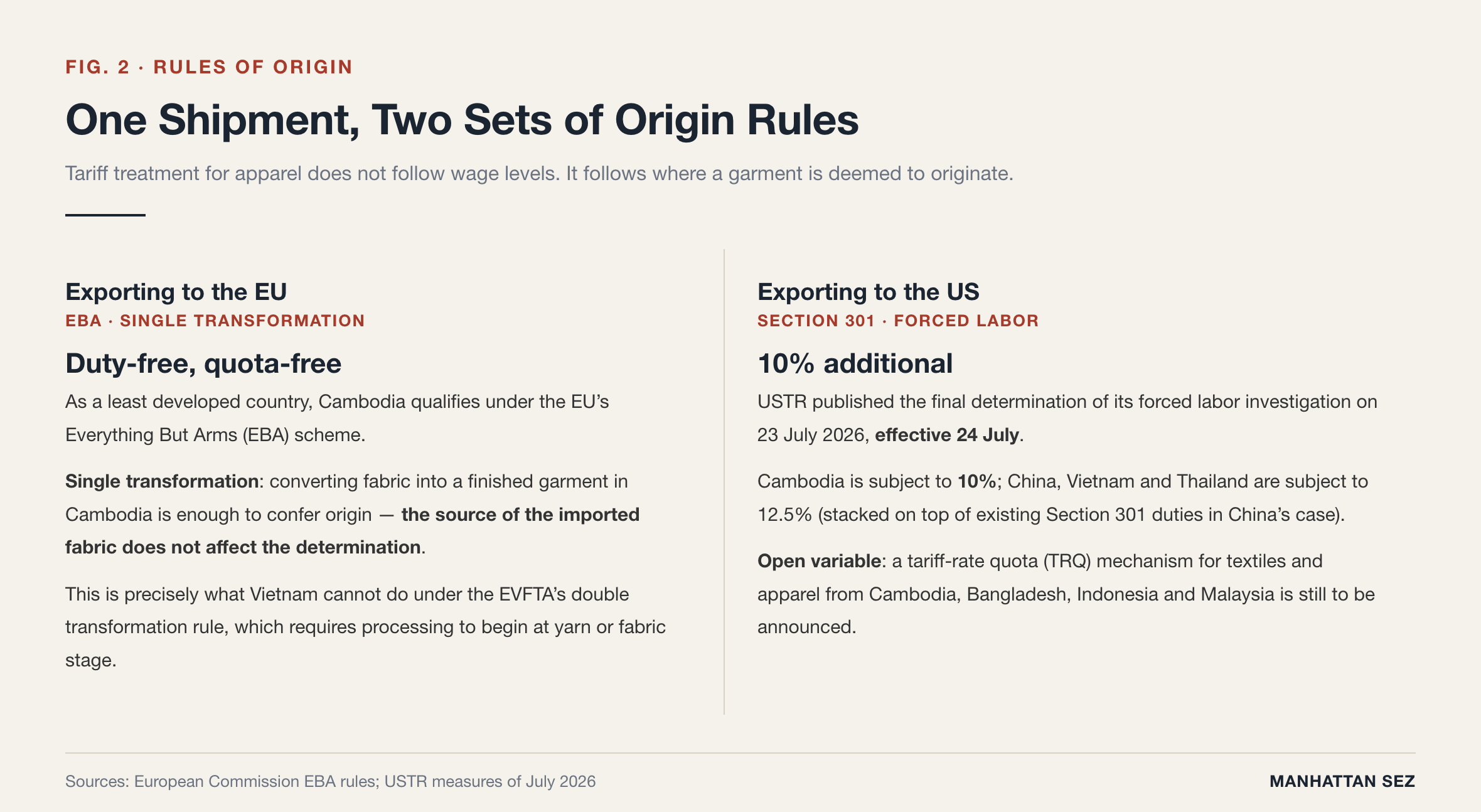
Figure 2: The same shipment faces two different origin determinations for the EU and the US. Compiled from EU EBA rules and current US measures.
The same rule has also shaped the sector: because imported fabric does not affect origin, companies have had no incentive to build a local fabric supply chain, and after three decades the industry remains concentrated in cut-and-sew processing. TAFTAC has explicitly identified this structural weakness and called for the gradual development of spinning, weaving, dyeing and finishing to improve supply chain resilience and domestic value added. The urgency behind that call comes from the timetable discussed in the next section.
4. Exporting to Europe and the US: How Are Origin and Duties Actually Calculated?
On 24 July 2026 the US tariff structure was rewritten again and the calculation for apparel entering the US changed with it. The calculation for the EU follows an entirely separate logic. The two are unrelated and must be worked out separately.
Take the US first. The Office of the United States Trade Representative published the final determination of its forced labor investigation on 23 July 2026 — an investigation conducted under Section 301 of the Trade Act of 1974 — effective 24 July, covering 60 economies and about 99.4% of US imports. At the same moment, the global surcharge that had applied provisionally under Section 122 since 24 February lapsed on reaching its statutory time limit. There are two bands: Cambodia, Bangladesh, India, Indonesia and Malaysia at 10%; China, Vietnam, Thailand and 35 other economies at 12.5%. On this layer, therefore, Cambodian-made apparel carries an additional rate 2.5 percentage points below Vietnam and China.
Apparel companies should note one variable that has not yet landed. For textiles and apparel from Cambodia, Bangladesh, Indonesia and Malaysia, the US will separately announce a tariff-rate quota mechanism, the details of which were still pending as this article was completed. That means the current 10% may be only a transitional state for apparel: once quotas are implemented, both the over-quota rate and the allocation method will bear directly on order decisions. Treating “Cambodia at 10%” as a long-run planning assumption therefore carries real risk (for how the various US tariff instruments fit together, see global footprint strategy under US tariffs).
The EU follows different logic. As a least developed country, Cambodia enjoys duty-free, quota-free treatment under EBA together with the single transformation rule described above. It is worth noting that EBA has been partially withdrawn since August 2020 over human rights concerns, so the treatment is not universal; even so, EU figures indicate that roughly 75% of Cambodian exports to the EU still enter duty-free and quota-free, with apparel accounting for close to 80% of preferential imports. For companies whose principal market is the EU, this channel is usually worth more than a few percentage points of difference on US duties.
5. Cambodia Leaves LDC Status in 2029: How Much Longer Does the EBA Benefit Last?
The single most important date for Cambodian apparel is not a tariff announcement but December 2029, when Cambodia formally graduates from least developed country status and enters a three-year transition.
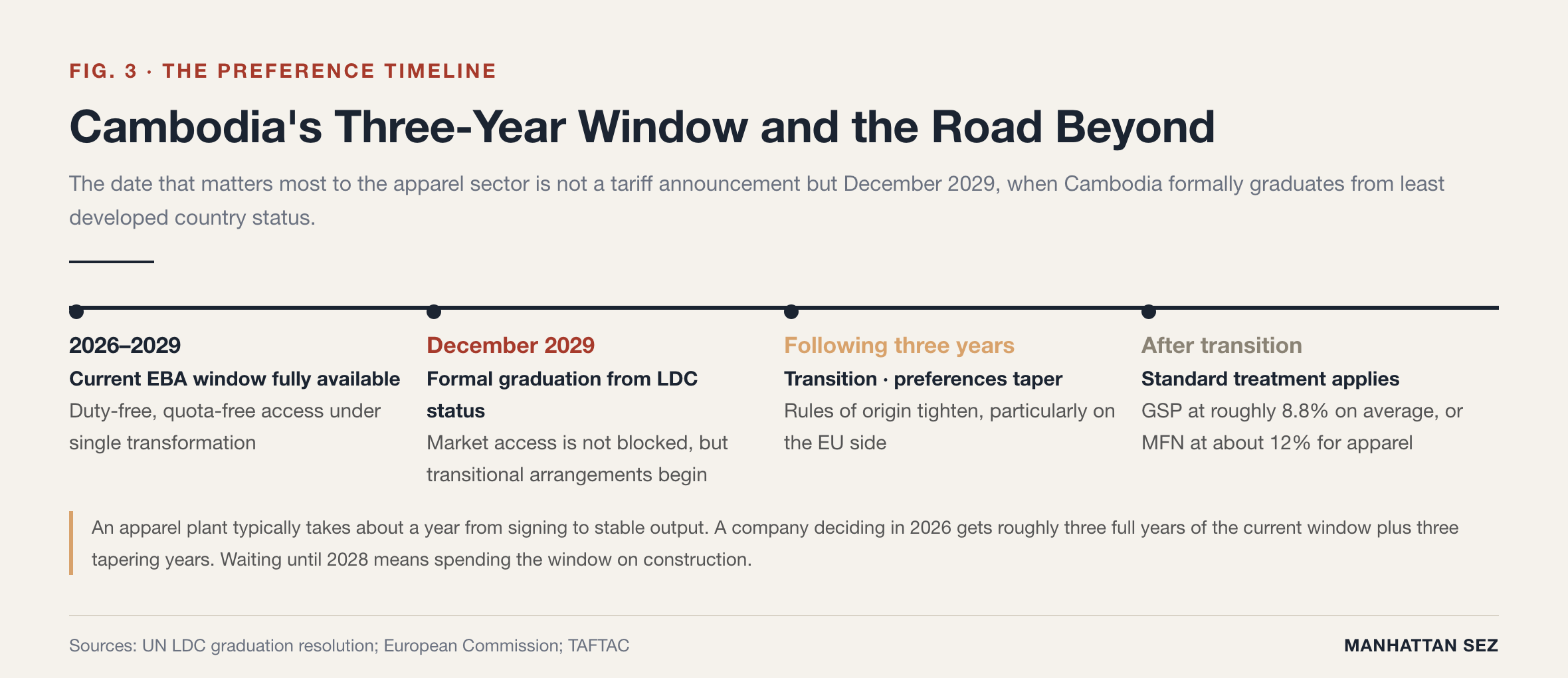
Figure 3: The preference timeline for Cambodian apparel. Compiled from the UN LDC graduation resolution and industry association guidance.
Graduation does not in itself block market access, but it tightens two things. First, preference margins narrow progressively: EBA duty-free treatment gives way to the standard GSP rate (averaging roughly 8.8%) or the MFN rate (about 12% for apparel), depending on the arrangements in place at the time. Second, rules of origin become stricter, particularly for the EU and Canada, since the permissive single transformation test is itself tied to least developed country status. TAFTAC has noted that the sector will no longer be able to rely on cost advantage alone and must shift to competitiveness built on productivity, technology adoption and depth in the value chain.
Set that timetable against an investment cycle and the trade-off becomes concrete. An apparel plant typically takes about a year from signing to stable output, after which equipment and staffing costs must be amortised. A company deciding in 2026 gets roughly three full years of the current EBA window plus three tapering years; one that waits until 2028 spends most of the window on construction. Seen the other way round, these three years are also a relatively permissive period in which to build local capability — once Cambodia graduates and origin rules tighten, moving upstream will be both more expensive and more difficult.
6. Three Paths for Apparel Supply Chain Restructuring: CMT, Vertical Integration, Dual Base
Once the rules and the timetable are clear, apparel supply chain restructuring in Cambodia comes down to three paths, and they correspond to three different time horizons.
| Path | Approach | Suited to | Position after 2029 |
| Pure CMT (cut, make, trim) | Lease a factory and cut and sew with imported fabric, taking transferred brand orders quickly | Companies with orders in hand that must show non-China capacity in the short term | Price competition intensifies as preferences taper; margin defence rests on efficiency and scale |
| Vertical deepening | Beyond sewing, progressively add trims, printing, washing or some fabric operations | Companies with the capital and technical capability that view Cambodia as a long-term base | Higher local value added, better placed to meet stricter rules of origin |
| Dual-base footprint | Cambodia takes EU orders under EBA single transformation; Vietnam or China handles other markets and complex processes | Companies supplying both Europe and the US that already operate an overseas base | Hedges any single rule change through origin diversification; the most flexible option |
None of the three is inherently better; the difference lies in what the company takes Cambodia to be. Treated as transitional capacity to satisfy a brand requirement, pure CMT is the fastest route with the lowest capital commitment, but also the one most exposed to pure price competition after 2029. Treated as a long-term base, the correct use of the three-year window is to extend value added upstream, because once Cambodia graduates, what determines who stays is not wages but whether local content can support stricter origin rules. For companies supplying both Europe and the US, a dual base is close to inevitable: Cambodia’s EBA single transformation and Vietnam’s EVFTA double transformation serve different market combinations by design.
7. What Does an Apparel Plant in Cambodia Cost? Phnom Penh vs Border Zones
Apparel is labour intensive, and whether workers can be recruited reliably affects real output more than the wage rate does. Cambodia’s labour situation varies markedly by location, a point usually flattened into the general claim that “hiring in Cambodia is hard”.
| Cost item (2026) | Cambodia | Notes |
| Minimum wage, textile, apparel and footwear sector | About USD 210 per month | Statutory level; average GFT sector pay is roughly USD 350 to 400 including overtime and allowances |
| Employer social security contribution (NSSF) | About 5.4% | Substantially below Vietnam’s roughly 22.5% |
| Foreign employee ratio limit | About 10 Cambodian to 1 foreign national | Applies to garment, footwear and other textile projects with fewer than 500 employees |
| Fabric and trims | About 60% imported from China | Landed cost must include sea freight, inland haulage and customs clearance |
That geographic variation deserves separate treatment. TAFTAC notes that firms in the Phnom Penh core have indeed faced recruitment bottlenecks over the past three years, while stating equally clearly that siting a plant fifty or sixty kilometres from the capital, or further, eases the problem — trading space for resources, as it is often put. In other words, the claim holds around Phnom Penh but not necessarily in border zones away from the core. In assessing labour, companies should take the zone’s location and its surrounding labour pool into account rather than relying on a national generalisation (for the full minimum wage rules by sector see the Cambodia minimum wage guide; for the lease-versus-build decision see renting versus building a factory).
8. Is MSEZ Suitable for Apparel? Cluster, Recruitment and Setup Conditions
What apparel companies actually need in Cambodia is the ability to start production quickly enough to use the full three-year window, to recruit experienced operators reliably, and to handle the customs documentation that origin claims depend on. Those requirements determine how a special economic zone should be chosen.
Start with experienced operators, since this is the first bottleneck an apparel plant meets after commissioning. Capacity does not arrive with the building; it depends on recruiting people who can already run a sewing machine, and this is precisely where the “hiring is hard” claim most needs qualifying. In Svay Rieng province, where Manhattan Special Economic Zone (MSEZ) is located, industrial zones are dense: nine zones with more than a hundred thousand people employed, and a normal monthly turnover of about 5% to 7%. That works out to five to seven thousand workers looking for new positions each month, most of them experienced hands from garment, footwear and Christmas-light factories. A newly arrived apparel plant therefore recruits from a functioning skilled labour market rather than training from scratch. For clerical and junior management roles, Svay Rieng University lies about 33 kilometres from the zone, offers programmes in English, accounting and management with around six hundred graduates a year, and has a cooperation arrangement with MSEZ; for Chinese-language positions the zone can assist with recruitment.
The second requirement is speed to production. With the full EBA window running only to 2029, every quarter of delay is a quarter of preferential access forgone. Apparel plants have short construction cycles and relatively light equipment, so the fastest route is usually to lease a ready-built standard factory rather than construct one. MSEZ offers standard factory buildings available for direct lease and operates its own power, water and wastewater treatment systems, so utility connections and effluent arrangements for a new plant are planned by the zone rather than waiting on external network coordination. This aligns with the structure of Qualified Investment Project (QIP) incentives: the tax holiday begins once the trigger period ends, so the later production starts, the fewer holiday years fall in profitable years.
The third is land and outbound logistics. On land, MSEZ offers both short-term and fifty-year long leases; the long lease carries a lease certificate issued by the Cambodian land authority and can be transferred within two years of signing, so different investment horizons and amortisation plans can be matched to different land arrangements. On shipping, the zone covers roughly 600 hectares, employs more than forty thousand people and exports over three thousand containers a month, which means customs and logistics capacity is already running rather than being built for a new arrival. Textiles, footwear and bags are the most established clusters inside the zone, so trims, packaging, machine repair and inspection services are available nearby. Administratively, the zone provides setup and customs assistance in Chinese; for apparel companies the most practical benefit lies in origin documentation — EU shipments must evidence the single transformation actually performed, and US shipments must withstand substantial transformation and transshipment scrutiny. Both require complete records of fabric sourcing and processing costs.
If your principal market is the EU and orders are already in hand, Cambodia is the most direct option available: EBA single transformation makes the imported-fabric model workable immediately, and that channel is intact until 2029. The emphasis should be on how quickly production can start — work with a zone that has ready-built factory space so the three-year window is used as fully as possible. If your principal market is the US, Cambodia’s 10% additional rate is lower than Vietnam’s and China’s, but the tariff-rate quota mechanism for textiles and apparel has not been announced, so it should not be the sole reason for the decision; entering at moderate scale to validate orders and operations, retaining flexibility to adjust, is the sounder approach. If you regard Cambodia as a ten-year base, the correct use of the window is not to expand CMT capacity but to build out trims, printing and washing locally in parallel — because after 2029 what determines who stays is local content, not wages. If your company is assessing where to place apparel capacity, you are welcome to review the overall conditions for investing in Cambodia or contact the MSEZ advisory team for indicative pricing and a setup plan based on your target market, product mix and intended production date.
9. Cambodia Apparel Manufacturing FAQ: Tariffs, Origin and LDC Graduation
Q1: Our apparel plant is moving to Southeast Asia. Cambodia or Vietnam?
| Start with your principal market. For the EU, Cambodia has a structural advantage: single transformation applies under EBA, so a garment made from imported fabric meets the origin requirement. Vietnam is subject to EVFTA double transformation, which requires production from the fabric stage within the agreement area, so Chinese fabric forfeits the preference. For the US, under the regime effective 24 July 2026 Cambodia carries a 10% additional rate against Vietnam’s 12.5%, though the tariff-rate quota mechanism for Cambodian textiles and apparel is still to be announced. If you supply both Europe and the US, a dual base is usually unavoidable. |
Q2: Cambodia has no fabric industry. Is that a problem?
| Under current rules it is not an obstacle. Cambodia produces only about 5% of its fabric and imports roughly 60% from China, yet remains a major global apparel exporter, precisely because EBA single transformation does not look at where the fabric came from. But that permissive test is tied to least developed country status. After Cambodia graduates in December 2029, rules of origin will tighten and local content will become the decisive factor. Companies treating Cambodia as a long-term base should use the window to build out trims and downstream processing. |
Q3: After Cambodia leaves LDC status in 2029, can apparel manufacturing continue?
| Yes, but on different terms. Graduation does not block market access; it opens a three-year transition in which preference margins narrow — EBA gives way to standard GSP at roughly 8.8% or MFN at about 12% — and rules of origin tighten, most visibly for the EU and Canada. Industry associations have noted that competitiveness will then have to come from productivity, technology and depth in the value chain rather than cost alone. |
Q4: People say hiring in Cambodia is difficult. Can an apparel plant recruit?
| The claim varies by location. TAFTAC notes genuine recruitment bottlenecks in the Phnom Penh core over the past three years, but also that siting a plant fifty or sixty kilometres out, or further, eases the problem — trading space for resources. Labour assessment should therefore look at the zone’s location and its surrounding labour pool rather than applying a national generalisation. |
Q5: Is it still worth entering Cambodia for apparel now?
| On the current timetable, a company deciding in 2026 gets roughly three full years of the EBA window plus a three-year taper. Apparel plants have short build cycles and relatively light equipment, so leasing ready-built space compresses time to production. The real question is what the window is used for: pure CMT will face price competition once preferences taper, whereas extending value added upstream in parallel makes these three years the period in which a defensible position is built. |
10. Sources and Further Reading
📚 Sources & References
- China Textile Network / China National Textile and Apparel Council, citing TAFTAC | Cambodia GFT exports of USD 15.8bn in 2025, 50.7% of merchandise exports (textiles and apparel 37.5%, footwear 6.7%, bags 6.5%); factories up from around 20 in 1996 to 1,867 in 2025; about 1.1 million employed, close to a tenth of national employment; average sector pay USD 350–400; Chinese-invested firms about 65%. Around 5% of fabric produced locally, about 60% from China.
https://info.texnet.com.cn/detail-1076322.html - China National Textile and Apparel Council | Following LDC graduation in December 2029 Cambodia enters a three-year transition with tapering preferences and tightening rules of origin, most notably for the EU and Canada; recruitment bottlenecks in the Phnom Penh core ease when plants are sited fifty to sixty kilometres out.
https://www.cntac.org.cn/zixun/hangye/202606/t20260612_4414129.html - Cambodia-China Times | 2025 GFT exports of USD 13.815bn, up 18.34% year on year (different scope and reporting period from the above), partly driven by front-loading ahead of US reciprocal tariffs; 2026 growth estimated at about 8.6%.
https://cc-times.com/posts/32606 - Office of the United States Trade Representative | Final determination and measures in the Section 301 forced labor investigations, published 23 July 2026 and effective 24 July: 60 economies covered, about 99.4% of US imports; Cambodia at 10%, China, Vietnam and Thailand at 12.5%; steel, aluminium and copper products already subject to Section 232 are excluded.
https://ustr.gov/about/policy-offices/press-office/press-releases/2026/july/ustr-takes-action-forced-labor-section-301-investigations - Baker McKenzie | The new Section 301 forced labor tariffs took effect on 24 July 2026, replacing the expiring 10% global surcharge under Section 122 at the same moment.
https://globalimportblog.bakermckenzie.com/2026/07/24/united-states-new-10-to-12-5-section-301-forced-labor-tariffs-on-over-60-countries-take-effect-july-24-2026-replacing-current-10-section-122-duties/ - Troutman Pepper Locke | Operational note on the final measures: textiles and apparel from Cambodia, Bangladesh, Indonesia and Malaysia are subject to a forthcoming USTR announcement on tariff-rate quotas.
https://www.troutman.com/insights/forced-labor-meet-section-301-new-tariffs-target-60-of-americas-biggest-trading-partners/ - European Commission | Everything But Arms: duty-free, quota-free treatment for least developed countries, with single transformation rules of origin for apparel; partially withdrawn since August 2020, though about 75% of Cambodian exports to the EU still enter duty-free and quota-free.
https://policy.trade.ec.europa.eu/development-and-sustainability/generalised-scheme-preferences_en - Manhattan SEZ Industry Knowledge Base | Cambodian FDI of USD 5.2bn in 2025, up 18.2%, with Chinese capital above 70%; CDC-approved investment of USD 7.8bn, of which USD 5.3bn went to industry and manufacturing; Cambodia holds 11 free trade agreements including RCEP, the Cambodia-China FTA, the Cambodia-Korea FTA and EU EBA.
https://www.manhattansez.com/en/chinas-manufacturing-shift/