


Summary: In the Cambodia factory setup process, what slows a project down is rarely a single approval. It is the dependency between four parallel administrative tracks: company formation (three-stage registration with the Ministry of Commerce, the General Department of Taxation and the Ministry of Labour), investment status (a Qualified Investment Project application to the Council for the Development of Cambodia or to the zone, yielding first a Conditional Registration Certificate and then, within 28 working days, a Final Registration Certificate), construction permits (notarisation of the land agreement, the building permit and the environmental impact assessment), and pre-operational filings (social security, customs registration and the duty-exemption master list).
The land agreement is a prerequisite for the investment application, and the Conditional Registration Certificate in turn specifies which further permits are required and from which ministries. Delay any link and everything behind it slips. That is how administrative friction becomes time cost, and time cost eventually becomes real expenditure: the QIP trigger period counts down whether or not production has started, committed capital sits idle, and delivery commitments to customers come under pressure. The one-stop window in a special economic zone has an explicit legal basis — under Sub-Decree No. 148 the Council for the Development of Cambodia authorises the Cambodian Special Economic Zone Board to establish a zone administration, with Customs, the Ministry of Commerce, Camcontrol and the Ministry of Labour stationing officers on site to receive and issue approvals. This article sets out what has to be done, what the one-stop window changes and does not change, the continuing annual obligations, and how to convert administrative time into money.
1. The QIP Came Through. Why Does Cambodia Factory Setup Still Take Eight Months?
A businessman complains in a meeting: the investment approval came through six months ago and the plant still has not shipped its first order. Pressed for detail, the picture emerges — the construction permit stalled on drawing revisions, the environmental assessment went back and forth three times, the duty-exemption list had not been approved when the equipment arrived and the cargo sat at the port for more than twenty days; by the time all of that cleared, recruitment ran into the festival season and the lines could not be filled.
This is not exceptional, and it is not a matter of one department being inefficient. The real reason is that what has to be done in Cambodia is not a single queue but four parallel tracks that depend on one another — until the earlier document is in place, the later procedure does not even qualify to join the queue. To see this clearly, the four tracks have to be laid out side by side.
2. What the Cambodia Factory Setup Process Involves: Four Parallel Tracks
The full Cambodia factory setup process falls into four tracks: company formation, investment status, construction permits and pre-operational filings. They are not completed in sequence; they run in parallel and condition one another.
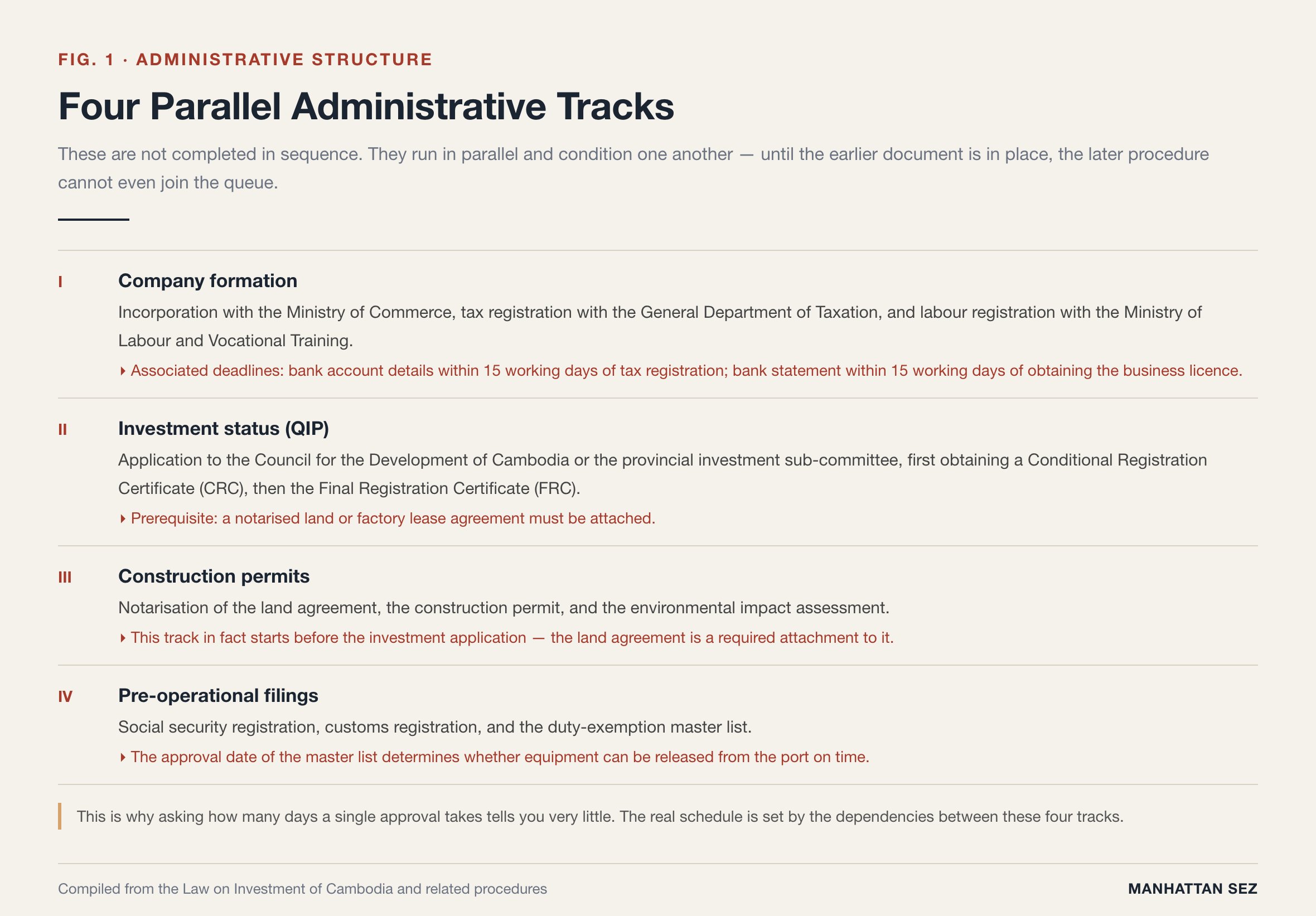
Figure 1: The four administrative tracks and their dependencies. Compiled from the Law on Investment of Cambodia and related procedures.
The first is company formation, in three formal stages: incorporation with the Ministry of Commerce, tax registration with the General Department of Taxation, and labour registration with the Ministry of Labour and Vocational Training. In practice several associated deadlines follow: bank account details must be provided within 15 working days of tax registration, and a bank statement submitted within 15 working days of obtaining the business licence; a declaration of opening must be filed with the Ministry of Labour before operations begin; companies with more than eight employees must adopt internal regulations conforming to the Labour Law and file them within three months of incorporation; and registration with the National Social Security Fund is required once there is more than one employee. Company registration itself typically takes two to six weeks depending on document readiness (for the full procedure see the guide to setting up a business in Cambodia).
The second track is investment status — the Qualified Investment Project application, which is the precondition for tax and import incentives. The third is construction permits, covering notarisation of the land agreement, the building permit and the environmental impact assessment; because the land agreement is a required attachment to the investment application, this track in fact begins before it. The fourth is pre-operational filings: social security registration, customs registration and the import duty-exemption master list. Equipment and construction materials can only be imported duty-free once the list is approved; otherwise cargo waits at the port or duty is paid up front.
The dependencies between the four tracks are the key to understanding the whole process: the land agreement is a prerequisite for the investment application; the Conditional Registration Certificate issued on that application specifies which further permits are needed and which ministries handle them; and the approval date of the duty-exemption list determines whether equipment can be released from the port. This is why asking how many days a particular approval takes tells you very little — the real schedule depends on whether these links connect.
3. How Does the QIP Application Work? What Separates a CRC From an FRC
One aspect of the Qualified Investment Project application is routinely misunderstood: two certificates are issued during the process, and companies often assume the first one means they are finished.
| Stage | Content | Key timing and requirements |
| Application | Submit the Qualified Investment Project application to the Council for the Development of Cambodia or the provincial-municipal investment sub-committee | A notarised land or factory lease agreement must be attached |
| Conditional Registration Certificate (CRC) | Specifies the authorisations, permits, licences and approvals the project requires, and the government departments responsible | This is a to-do list, not proof of completion |
| Capital and tax registration | Submit a bank statement for 25% of registered capital; the Council forwards the VAT registration application to the tax department | Bank statement and registration documents must be complete |
| Final Registration Certificate (FRC) | Formally establishes Qualified Investment Project status, with the company registration certificate, patent tax certificate and VAT certificate attached | Issued within 28 working days of the Conditional Registration Certificate |
| Duty-exemption application | Submit the master list for import of construction materials, production equipment and production inputs | The list must be approved before equipment can be released duty-free on arrival |
The point of the table is the difference in the nature of the two certificates. The Conditional Registration Certificate is a to-do list issued by the authority — it tells you which further permits to obtain and from which ministries. The Final Registration Certificate is what formally establishes the status. Many companies assume that receiving the conditional certificate means construction can start, when in fact the building permit, the environmental assessment and the various registrations are all still on the list. In addition, investment projects are in principle subject to automatic approval, with the authority required to complete review within 31 working days of receiving the investment proposal. That period measures review time once documents are complete; it does not include the time a company spends preparing or supplementing them, which is the main source of the gap between the statutory limit and what companies actually experience.
4. Why Can a Zone Approve On Site? Sub-Decree 148 and the Secondment Mechanism
The one-stop service in a special economic zone is not a value-added service the zone provides on its own initiative. It is a government secondment mechanism with a legal basis, and that is what fundamentally distinguishes it from a park’s document-filing service.
On 29 December 2005 the Cambodian government promulgated Sub-Decree No. 148 ANK/BK on the Establishment and Management of Special Economic Zones, setting the framework for how zones are established and administered. Under Article 4 of the Law on Investment and that sub-decree, the Council for the Development of Cambodia supervises special economic zones and authorises the Cambodian Special Economic Zone Board (CSEZB) to decide on their establishment and administration. The Board may establish a zone administration within a zone to act as the one-stop service window, staffed by officers seconded from the Board itself, Customs, the Ministry of Commerce, the Import-Export Inspection and Fraud Repression Directorate-General (Camcontrol) and the Ministry of Labour and Vocational Training, who approve and issue permits, licences and registrations to investors in the zone and grant investment incentives under delegated authority. A separate dispute settlement committee handles disagreements within the zone.
What matters about this arrangement is that the approval authority sits inside the zone, rather than the zone filing documents on your behalf. For a company the difference shows up in two ways: there is no need to travel between Phnom Penh and different ministries for different permits, and when a document has a problem it can be clarified in person and corrected on the spot instead of going through a cycle of posting, waiting and re-posting. Projects outside a zone are handled by the Council for the Development of Cambodia or a provincial-municipal investment sub-committee, with the sub-committee having jurisdiction over projects below USD 2 million.
5. What the One-Stop Service Changes, and What It Does Not
To assess what a one-stop window is actually worth, you have to be equally clear about what it cannot do — otherwise the comparison is distorted.
What it does not change: the statutory review period of 31 working days is a nationwide standard and no zone can beat it; the incentives themselves are the same as outside, so a zone cannot grant preferences beyond the regulations and the holiday is no longer; and the documents, capital and compliance responsibilities the company must bring are no lighter. What it changes is everything that happens between those statutory steps — the number of trips, the number of re-submissions, the points at which cross-ministry coordination fails, and how early a problem is discovered. A document whose omission is pointed out at the counter costs a same-day correction; one returned by post two weeks later costs two weeks plus a fresh place in the queue.
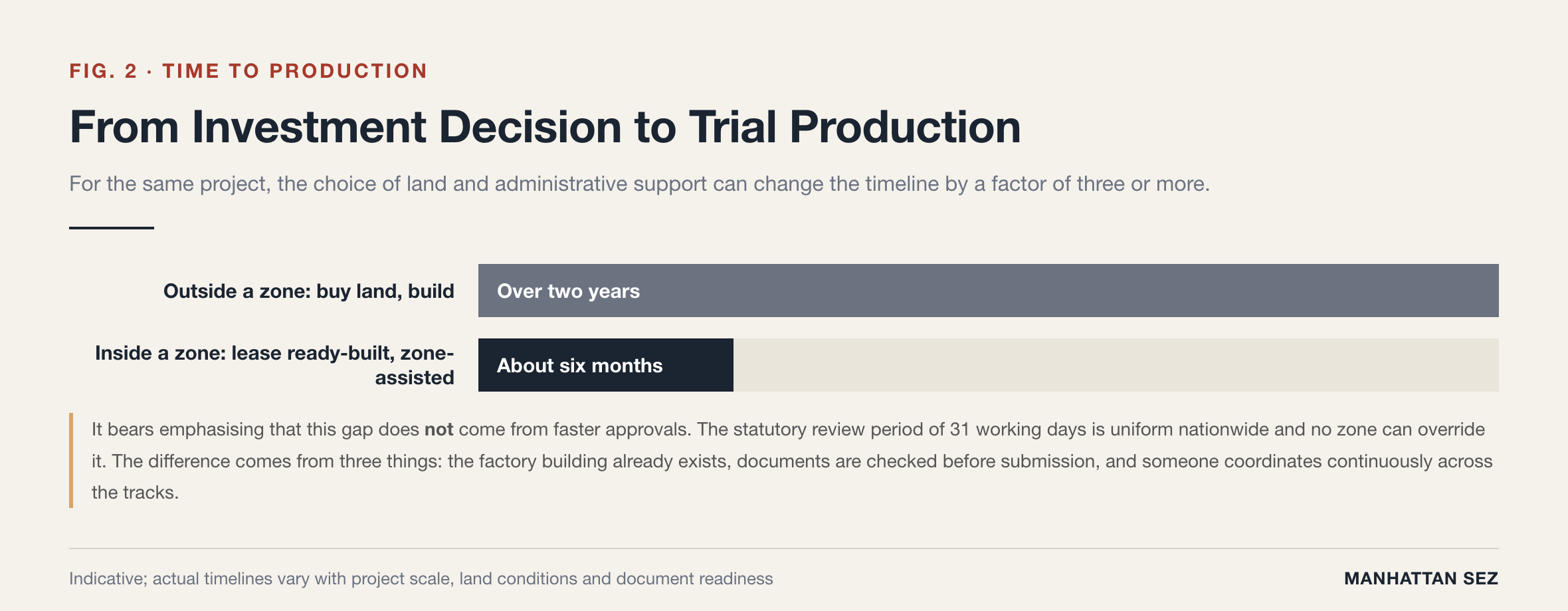
Figure 2: Two paths from investment decision to trial production. Indicative; actual timelines vary with project scale, land conditions and document readiness.
Accumulate those differences and you get the gap shown in Figure 2. For the same project, buying land and building outside a zone while handling each step independently often takes more than two years from investment decision to trial production; leasing a ready-built factory inside a zone with the zone assisting can compress that to around six months. It bears emphasising that the gap does not come mainly from faster approvals. It comes from three things: the building does not have to start from design and permitting, utilities and effluent connections are handled by the zone, and document problems are resolved on site (for the cost comparison between leasing and building, see renting versus building a factory).
6. What a QIP Requires Every Year: Compliance Certificate, Master List, Monthly Filings
Completing setup does not end the administrative work. QIP incentives carry continuing annual obligations, something most companies only feel properly in the second year.
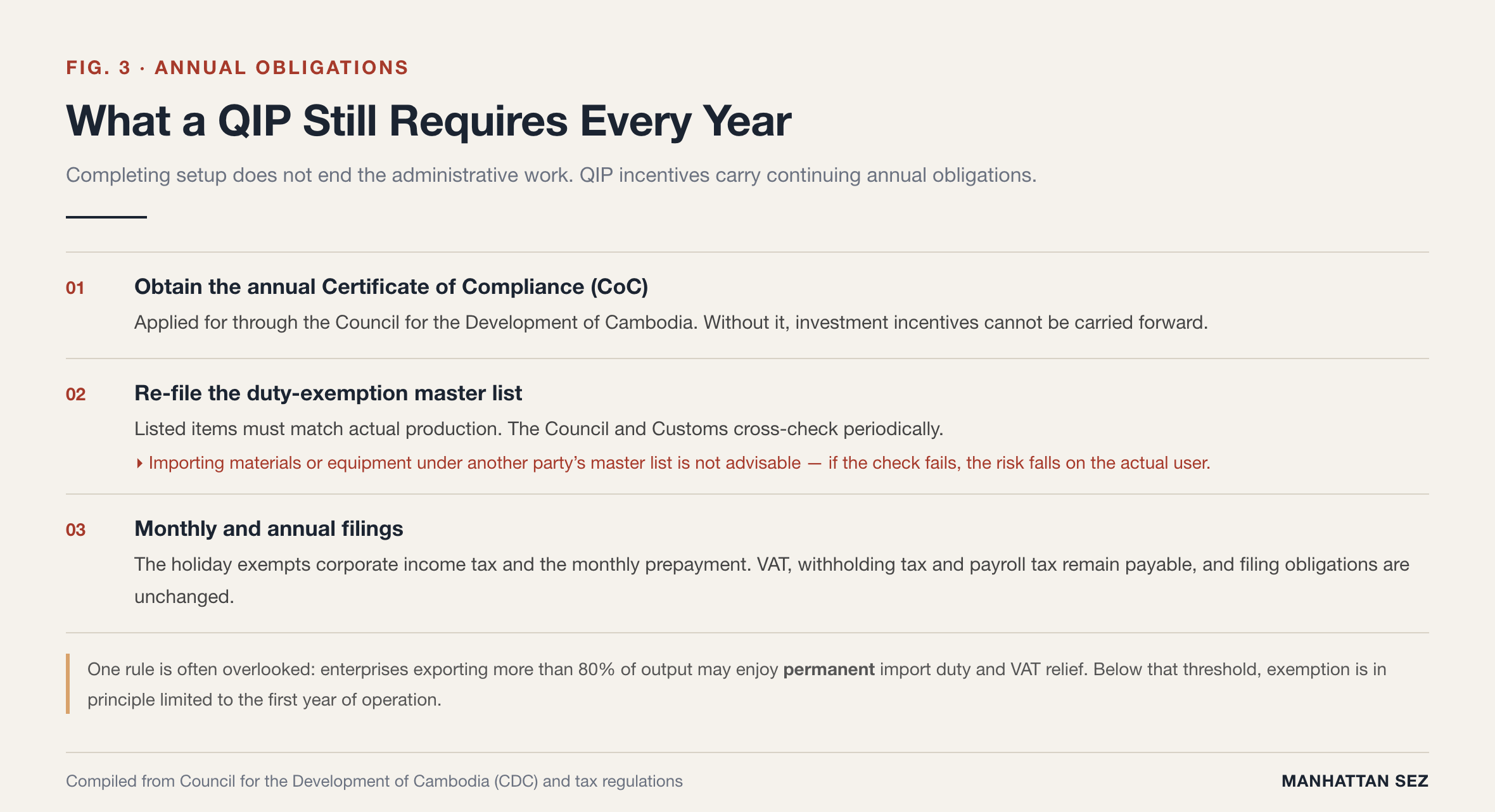
Figure 3: Continuing annual obligations for QIP companies. Compiled from Council for the Development of Cambodia and tax regulations.
At least three things must be done each year. First, obtain a Certificate of Compliance from the Council for the Development of Cambodia; without it, investment incentives cannot be carried forward. Second, re-file the import duty-exemption master list, whose items must match actual production — the Council and Customs periodically cross-check imported materials and machinery against the production activity, and a mismatch can lead to back duties, penalties, or in serious cases loss of status. Third, file the annual corporate income tax return. Beyond that, VAT, withholding tax and payroll tax are filed monthly; even during the holiday, when the 1% monthly prepayment is waived, a nil return must still be submitted.
One rule deserves separate mention: under the applicable regulations, enterprises exporting more than 80% of output may enjoy permanent import duty and VAT relief, while those below that threshold are in principle exempt only in the first year of operation. Export share is therefore not merely an operating metric but a threshold that affects the long-run tax burden, and should be factored into any plan for the domestic-export mix (see also the guide to business licences in Cambodia).
Because these obligations recur annually, it is widely advised against importing materials or equipment under another party’s duty-exemption list. If a check fails, the risk falls on the actual user, and regaining status costs far more than the paperwork originally saved.
7. What Does Administrative Time Eventually Cost?
The preceding sections covered how the four tracks are sequenced and where they tend to stall. What a company actually needs to convert, though, is what those delays cost.
The first thing consumed is the tax holiday. A QIP holiday begins once the trigger period ends; it does not wait for the company to become profitable. The later production starts, the fewer holiday years fall in profitable years (for how the mechanism works, see Cambodian corporate income tax and QIP incentives). This loss appears on no invoice, which is why it is the most commonly underestimated item at the appraisal stage.
The second is committed capital sitting idle. Land payments, construction works and equipment are all paid for before production starts, while generating no cash inflow. Every month of delay adds a month of opportunity cost on that capital, and the effect grows with project size.
The furthest-reaching is the delivery commitment to customers. Most companies relocate because a brand has asked for capacity outside China, and such requests usually come with a firm timetable. Failing to deliver qualified capacity within the agreed period risks not just the current order but the supply position for the entire category.
Put together, the value of how quickly production can start usually exceeds a few dollars per square metre on land. This is the point companies most often miss when evaluating zones: land and rent are quoted openly and easy to compare, whereas speed to production and administrative friction never appear on a quotation, yet directly determine when those costs begin to be recovered. Which raises the next question: what actually allows a zone to compress that time.
8. From One-Stop Window to Actual Production: How MSEZ Shortens Setup Time
When assessing zones in Cambodia, asking whether there is a one-stop service is not enough. Government departments stationed on site to handle investment and trade matters are a baseline feature of the special economic zone system.
What separates zones is whether that window works together with zone administration, the customs team, factory handover and infrastructure connection, so that the several administrative tracks a company faces are strung into one executable path to production. Put differently, having a window inside the park does not by itself mean the project moves quickly. Three questions are worth confirming: whether the zone team understands the sequence linking land, QIP, construction, environmental assessment and the master list; whether someone catches document problems before submission rather than after a ministry returns them; and whether the building, utilities, wastewater treatment and equipment clearance can be synchronised with approval progress. What governs time to production is usually not how long any single approval takes, but whether someone coordinates continuously between these steps. These questions apply to any zone, MSEZ included.
The difference at Manhattan Special Economic Zone (MSEZ) should likewise be understood in terms of execution capability rather than the phrase “one-stop window” alone. The zone has operated since 2005, its one-stop window has worked alongside the administrative and customs teams on site for years, and Chinese is one of its main working languages. For a Chinese company entering Cambodia for the first time, that means fewer rounds of repeated communication between headquarters, site staff and local authorities caused by language conversion and information gaps.
More concretely, MSEZ can intervene early at several interfaces where production dates tend to slip. Land or factory contracts are provided by the zone and their form can be confirmed before the investment application, reducing the risk that a contract issue affects the QIP application. The follow-on permits listed in the Conditional Registration Certificate can be mapped out in advance by the zone team together with the seconded departments, so a company does not discover outstanding procedures only after receiving the certificate. The duty-exemption master list for equipment and raw materials can be checked for item descriptions and declaration method before procurement and shipment, reducing the risk of demurrage when equipment arrives against a non-matching list. Because the zone’s administrative and customs teams sit in the same execution chain, master list approval, equipment arrival and port clearance can be timed to connect. Ready-built standard factories and the zone’s own power, water and wastewater systems mean a company does not start from land development and infrastructure, shortening the front end further.
MSEZ is located at Bavet on the Cambodia-Vietnam border, about 6 kilometres from the border crossing and roughly 90 kilometres from the Ho Chi Minh City port area. Location alone does not substitute for administrative capability, but for companies whose raw materials or equipment enter through Vietnamese ports and whose finished goods need cross-border logistics, customs coordination inside the zone and the border position can form a single execution chain. Its value is not preferences beyond the regulations, nor any change in how rules apply; what it reduces is the coordination cost between obtaining investment status and getting equipment on site to begin trial production.
When comparing zones, therefore, do not stop at land price, rent or the incentive list, and do not settle for confirming that a one-stop window exists. A more useful approach is to ask the zone to explain, for your specific project: who coordinates the procedures overall, which documents are checked before submission, when master list preparation begins, who handles equipment on arrival, and the earliest date the building and utilities can be handed over. Only when these have named owners and dates does a one-stop service translate into speed to production.
If your company is evaluating where to land in Cambodia, you can provide the MSEZ team with the project type, investment scale, factory requirements, equipment arrival dates and intended production date, and the zone will set out what it can assist with, where responsibility sits and the expected critical dates. You may also wish to review the overall conditions for investing in Cambodia first.
9. Cambodia Factory Setup FAQ
Q1: What does setting up a factory in Cambodia involve from start to finish?
| It falls into four parallel tracks: company formation (incorporation with the Ministry of Commerce, tax registration with the General Department of Taxation, labour registration with the Ministry of Labour and Vocational Training); investment status (the Qualified Investment Project application, yielding first a Conditional Registration Certificate and then a Final Registration Certificate); construction permits (notarisation of the land agreement, the building permit, the environmental impact assessment); and pre-operational filings (National Social Security Fund registration, customs registration, the import duty-exemption master list). The four run in parallel and condition one another — the land agreement is a required attachment to the investment application, and the conditional certificate specifies the further permits required. |
Q2: What is the difference between a CRC and an FRC? Can construction start on a CRC?
| No. The Conditional Registration Certificate is a to-do list issued by the authority, specifying the authorisations, permits and licences the project requires and the responsible departments. The Final Registration Certificate is what formally establishes Qualified Investment Project status, issued within 28 working days of the conditional certificate. When the conditional certificate arrives, the building permit, environmental impact assessment and the various registrations are typically still outstanding on that list. |
Q3: How does a zone one-stop service differ from a park filing documents for you?
| The difference is legal basis and approval authority. Under Sub-Decree No. 148 and Article 4 of the Law on Investment, the Council for the Development of Cambodia authorises the Cambodian Special Economic Zone Board to establish a zone administration on site, staffed by officers seconded from Customs, the Ministry of Commerce, Camcontrol and the Ministry of Labour, who approve and issue permits, licences and registrations directly. The approval authority is inside the zone, rather than the park couriering your documents to Phnom Penh. |
Q4: Does a one-stop service make approvals faster?
| It cannot beat the statutory timetable. Investment projects are subject to automatic approval, with review due within 31 working days; that is a nationwide standard no zone can accelerate, and the incentives and holiday length are the same as outside. What the window changes is what happens between the statutory steps: the number of trips, the number of re-submissions, the points where cross-ministry coordination fails, and how early problems surface. An omission pointed out at the counter costs a same-day correction rather than a rejection two weeks later and a fresh place in the queue. |
Q5: What does a QIP require each year after approval?
| At least three things: obtain the annual Certificate of Compliance from the Council for the Development of Cambodia (without it, incentives cannot be carried forward); re-file the import duty-exemption master list (items must match actual production, and the Council and Customs cross-check periodically); and file the annual corporate income tax return. VAT, withholding tax and payroll tax are also filed monthly; even during the holiday, when the 1% monthly prepayment is waived, a nil return must still be submitted. |
10. Sources and Further Reading
📚 Sources & References
- DHH Law Firm, Beijing | Cambodia investment series: guidance on establishing special economic zones and investor entry. Sub-Decree No. 148 ANK/BK on the Establishment and Management of Special Economic Zones was promulgated on 29 December 2005. Under Article 4 of the Law on Investment, the Council for the Development of Cambodia supervises zone administrations and authorises the Cambodian Special Economic Zone Board (CSEZB) to decide on establishment and administration; the CSEZB may establish a zone administration as the one-stop service window, staffed by officers from the CSEZB, Customs, the Ministry of Commerce, Camcontrol and the Ministry of Labour, who approve and issue permits, licences and registrations to zone investors. A separate dispute settlement committee is also established.
- Cambodia investment practice compilation | QIP application process: submit to CDC or PMIS with a notarised land or factory lease attached; the Conditional Registration Certificate is issued listing required authorisations, permits, licences and responsible departments; submit a bank statement for 25% of registered capital; VAT registration is forwarded by CDC; the Final Registration Certificate is issued within 28 working days of the CRC, with the company registration certificate, patent tax certificate and VAT certificate attached; submit the duty-exemption master list for construction materials, production equipment and raw materials.
https://zhuanlan.zhihu.com/p/100846705 - CTILS and DeHeng Law Offices | Guide to foreign investment in Cambodia: projects below USD 2 million fall under the provincial-municipal investment sub-committee (PMIS); a QIP must obtain an annual Certificate of Compliance from CDC to continue enjoying incentives; investment projects are subject to automatic approval, generally to be completed within 31 working days of receipt of the investment proposal.
https://www.ctils.com/articles/8088 - Company110 | QIP practice notes: holding a QIP certificate does not mean automatic exemption — a compliance certificate must be applied for annually; the duty-exemption master list must match the production activity, CDC and Customs cross-check periodically, and mismatches can lead to back duties, penalties or loss of QIP status; importing under another party’s list is not advised.
https://www.company110.com/page-19-1991.html - Yingtian Overseas Consulting | Cambodian company registration and associated deadlines: three stages of registration with the Ministry of Commerce, the General Department of Taxation and the Ministry of Labour; bank account details within 15 working days of tax registration and a bank statement within 15 working days of the business licence; a declaration of opening before operations begin; internal regulations required above 8 employees, filed within 3 months of incorporation; NSSF registration once there is more than 1 employee.
https://www.yingtianbus.com/article/218/detail/109.html - AMZ123 | Cambodian company registration generally takes 4 to 6 weeks; the standard corporate income tax rate is 20% under a self-assessment system.
https://www.amz123.com/ask/iP7BP5hV - Manhattan SEZ | Guide to business licences in Cambodia: enterprises exporting more than 80% of output may enjoy permanent import duty and VAT relief, otherwise exemption is in principle limited to the first year of operation; for garment, footwear and other textile projects with fewer than 500 employees the Cambodian-to-foreign employee ratio is 10 to 1.
https://www.manhattansez.com/en/business-license-in-cambodia/ - Council for the Development of Cambodia (CDC) | QIP incentives and eligible sectors: the income tax holiday depends on the category of investment activity, and imports of construction materials, production equipment and production inputs may be exempt from customs duty, special tax and VAT.
https://cdc.gov.kh/incentives-and-schemes/