Summary: A global manufacturing strategy built on one tariff rate failed in 2026. US tariffs that year taught manufacturers an expensive lesson: any investment decision built on a single tariff rate can be overturned within months. On 20 February the Supreme Court struck down IEEPA reciprocal tariffs; a 10% global surcharge under Section 122 stood in, survived just five months and lapsed by operation of law on 24 July. At that same moment the Section 301 forced-labour final action took effect — 10% for 17 economies including Cambodia, Indonesia, Malaysia, Mexico and Canada, and 12.5% for 38 economies including China, Vietnam, Thailand, Singapore and the Philippines (for China and Brazil it stacks on existing 301 duties). Cambodia and three other economies also received textile and apparel tariff-rate quotas tied to imports of US cotton, and technology products are exempt across all 60 economies. Meanwhile Section 232 on steel, aluminium and copper applies globally regardless of origin and does not stack with the above, and overcapacity investigations covering 16 economies have yet to produce duties. A system this layered — and one where the new duty has no rate ceiling and no expiry — means the goal is not to find the country with the lowest rate, but to build a multi-node footprint that can absorb policy volatility. This article maps the 2026 tariff tools and timeline, unpacks the logic of “China plus N”, and offers a framework for allocating capacity by target market, process complexity and tariff exposure.
1. Global Manufacturing Strategy When Tariff Policy Keeps Moving
In 2025 a factory exporting to the US completed its investment model on a 19% reciprocal tariff. In February 2026 a single court ruling reduced that rate to zero. Five months later the bridging measure that replaced it also expired by law, and new country-specific rates came into force on 24 July — the numbers are now 10% or 12.5%.
For a manufacturer this is not news; it is the cell in the financial model nobody wants to touch. A factory is depreciated over ten years while tariff rules are rewritten by the month. That raises the real question: when the rules themselves are unstable, can “which country has the lower rate” still decide where capacity goes? Answering it starts with seeing clearly what the tariff system actually looks like in the second half of 2026.
2. The Four Tariff Tools: IEEPA, Section 122, Section 301 and Section 232
Four tools with four different legal bases now shape US-bound manufacturing. They work differently and target different things — conflating them is where misjudgement begins.
| Tool | What it targets | Status (25 July 2026) | What it means for footprint |
| IEEPA reciprocal tariffs | Nearly all trading partners | Struck down by the Supreme Court on 20 Feb 2026; collection ceased 24 Feb | No longer in force; models built on it must be redone |
| Section 122 | Global (interim surcharge) | 10% from 24 Feb 2026; lapsed by law on 24 July after five months | A bridge that has now been withdrawn |
| Section 301 (forced labour) | Specific economies / conduct | Final and in force: 10% for 17 economies including Cambodia; 12.5% for 38 including China, Vietnam and Thailand; no ceiling, no expiry | Country-specific — the key variable a footprint decision can influence |
| Section 232 | Steel, aluminium, copper and derivatives | 50% / 25% / 15%, applied globally regardless of origin, does not stack with Section 301 | Relocation cannot avoid it; metal categories need separate modelling (see our hardware manufacturing analysis) |
The most important line in that table is Section 232, which follows a completely different logic. It targets what a product is made of, applies worldwide and ignores country of origin — so steel and aluminium goods face the same duty wherever they are made, and moving a factory does not avoid it. Section 301 targets where a product comes from, which is why it varies by country and why it is the layer a site decision can genuinely affect.
The final action also contains two design features that are easy to miss and directly affect footprint decisions. First, technology products are exempt across all 60 economies — smartphones, laptops, desktops, hard drives, keyboards and other automatic data-processing machines and their parts, mobile communications equipment, base stations, antennas and semiconductors all fall outside the duty, on the reasoning that taxing them could cause economy-wide disruption. Electronics and IT capacity is therefore almost untouched by this layer of country rates. Second, for China and Brazil the duty stacks on top of their existing 301 duties, so the real gap between those origins and Cambodia is considerably wider than 2.5 percentage points.
3. The 2026 Timeline: From IEEPA to Section 301
The 2026 switch has now run through all three stages, and 24 July is where the timeline lands.
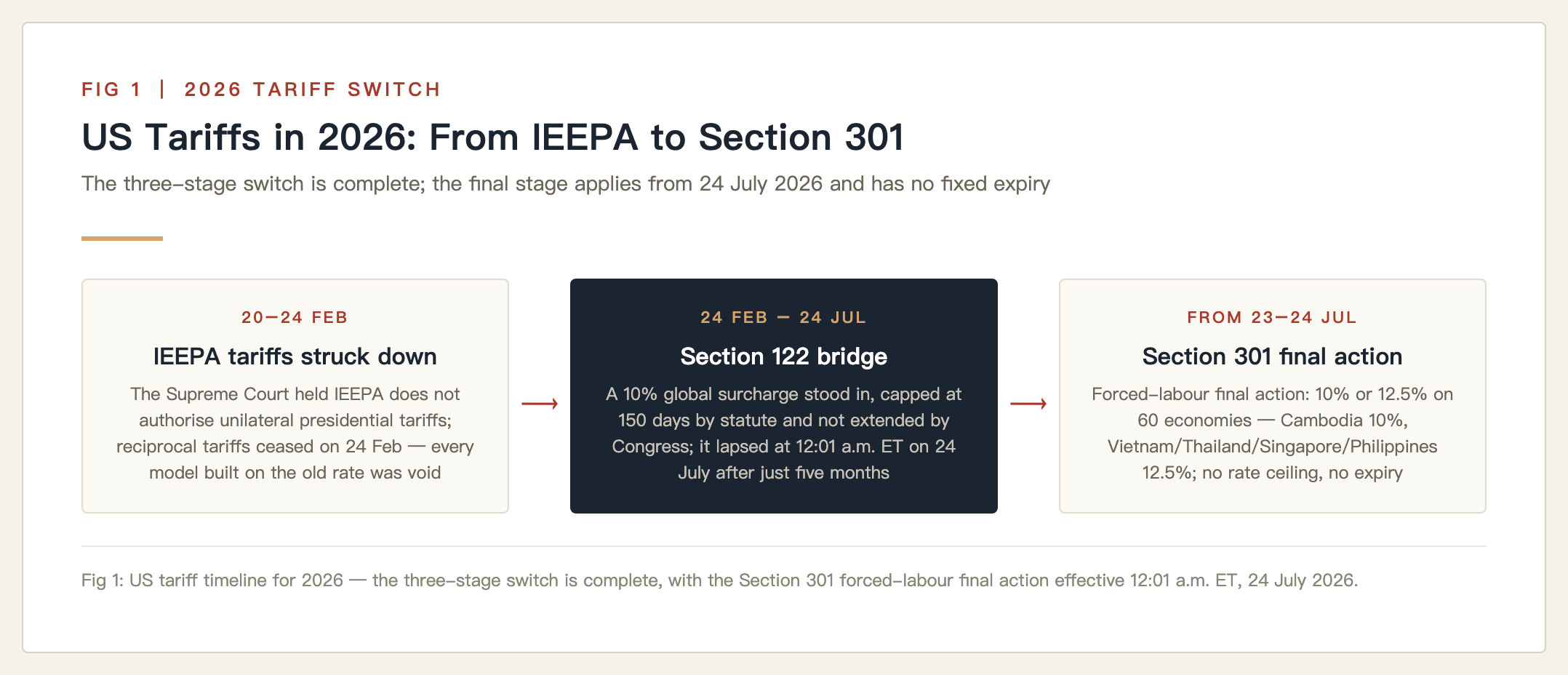
Fig 1: US tariff timeline for 2026 — the three-stage switch is complete, with the Section 301 forced-labour final action effective 12:01 a.m. ET, 24 July 2026.
In detail: on 20 February 2026 the Supreme Court held in Learning Resources, Inc. v. Trump that IEEPA does not authorise the President to impose tariffs unilaterally, and reciprocal tariffs ceased on 24 February. From the same day a 10% global surcharge under Section 122 stood in — but that provision carries a 150-day statutory cap, the President could not extend it and Congress did not, so it lapsed automatically at 12:01 a.m. ET on 24 July (the Court of International Trade had also ruled on 7 May that the measure exceeded the statute; that is on appeal). To close the gap, USTR published its Section 301 forced-labour determination and proposed rates on 2 June, held a hearing on 7 July, noticed the final action on 23 July and brought it into force at 12:01 a.m. ET on 24 July, with a grace period for goods in transit. Seventeen economies with a forced-labour import prohibition or a reciprocal trade agreement pay 10% (Cambodia, Indonesia, Malaysia, Mexico, Canada, India and the UK among them); the remaining 38 pay 12.5% (including China, Vietnam, Thailand, Singapore, the Philippines and Brazil). The EU and Taiwan pay 10% net of MFN duty, while Japan, South Korea and Switzerland pay 12.5% on the same basis.
One caveat matters more than the rest: unlike Section 122, this duty has no fixed expiry and no statutory rate ceiling — more stable than a bridging measure, but the room to adjust also remains with Washington. It does not stack with Section 232, and Annexes I and II carry extensive exclusions (the universal list covers 2,120 tariff codes, of which 863 are exempt as entered, and 13 economies have their own targeted lists). The overcapacity Section 301 investigations covering 16 economies including Cambodia are still running and could add another layer before year-end. In short, the measure landing on 24 July does not mean the tariff environment is now settled.
4. Why the Lowest Rate Cannot Decide Your Footprint
For two years many companies relocated on the logic of “go wherever the rate is lowest”. 2026 shows that question has three fatal flaws.
First, rates change faster than factories depreciate. The 19% reciprocal tariff went from imposition to invalidity in under a year; its Section 122 replacement lasted five months; and today’s Section 301 duty, though final, explicitly has no expiry and no ceiling — meaning it will not end on its own and can be adjusted again. Basing a ten-year investment on any current rate is still betting on a number that can be rewritten.
Second, the rate is not one number but a stack. A single shipment may face MFN duty, Section 301, Section 232 and anti-dumping or countervailing duties at once, each with its own rules. Steel and aluminium hardware is bound by Section 232, so relocation is ineffective; furniture and mattresses face anti-dumping measures that in some cases already cover Southeast Asia (see our home and building materials analysis); lighting is mainly exposed to China-specific Section 301 duties, which moving out of China does avoid (see our lighting analysis); and electronics are fully excluded from the final action, so this layer simply does not apply. Talking about country rates before establishing which layer your product sits in is meaningless.
Third, relocation carries its own constraints: substantial transformation for origin, scrutiny of Chinese content, penalty duties of up to 40% for transshipment that falsifies origin, and anti-circumvention investigations. A low rate does not mean you can lawfully claim it. The right question is therefore not “which country is cheapest” but “which layer binds my product, which steps belong where, and how fast can I adjust when the rules move again”.
5. “China Plus N”: Allocating Sites by Market and Process
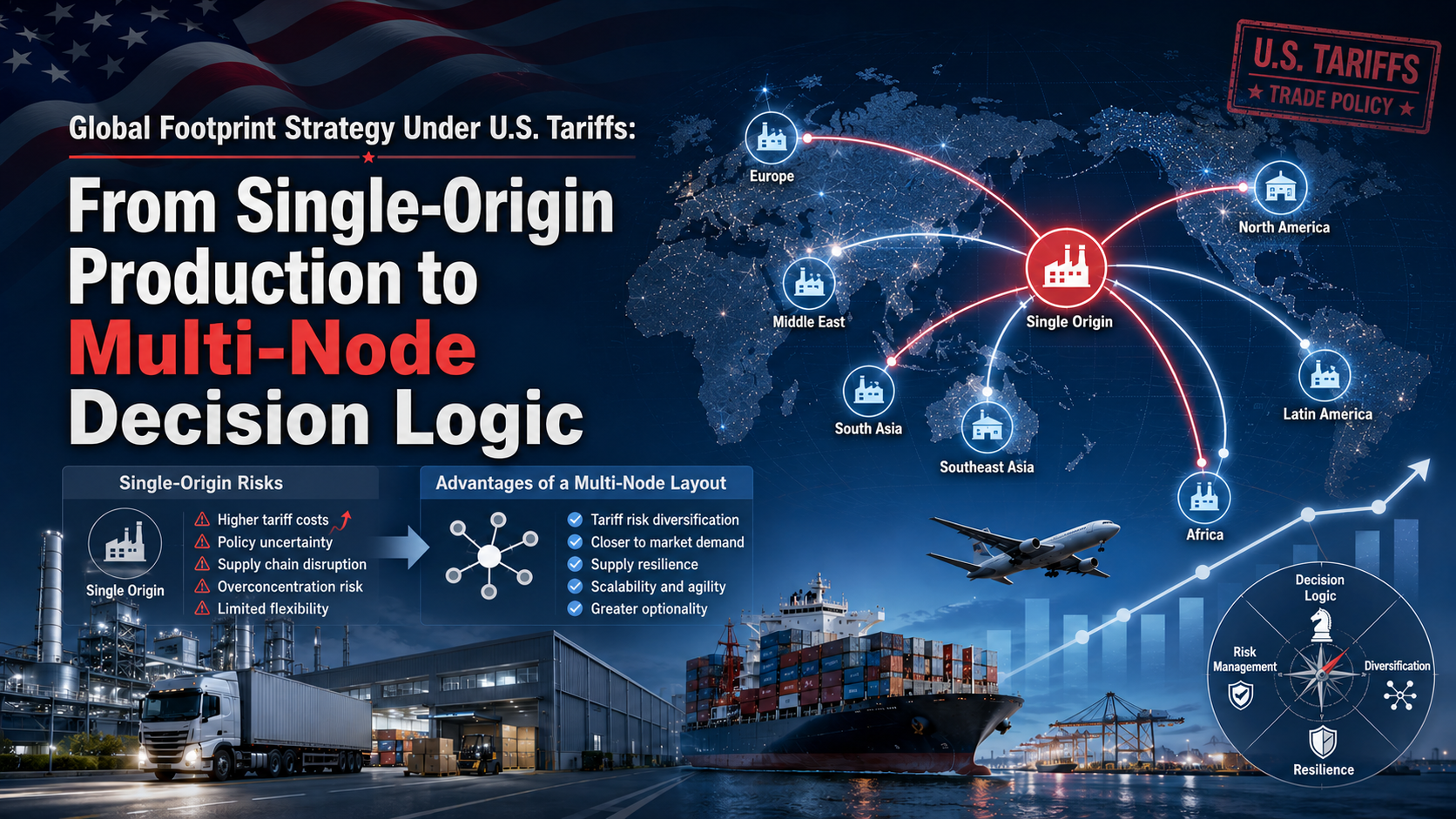
Faced with multiple tools and variables, experienced companies do not relocate wholesale — they split capacity into nodes allocated by target market and process complexity.
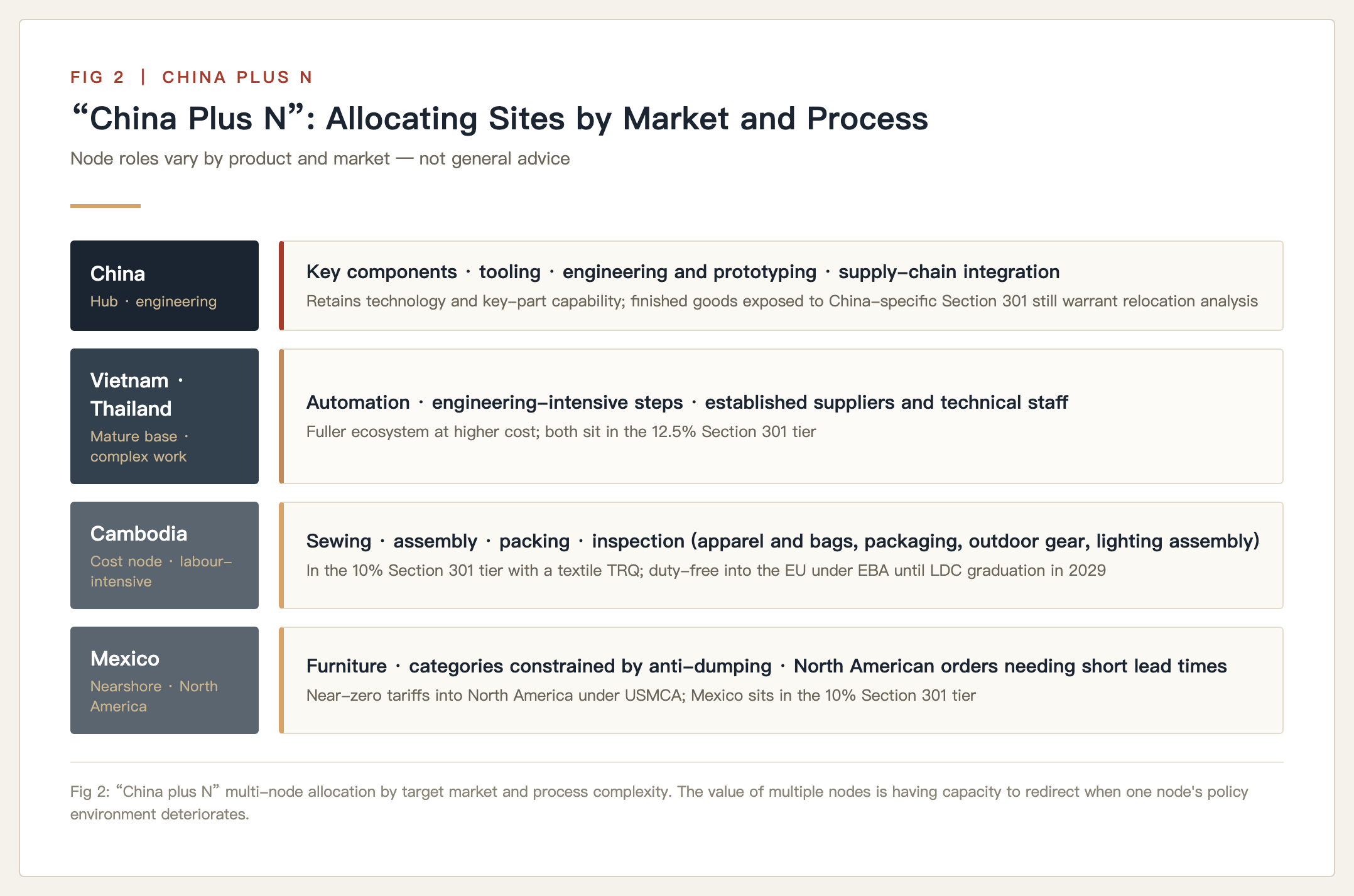
Fig 2: “China plus N” multi-node allocation by target market and process complexity (node roles vary by product and market — not general advice).
The pattern is already visible across industries. Among lighting makers, larger players tend to use Thailand as their overseas base while some choose Mexico for near-zero-tariff access to North America under USMCA. Furniture makers, facing heavy anti-dumping barriers, have moved in numbers to Mexico. Leading outdoor-gear OEMs set up in Vietnam years ago, with Cambodia taking cost-sensitive sewing and assembly (see our outdoor gear analysis). The common thread: China retains key components, tooling and engineering capability while overseas nodes divide work by market and cost, instead of concentrating all capacity in one country.
Cambodia’s place on this map is reasonably clear. It is not a replacement for a mature supply chain; it is the node that absorbs labour-intensive, standardised, cost-sensitive work. Under the final Section 301 measure it sits in the 10% tier, below Vietnam’s and Thailand’s 12.5%, and textile and apparel goods may also qualify for the tariff-rate quota tied to US cotton imports (an initial three years, with rules still to be published). That is a substantive signal worth including in an evaluation but, as above, not a sufficient reason on its own. The real value of multiple nodes is having capacity to redirect when the policy environment at one node deteriorates.
6. A Decision Framework: Market, Process Complexity and Tariff Exposure
Where capacity goes comes down to three variables in combination: target market, process complexity and the type of tariff exposure.
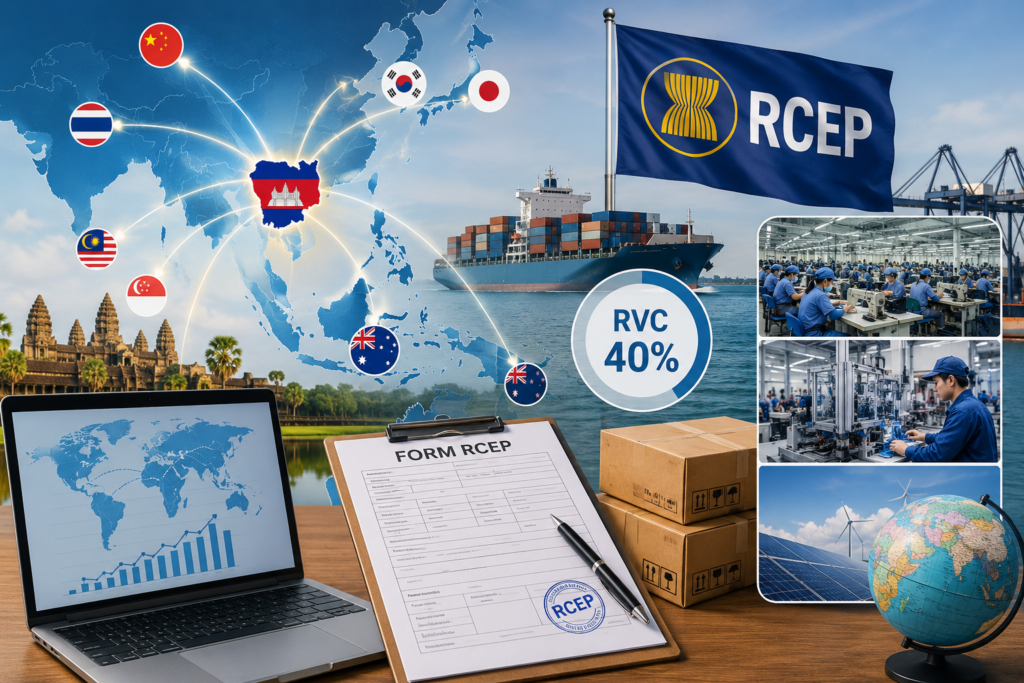
Variable one — target market. Serving North America puts USMCA first (near-zero tariffs from Mexico, which also sits in the 10% Section 301 tier) alongside country differences under Section 301. Serving the EU makes Cambodia’s duty-free access under EBA (until LDC graduation in December 2029) materially valuable, subject to compliance thresholds such as the EUDR. Serving Asia-Pacific makes origin cumulation under RCEP and the China–Cambodia FTA the more important lever.
Variable two — process complexity. Engineering-intensive and automated steps that need mature suppliers and technical staff belong in China or in established bases such as Thailand and Vietnam. Sewing, assembly, packing and inspection — labour-intensive and standardised — suit a cost node like Cambodia (on the trade-off, see Cambodia versus Thailand).
Variable three — tariff exposure. If a product falls under Section 232 (steel, aluminium, copper), relocation is ineffective and site choice should follow cost and market. If it is exposed to China-specific Section 301 duties, moving out of China has real effect — and more so now that the new duty stacks for China. If it is a technology product and fully excluded, country rates are no reason to relocate at all. If it faces anti-dumping measures that already cover Southeast Asia, check case by case, because moving may not release you.
| If this is your situation | Suggested direction |
| Serving the US, product exposed to China-specific 301, labour-intensive processes | Establish a second site outside China; Cambodia’s confirmed 10% tier is worth evaluating, with origin properly substantiated |
| Serving the US, product is steel or aluminium (Section 232) | Relocation cannot avoid the duty; decide on cost, lead time and diversification into non-US markets |
| Product is electronics or IT (laptops, handsets, semiconductors) | Fully excluded from the final action — decide on cost, talent and supply chain, not on this tariff layer |
| Product is textiles, apparel or sewn goods sold into the US | Cambodia sits at 10%; track the implementation rules and application route for the US-cotton-linked TRQ |
| Product faces anti-dumping duties (mattresses, some furniture) | Check case by case whether measures cover the target country; evaluate Mexico and similar alternatives if needed |
| Serving the EU with textiles or light industry | Cambodia’s EBA duty-free access is materially valuable; prepare EUDR and PPWR compliance in parallel |
| Orders not yet confirmed, need validation first | Start asset-light by leasing a factory to retain flexibility (see renting versus building) |
7. MSEZ: Cambodia’s Role as a Node in a Global Chain
In a multi-node footprint, Cambodia’s value is not “the lowest rate” but cost, speed and redeployability — and MSEZ’s conditions map onto those three.
Manhattan Special Economic Zone (MSEZ) sits at Bavet on the Cambodia–Vietnam border, covers about 600 hectares and lies about 90 km by road from Cat Lai Port in Ho Chi Minh City. In a multi-node design that location makes more sense: a company can keep Vietnam or China as its hub for key components and supply chain while placing labour-intensive steps at Bavet, about a day’s drive apart, keeping restocking, coordination and redeployment within manageable limits — and can choose Vietnamese or Cambodian ports on export. The zone already hosts garment, bag, footwear, electronics and lighting clusters, so a new node does not have to build its ecosystem and workforce from scratch (for the wider policy backdrop see our complete guide to Cambodian special economic zones).
Operationally, the park’s administrative and customs team works primarily in Chinese, supported by English and Khmer, and has operated since 2005 — over twenty years. It can help with import clearance for materials, certificates of origin under RCEP, the CCFTA and EBA, assembling the supply-chain and cost documentation that origin and Chinese-content checks require, and connecting QIP incentives with utility hook-ups; once implementation rules for the textile TRQ are published, the park can help track the application route. When tariff rules shift again, how quickly documentation and compliance keep up often matters more to a company’s adjustment speed than the headline rate. If you are restructuring your global footprint, you are welcome to review the overall case for investing in Cambodia or contact the park team for an initial assessment based on your products, markets and process structure.
8. FAQ: Section 301, Section 232 and China Plus N
Q1: What do US tariffs look like after 24 July 2026?
| The 10% Section 122 global surcharge lapsed by operation of law at 12:01 a.m. ET that day, and the Section 301 forced-labour final action took effect at the same moment: 17 economies with a forced-labour import prohibition or a reciprocal trade agreement pay 10% (including Cambodia, Indonesia, Malaysia, Mexico, Canada, India and the UK), and the remaining 38 pay 12.5% (including China, Vietnam, Thailand, Singapore, the Philippines and Brazil, where for China and Brazil it stacks on existing 301 duties). The duty does not stack with Section 232, Annexes I/II carry extensive exclusions, and technology products are exempt across all 60 economies. Unlike Section 122, the new duty has no fixed expiry and no statutory rate ceiling. |
Q2: Why not simply build in the country with the lowest rate?
| Three reasons. Rates change faster than factories depreciate — the 19% reciprocal tariff was invalid within a year, its Section 122 replacement lasted five months, and today’s Section 301 duty, though final, has no expiry or ceiling and can be adjusted again. The rate is a stack, not a number: one shipment can face MFN duty, Section 301, Section 232 and anti-dumping duties together, so you must first establish which layer binds your product. And relocation must satisfy substantial transformation and Chinese-content checks, with penalty duties up to 40% for transshipment that falsifies origin. The right question is which layer binds you and which steps belong where. |
Q3: How do Section 232 and Section 301 differ?
| Section 232 targets what a product is made of (steel, aluminium, copper and derivatives), applies globally regardless of origin and does not stack with Section 301 — relocation cannot avoid it. Section 301 targets where a product comes from, or specific conduct, and varies by economy, which is why site choice materially affects this layer. Keeping the two apart is the single most important distinction in footprint planning. |
Q4: What is a “China plus N” multi-node footprint?
| Rather than concentrating capacity in one country, work is allocated by target market and process complexity: China keeps key components, tooling and engineering; Vietnam and Thailand take mature supply chains and complex processes; Cambodia takes labour-intensive, standardised, cost-sensitive assembly; and Mexico serves North America under USMCA. The core value is having capacity to redirect when policy at one node deteriorates. |
Q5: What role suits Cambodia in this design?
| It suits labour-intensive, standardised, cost-sensitive capacity — particularly apparel and bags, packaging, lighting assembly, outdoor gear, sanitaryware and the mid-to-late stages of hardware. Companies serving the EU can also use EBA duty-free access until LDC graduation in December 2029. Under the final Section 301 measure Cambodia sits in the 10% tier against Vietnam’s and Thailand’s 12.5%, and textiles and apparel may qualify for the TRQ — worth evaluating, but not a sufficient reason on its own. |
9. References: Policy, Rates and Supply-Chain Sources
📚 References
- US Supreme Court — Learning Resources, Inc. v. Trump (20 Feb 2026): IEEPA does not authorise unilateral presidential tariffs; reciprocal tariffs ceased 24 Feb 2026.
https://www.supremecourt.gov/opinions/25pdf/24-1287_4gcj.pdf - USTR — Notice of Final Action in the Section 301 forced-labour investigations (Federal Register Notice, 23 July 2026): additional duties of 10% or 12.5% on 60 economies, effective 12:01 a.m. ET, 24 July 2026.
https://ustr.gov/sites/default/files/files/Press/Releases/2026/FLIP%20301%20Investigation%20Final%20Action%20FRN%207-23-26%20FINAL.pdf - Global Trade Alert — Overview of the final action: 17 economies at 10% (including Cambodia, Indonesia, Malaysia, Mexico, Canada, India and the UK) and 38 at 12.5% (including China, Vietnam, Thailand, Singapore, the Philippines and Brazil); for China and Brazil the duty stacks on existing Section 301 duties; tariff-rate quotas are directed for Bangladesh, Cambodia, Indonesia and Malaysia, tied to imports of US cotton and textile inputs, letting a set volume of textiles and apparel enter free of the duty for an initial three years; exclusions sit in Annexes I/II, where 863 of 2,120 universal tariff codes are exempt as entered; the duty does not stack with Section 232.
https://globaltradealert.org/blog/forced-labour-section-301-final-action - TNGlobal — Southeast Asian tiers and technology exclusions: Cambodia, Indonesia and Malaysia at 10%; Vietnam, Thailand, Singapore and the Philippines at 12.5%. Smartphones, laptops, desktops, hard drives, keyboards and other automatic data-processing machines and parts, mobile handsets, base stations, antennas and semiconductors are exempt across all 60 economies.
https://technode.global/2026/07/24/u-s-section-301-hits-southeast-asia-10-for-three-12-5-for-singapore-vietnam-technology-escapes/ - Nakachi Eckhardt & Jacobson — The Section 122 global surcharge (Proclamation 11012, effective 24 Feb 2026) was capped at 150 days by statute and lapsed automatically on 24 July 2026; the President could not extend it unilaterally, and the Court of International Trade held on 7 May 2026 that the measure exceeded the statute (on appeal).
https://www.tradelawcounsel.com/insights-news/2026/7/4/section-122-surcharge-sunsets-july-24-what-importers-should-do-beforeand-afterthe-150-day-clock-runs-out - Holland & Knight — On 11 March 2026 USTR opened overcapacity Section 301 investigations covering 16 economies including Cambodia, with determinations expected during 2026.
https://www.hklaw.com/en/insights/publications/2026/03/ustr-launches-awaited-section-301-investigations - BDO — CBP applies penalty duties of up to 40% for transshipment that evades origin rules (HTS 9903.02.01); scrutiny of Chinese content is tightening.
https://www.bdo.com/insights/tax/ieepa-tariff-refunds-frequently-asked-questions - European Commission — EBA: Cambodia enters the EU duty-free as an LDC, transitioning after LDC graduation in December 2029; the EUDR (Reg 2023/1115) applies to large and medium enterprises from 30 December 2026.
https://environment.ec.europa.eu/topics/forests/deforestation/regulation-deforestation-free-products_en
US Department of Commerce BIS / White House Proclamations — Section 232 on steel, aluminium and copper: 50% on primary metals, 25% on derivatives and 15% on some industrial equipment (interim through end-2027); assessed on full value from 6 April 2026; applies globally regardless of origin and does not stack with Section 301.
Rates and rules described here reflect public information available as of 25 July 2026. The scope of exclusions and the quota rules under the Section 301 final action await further US announcements, and the overcapacity investigations have not yet produced duties. Verify actual liability against HS codes with professional advisers; this article is not legal or tax advice.