Summary: Sanitaryware manufacturing is an export industry China dominates — Chaozhou is the world’s largest ceramic sanitaryware OEM base, Foshan has the most complete chain, and Wenzhou and Kaiping lead in taps and fittings, with China accounting for over 35% of global output. More than ten Chinese firms including Jomoo, Huida, Sunlot, Seagull and Runner have built or acquired plants abroad, mostly in Thailand. For Cambodia the decisive question is sorting by category, and the answer is reasonably clear: labour-intensive makers of ceramic toilets and basins, bathroom vanities, and glass or acrylic bathroom products selling into the US and EU are the better fit — these categories fall outside Section 232, so moving out of China avoids the China-specific Section 301 duty and cuts the US burden from roughly 43.3% to about 15.8% (recalculated after the Section 301 forced-labour final action took effect on 24 July 2026). Conversely, makers of stainless steel sinks (where Section 232 steel stacks with anti-dumping duties for a China-made total of about 126%) or solid copper taps (potentially Section 232 copper) that depend on the US market may find relocation does not solve their tariff problem. This article covers demand-side drivers, supply-chain maturity, tariff tiers by category, operating costs and return logic, competitive comparison and the main risks.
1. Why Some Bathroom Products Can Move and Others Cannot
A bathroom-products factory in Chaozhou ships three things on the same export line: ceramic toilets, brass taps and stainless steel sinks. When a brand customer asks for capacity outside China, the owner starts planning a move to Southeast Asia — until the customs broker separates the three tariff classifications and it becomes clear their fates are completely different.
This is what sets sanitaryware apart from other light industries. When apparel or outdoor gear relocates, the tariff logic for the whole product line is broadly consistent. Bathroom products put ceramics, copper, stainless steel, glass and plastics in one box — and each material meets a different rule at US customs. So the question “should sanitaryware go to Cambodia” is answered not by country but by category. Understanding that starts with what is actually driving this wave of relocation.
2. Sanitaryware Manufacturing: Why Brands Are Pushing Production Out
The real drivers are not simply cheaper wages but three downstream forces: tariff cost, demands for sourcing diversification, and the property cycle.
First, international bathroom brands — Kohler, Moen, Delta, Roca, Hansgrohe and Villeroy & Boch among them — have long manufactured in China and now require suppliers to build “China plus one” capacity to spread tariff and geopolitical risk. Second, China’s property adjustment has put domestic sales under pressure, making overseas retail and exports the growth engine: results from Seagull, Sunlot and Runner all show steady overseas growth against domestic decline. Third, Runner has explicitly moved to strengthen its Thai supply chain and North American localisation — evidence that relocation is a deliberate strategy built around proximity to end markets plus origin diversification, not a hunt for low wages.
For Cambodia the implication is this: a sanitaryware company evaluating the country is really asking how to use a lower-cost origin with different tariff treatment from China to meet brand customers’ diversification requirements — and the answer depends heavily on product category (for the overall tariff picture see our analysis of global manufacturing strategy under US tariffs).
3. The Industry: China Dominates, So What Can Cambodia Take?
China is the dominant global production base and Cambodia is at an early stage — suited to labour and assembly-intensive categories where kiln and technical barriers stay manageable.
China accounts for over 35% of global sanitaryware output, and Guangdong alone for nearly 70% of national production value. Chaozhou has more than 800 ceramic sanitaryware firms and is the world’s largest OEM hub; Foshan has the most complete chain and the most brands; Wenzhou, Kaiping and Xiamen specialise in taps, valves and plumbing fittings (Xiamen supplies cistern fittings used by over 70% of global brands). Cambodia has no comparable industrial belt and lacks upstream ceramic materials, copper stock and hardware, so it cannot replicate China’s completeness in the near term. What it can take on is vanity assembly and categories where technical and certification barriers are manageable and production can run on imported materials plus local processing — not high-end smart sanitaryware or a full complex-hardware chain.
4. Supply-Chain Maturity: Where Cambodia Sits
Viewed in layers, Cambodia currently sits at assembly and partial processing, with upstream materials and key parts still imported.
| Supply-chain layer | Content | Cambodia today |
| Upstream materials | Ceramic bodies and glazes, copper and brass, stainless steel, glass, acrylic sheet | Essentially all imported (China / region) |
| Core components | Ceramic firing, valve cartridges, tap casting, hardware electroplating | Early stage; kilns and plating need investment and carry higher technical barriers |
| Assembly / downstream | Vanity assembly, tap assembly, packing, inspection | Strong fit — labour-intensive and can be absorbed relatively quickly |
| Support | Hardware fittings, packaging, printing, logistics, inspection | Can be built up gradually on the park’s existing clusters |
The implication is direct: sanitaryware in Cambodia remains an “imported materials and key parts plus local downstream assembly” model, much like hardware and lighting. When locating, the design of sourcing and import logistics — and the depth of local processing, which determines whether origin requirements can be met — are what drive cost and compliance.
5. Tariff Tiers: US Duties Vary by Category
Sanitaryware has the most fragmented US tariff treatment of any light industry: the logic differs completely by category, so whether relocating to Cambodia avoids duty depends entirely on which tier a product falls into.
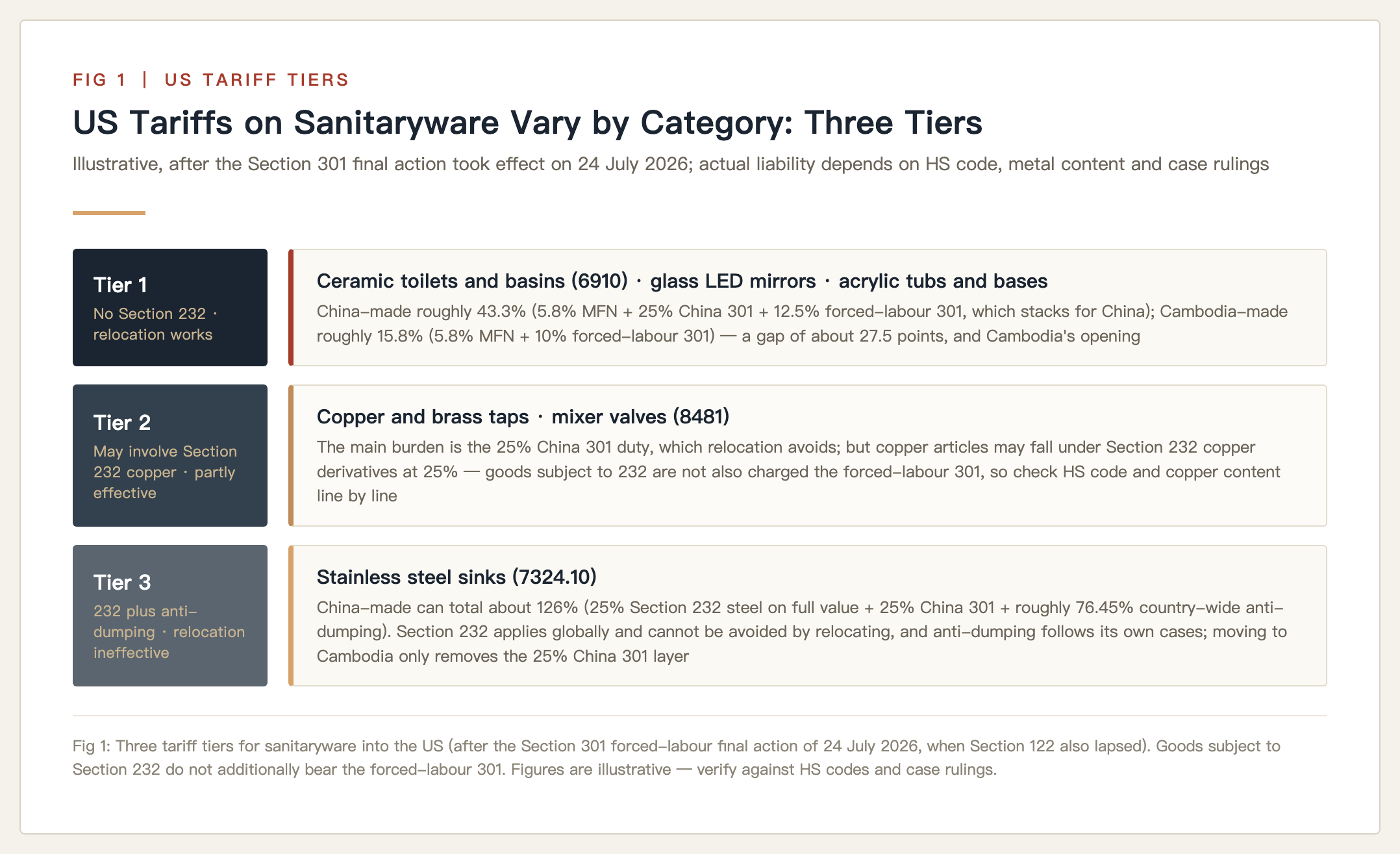
Fig 1: Three tariff tiers for sanitaryware into the US (after the Section 301 forced-labour final action of 24 July 2026, when Section 122 also lapsed). Goods subject to Section 232 do not additionally bear the forced-labour 301. Figures are illustrative — verify against HS codes and case rulings.
Tier 1 — no Section 232: ceramic toilets and basins (HS 6910), glass LED mirrors, acrylic tubs and shower bases. These are not steel, aluminium or copper articles, so the main burden is the China-specific Section 301 duty of 25%. Taking ceramics as the example, China-made totals roughly 43.3% (5.8% MFN + 25% China 301 + 12.5% forced-labour 301, which stacks on existing 301 duties for China); the same product made in Cambodia comes to about 15.8% (5.8% MFN + 10% forced-labour 301) — a gap of roughly 27.5 percentage points, driven mainly by the avoidable China 301 layer. This tier follows the same logic as lighting and is where Cambodia’s opportunity lies.
Tier 2 — potentially Section 232 copper: copper and brass taps and mixer valves (HS 8481) are mainly bound by the 25% China 301 duty, which relocation avoids; but copper articles may fall under Section 232 copper derivatives at 25%, so check HS code and copper content. Note that goods subject to Section 232 are not additionally charged the forced-labour Section 301 — the two do not stack — but Section 232 itself is not removed by relocating.
Tier 3 — Section 232 stacked with anti-dumping: stainless steel sinks (HS 7324.10) attract Section 232 steel (25%, on full value, applied globally), the China 301 duty (25%) and anti-dumping duties (a country-wide China rate of about 76.45%), for a China-made total of roughly 126%. Section 232 applies regardless of origin and cannot be avoided by relocating, and anti-dumping follows its own cases — moving to Cambodia removes only the 25% China 301 layer. Companies centred on stainless steel sinks or solid copper taps that depend on the US market may therefore find relocation does not solve the problem, and should verify category by category against HS codes.
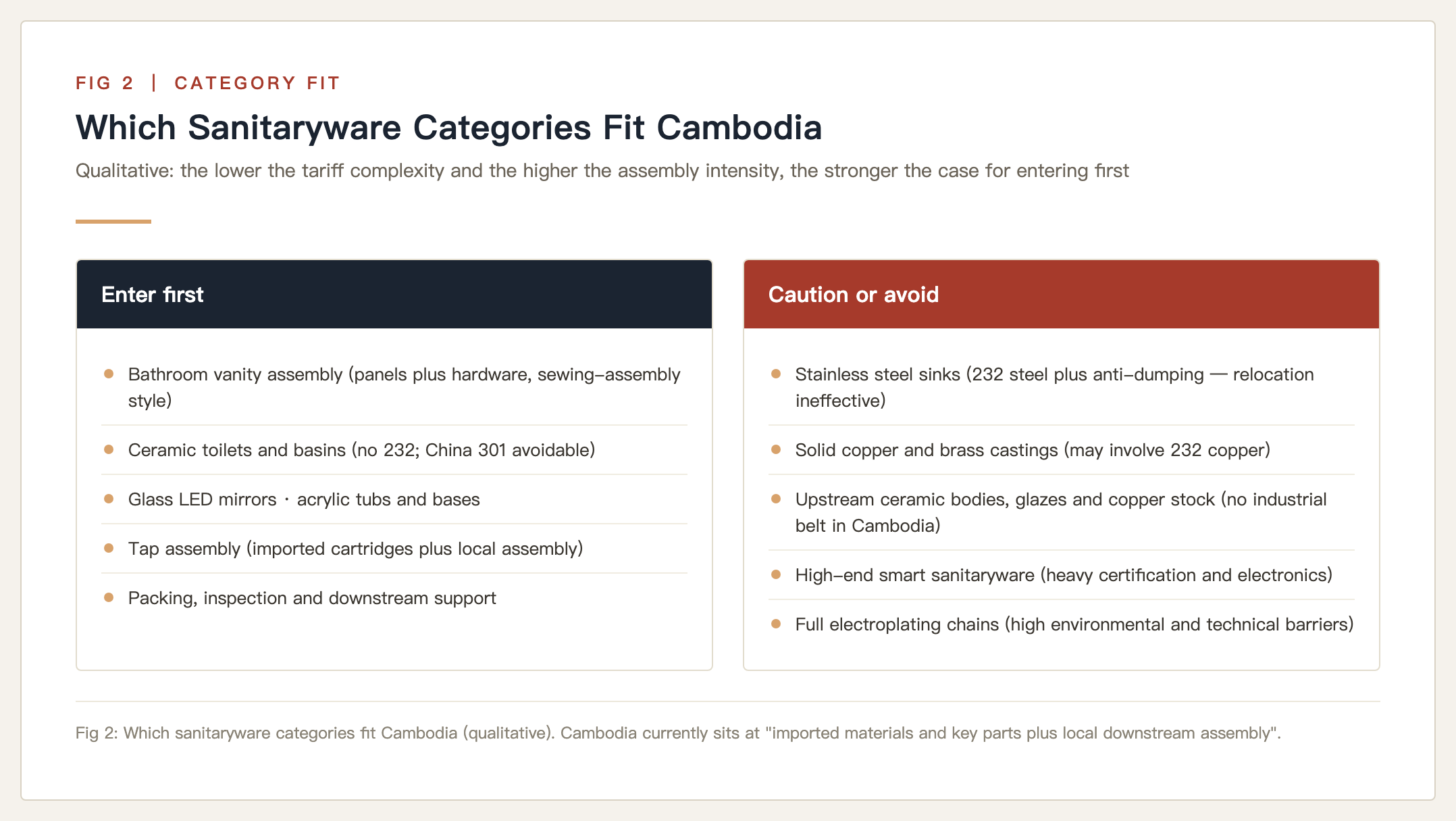
Fig 2: Which sanitaryware categories fit Cambodia (qualitative). Cambodia currently sits at “imported materials and key parts plus local downstream assembly”.
6. Operating Costs and How to Model the Return
Beyond labour and social security, sanitaryware costs must account for the energy and environmental burden of ceramic kilns and electroplating. Model the return with hard numbers for what is quantifiable and ranges for what is not — never a single figure.
| Cost item (2026) | Cambodia | Notes |
| General worker minimum wage | About USD 210/month | Statutory for the GFT sector; sanitaryware assembly references it or negotiates separately (total labour cost breakdown) |
| Employer social security (NSSF) | About 5.4% | Markedly below Vietnam’s roughly 21.5% |
| Industrial electricity | Request a current quote from the park | Ceramic firing and plating are power-hungry — model this carefully |
| Bodies/glazes, copper, stainless steel | Mostly imported from China or the region | Include landed cost and environmental treatment |
| Tax incentives | QIP holiday or special depreciation — one or the other | On structure and real benefit see corporate income tax and QIP incentives |
| Factory building | Lease or build | On leasing to trial first versus long-term land and self-build, see renting versus building |
A framework for modelling the return (a 1,000-worker assembly plant, Vietnam versus Cambodia; figures are illustrative — substitute real quotes):
① Quantifiable with hard data: the wage gap — about USD 210/month in Cambodia against more in Vietnam — and the social security gap, about 5.4% against roughly 21.5%, which at 1,000 workers produces a substantial annual difference in employer cost.
② Estimate as ranges, with assumptions stated: incremental inbound logistics for materials, tariff savings (only for non-232 categories — about 27.5 points for ceramics), and initial training and yield ramp-up costs.
③ The conclusion logic: for non-232 categories serving the US, tariff savings plus labour savings are usually the main drivers of return. For 232 and anti-dumping categories, tariff savings do not exist and the case must rest on cost and non-US markets. Never conclude from a single tariff rate or a single wage gap.
7. Cambodia versus Vietnam versus Thailand
Each has a different emphasis: Thailand has the most mature supply chain and hosts most of the large bathroom manufacturers, Vietnam sits in between, and Cambodia competes on cost and its tariff tier.
| Dimension | Cambodia | Vietnam | Thailand |
| Labour cost | Lowest (about USD 210) | Higher | Higher still |
| Sanitaryware supply-chain maturity | Early stage | Intermediate | More mature (large plants clustered) |
| Upstream ceramics / copper | Weak (import-dependent) | Intermediate | Fairly complete |
| US Section 301 tier (non-232 categories) | 10% | 12.5% | 12.5% |
| EU access | EBA duty-free (until December 2029) | EVFTA | GSP / standard |
| Best fit | Cost-sensitive assembly of non-232 categories | Balanced overall | Complex, high-end, local supply chain |
The conclusion: for ceramics, glass and acrylic — non-232, cost-sensitive categories serving the US and EU — Cambodia’s combination of the 10% tier, the lowest labour cost and EBA duty-free access is the most attractive. For companies needing a mature bathroom supply chain, complex hardware or high-end products, Thailand remains first choice (see Cambodia versus Thailand for the full trade-off).
8. Main Risks and Responses
The principal risks, ranked by impact, with the direction of response.
| Risk | Level | Response |
| Section 232 and anti-dumping (stainless steel, copper parts) | High | Allocate by category tier; do not relocate 232 or anti-dumping categories, or handle them under their own rules |
| US tariff policy volatility | High | Diversify markets and origins; Section 301 has no expiry and no ceiling, so track it continuously |
| Dependence on imported bodies, glazes and copper | Medium-high | Lock in suppliers, hold safety stock, restock nearby via Vietnam |
| Kiln energy use and power stability | Medium | Choose a park with its own power supply, obtain industrial tariffs, model energy use |
| LDC graduation in 2029 (EU transition) | Medium | Use the EBA window and plan GSP and origin rules in advance |
9. Setting Up Sanitaryware Production at MSEZ
The hard parts are import logistics for materials and copper, power and environmental capacity for kilns and plating, and category-level tariff and origin compliance. MSEZ’s conditions sit on exactly those points.
Manhattan Special Economic Zone (MSEZ) is located at Bavet on the Cambodia–Vietnam border, covers about 600 hectares and lies about 90 km by road from Cat Lai Port in Ho Chi Minh City — convenient for importing bodies and glazes, copper, stainless steel and hardware from China and Vietnam. The zone already hosts garment, bag, hardware and lighting clusters, which gives sanitaryware assembly and packaging a ready-made support base. The park operates its own stable power, water and wastewater treatment — particularly important for power-hungry, emitting processes such as ceramic firing and electroplating (for the policy backdrop see our complete guide to Cambodian special economic zones).
Operationally, the park’s administrative and customs team works primarily in Chinese, supported by English and Khmer, and has run since 2005 — more than twenty years. It can assist with import clearance for materials, certificates of origin under RCEP, the CCFTA and EBA, assembling the documentation that category tariffs and Chinese-content checks require, and connecting QIP incentives with utility hook-ups.
📋 Pre-decision checklist
☐ Category tier: is your main product non-232 (ceramic, glass, acrylic) or 232 / anti-dumping (stainless steel, copper)? Verify each HS code.
☐ Target market: primarily the US (check the 301 tier), the EU (check EBA) or Asia-Pacific (check RCEP and the CCFTA)?
☐ Material sources and landed cost: suppliers, lead times, minimum order quantities and inbound logistics for bodies, glazes, copper and hardware.
☐ Power and environment: kiln and plating energy use, industrial electricity tariffs, and permits for wastewater and glaze emissions.
☐ Labour and training: sources of skilled technicians, yield ramp-up period, initial training investment.
☐ Return modelling: hard wage and social security figures plus tariff and logistics ranges, applied to a 1,000-worker model, separated by category.
☐ Entry mode: lease a standard factory to trial production, or take long-term land and build.
If you are evaluating overseas sanitaryware capacity, you are welcome to review the overall case for investing in Cambodia or contact the park team for first-hand quotes and an initial plan based on your product categories, target markets and material structure.
10. Frequently Asked Questions
Q1: Will moving sanitaryware production to Cambodia lower US tariffs?
| It depends on the category. For non-Section-232 categories — ceramic toilets and basins, glass mirrors, acrylic tubs — the main burden is the China-specific Section 301 duty, which moving out of China avoids (ceramics run about 43.3% China-made against roughly 15.8% Cambodia-made, a gap of some 27.5 percentage points). But stainless steel sinks (Section 232 steel plus anti-dumping, about 126% China-made) and solid copper taps (potentially Section 232 copper) are not necessarily solved by relocating. Verify by HS code first. |
Q2: Why do stainless steel sinks save so little by moving to Cambodia?
| Because three layers stack: Section 232 steel (25%, on full value, applied globally, unaffected by relocation), the China Section 301 duty (25%), and anti-dumping duties (a country-wide China rate of about 76.45%). Section 232 ignores origin and anti-dumping follows its own cases — moving to Cambodia removes only the China 301 layer, leaving 232 and anti-dumping in place, so the reduction is limited. |
Q3: Can Cambodia support upstream ceramic sanitaryware production?
| Not in the near term. Cambodia lacks upstream ceramic bodies and glazes, copper stock and hardware, so it operates on an “imported materials and key parts plus local downstream assembly” model. It suits vanity assembly, tap assembly, packing and inspection; high-end smart sanitaryware and full complex-hardware chains are better evaluated in Thailand. |
Q4: How should we choose between Cambodia and Thailand?
| Thailand has the most mature bathroom supply chain with large manufacturers clustered there, which suits complex, high-end products or anything needing a local supply chain. Cambodia has the lowest labour cost, sits in the 10% US Section 301 tier (against 12.5% for Vietnam and Thailand) and offers EBA access to the EU — which suits cost-sensitive assembly of non-232 categories serving the US and EU. |
Q5: Ceramic firing uses a lot of power — can Cambodia’s supply keep up?
| This needs careful evaluation. Kilns and electroplating are power-hungry, emitting processes, so prioritise an established park with its own power, water and wastewater treatment, and obtain current industrial electricity tariffs for an energy model. Supply stability and electricity price often affect total sanitaryware cost more than wages do. |
11. References
📚 References
- China Ceramics Network — Distribution of China’s sanitaryware clusters: China accounts for over 35% of global output and Guangdong for nearly 70% of national production value; Chaozhou hosts more than 800 ceramic sanitaryware firms and is the largest OEM base worldwide; Foshan has the most complete chain; Wenzhou, Kaiping and Xiamen lead in taps and plumbing fittings.
https://www.ceramicschina.com/PG_ViewNews_66418.html - Sina Finance — Sanitaryware going overseas: more than ten firms including Jomoo, Huida, Sunlot, Seagull and Runner have built or acquired plants abroad, with Runner strengthening its Thai supply chain and North American localisation.
https://finance.sina.com.cn/tech/roll/2024-08-19/doc-inckcwek4657104.shtml - 21st Century Business Herald — Home and bathroom exports: Seagull’s tap exports and Sunlot’s steady overseas growth against domestic pressure; China’s property adjustment is pushing firms abroad.
https://www.21jingji.com/article/20240815/herald/0222bd8c0134e86dc55ca9e1c7e92e3e.html - Building materials HS-code tariff tracker — Ceramic toilets and basins (6910) carry 5.8% MFN; copper taps (8481) mainly face Section 301 and may fall under Section 232 copper; stainless steel sinks (7324.10) face 25% Section 232 steel plus a country-wide anti-dumping rate of about 76.45%.
https://felixdeco.com/china-building-materials-tariffs-hs-code/ - White & Case — Section 232 steel, aluminium and copper have been assessed on full value since 6 April 2026, including derivatives; goods subject to 232 do not additionally bear the forced-labour Section 301 duty.
https://www.whitecase.com/insight-alert/united-states-modifies-steel-aluminum-and-copper-section-232-tariffs - USTR — Notice of Final Action in the Section 301 forced-labour investigations (23 July 2026): additional duties of 10% or 12.5% on 60 economies, effective 12:01 a.m. ET on 24 July 2026; Cambodia at 10%, China, Vietnam and Thailand at 12.5%, stacking on existing 301 duties for China.
https://ustr.gov/sites/default/files/files/Press/Releases/2026/FLIP%20301%20Investigation%20Final%20Action%20FRN%207-23-26%20FINAL.pdf - Global Trade Alert — Overview of the final action: two tiers at 10% and 12.5%, exclusions in Annexes I/II, no stacking with Section 232, and tariff-rate quotas for four economies including Cambodia tied to imports of US cotton and textile inputs.
https://globaltradealert.org/blog/forced-labour-section-301-final-action
Cambodia Ministry of Labour and Vocational Training — 2026 GFT-sector minimum wage of USD 210; employer NSSF contribution about 5.4%. RCEP and the CCFTA (in force 2022) allow origin cumulation into their member markets.
Rates and rules here reflect public information available as of 25 July 2026. The scope of exclusions under the Section 301 final action awaits further US announcements and anti-dumping measures follow their own cases; verify actual liability against HS codes with professional advisers. This article is not legal or tax advice.