Summary: Cambodia corporate income tax has a standard rate of 20%, and companies granted Qualified Investment Project (QIP) status can obtain an income-tax holiday of up to nine years — usually the first reason a company looks at Cambodia. Three things are widely misunderstood in practice. First, the nine years are not nine continuous exempt years: they consist of a trigger period (up to 3 years), an exemption period (a fixed 3 years) and a priority period (0 to 3 years), and the clock starts with the first year of revenue and profit. Second, the holiday waives income tax and the 1% monthly prepayment — VAT, withholding tax, payroll tax and every filing obligation continue, monthly. Third, the basic QIP incentive is a choice between the tax holiday and special depreciation, not both. Two cross-border variables also matter: Vietnam’s new CIT law has removed income-tax incentives based on location in an industrial zone, and the OECD global minimum tax can erode the real benefit of a holiday for large multinational groups. This article sets out which taxes a Cambodian company actually pays, what a QIP exempts and how it is calculated, what differs inside a special economic zone, and how Cambodia compares with Vietnam and Thailand.
1. Why a Nine-Year Holiday Rarely Feels Like One
“Cambodia offers up to nine years free of income tax” appears in almost every investment presentation, and it is genuinely central to the country’s incentive regime. Yet finance teams at companies that have actually opened a plant often see something different: monthly trips to the tax office, tax still payable, and a stack of filings at year end.
The gap is not that the policy was watered down — it is that which tax is exempted was never pinned down. Corporate income tax is only one layer of the Cambodian system. The holiday removes that layer and its monthly prepayment; VAT, withholding tax, payroll tax and filing duties carry on unchanged. Getting the arithmetic right starts with laying out every tax a Cambodian company meets (for the wider picture see our Cambodia tax guide).
2. Beyond Cambodia Corporate Income Tax: What a Company Actually Pays
Five taxes dominate day-to-day operations: corporate income tax, minimum tax, the monthly prepayment, VAT and withholding tax. They are independent of one another and should not be conflated.
| Tax | Rate (2026) | Key points |
| Corporate income tax (CIT) | 20% standard | Applies to medium and large taxpayers; small taxpayers 0–20% progressive; oil, gas and some mining 30%; insurance 5% of gross premiums |
| Minimum tax (MT) | 1% of annual turnover (excl. VAT) | A separate tax standing alongside CIT; payable when 1% of turnover exceeds 20% CIT. Under the 2017 Law on Financial Management it does not apply to taxpayers keeping proper accounting records |
| Monthly prepayment | 1% of monthly turnover (incl. taxes, excl. VAT) | Paid monthly and creditable against annual CIT and minimum tax; waived during a holiday, but nil returns are still required |
| VAT | 10% standard; 0% on exports | Registration threshold is KHR 125 million in annual turnover (about USD 31,000); exports and certain supporting industries supplying exporters are zero-rated |
| Withholding tax (WHT) | Residents: services 15%, royalties 15%, rent 10%, interest 15%; non-residents 14% | Services paid to a registered taxpayer with a valid VAT invoice can be exempt from withholding |
Two traps sit in that table. First, the minimum tax is a separate tax — even at a loss, a company pays it whenever 1% of turnover exceeds its income tax. The law exempts taxpayers keeping proper accounting records, but “proper accounting records” has never been clearly defined, so discretion remains in practice and complete books plus an audit are the sensible protection. Second, withholding on outbound payments such as rent and services is the item newcomers most often miss — 10% on factory rent, 14% on offshore service fees — and unwithheld tax ultimately lands on the company itself.
3. How the QIP Holiday Is Calculated: Three Stages and a Start Date
The QIP income-tax holiday runs up to nine years, but not as one continuous block — it is a trigger period, an exemption period and a priority period in sequence.
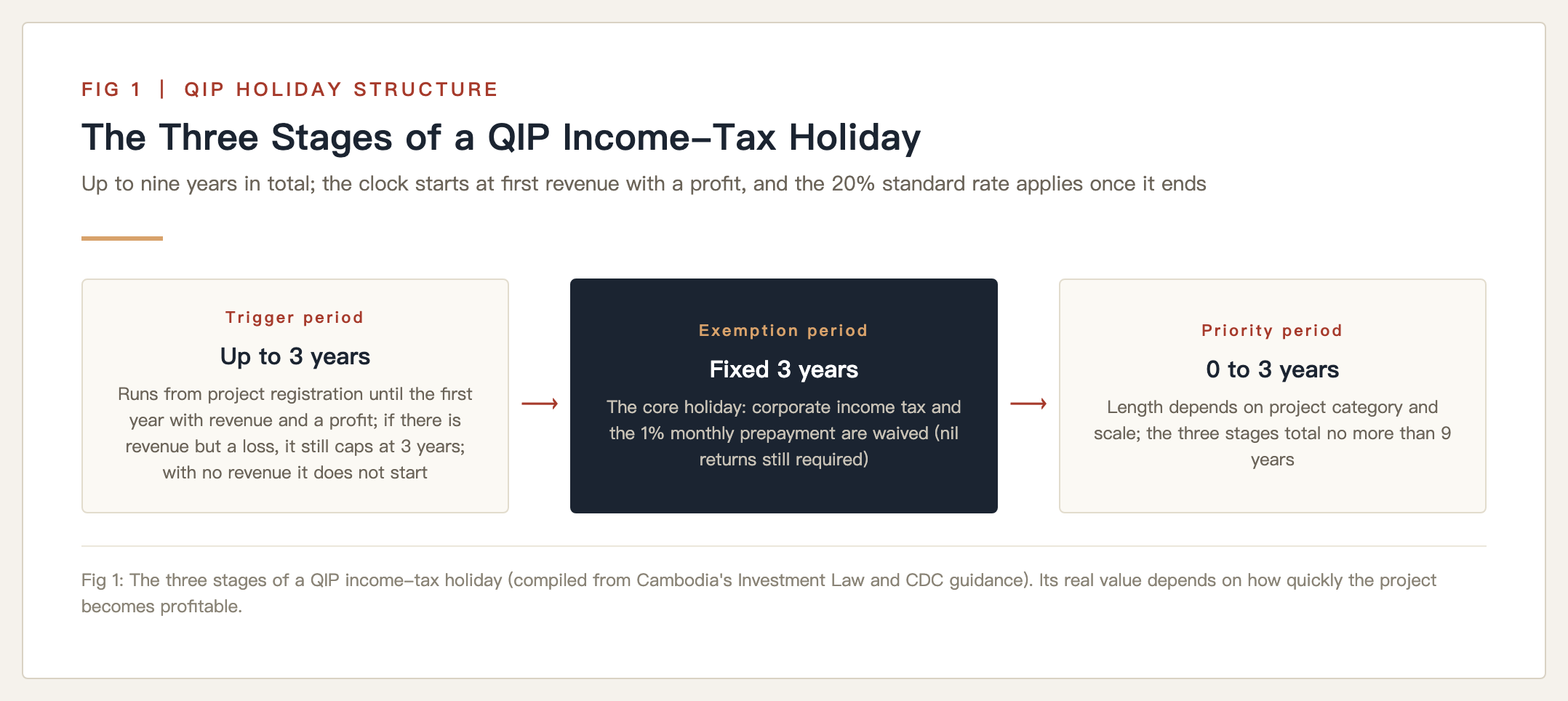
Fig 1: The three stages of a QIP income-tax holiday (compiled from Cambodia’s Investment Law and CDC guidance). Its real value depends on how quickly the project becomes profitable.
The rules run as follows. The trigger period starts at project registration and lasts up to three years, ending in the first year the project earns revenue and turns a profit; if there is revenue but a loss, it still caps at three years; with no revenue at all it does not begin. Next comes a fixed three-year exemption period, the core of the holiday. Last is the priority period, running from zero to three years depending on project category and scale. The three stages total no more than nine years, after which the 20% standard rate applies.
For financial planning the implication is direct: the value of the holiday depends on when the company starts making money. A long build-out and slow ramp burn part of the trigger period; reaching profitable production sooner puts the exemption years where profits are concentrated. That is a large part of why many companies lease a standard factory to start production quickly rather than spending years building (on the trade-off, see renting versus building a factory).
4. What a QIP Exempts: Two Basic Incentives and Import Relief
The basic QIP incentive is a choice between the tax holiday and special depreciation — not both. Import tax relief sits alongside it and is often underestimated.
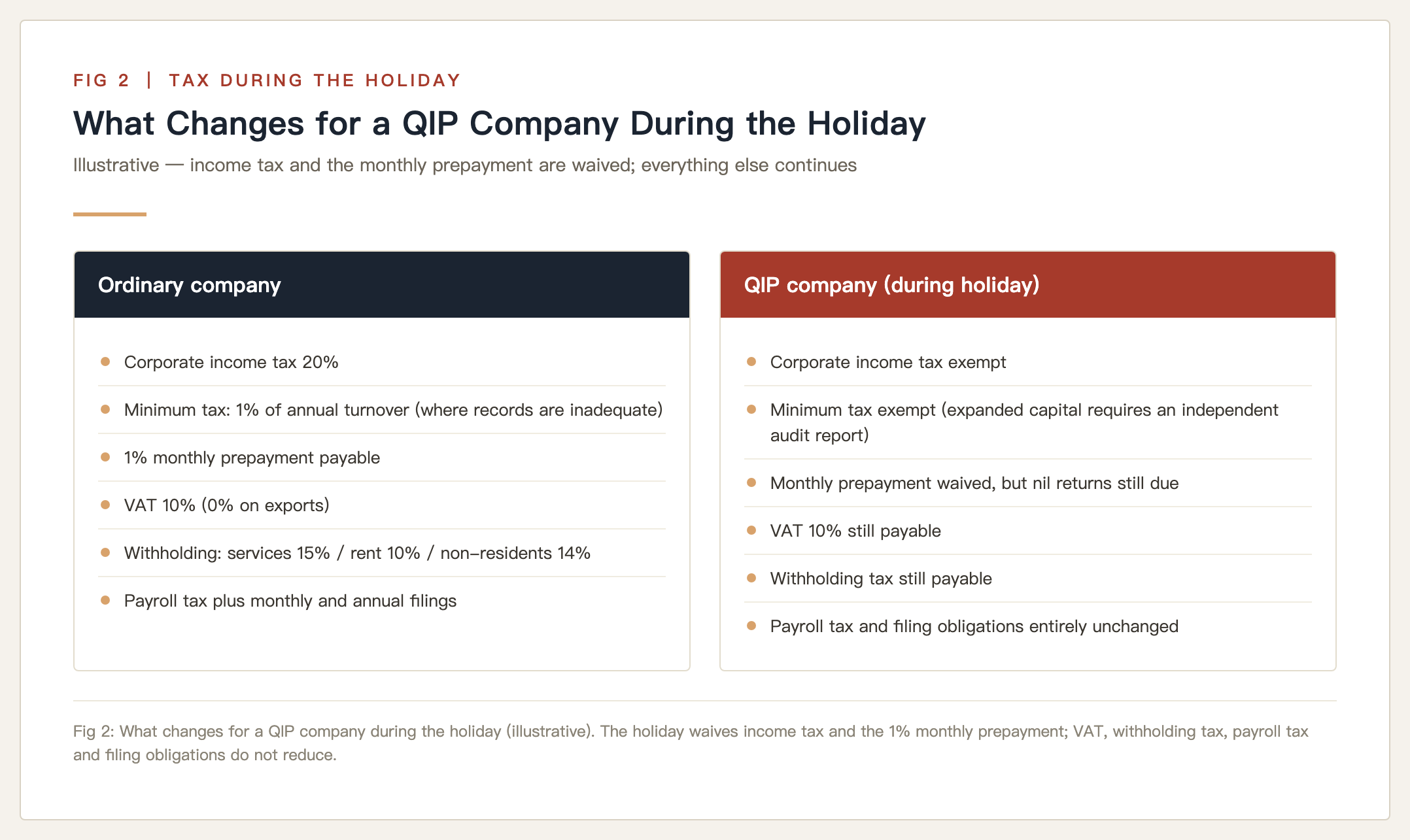
Fig 2: What changes for a QIP company during the holiday (illustrative). The holiday waives income tax and the 1% monthly prepayment; VAT, withholding and payroll tax and filing obligations do not reduce.
On the choice: a company can take the income-tax holiday described above, or elect special depreciation — accelerated depreciation on productive assets that reduces taxable income in the early years. The holiday suits projects expected to become profitable quickly with concentrated profits; special depreciation suits capital-heavy projects that prefer to spread relief over time. This calls for modelling against your own financial structure rather than assuming the holiday is always better.
Import tax relief covers construction materials, production equipment and production inputs, which can be exempt from customs duty, special tax and VAT, with the relief on production inputs applying to export-oriented production. For manufacturers the cash-flow benefit during construction and ramp-up often rivals the income-tax holiday, since equipment and materials imports are concentrated in the early period. Note that these exemptions require a list submitted to and approved by the CDC in advance — they are not automatic — and after the holiday ends, production materials can continue to receive duty relief subject to annual CDC approval.
One provision is regularly overlooked: where an existing QIP adds investment and expands capacity, Prakas No. 313 allows the expanded capital to receive income tax, prepayment and minimum-tax relief, calculated on the ratio of expanded capital to total capital before and after. Minimum-tax relief requires an independent audit report, and the incentive is withdrawn if the funds are not applied to construction materials and new equipment as planned.
5. What Differs for a QIP Inside a Special Economic Zone
Inside a zone, the substance of QIP tax incentives is broadly the same as outside; the difference lies in the application route and execution speed.
Under Cambodia’s Investment Law, projects outside a zone register with the Council for the Development of Cambodia (CDC) or a Provincial-Municipal Investment Sub-committee (PMIS) to obtain a final registration certificate. Projects inside a special economic zone can normally be handled through the zone administration’s one-stop window, with customs, tax and labour matters coordinated within the park (see also the QIP online application process and our complete guide to Cambodian special economic zones). For most manufacturers the real difference is not how much tax is exempt but how quickly approvals arrive and how smoothly clearance and annual list reviews run — and that administrative efficiency shows up directly in construction schedules and cash flow.
6. Cambodia, Vietnam and Thailand: All at 20%, Differing in Incentives
An easily missed fact: Cambodia, Vietnam and Thailand all levy corporate income tax at a 20% standard rate. What separates them is the structure and conditions of their incentives.
| Item | Cambodia | Vietnam | Thailand |
| Standard rate | 20% | 20% | 20% |
| Main incentive tool | QIP: a holiday of up to 9 years, or special depreciation — one or the other | Preferential rates by sector and region, such as 10% for 15 years or 17% for 10 years | BOI exemptions or reductions by activity category |
| SME rates | Small taxpayers 0–20% progressive | Micro 15%, small 17% (most foreign investors do not qualify) | Separate SME brackets |
| Recent change | Stable since the 2021 Investment Law and Sub-decree No. 111 | New CIT law (effective Oct 2025) removed industrial-zone income-tax incentives | BOI conditions under continuing revision |
| Import tax relief | Construction materials, equipment and export production inputs can be exempt (CDC approval required) | By project category | By BOI project category |
Vietnam’s change deserves the most attention. Under the new corporate income tax law (No. 67/2025/QH15), passed in June 2025 and effective that October, Vietnam removed income-tax incentives conditioned on location in an industrial zone, shifting to sector and specific-region criteria instead. The new 15% and 17% brackets apply to micro and small enterprises below VND 3 billion and VND 50 billion in annual revenue, which most foreign manufacturers do not meet. The old intuition that entering a Vietnamese industrial zone brings tax incentives no longer holds.
The other cross-border variable is the OECD Pillar Two global minimum tax. For multinational groups with consolidated revenue above EUR 750 million, an effective rate below 15% in one country can be topped up in another jurisdiction. For such groups a holiday may not save tax at all — it may simply move the liability elsewhere. Small and medium enterprises and non-group structures are unaffected. Before valuing a holiday, confirm whether Pillar Two applies to you.
7. Practical Point: Exempt From Tax Is Not Exempt From Filing
The commonest misreading of a holiday is that it means not having to deal with tax. Filing obligations do not reduce by a single day.
・Monthly filings continue: the 1% prepayment is waived during the holiday, but nil returns are still due monthly, and VAT, withholding tax and payroll tax must be filed and paid monthly.
・Books and audit are preconditions: minimum-tax relief depends on keeping proper accounting records, and minimum-tax relief on expanded capital expressly requires an independent audit report — weak bookkeeping can cost you the incentive.
・Import relief must be applied for in advance: exemption lists for equipment and materials require CDC review and approval, and must be reapplied for annually after the holiday — nothing rolls over automatically.
・Related-party transactions and transfer pricing: purchases, services and loans with a parent or affiliate must meet the arm’s-length principle with documentation ready; scrutiny has tightened in recent years.
・Watch the capital gains tax timetable: Cambodia has legislated a 20% capital gains tax framework, but implementation has been postponed repeatedly — rely on the latest announcement.
Get these right up front and the incentive holds. Get them wrong and a reassessment for filing or bookkeeping defects can swallow the savings: Cambodia penalises late filing at 10% to 25% of tax due, with monthly interest on late payment.
8. How MSEZ Helps With Tax Execution
Whether an incentive lands successfully usually depends less on the policy than on whether QIP registration, import-list review and monthly filings are completed on time — which is where MSEZ’s support sits.
Manhattan Special Economic Zone (MSEZ) sits at Bavet on the Cambodia–Vietnam border, covers about 600 hectares and has operated since 2005 — more than twenty years. The park’s administrative team works primarily in Chinese, supported by English and Khmer, and can help with QIP registration and annual import-exemption list filings, liaison with tax and customs windows, and certificates of origin and clearance work. For companies entering Cambodia for the first time without a local finance and tax team (on incorporation, see our guide to setting up a business in Cambodia), that support meaningfully shortens the early learning curve.
To be clear, the park provides administrative and process support; actual tax filing and planning should be carried out by your own accountant or tax adviser. If you are evaluating the tax structure of a Cambodian investment, you are welcome to review the overall case for investing in Cambodia or contact the park team to discuss QIP eligibility and the application process for your project category and investment scale.
9. Frequently Asked Questions
Q1: What is Cambodia’s corporate income tax rate?
| The standard rate is 20% for medium and large taxpayers, while small taxpayers face a 0% to 20% progressive scale. Oil, gas and certain mining are taxed at 30%, and insurance at 5% of gross premiums. Companies with QIP status are exempt from income tax during the holiday period. |
Q2: How is the nine-year QIP holiday calculated?
| It has three stages: a trigger period (from registration, up to 3 years, ending at the first year with revenue and a profit), an exemption period (a fixed 3 years) and a priority period (0 to 3 years, by project category). The maximum total is nine years, after which the 20% rate applies. The real value therefore depends on how quickly the project becomes profitable. |
Q3: What still has to be paid and filed during the holiday?
| The holiday waives corporate income tax and the 1% monthly prepayment. VAT, withholding tax and employee payroll tax remain payable, and although the prepayment is waived, nil returns must still be filed monthly. Exempt from tax is not exempt from filing — monthly and annual obligations are entirely unchanged. |
Q4: What is the minimum tax, and is it payable at a loss?
| The minimum tax is a separate tax standing alongside income tax, levied at 1% of annual turnover excluding VAT. It becomes payable whenever it exceeds 20% income tax, regardless of profit or loss. Under the 2017 Law on Financial Management it does not apply to companies keeping proper accounting records, but the law does not define what “proper” means — which is why complete books and an audit matter. |
Q5: Are Cambodia’s or Vietnam’s tax incentives more favourable?
| Both have a 20% standard rate; the difference is structural. Cambodia offers a QIP holiday of up to nine years or special depreciation (one or the other) plus import tax relief on construction materials and equipment. Vietnam grants preferential rates such as 10% and 17% by sector and region, but its new law effective October 2025 removed industrial-zone income-tax incentives. Groups with global revenue above EUR 750 million must also weigh the OECD global minimum tax. Model it case by case against your sector, scale and group structure. |
10. References
📚 References
- PwC Worldwide Tax Summaries — Cambodia corporate income tax: 20% standard rate for medium and large taxpayers, 0–20% progressive for small taxpayers, 30% for oil, gas and certain mining, 5% of gross premiums for insurance; the minimum tax is a separate 1% of annual turnover (excluding VAT) and does not apply to taxpayers keeping proper accounting records under the 2017 Law on Financial Management.
https://taxsummaries.pwc.com/cambodia/corporate/taxes-on-corporate-income - PwC Worldwide Tax Summaries — Cambodia tax administration: the monthly prepayment is 1% of monthly turnover (inclusive of taxes, excluding VAT), creditable against annual income tax and minimum tax; it is waived during a tax holiday but nil returns are still required; monthly taxes are due by the 20th of the following month.
https://taxsummaries.pwc.com/cambodia/corporate/tax-administration - PwC Worldwide Tax Summaries — Cambodia withholding tax: residents pay 15% on services, 15% on royalties, 10% on rent and 15% on interest (excluding payments to Cambodian-registered banks and financial institutions); payments to non-residents are 14%.
https://taxsummaries.pwc.com/cambodia/corporate/withholding-taxes - Acclime Cambodia — Practical guidance on Cambodian corporate income tax and minimum tax, the QIP holiday and prepayment exemption; VAT at 10% with a registration threshold of KHR 125 million in annual turnover.
https://cambodia.acclime.com/guides/corporate-income-tax/ - Council for the Development of Cambodia (CDC) — QIP incentives and eligible sectors: income-tax holidays by investment activity category, with customs duty, special tax and VAT exemptions on construction materials, production equipment and production inputs.
https://cdc.gov.kh/incentives-and-schemes/ - Cambodia Investment Promotion — The three stages of a QIP holiday: trigger period up to 3 years, exemption period of 3 years and priority period of 0–3 years, for a maximum of 9 years; the 20% rate applies afterwards, while production materials can continue to receive duty relief subject to annual CDC approval.
https://www.cambodiasez.com/351page.html - Prakas No. 313 MEF.PrK.PD — Incentives for expanded capital in an existing QIP: the exemption is calculated on the ratio of expanded capital to total capital, minimum-tax relief requires an independent audit report, and incentives are withdrawn if funds are not applied as planned.
- PwC Worldwide Tax Summaries — Vietnam corporate income tax: 20% standard rate; the new CIT Law (No. 67/2025/QH15, effective 1 October 2025) adds 15% and 17% brackets for micro and small enterprises; preferential rates of 10% (15 years) and 17% (10 years) apply by sector.
https://taxsummaries.pwc.com/vietnam/corporate/taxes-on-corporate-income - EY — Key points of Vietnam’s new CIT Law: 15% for micro enterprises with turnover under VND 3 billion and 17% for small enterprises between VND 3 billion and VND 50 billion; the new law removes income-tax incentives based on location in an industrial zone; Vietnam has applied the OECD Pillar Two global minimum tax since 2024 for groups with consolidated revenue above EUR 750 million.
https://www.ey.com/en_gl/technical/tax-alerts/vietnam-passes-new-corporate-income-tax-law - PwC Worldwide Tax Summaries — Thailand corporate income tax at a 20% standard rate, with BOI exemptions or reductions by activity category.
https://taxsummaries.pwc.com/thailand/corporate/taxes-on-corporate-income
Rates, incentive conditions and filing rules here were verified in July 2026 with sources noted. Cambodia’s tax system continues to change (ministerial income-tax regulations, GDT standard operating procedures and repeated postponement of capital gains tax among them), and Vietnam has applied a new corporate income tax law since October 2025. This is general information: your applicable rates, QIP eligibility, incentive duration and filing obligations depend on documents issued by the Council for the Development of Cambodia (CDC), the latest General Department of Taxation rules and professional tax advice. This article is industry information and does not constitute investment, tax or legal advice.