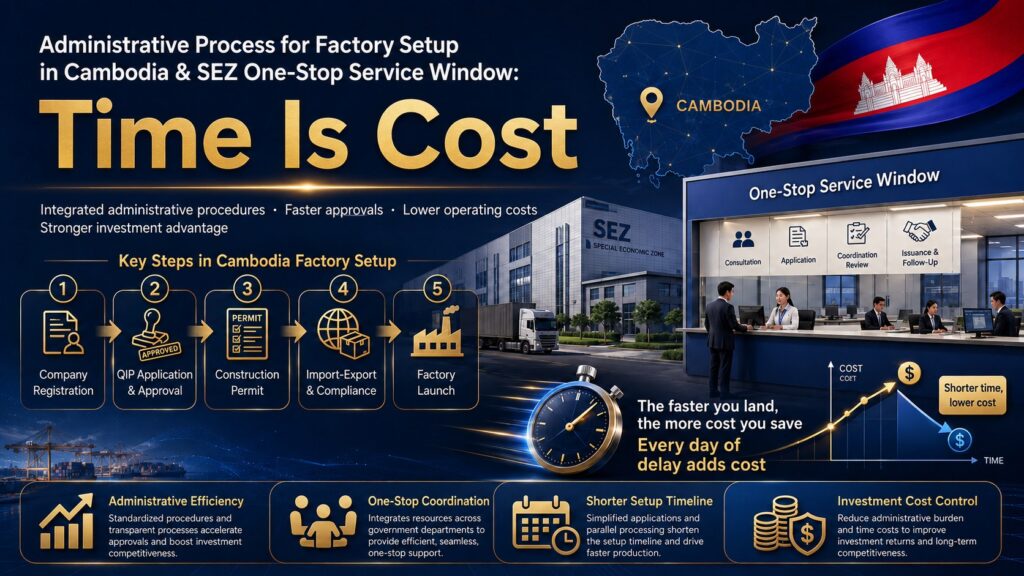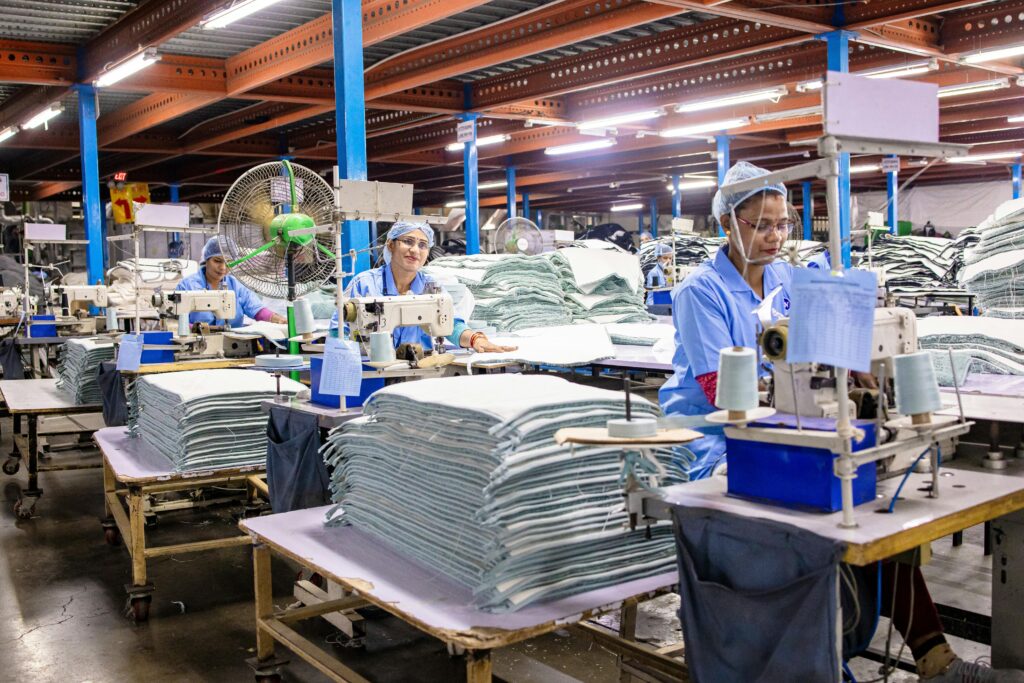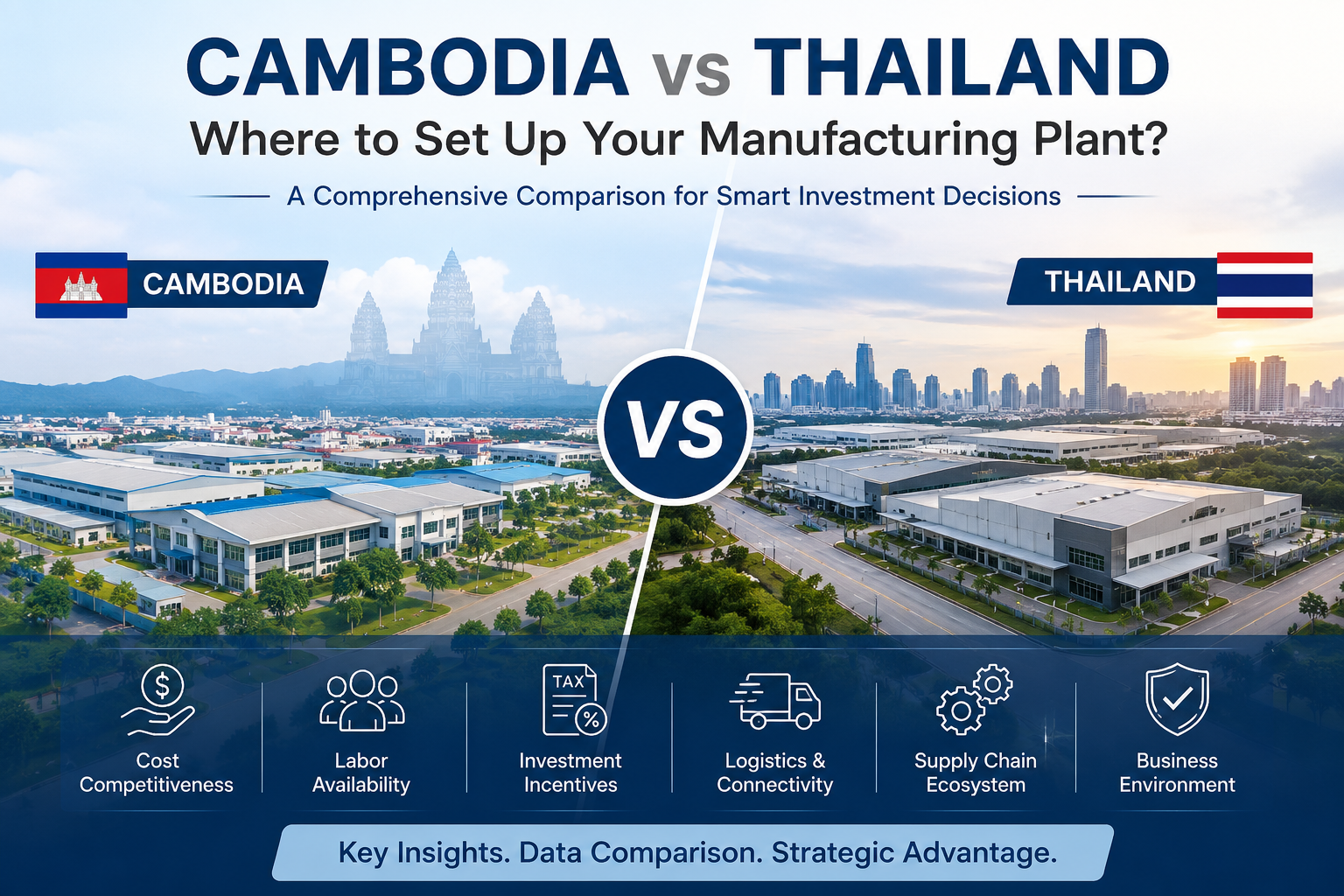
Summary:
Cambodia vs Thailand manufacturing is not a choice between a lower and a higher tier — the two are distinct supply-chain organization modes that can each stand alone or be combined. Thailand’s value lies in multi-industry local integration, engineering services and market networks; the Cambodian border park represented by MSEZ offers a mature regional-coordination platform through long operation, park infrastructure, Chinese-language administration and clearance, southern-Vietnam restocking and an export-manufacturing cluster.
Companies should start from target market, order structure, BOM, process interfaces, organizational capability and capital arrangement to compare a Cambodia single node, a Thailand single node and a dual node. This article unifies the cost basis, breaks down QIP/BOI, logistics, plant and risk, and points the conclusion toward an MSEZ setup-cost model — so national impressions do not replace project data.
Cambodia vs Thailand manufacturing: choose a supply-chain architecture, not a national ranking
Cambodia vs Thailand manufacturing is, at heart, a choice between different supply-chain organization modes — it cannot be summarized as “low tier” versus “high tier.”
Thailand has local suppliers across many industries, engineering services and a market network, suited to concentrating sourcing, production, technical collaboration and sales in one country. The Cambodian border park represented by MSEZ, through more than twenty years of operating experience, park infrastructure, Chinese-language administration and clearance, southern-Vietnam restocking and an export-manufacturing cluster, forms a mature cross-border coordination platform. A company should first clarify market, orders, materials, process interfaces and organizational capability, then decide on Thai local integration, Cambodian regional coordination, or a division of labor between two nodes; this is not a choice of capability tier but of operating architecture.
Decision conclusion: use one consistent basis to compare target market, cost per conforming unit, material and process interfaces, organizational capability and capital arrangement, then choose a Cambodia single node, a Thailand single node or a dual node. MSEZ and Thai industrial parks represent different organization modes, not a ranking of manufacturing capability.
Cambodia and Thailand factory cost: compare on cost per conforming unit
Cost differences between the two come from a mix of wages, social security, efficiency, supply chain, plant and management — looking at the minimum wage alone magnifies wrong conclusions.
As an example from current data, Cambodia’s GFT-sector 2026 minimum wage is about US$210/month; Thailand’s minimum wage is graded by province, ranging from 337 to 400 baht per day. Social-security systems, wage ceilings and covered groups differ and cannot be converted at one ratio. These figures are only inputs; a company must still remodel by role structure, shifts, overtime, yield, training, turnover and actual local wages.
In Cambodia, whether the cost advantage is realized depends on the training system, line-leader and middle-management setup, cross-border restocking and management replication; in Thailand, higher wages may come together with local supply responsiveness, engineering repair, automation upkeep and market proximity. Both can take on complex projects, and both can lose the cost edge if the organization mode does not fit. The comparison basis should be unified as “landed cost per conforming unit,” including wages, social security, management, yield, rework, line stoppage, equipment upkeep, logistics, inventory, compliance and capital hold.
Cost formula: cost per conforming unit = direct labor + social security + training and management + yield/rework + equipment upkeep + logistics and inventory + compliance + capital hold. Both sides must be compared under the same volume, quality and delivery assumptions.
| Cost dimension | Cambodia / MSEZ observation | Thailand observation |
| Base wage | By sector minimum wage, role market rate, shifts and overtime | By provincial minimum wage, role market rate, shifts and overtime |
| Social-security burden | By NSSF schemes, wage base and actual staffing structure | By social-insurance rate, wage ceiling and role structure |
| Efficiency factors | Validate training, management pipeline, yield ramp and cross-border restocking | Validate engineering services, supplier efficiency and local-market coordination |
| Cost conclusion | Fits projects that link park production into a stable regional chain | Fits projects needing concentrated market, supply and tech collaboration in Thailand |
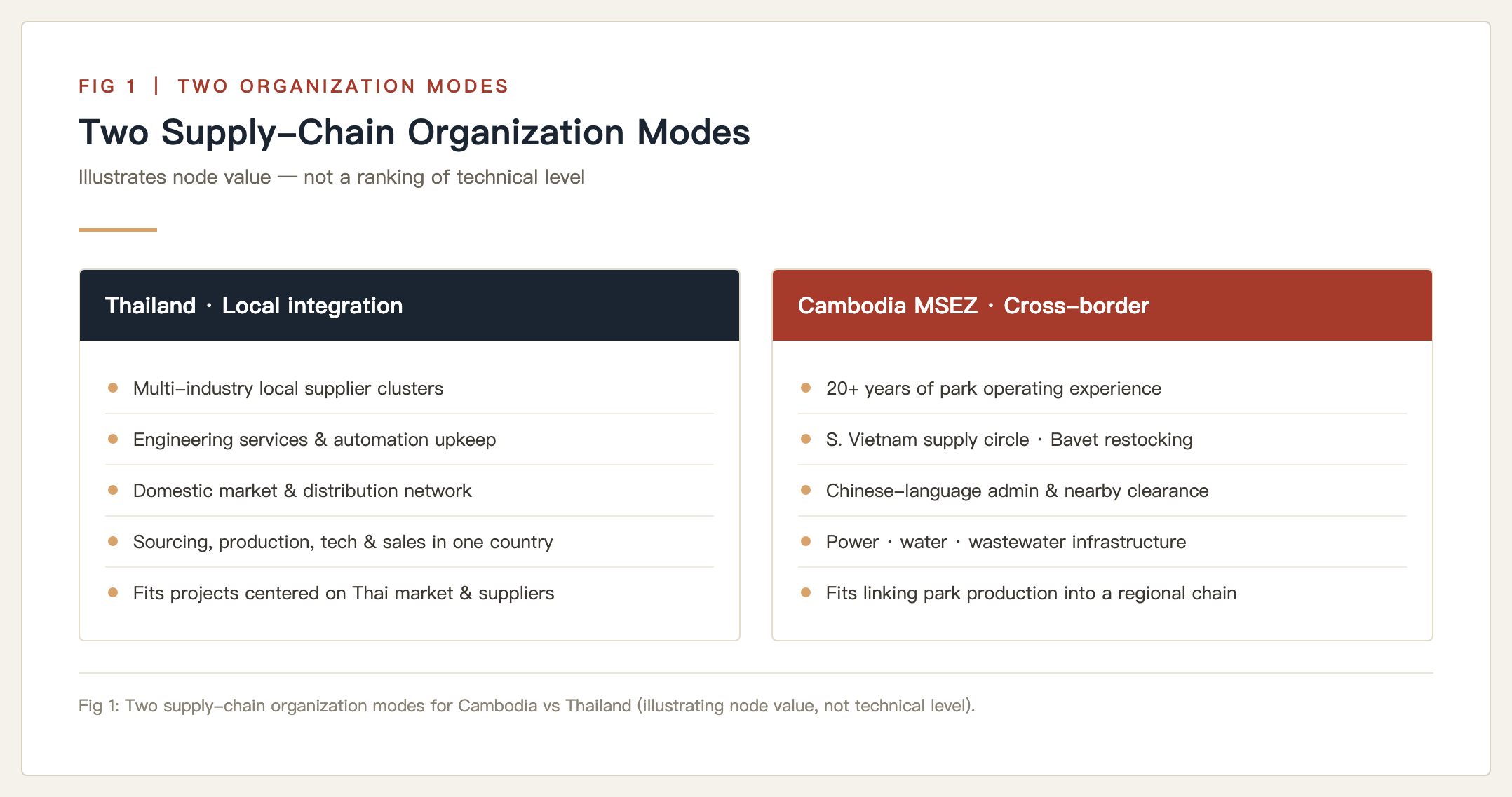
Fig 1: Two supply-chain organization modes for Cambodia vs Thailand (illustrating node value, not technical level).
Cambodia–Thailand manufacturing: Thai local integration vs MSEZ cross-border coordination
Supply-chain maturity depends not only on the number of local suppliers, but on whether material, information and liability interfaces are manageable.
Thailand’s edge is a fairly complete domestic network of multi-industry clusters, engineering services and local market; MSEZ’s maturity shows in park execution and regional connection: manufacturers can bring in materials, components, molds and equipment from southern Vietnam, China or Thailand and complete production, inspection, packing and export delivery at Bavet. Both systems run stably; the difference is that the former relies more on local integration while the latter emphasizes cross-border timing, inventory design and park coordination.
When evaluating, split the BOM into key materials that need instant response, general materials that can be restocked weekly across the border, and consumables that can be stocked monthly, and record supply location, lead time, substitutes, clearance, inventory and quality liability for each. If these interfaces can be clearly defined, the Cambodian node can carry a complete product or key processes; if orders face the Thai market and suppliers need high-frequency on-site collaboration, Thai local integration is more effective. The conclusion should come from material and order flow, not from an industry label.
| Operating segment | Role MSEZ / Cambodia can carry | Role Thailand can carry |
| Garment, luggage, footwear | Production, inspection, packing and delivery for Cambodia and export orders | Production, supply coordination and market service for Thai and regional orders |
| Packaging, lighting, outdoor goods | Near-field production, version management, reorders, inventory and export delivery | Regional material sourcing, product development, local market and supplier collaboration |
| Automotive, precision electronics | Configure a full line or specific product capacity under an established supply/quality system | Use the auto-electronics cluster, engineering services and local orders to organize capacity |
| Food, beverage and chemical packaging | Build a dedicated line when cleanroom, testing, environment and orders are in place | Use food, chemical, material and testing networks to serve local and regional markets |
Cambodia QIP vs Thailand BOI: comparing incentive eligibility
Both QIP and BOI can lower the investment burden of qualifying projects, but the content depends on the specific activity, scale, equipment, material use and continuing compliance.
Cambodia’s QIP can offer 3, 6 or 9 years of income-tax holiday by activity category, plus import-duty relief for qualifying construction materials, production equipment and production inputs. Thailand’s BOI manages by activity classification and conditions; different categories may obtain corporate income tax, import duty on machinery and export-use raw materials, and land or foreign-expert incentives. Neither applies automatically to every manufacturing project — before applying you must check activity codes, minimum investment, process, environment, machinery and reporting obligations.
What a company should compare is the realizable net value of incentives: expected tax and import savings minus the cost of application, accounting, list management, project changes, reporting and compliance upkeep. If the project uses regional restocking and produces in Cambodia, check whether QIP covers the planned equipment and inputs; if the project combines local market, R&D, automation or supply-chain upgrading in Thailand, model it by BOI activity and conditions. For the Cambodian side, corporate income tax and tax incentives should be re-checked against the latest rates and eligibility. The tax-holiday period is only one outcome and should not replace a business-model judgment.
| Dimension | Cambodia QIP | Thailand BOI |
| Corporate income tax | Standard 20%; QIP offers 3/6/9-year holiday by category | Standard 20%; BOI projects enjoy exemption or reduction by activity category |
| Import duties | Equipment, building materials and production inputs may be exempt on conditions | Machinery and export-use raw materials may enjoy import-duty relief by project |
| Policy focus | Export manufacturing, supply-chain support, SEZs and qualified investment activities | Supports varied investment goals by activity category, region and added conditions |
| Suitable companies | Eligibility depends on activity, investment scale, input list and continuing compliance | Eligibility depends on activity code, capital, machinery, process, environment and reporting |
Southeast Asia site selection: configure logistics and plant by market and material flow
The best mix of logistics and plant depends on whether market direction, restocking route, clearance interface and scale-up method are consistent.
Thailand’s Eastern Economic Corridor, the Bangkok area and its port system suit projects needing the Thai market, local suppliers, engineering collaboration or regional distribution. Bavet connects Cambodian manufacturing, the southern-Vietnam supply circle and the Ho Chi Minh City port group, suited to designing cross-border restocking, park production and export delivery into one continuous route. For plant, Thailand can use mature industrial parks and service networks; a Cambodian SEZ can use standard plant, custom plant or long-term land lease and self-build. Both support long-term investment and both can rent first and expand later; the key is whether lease term, alteration, fire safety, environment, utilities, exit and scale-up conditions match the project’s pace.
So comparing “how far from the port” is not enough. A company should map four routes — material inbound, production flow, order acceptance and finished-goods outbound — marking the responsible party, time, documents and safety stock at each step. If materials come from southern Vietnam, production is at Bavet, and orders face regional or export markets, MSEZ’s border location may create clear efficiency; if sales, suppliers and engineering services are all concentrated in Thailand, the Thai node’s domestic integration has the edge.
Cambodia–Thailand single vs dual node: choose the architecture by organizational capability
Site selection should start from the company’s value chain and management boundary, not from pinning a national label on an industry.
A Cambodia single node suits projects whose orders, materials and export routes can be organized around a regional chain and where the company is willing to build engineering, quality, training and supplier-management capability in the park; a Thailand single node suits projects whose main market, key suppliers and technical collaboration are concentrated in Thailand. A dual node suits cases where market and supply are spread across countries but the company can unify planning, quality, inventory and data management. All three can support anything from standardized production to demanding manufacturing — the difference is where capability sits and who owns the interfaces.
The same industry can adopt different architectures. A lighting project can build a full line of driver import, assembly, testing, packing and delivery at MSEZ, or integrate local suppliers and market in Thailand; a packaging project can serve park and Cambodia–Vietnam border orders in Cambodia, or serve food, chemical or local consumer markets in Thailand. Rather than “which product belongs to which country,” define the products, processes, customer interface, materials and quality liability each node owns.
| Configuration | Applicable conditions | Key checks |
| Cambodia single node | Orders and export routes can be organized around a regional chain; the company will build local management | Cross-border materials, talent, quality, park services and scale-up conditions |
| Thailand single node | Main market, key suppliers, engineering collaboration and service demand concentrated in Thailand | Local cost, supplier commitment, market size, BOI conditions and competition intensity |
| Cambodia–Thailand dual | Market and supply span countries; the company can unify planning, quality, inventory and data | Node division, transfer pricing, origin, in-transit inventory and exception handling |
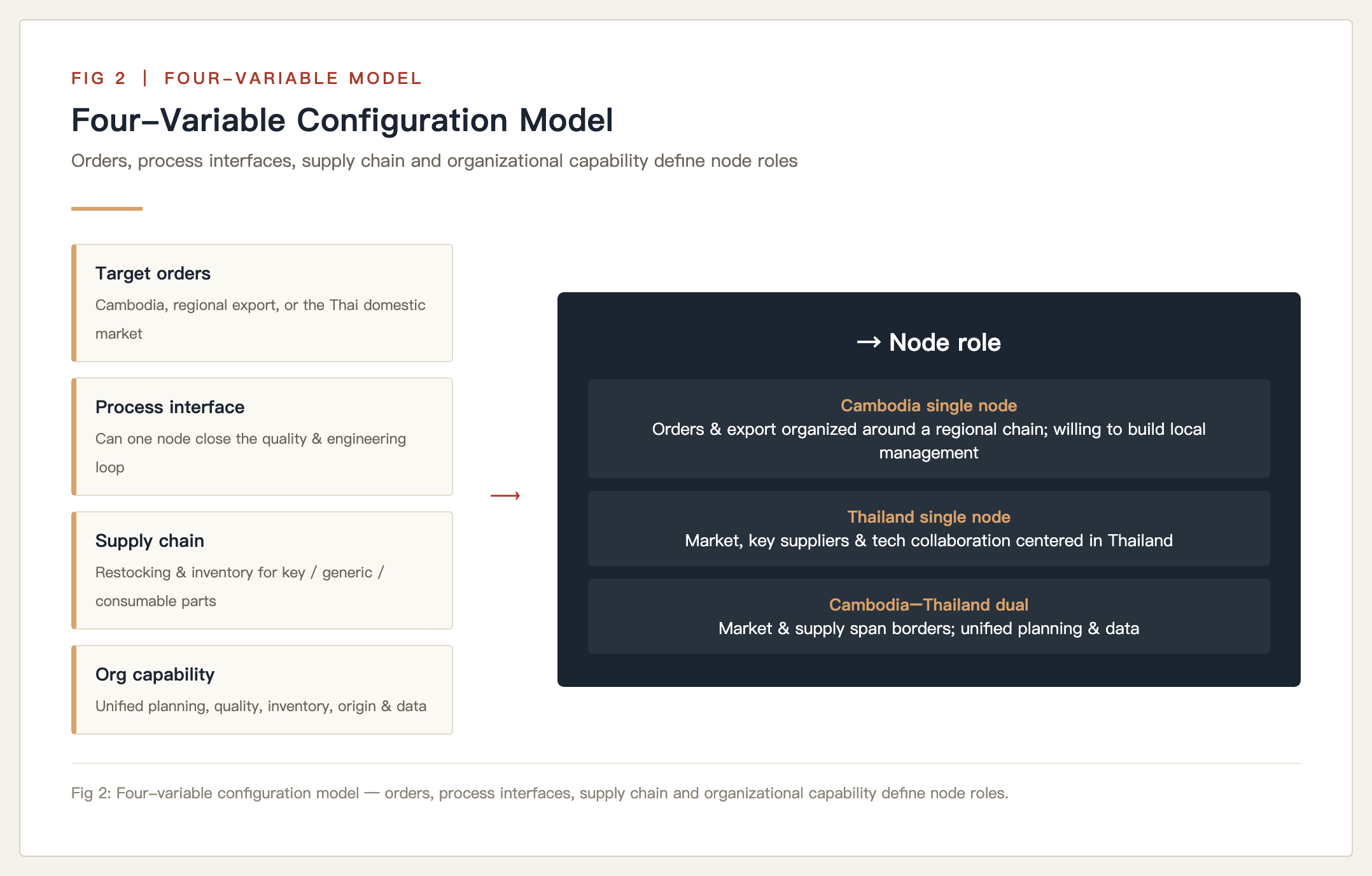
Fig 2: Four-variable configuration model — orders, process interfaces, supply chain and organizational capability define node roles.
Cambodia and Thailand factory risk: validate key assumptions with one checklist
Risk shows differently in the two, but both can be reduced through project design, contracts, process and continuous management.
A Cambodia project should focus on training and the management pipeline, cross-border restocking, clearance, environmental permits, labor and document management; a Thailand project should focus on labor and engineering cost, industry competition, supplier bargaining, local regulation and market assumptions. Governance and reputation indicators are only national-level signals and cannot replace project-level due diligence on the park, lease entity, clearance route, suppliers, agents, labor and customer audits. All key commitments should be written into contracts, service standards, owners and exit mechanisms.
Trade policy is a shared external variable for both. A company should not build returns on a single tariff or origin assumption, but test tariffs, origin, transshipment scrutiny, exchange rate and demand swings for each main market, and keep alternative suppliers, ports, inventory and capacity-switching plans. The goal of site selection is not to bet that a policy stays unchanged, but to raise the adjustability of orders and supply chain.
| Risk category | Cambodia / MSEZ focus | Thailand focus | Response action |
| People | Training system, management pipeline, role market rate and staff stability | Skilled-role cost, talent competition, engineering team and staff structure | Fold efficiency, yield and management cost into unit cost |
| Supply chain | Cross-border restocking, clearance, inventory and regional-supplier liability | Local-supplier dependence, price, capacity and alternative sources | Split the BOM into key / general / consumable parts |
| Compliance | QIP, labor, environment, clearance, lease and reputation diligence | BOI, labor, environment, park, contracts and local regulation | Complete permits and the customer audit list before building |
| Trade | Origin, transshipment scrutiny, tariff swings | Also affected by US and regional trade policy | Avoid basing the investment case on a single tax rate |
Evaluating the Cambodian SEZ: complete a project-level cost model with MSEZ
When a company needs to connect Cambodian production, southern-Vietnam restocking, Chinese-language execution and export delivery, MSEZ can enter formal evaluation as a mature manufacturing platform.
MSEZ sits at Bavet on the Cambodia–Vietnam border, has operated for over twenty years since 2005, spans about 600 hectares and is about 90 km by road from Cat Lai Port in Ho Chi Minh City. The park already hosts many export manufacturers and supporting demand, with power, water, wastewater treatment, administration and clearance services. Its value is not moving the whole supply chain into the park, but using the park as an execution hub to organize cross-border materials, production resources, documents and delivery. A company still needs project-level verification of target plant, utilities/environment, logistics, labor, clearance and orders.
The next step is to use an MSEZ setup-cost model, turning the comparison tables into a financial and operating model: input target market, order SKUs, monthly volume, processes, material sources, staffing, equipment, plant, utilities/environment, logistics and inventory, QIP/BOI assumptions and start-up time, and compute the cost per conforming unit, cash need and break-even point for a Cambodia single node, a Thailand single node and a dual node. The results screen options, then are re-checked against park quotes, supplier quotes and professional advice.
| Evaluation question | Cambodia / MSEZ observation | Thailand observation |
| Order status | Whether orders face Cambodia, the border or regional export and need park execution | Whether orders face the Thai market or rely on Thai local supply and service |
| Process structure | Whether processes can close a full quality and engineering loop in the park | Whether processes need high-frequency collaboration with local suppliers and engineers |
| Supply chain | Whether materials can be restocked weekly/monthly across the border with substitutes and safety stock | Whether local sourcing of key materials beats cross-border on price, capacity and response |
| Management need | Whether Chinese-language administration, clearance, park coordination and cross-border planning are needed | Whether a Thai local sales, technical, sourcing and supplier team is needed |
Investment note: wages, social security, QIP/BOI, logistics, tariffs and park quotes all change. Before a formal decision, input the same set of order, volume, quality and delivery assumptions into a project-level model and re-check against the latest data from authorities, the park, suppliers and professional advisers.
Cambodia vs Thailand manufacturing FAQ: five site-selection questions
Q1: How should total cost be compared between Cambodia and Thailand?
| Unify assumptions first, then compare cost per conforming unit. Beyond wages and social security, include training and management, yield, rework, equipment upkeep, logistics and inventory, compliance, plant and capital hold. Which is lower depends on the specific role, volume, material flow and organization mode — not the minimum wage alone. |
Q2: Thailand’s industrial system is more complete — does that mean the project must land in Thailand?
| Not necessarily. Thailand’s industry network can lower local-supply and engineering-collaboration cost; MSEZ’s long operation, park services and cross-border connection also form a mature manufacturing platform. A project should compare target market, material and process interfaces, team capability and total cost — not substitute national-level completeness for plant-level verification. |
Q3: How should QIP and BOI be built into an ROI model?
| Confirm eligibility first, then compute realizable net value. QIP and BOI income-tax, equipment or material import incentives all carry activity, investment, list and continuing-compliance conditions; subtract application, accounting, reporting and change costs from expected savings, and run a sensitivity analysis for non-approval or delay. |
Q4: When is a Cambodia–Thailand dual node appropriate?
| When market, suppliers or capacity need to span countries and the company can unify planning, quality, inventory, origin, transfer pricing and exception handling. The division need not be fixed as “technology in Thailand, processing in Cambodia” — it can also be by product line, market, customer group or risk backup. |
Q5: When should MSEZ be put into formal evaluation?
| When a project needs to connect Cambodian or regional orders, southern-Vietnam restocking, Bavet clearance, park plant and Chinese-language execution. The next step is an MSEZ setup-cost model comparing the cost, cash need and break-even of a Cambodia single node, a Thailand single node and a dual node. |
Cambodia vs Thailand: references and data sources
- Council for the Development of Cambodia (CDC) | Open investment climate: equal treatment for foreign and local investors, generally no local-equity requirement, and few restrictions on currency exchange and profit repatriation; under the single-window principle, non-negative-list projects can obtain a registration certificate by process.
https://cdc.gov.kh/why-cambodia/conducive-investor-climate/ - Council for the Development of Cambodia (CDC) | QIP incentives: income-tax holidays of 3/6/9 years by activity category; import of construction materials, production equipment and production inputs may enjoy customs-duty, special-tax and VAT exemption.
https://cdc.gov.kh/incentives-and-schemes/ - Council for the Development of Cambodia (CDC) | Cambodia SEZs: as of H1 2024, about 26 operating SEZs, 745 investment projects, around US$8.9bn invested and over 180,000 employees.
https://cdc.gov.kh/sez-smart-search/ - Thailand Board of Investment (BOI) | A Guide to Investment: promotion conditions, minimum capital, value-added rate, machinery requirements, corporate income-tax exemption, import duty, land and foreign-expert incentives.
https://www.boi.go.th/upload/content/BOI_A_Guide_EN.pdf - DLA Piper / wage.is | Thailand minimum wage: after phased adjustments on 1 Jan and 1 Jul 2025 continuing into 2026, 337–400 baht/day (Bangkok, Phuket, Chonburi etc. at 400 baht; average about 374 baht); employer social insurance 5% with a monthly cap (about 750–875 baht), and the 2026 social-security wage ceiling rising to 17,500 baht.
https://www.expatica.com/th/work/law/thailand-minimum-wage-2172841/ - PwC Worldwide Tax Summaries | Cambodia corporate income tax standard rate 20%, NSSF employer contributions; Thailand corporate income tax standard rate 20%, social insurance 5% each for employer and employee (with a monthly cap).
https://taxsummaries.pwc.com/cambodia/corporate/taxes-on-corporate-income - World Bank | Cambodia and Thailand country overviews: Cambodia’s manufacturing exports are a key support for the formal sector amid rising external trade-policy uncertainty; Thailand is a modern, industrialized, export-oriented economy whose long-term slowdown, aging population and structural transition are its main challenges.
https://www.worldbank.org/en/country/cambodia/overview - Transparency International | Corruption Perceptions Index (CPI) 2024: Cambodia 21, Thailand 34 (used to identify national-level governance and administrative-friction signals, not a substitute for project-level diligence).
https://www.transparency.org/en/cpi/2024 - US Supreme Court | Learning Resources, Inc. v. Trump (20 Feb 2026): IEEPA does not authorize the President to impose tariffs unilaterally; US tariff policy remains highly uncertain.
https://www.supremecourt.gov/opinions/25pdf/24-1287_4gcj.pdf - Washington Post (7 May 2026) | The US Court of International Trade ruled the provisional 10% Section 122 global tariff unlawful; the government’s appeal and Section 301/232 tools may still affect Southeast Asian export layout.
https://www.washingtonpost.com/business/2026/05/07/tariffs-trade-court-ruling-trump/