Summary: Cambodia imported US$5.428 billion of fabric in 2025, 87.8% of it from China. Garment capacity is already in Cambodia, but dyeing and finishing has not followed, not for lack of orders but because of the environmental threshold of wet processing. Under Prakas 3591, issued by Cambodia’s Ministry of Environment in May 2025, weaving and dyeing factories of any size must submit an Initial Environmental Impact Assessment (IEIA), reviewed within 60 working days, while pure garment sewing needs only an Environmental Protection Agreement (EPA).
Wastewater is the core cost driver. Under the Sub-Decree on Water Pollution Control as amended in 2021, COD (chemical oxygen demand, a measure of organic pollution in wastewater) is limited to 60 or 120 mg/L for direct discharge to water bodies and 300 mg/L for connection to a central wastewater treatment plant’s sewer network. BOD5 (five-day biochemical oxygen demand) discharge limits are 30, 60 and 200 mg/L, while untreated textile wet-processing wastewater typically carries BOD of 700 to 2,000 mg/L. A plant producing 5 tonnes of knitted cotton fabric a day discharges roughly 300 to 675 cubic meters of wastewater daily. On that basis, this article explains EIA classes, discharge standards, wastewater estimates, brand testing requirements and compliance cost items for Cambodia dyeing and finishing plants.
1. Cambodia’s Garment Exports Grew 16.5%: Why Is Nearly 90% of Its Fabric Still Imported from China, and Where Is Dyeing Stuck?
Cambodia imported US$5.428 billion of fabric in 2025, up 5.87% year on year, of which US$4.765 billion, or 87.8%, came from China. Garment capacity is already in Cambodia while dyeing and finishing remains outside the country, held back by the environmental threshold and infrastructure needs of wet processing.
Consider a common scenario. A knitted-fabric dyeing and finishing plant’s main customer has moved its garment capacity to Cambodia and wants fabric supplied nearby to shorten sampling and reorder lead times. The company finds that buildings, equipment and workers are not the problem. What it must answer first is a different set of questions: which EIA class applies, where the daily wastewater goes, what standard it must be treated to, and how much to budget for this compliance work.
Import data show the size of the gap. According to trade data compiled by Fibre2Fashion in February 2026, Cambodia’s fabric imports rose 5.87% in 2025 and yarn imports rose 24.89% to US$572 million; in the same year garment exports grew 16.5% to US$11.4 billion. Finished-goods exports and fabric and yarn imports grew together, so reliance on upstream supply has not fallen.
This article complements Apparel Supply Chain Restructuring, which discusses why the garment industry needs local fabric and how origin rules will change demand after Cambodia graduates from least developed country status in 2029. This article covers only the supply side: the environmental and compliance thresholds a dyeing and finishing plant must clear to set up in Cambodia. Weaving is outside its scope.
2. Which EIA Class Applies to a Dyeing and Finishing Project in Cambodia? Prakas 3591 Classes and Review Periods
Under Prakas 3591, issued by Cambodia’s Ministry of Environment on 6 May 2025 and in force from 6 June, weaving and dyeing factories of any size must submit an Initial Environmental Impact Assessment (IEIA), with a 60-working-day review; the same annex lists pure garment sewing as requiring only an Environmental Protection Agreement (EPA).
Prakas 3591 replaced Prakas No. 021 of 2020 and divides development projects into three classes by environmental and social impact: projects with minor impact sign an Environmental Protection Agreement and submit an environmental management plan, reviewed in 30 working days; projects with moderate impact submit an Initial Environmental Impact Assessment report, reviewed in 60 working days; and projects with severe impact submit a Full Environmental Impact Assessment (FEIA) report, reviewed in 90 working days. A project’s class is determined by the project types and size thresholds listed item by item in the annex.
| Annex item | Project type (translated from the Khmer original) | EIA class | Size threshold |
| Item 21 | Chemical factories | FEIA | Any size |
| Item 66 | Weaving and dyeing factories | IEIA | Any size |
| Item 67 | Sewing, washing and printing factories | IEIA | Any size |
| Item 157 | Garment sewing factories | EPA | Any size |
Table 1: EIA classes for textile and dyeing projects in the Prakas 3591 annex (compiled from the annex issued by Cambodia’s Ministry of Environment on 6 May 2025).
The pattern is clear: within the textile industry, once a process involves wet operations such as dyeing, washing or printing, the EIA class rises from EPA to IEIA; if the project also produces chemicals such as dyes or auxiliaries, it may fall into the chemical factory category and require an FEIA. The EPA fast track described in the knowledge base article Cambodia’s Tiered EIA System applies to pure sewing garment factories; dyeing and finishing projects are not on that track.
For scheduling, the 60 working days of an IEIA start when the Ministry of Environment receives the report; preparing the report, field surveys and public consultation take additional time. If a project combines several processes, the final class is determined by the Ministry of Environment, so it is best to confirm the classification with the reviewing authority at the evaluation stage.
3. What Are Cambodia’s Discharge Standards for Dyeing Wastewater? Direct Discharge Versus a Central Treatment Plant
Cambodia’s industrial effluent standards fall into three categories by discharge destination: the COD limit is 60 mg/L for discharge to enclosed waters, 120 mg/L for discharge to open, flowing waters and 300 mg/L for connection to a central wastewater treatment plant’s sewer network. The same dyeing plant must treat its wastewater to different levels depending on where it goes.
These standards come from Sub-Decree No. 27 on Water Pollution Control of 1999, whose annex was amended by Sub-Decree No. 103 on 29 June 2021, adding the category of connection to a central wastewater treatment plant’s sewer network. The limits for the main parameters are: pH 6 to 9, 5.5 to 9 and 5 to 9 respectively; BOD5 30, 60 and 200 mg/L; color 50, 150 and 300 platinum-cobalt units; and suspended solids 50, 100 and 200 mg/L.
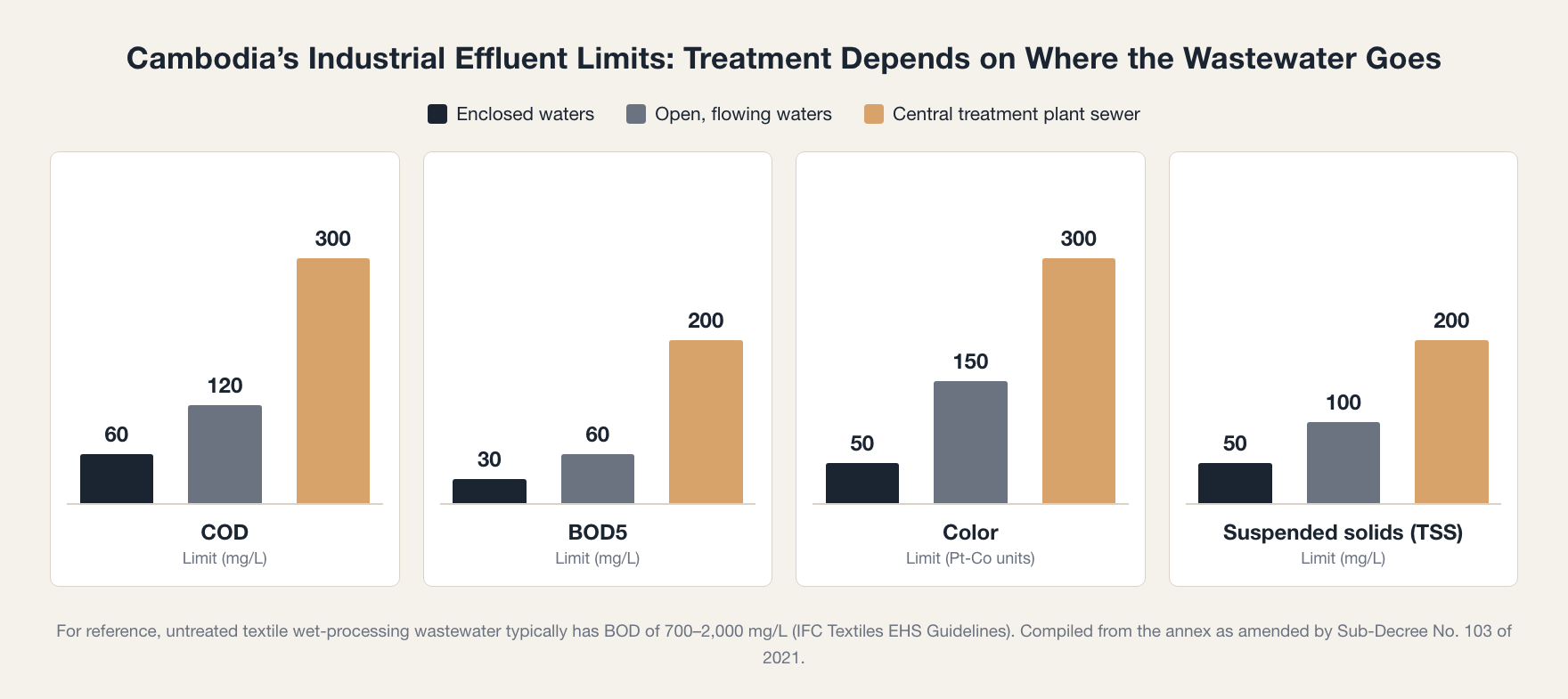
Figure 1: Cambodia’s effluent standards for the three industrial wastewater discharge destinations (compiled from the annex as amended by Sub-Decree No. 103 of 2021).
Set against the starting point of dyeing wastewater, the gap becomes concrete. According to the International Finance Corporation (IFC) Environmental, Health and Safety Guidelines for Textiles Manufacturing, textile wet-processing wastewater is usually alkaline, with BOD typically between 700 and 2,000 mg/L. Direct discharge to open waters requires cutting BOD by about 91% to 97%; connection to a central treatment plant requires a cut of only about 71% to 90%, with the rest done by the central plant. The difference lies not only in removal rates: direct discharge usually needs biological plus advanced treatment to meet the standard reliably, while pre-treatment for sewer connection can be simpler.
Note that a looser connection standard does not mean a company can skip treatment. A central plant has a fixed design load and influent standard; inadequate pre-treatment can be refused or charged extra, and parameters such as color and heavy metals each have their own connection limits. In addition, if customers or project lenders require compliance with the IFC guidelines, benchmarks for COD and other indicators are stricter, so evaluations should be based on actual customer requirements.
4. How Much Wastewater Does a Dyeing Plant Discharge Each Day? Estimating Volume and Sludge from Daily Output
A dyeing plant’s wastewater volume can be estimated as “daily output × wastewater per kilogram of fabric”. Based on industry benchmarks cited by the IFC, finishing knitted cotton fabric takes about 60 to 135 liters per kilogram, so a plant producing 5 tonnes of knitted cotton fabric a day discharges about 300 to 675 cubic meters of wastewater daily.
| Product and process | Wastewater per kg of product | Daily wastewater at 5 tonnes a day |
| Knitted cotton fabric finishing | 60–135 liters | 300–675 m³ |
| Knitted synthetic fabric finishing | 35–80 liters | 175–400 m³ |
| Woven cotton fabric finishing | 50–70 liters | 250–350 m³ |
| Woven synthetic fabric finishing | 100–180 liters | 500–900 m³ |
| Cotton yarn finishing | 100–120 liters | 500–600 m³ |
Table 2: Unit wastewater volumes for textile wet processing and conversions (compiled from the industry benchmarks in Table 4 of the IFC Textiles EHS Guidelines; conversions are this article’s calculations).
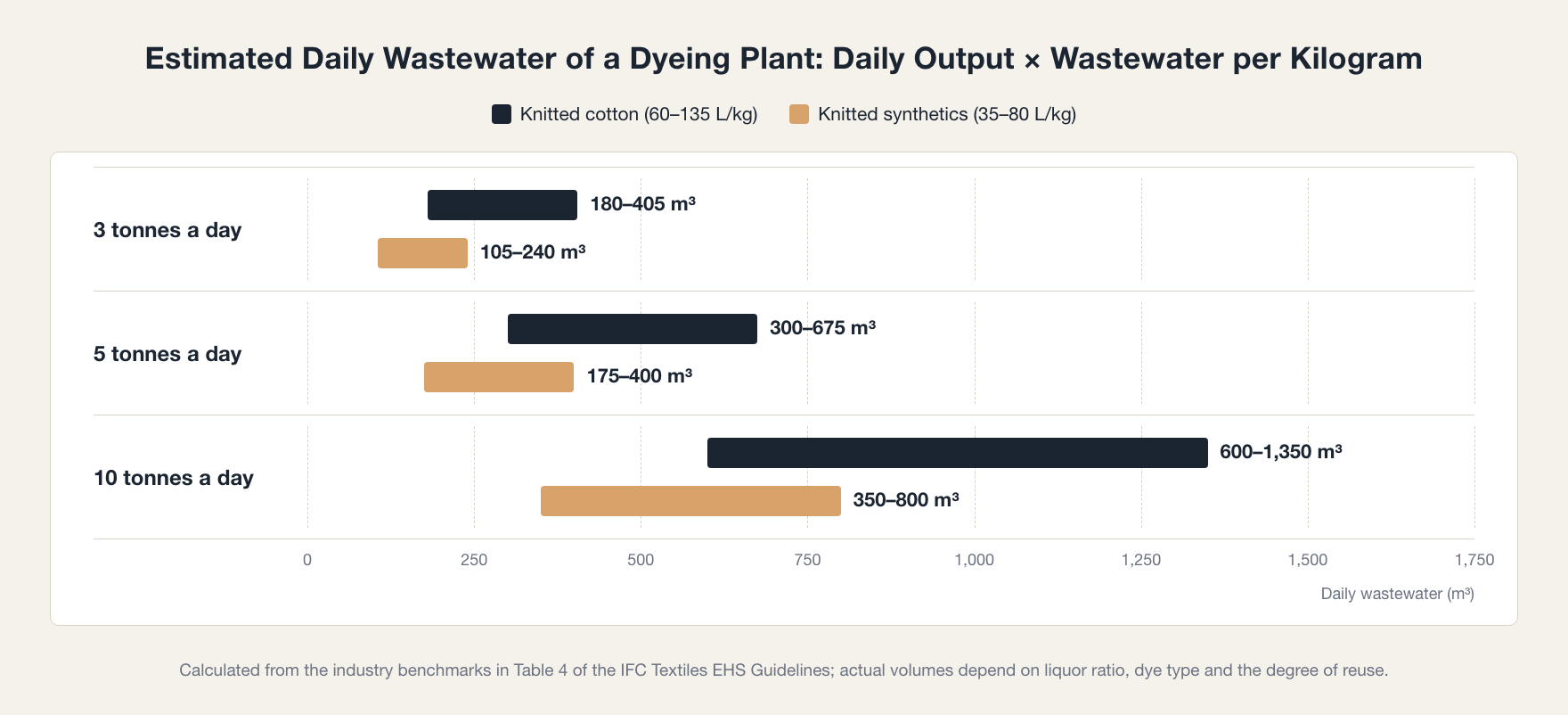
Figure 2: Estimated daily wastewater at different daily outputs (calculated from the IFC industry benchmark ranges).
Sludge is another frequently underestimated figure. The same guidelines put dewatered sludge at about 1 to 5 kilograms per cubic meter of wastewater treated; at 600 cubic meters a day, that is about 0.6 to 3 tonnes daily, and its storage, transport and disposal must be arranged separately.
These benchmarks come from EU industry surveys, and actual figures depend on liquor ratio, dye type and the degree of reuse: plants using low-liquor-ratio dyeing machines, dye-bath reuse or cold pad-batch processes can come in below the lower bound. The estimate is not meant for detailed design; its purpose at the site-selection stage is to confirm one thing first: whether the target location’s water supply and drainage can handle this order of magnitude.
5. What Else Do Brand Customers Check? ZDHC Wastewater Guidelines and Chemical Management
Even when Cambodia’s discharge standards are met, brand customers will usually also require suppliers to test against the wastewater guidelines of ZDHC (Zero Discharge of Hazardous Chemicals) and to check whether incoming chemicals comply with its Manufacturing Restricted Substances List (MRSL). Cambodian law decides whether a plant may discharge; brand requirements decide whether it can win orders.
In March 2022 ZDHC released version 2.0 of its Wastewater Guidelines, merging the previously separate textile and leather guidelines into one. Testing covers conventional parameters, heavy metals and substances listed in the MRSL, and adds conventional parameters such as E. coli, total dissolved solids and sulfate; sampling and testing methods are specified separately for direct discharge, indirect discharge (that is, connection to a central treatment plant) and zero liquid discharge.
6. Where Do the Compliance Costs of a Dyeing Project in Cambodia Fall?
The compliance costs of a dyeing project concentrate in a few items: wastewater treatment facilities, treatment operation, sludge disposal, testing and reporting, and EIA preparation. The biggest difference lies in the first item: direct discharge versus connection to a central treatment plant determines whether an advanced treatment stage must be built.
| Cost item | Direct discharge (full in-house treatment) | Connection to a central wastewater treatment plant |
| Wastewater treatment facilities | Must reach COD of 60 or 120 mg/L, usually requiring biological plus advanced treatment | Pre-treatment to COD of 300 mg/L |
| Treatment operation | Chemicals, power and operators all borne by the company | Pre-treatment stage borne by the company, plus a connection treatment fee |
| Sludge disposal | About 1–5 kg per cubic meter of wastewater | Depends on the level of pre-treatment; similar order of magnitude |
| Testing and reporting | Ministry of Environment monitoring plus ZDHC testing required by brands | Same; the discharge point is the sewer connection |
| EIA | IEIA (60-working-day review) | IEIA (60-working-day review) |
| Land | Space must be reserved for treatment facilities and an emergency basin | Less land needed for pre-treatment facilities |
Table 3: Compliance cost items for dyeing projects and differences between the two discharge routes (compiled from regulations and the IFC guidelines; excludes equipment quotations).
Heat is one of the biggest differences between dyeing and finishing and other textile processes. Dyeing and heat setting need large amounts of steam and hot air, so boiler fuel supply, storage and emissions, as well as backup power, should be budgeted together with wastewater. These items barely exist in a pure sewing garment factory, so a garment factory’s unit costs cannot be used to estimate a dyeing plant’s.
7. Should a Dyeing Plant Wait for a Dedicated Textile Park or Enter a Multi-Industry SEZ?
There are broadly two directions for siting a dyeing plant: wait for a dedicated park focused on dyeing to be built, or enter a multi-industry special economic zone that already has a central wastewater treatment plant and garment customers. The former has not started operating in Cambodia and its timeline is uncertain; the latter allows the EIA and construction process to begin immediately, and the key point to evaluate is the allocable connection volume.
Dedicated dyeing parks are still in planning. For example, the Cambodia Textile Industrial Park, which broke ground in Kampong Speu Province in November 2024, is positioned as a base for textile dyeing and leather plating; as of September 2026 no start of operations had been announced. If such parks are completed, wastewater and heat can be planned centrally, but when the central treatment plant will operate and what its connection standards and tariffs will be cannot yet be written into a company’s EIA report or investment budget.
The advantage of a multi-industry special economic zone is certainty: the central wastewater treatment plant is already licensed and operating, so the discharge destination can be written directly into the EIA documents; if dyeing companies in the zone already discharge into it, the plant’s capacity to handle dyeing wastewater has been tested in practice; and garment customers are nearby, so fabric can be delivered the same day, which is exactly why dyeing capacity follows garment orders into Cambodia. What needs confirming at the evaluation stage is the connection volume: the zone’s wastewater capacity is shared by its tenants, so a dyeing project should first confirm the connection volume and standards it can be allocated.
The two directions suit different companies. Dyeing capacity that serves nearby garment factories and needs to start production quickly to keep up with customer orders is better placed in a multi-industry SEZ with central treatment. Large integrated textile mills discharging several thousand cubic meters a day, or those whose brands require zero liquid discharge, need full in-house treatment and recycling systems whatever type of park they choose, and should weigh power supply, land and industrial infrastructure more heavily when selecting a site.
8. Where Should Dyeing Wastewater Go? Central Treatment and Existing Dyeing Tenants at Manhattan SEZ
For a dyeing plant, the most important condition an SEZ offers is not the factory building but whether wastewater can be connected, how much and to what standard. This determines whether the company builds pre-treatment or full treatment, and when it can start production.
A dyeing project’s EIA report and investment budget must state where wastewater goes and on what connection terms, so several concrete answers should be obtained before signing: whether the central wastewater treatment plant holds a license issued by the Ministry of Environment and has online monitoring; how many cubic meters a day of connection volume can be allocated to a new project; whether the influent standard is the statutory COD of 300 mg/L or something stricter; how the connection treatment fee is charged; and whether dyeing companies in the zone already discharge into the system.
Manhattan SEZ was the first special economic zone in Cambodia to obtain a wastewater license, and its treatment plant was the first wastewater treatment plant to receive national-level EIA certification, with a capacity of 5,000 cubic meters a day and 24/7 online monitoring. Dyeing and chemical companies already operate in the zone, and their process wastewater is treated centrally by dedicated treatment facilities. On energy, the zone has a dual-circuit high-voltage power supply with 80 MW of capacity. Once fabric leaves the plant, nearby garment companies are ready customers, and imported dyes and auxiliaries can come in through the Bavet border checkpoint about 6 km from the zone and the Ho Chi Minh City port area about 90 km away. The connection volume and standards available to a new project are confirmed case by case according to the company’s capacity, processes and discharge volume, and written into the lease and EIA documents.
Central treatment resolves the discharge destination, but the EIA itself must still be filed by the company with the Ministry of Environment under Prakas 3591 and pass review; whether pre-treatment is needed, and to what level, is confirmed against the connection standard and the company’s actual discharge. If your company is evaluating where to locate dyeing and finishing capacity, please use the Manhattan SEZ advisory team contact form to share your products and processes (knitted or woven, cotton or synthetic), expected daily output and wastewater volume, and steam and power needs. The zone will then explain the connection volume and standards it can allocate, land and power conditions, and what it can help coordinate during the EIA application.
9. Cambodia Dyeing and Finishing FAQ: EIA, Discharge Standards and Wastewater Treatment
Q1: Which EIA class applies to a dyeing plant in Cambodia?
| An Initial Environmental Impact Assessment (IEIA). Under Prakas 3591, in force since June 2025, weaving and dyeing factories of any size are classed as IEIA, and the Ministry of Environment reviews the report within 60 working days of receipt; if the plant also produces chemicals such as dyes or auxiliaries, it may fall into the chemical category, which requires a full environmental impact assessment. |
Q2: What are Cambodia’s discharge standards for dyeing wastewater?
| It depends on the destination. Under the Sub-Decree on Water Pollution Control as amended in 2021, the COD limit is 60 mg/L for enclosed waters, 120 mg/L for open waters and 300 mg/L for connection to a central wastewater treatment plant’s sewer network; the color limits are 50, 150 and 300 platinum-cobalt units respectively. |
Q3: Roughly how much wastewater does a dyeing plant discharge per day?
| Using IFC industry benchmarks, knitted cotton fabric takes about 60 to 135 liters per kilogram and knitted synthetics about 35 to 80 liters. A plant producing 5 tonnes of knitted cotton fabric a day discharges about 300 to 675 cubic meters daily; plants with low-liquor-ratio equipment or dye-bath reuse can be lower. |
Q4: Should dyeing wastewater be treated in-house to discharge standards or connected to a park treatment plant?
| It depends on the location. With connection to a central wastewater treatment plant, pre-treatment to a COD of 300 mg/L is enough, saving the investment and operating cost of an advanced treatment stage; but the park’s allocable connection volume and charging method must be confirmed first, and plants with very large discharge volumes may still need full in-house treatment. |
Q5: Does Cambodia have a dedicated textile dyeing park?
| There is a project in planning. The Cambodia Textile Industrial Park, supported by EPIAC, TAFTAC and CTAC, broke ground in Kampong Speu Province in November 2024, with more than 500 hectares planned as a base for textile dyeing and leather plating; as of September 2026 no start of operations had been announced. |
10. Sources and References
📚 References
- Fibre2Fashion (2026-02-09) | Cambodia’s fabric, yarn imports rise in 2025, heavily reliant on China: fabric imports of US$5.428 billion in 2025, up 5.87%; yarn imports of US$572 million, up 24.89%; China supplied US$4.765 billion or 87.80%, Taiwan 4% and Hong Kong 1.86%.
https://www.fibre2fashion.com/news/textile-news/cambodia-s-fabric-yarn-imports-rise-in-2025-heavily-reliant-on-china-308251-newsdetails.htm - Fibre2Fashion (2026-01-14) | Cambodia’s apparel exports grow 16.5% to $11.4 bn in 2025: Cambodia’s garment exports reached US$11.4 billion in 2025, up 16.5%.
https://www.fibre2fashion.com/news/apparel-news/cambodia-s-apparel-exports-grow-16-5-to-11-4-bn-in-2025-307712-newsdetails.htm - Cambodia Ministry of Environment (2025-05-06) | Prakas No. 3591 on the classification of development projects for environmental impact assessment: annex Item 21 chemical factories FEIA, Item 66 weaving and dyeing factories IEIA, Item 67 sewing, washing and printing factories IEIA, Item 157 garment sewing factories EPA, all regardless of size.
https://data.opendevelopmentcambodia.net/laws_record/prakas-no-3591-on-the-classification-of-development-projects-for-environmental-impact-assessm - Rajah & Tann Sok & Heng (2025-06) | Prakas on Classification of Development Projects for Environmental Impact Assessment: Prakas 3591 was issued on 6 May 2025, repealing Prakas No. 021 of 2020; review periods of 30 working days for EPA, 60 for IEIA and 90 for FEIA.
https://www.rajahtannasia.com/wp-content/uploads/2025/06/Client-Update-Prakas-No.-3591.0525-on-Development-Project-Classifications-for-Environmental-Impact-Assessment.pdf - Council for the Development of Cambodia, republished copy (1999-04-06) | Original text of Sub-Decree No. 27 on Water Pollution Control.
https://cdc.gov.kh/wp-content/uploads/2022/04/Sub-Degree-27-on-Water-Pollution-Control_990406.pdf - Enviliance ASIA (2021-07-08) | Cambodia amends Sub-Decree on Water Pollution Control: Sub-Decree No. 103 (2021-06-29) revised effluent standards into three categories, enclosed waters, open waters and connection to a central wastewater treatment plant; COD limits 60, 120 and 300 mg/L, BOD5 30, 60 and 200 mg/L, color 50, 150 and 300 platinum-cobalt units.
https://enviliance.com/regions/southeast-asia/kh/report_3360 - International Finance Corporation (IFC) (2007-04-30) | Environmental, Health and Safety Guidelines for Textiles Manufacturing: wet-processing wastewater BOD typically 700–2,000 mg/L; Table 4 unit wastewater benchmarks (knitted cotton fabric finishing 60–135 L/kg, etc.) and sludge of 1–5 kg per cubic meter.
https://www.ifc.org/content/dam/ifc/doc/2000/2007-textiles-manufacturing-ehs-guidelines-en.pdf - Ecotextile News (2022-03-01) | ZDHC releases Wastewater Guidelines Version 2.0: textile and leather guidelines merged; conventional parameters such as E. coli, total dissolved solids and sulfate added; sampling and testing specified for direct, indirect and zero liquid discharge.
https://www.ecotextile.com/2022030129021/dyes-chemicals-news/zdhc-releases-wastewater-guidelines-version-2-0.html - Environmental Protection Industry Association of Cambodia, EPIAC (2024-11-08) | Ground-breaking of the Cambodia Textile Industrial Park: located in Kampong Speu Province, planned as a production base of more than 500 hectares for textile dyeing and leather plating.
http://www.epiac.org/xxzx/xhdt/72.html - Manhattan SEZ Knowledge Base | Related articles: Apparel Supply Chain Restructuring; Cambodia’s Tiered EIA System; Cambodia’s 2029 LDC Graduation.