

Summary: Cambodia ODI filing is the step that most often stalls a Chinese company’s factory project in Cambodia, and the delay usually comes from the Chinese side rather than the Cambodian one. Cambodia has diplomatic relations with China, is not under UN sanctions, and manufacturing is not on the sensitive-industry list, so projects qualify for the lighter record-filing regime rather than approval. Three steps are required in China: an NDRC project record, a MOFCOM filing that issues the Enterprise Overseas Investment Certificate, and foreign-exchange registration at a bank, after which funds can be remitted legally. The whole process usually takes one to three months.
The State Council Provisions on Outbound Investment (State Council Order No. 837), in force from 1 July 2026, raise rules that were previously scattered across ministerial regulations to the level of an administrative regulation and set out penalties for failing to file or submitting false materials, up to a one-to-three-year ban on outbound investment.
1. The Factory Deal Is Done, So Why Can’t the Money Leave? ODI Filing Comes First
On a Cambodian factory timeline, the item most often underestimated is not construction or hiring but the outbound-investment filing in China. Once factory terms are agreed and an investment agreement is initialled, payments, company registration and lease commencement in Cambodia all have to wait if the money has no legal way out of China.
In practice this procedure is called ODI (Outbound Direct Investment) filing. China controls capital-account transactions, so a company investing its own funds to set up an overseas company or acquire assets must first obtain a record-filing or approval document from the competent authorities before a bank will process the cross-border remittance. Without these documents funds cannot leave through official channels, and the risk of non-compliant routes has risen markedly in the 2026 regulatory environment.
Earlier articles in this knowledge base covered the Cambodian side: tariffs and certificates of origin, land and factory pricing, setup procedures and annual compliance. This article covers the Chinese side: what an investor must complete at home between deciding to build and getting the money to Cambodia.
2. Record-Filing or Approval: Which Applies to a Factory in Cambodia?
Outbound investment is managed by either approval or record-filing. The test is whether the destination or the industry is sensitive; the amount invested does not decide it.
Under Article 13 of the NDRC Measures for the Administration of Enterprise Outbound Investment (NDRC Order No. 11 of 2017), approval applies to sensitive projects, meaning those involving sensitive countries and regions or sensitive industries. Sensitive countries and regions are those without diplomatic relations with China, those in war or civil unrest, those where investment must be restricted under treaties China has concluded or joined, and other sensitive locations. Sensitive industries are listed in the Catalogue of Sensitive Industries for Outbound Investment (2018 edition, NDRC Foreign Investment [2018] No. 251) as weapons development, production and maintenance; cross-border water resource development; news media; and industries where Chinese law and policy require outbound investment to be restricted.
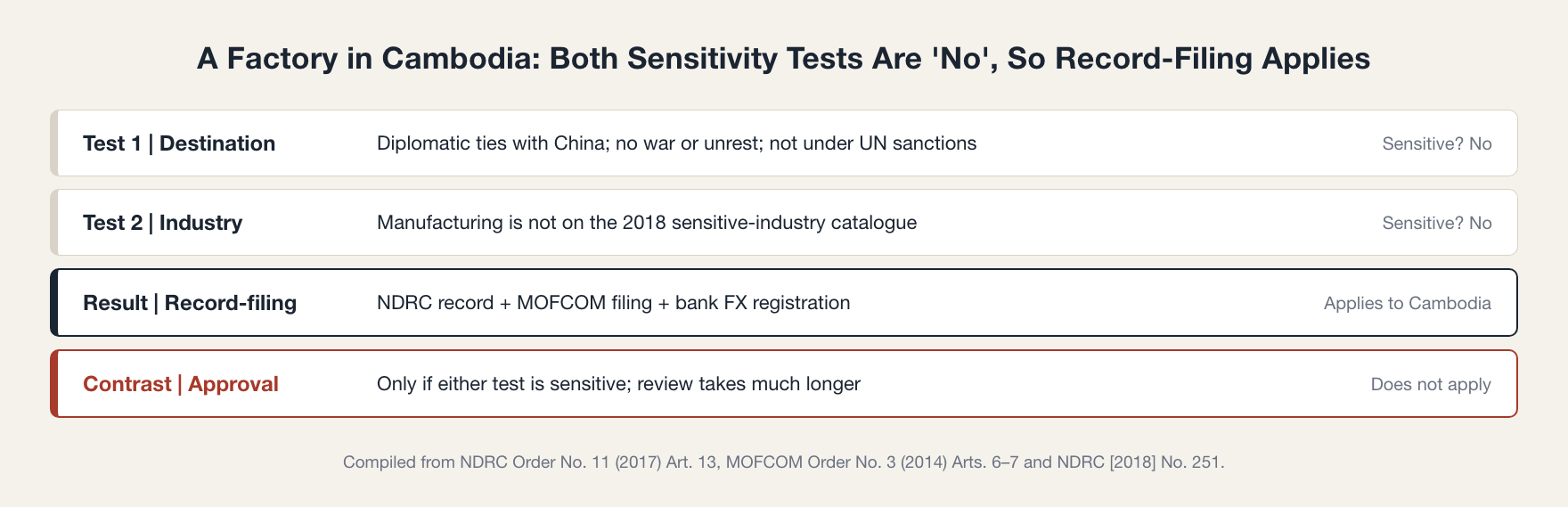
Figure 1: How record-filing and approval are determined (compiled from NDRC Order No. 11, Article 13, and NDRC [2018] No. 251).
Apply the two tests to a Cambodian factory. China and Cambodia established diplomatic relations in 1958 and they remain in place; Cambodia is not in war or civil unrest and is not under UN sanctions; and manufacturing is not on the sensitive-industry list. Both answers are no, so record-filing applies.
MOFCOM’s test differs slightly but reaches the same conclusion. Article 6 of the MOFCOM Measures for the Administration of Overseas Investment (MOFCOM Order No. 3 of 2014) applies approval to sensitive countries, regions and industries and record-filing to everything else. Article 7 defines approval countries as those without diplomatic relations with China and those under UN sanctions, and approval industries as those involving products and technologies China restricts from export or affecting the interests of more than one country or region. Cambodia falls into neither.
The practical significance is time. Record-filing has statutory limits counted in working days, while approval involves inter-agency consultation and substantive review and takes much longer. A company setting up garment, footwear, hardware or electronics assembly in Cambodia uses record-filing.
3. What Changed in July 2026? State Council Order No. 837
State Council Order No. 837, published on 5 May 2026, issued the Provisions on Outbound Investment, effective 1 July 2026, in 34 articles. It is the first unified regulation of outbound investment at the level of an administrative regulation; previously the rules sat in ministerial regulations.
For companies already preparing a filing, the Provisions do not change the procedure itself but the cost of breaking the rules. Article 27 sets out specific penalties. Investing in prohibited projects leads to an order to stop, disposal of shares and assets within a time limit and confiscation of illegal gains, with fines of 0.5% to 1% of the investment for refusal to comply and RMB 50,000–100,000 for the responsible managers. Failing to complete approval or filing, or submitting false materials, leads to confiscation of illegal gains and a fine of 0.1% to 0.5% of the investment, rising to 0.5% to 1% for refusal to correct, and RMB 20,000–50,000 for the responsible managers. Approval obtained by bribery or deception is revoked, with confiscation and fines. Once a penalty takes effect, the authorities may also refuse to accept the investor’s approval or filing applications for three years, or ban outbound investment for one to three years (Article 27, paragraph 4); Article 28 provides the same ban for refusing to cooperate with an outbound-investment security review.
Article 12 also confirms that investors must complete approval or filing, information reporting and cross-border fund registration as required by national rules; Article 15 establishes an outbound-investment security review; and Article 16 requires investors and their overseas companies to improve governance and establish compliance and internal-control systems. Together these provisions mean that filing is no longer a one-off document but a continuing compliance obligation.
Note that Order No. 837 is a framework regulation. Operational details such as the sensitive-industry list and filing thresholds still follow NDRC Order No. 11, MOFCOM Order No. 3 and the related catalogues, and the three ministries said in their press Q&A that supporting rules will be drafted and revised. In other words, the procedures in Sections 4 to 6 still apply as of September 2026, but penalties and compliance expectations have been raised.
4. NDRC Project Record: Which Office, the US$300 Million Threshold and Time Limits
The NDRC record covers the project itself. The filing authority depends on the type of company and the amount: centrally administered enterprises file with the NDRC; local enterprises file with the NDRC if the Chinese investment is US$300 million or more and with the provincial development and reform department if it is below US$300 million (Order No. 11, Article 14).
Almost all private manufacturers setting up in Cambodia invest less than US$300 million, so they file with the provincial development and reform department where the company is located, through the outbound-investment management and service online system. It is a common misconception that the filing must go to the national NDRC; it does not.
One obligation is easy to miss. Article 42 of Order No. 11 requires investors carrying out large non-sensitive projects through overseas companies they control to submit a report form before the project is implemented, where large means Chinese investment of US$300 million or more. In other words, even reinvestment through an existing overseas subsidiary that needs no filing still carries a reporting duty once the threshold is reached.
The application centers on the genuineness of the project: the investor’s business licence and audited accounts, basic information on the investment target, the amount and source of funds, the land or factory arrangement abroad, and the investment decision documents. The most common reason for return is the source of funds: own funds must match account balances, and borrowed funds need evidence of a lawful source.
5. MOFCOM Filing: The Overseas Investment Certificate and Its Two-Year Validity
The MOFCOM filing covers the investor and the overseas ownership structure. It produces the Enterprise Overseas Investment Certificate, which is required for foreign-exchange registration.
Under Article 9 of MOFCOM Order No. 3, central enterprises file with MOFCOM and local enterprises with the provincial commerce department, which records the filing and issues the Certificate within three working days of receiving the form. For approval cases, Article 12 gives MOFCOM 20 working days and the provincial authority 15 working days for preliminary review. A factory in Cambodia does not take this route, and the gap between the two time limits shows why the destination directly affects the timeline.
The Certificate has a limit that belongs on the project schedule. Under Article 16 of Order No. 3, it lapses automatically if the company has not invested abroad within two years of receiving it. Filing too early is therefore risky: a certificate obtained before the Cambodian land, factory and partnership terms are settled may lapse unused. The safer approach is to start once the key overseas terms are essentially locked and can be written into the application.
| Step | Authority and legal basis | Time limit | Output document |
| NDRC project record | Provincial development and reform department (Chinese investment below US$300 million) Basis: NDRC Order No. 11, Art. 14 | Statutory 7 working days (Order No. 11, Art. 31); about 7–15 working days in practice including supplements | Overseas investment project record notice |
| MOFCOM overseas investment filing | Provincial commerce department Basis: MOFCOM Order No. 3, Art. 9 | 3 working days after receiving the filing form | Enterprise Overseas Investment Certificate (lapses if unused within 2 years) |
| ODI foreign-exchange registration | Handling bank Basis: SAFE Circular Huifa [2015] No. 13 | About 3–5 working days in practice | Business registration certificate |
Table 1: The three steps in China for investing in Cambodia (statutory limits from the regulations; practical working days from public sources).
6. Foreign-Exchange Registration and Remittance: The Bank Step and Common Hold-ups
Since 2015, foreign-exchange registration no longer requires a visit to SAFE: under the Circular on Further Simplifying and Improving Foreign Exchange Administration Policies for Direct Investment (Huifa [2015] No. 13), banks handle ODI foreign-exchange registration directly.
The company takes the documents from the first two steps to its bank, obtains a business registration certificate, and can then buy and remit foreign currency. The bank reviews something different from the first two steps: they check whether the project and investor are compliant, while the bank checks whether the money flow is clear, including whether the remitted amount matches the filed amount, whether the payee is the filed overseas company, and whether the source of funds matches actual account balances. If any of the three does not match, the remittance is held.
The most common hold-ups are a filed amount set too tightly, so that additional investment requires a new filing; a receiving account whose name differs from the filed overseas company; and staged contributions that do not follow the filed schedule. These are gaps in documentation and execution rather than obstacles in the system, and can be avoided by leaving room in the amount and structure at the assessment stage.
One more change in the 2026 environment is worth noting. AllBright Law Offices’ June 2026 commentary on Order No. 837 notes that individual outbound investments made through SPVs (special purpose vehicles) or nominee arrangements will face compliance requirements and risk. This is consistent with Article 27’s penalties for failing to file or submitting false materials: preparing complete materials beforehand costs less than correcting them afterwards.
7. How Long Does ODI Take? Sequencing China Approvals with the Cambodian Project
There is a timing gap between the China steps and the Cambodian project. The filing requires concrete details of the overseas project, which exist only once the Cambodian side is agreed, while signing and paying in Cambodia must wait until funds can leave China. The key is to stagger the two sides rather than have each wait for the other.
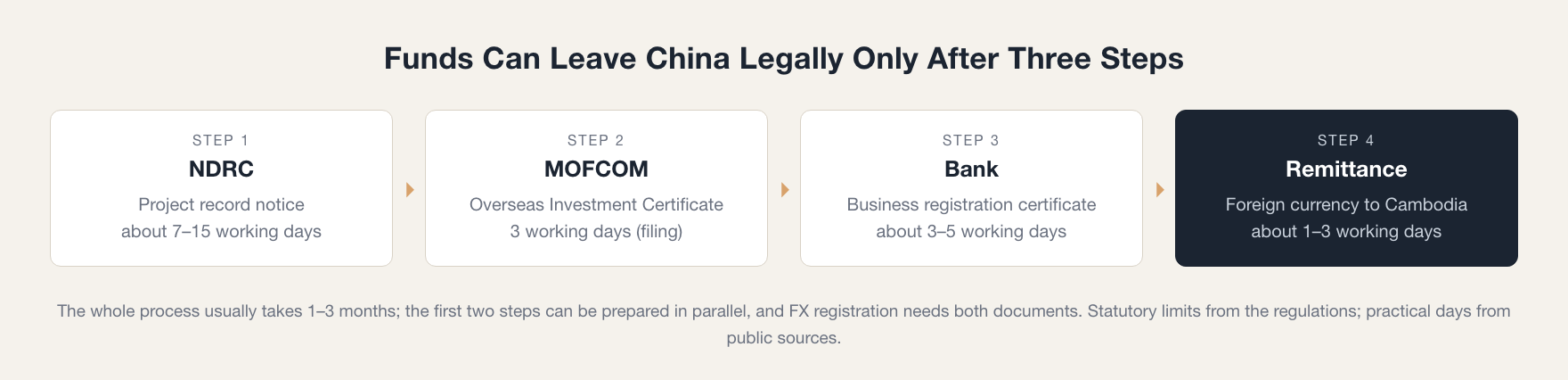
Figure 2: The order of the three steps in China, their output documents and practical processing time (compiled from regulations and public sources).
A workable sequence is to complete site selection and confirm terms in Cambodia first, settling the land or factory plan, investment amount and ownership structure to the point where they can go into the filing, but without signing contracts that create payment obligations; then start the NDRC and MOFCOM filings in parallel; register foreign exchange once both are in hand; and sign and pay once the funds are available.
Based on public sources, the whole process usually takes one to three months, and the length depends on how complete the materials are rather than on the agencies: every request for supplements pushes the schedule back. If the company has a multi-layer ownership structure in China, or the funds come from shareholder loans, allow a longer preparation period; these are the two areas where supplements are most often requested.
| Common reason for return or delay | Where it happens | What to prepare in advance |
| Source-of-funds explanation does not match account balances | NDRC, bank | Prepare account evidence of own funds; for shareholder loans, have the loan agreement and disbursement records ready |
| Overseas project details are vague (land, factory, amount) | NDRC | Obtain a formal quotation and terms confirmation from the zone or landlord and put quantified terms into the materials |
| Ownership structure differs from the actual funding route | MOFCOM, bank | Decide first between direct investment and an offshore intermediate holding, then file |
| Filed amount too tight, so extra investment needs a new filing | Throughout | Include equipment, working capital and phase-two expansion in the estimate at the assessment stage |
| Enterprise Overseas Investment Certificate unused after two years | MOFCOM | Start filing once overseas terms are essentially locked, to avoid obtaining the certificate too early |
Table 2: Common reasons for ODI filing returns and delays (compiled from public policy commentary and practice).
8. What Practical Support Can Manhattan SEZ (MSEZ) Provide for ODI Filing?
The filing asks for concrete terms of the overseas project, most of which must come from the zone. What Manhattan SEZ can provide are the data that make the China filing specific and consistent with what is actually executed later.
Both the NDRC and MOFCOM filings ask about the investment target and land arrangements. For a manufacturing project, providing specific figures and documents here reduces rounds of supplements. Manhattan SEZ is in Bavet, Svay Rieng, and offers standard factories as well as land for lease or sale, an 80 MW power capacity with dual-circuit high-voltage supply, and daily water supply and wastewater treatment capacity of 5,000 tonnes each. These are figures that can be given at the assessment stage and written into the lease and the filing.
Estimating the investment amount also requires the zone’s pricing structure. The rental basis, one-off charges, utility connection fees and escalation clauses determine how high the filed amount should be to leave room for adjustment; for how to read and compare these items, see Cambodia Factory Lease Terms: Pricing Structure, Basis and Contract Clauses. An accurate estimate avoids refiling when investment increases later.
Coordinating the project timeline also needs the zone’s cooperation. The zone has administration and customs contact points, so the order of company registration, Qualified Investment Project (QIP) application and factory handover can be confirmed while the China filing is under way, letting the two timelines run in parallel rather than one side waiting for the other.
The data to request from a zone include allocable power capacity and supply guarantees, water and discharge allowances, factory handover specifications and dates, land area and expansion room, a complete set of pricing fields, and the specific administration and customs arrangements, all of which are fields the filing will ask about; the full list of items to confirm at the assessment stage is in the Cambodia factory setup checklist.
To be clear, what Manhattan SEZ provides are concrete terms and documents that can go into the filing. Acceptance and review of the ODI filing remain with the Chinese authorities under the law, and the source-of-funds explanation and ownership structure must be confirmed by the company and its financial and legal advisers. If your company is preparing an outbound-investment filing, please contact the Manhattan SEZ advisory team with the planned production type and land area, power load and water use, the expected investment range and funding method, and target dates for signing and start-up. The zone will provide a terms confirmation and complete pricing fields that can be used in the filing, together with the expected schedule for factory handover and administrative coordination.
9. Cambodia ODI Filing FAQ: Filing vs Approval, Timing, Amounts and Rejections
Q1: Does investing in Cambodia require record-filing or approval?
| Record-filing. Approval applies only to sensitive countries and regions or sensitive industries. Cambodia has diplomatic relations with China, is not in war or civil unrest and is not under UN sanctions, and manufacturing is not on the 2018 Catalogue of Sensitive Industries for Outbound Investment, so neither test is triggered and record-filing applies. |
Q2: Does the NDRC record have to be filed in Beijing?
| It depends on the amount. Under Article 14 of NDRC Order No. 11, local enterprises file with the provincial development and reform department when Chinese investment is below US$300 million, and with the national NDRC at US$300 million or above; centrally administered enterprises always file with the NDRC. Most private manufacturers’ Cambodian projects fall into the first group and can be filed in their home province. |
Q3: How long is the Enterprise Overseas Investment Certificate valid?
| Two years. Under Article 16 of MOFCOM Order No. 3, the Certificate lapses automatically if the company has not invested abroad within two years of receiving it, so the filing should be timed to the overseas project rather than made before terms are settled. |
Q4: Do I need to visit SAFE for foreign-exchange registration?
| No. Under Huifa [2015] No. 13, ODI foreign-exchange registration is handled by banks. The company takes the NDRC and MOFCOM documents to its bank, obtains a business registration certificate and then buys and remits currency. The bank checks that the amount, payee and source of funds match the filing. |
Q5: Does State Council Order No. 837, effective July 2026, affect companies that have already filed?
| Yes, through continuing obligations and penalties. The Provisions took effect on 1 July 2026 with 34 articles. Article 16 requires investors and their overseas companies to set up compliance and internal-control systems, and Article 27 provides for confiscation of illegal gains and fines proportional to the investment for failing to file or submitting false materials, with serious cases barred from outbound investment for one to three years. Completing the filing does not end compliance. |
10. Sources and References
📚 References
- Chinese Government | Provisions of the State Council on Outbound Investment (State Council Order No. 837): published 5 May 2026, effective 1 July 2026, 34 articles; Art. 12 filing and cross-border fund registration, Art. 15 security review, Art. 16 compliance and internal control, Arts. 27–29 legal liability.
https://www.mee.gov.cn/zcwj/gwywj/202606/t20260602_1157822.shtml - NDRC | Ministry of Justice, NDRC and MOFCOM officials answer press questions on the Provisions on Outbound Investment: legislative background and plans to draft and revise supporting rules.
https://www.ndrc.gov.cn/xwdt/xwfb/202606/t20260601_1405611.html - Chinese Government | Measures for the Administration of Enterprise Outbound Investment (NDRC Order No. 11 of 2017): Art. 13 approval scope and sensitive countries and industries; Art. 14 filing scope and US$300 million threshold; Art. 42 reporting of large non-sensitive projects.
https://www.gov.cn/gongbao/content/2018/content_5280579.htm - NDRC | Catalogue of Sensitive Industries for Outbound Investment (2018 edition, NDRC Foreign Investment [2018] No. 251): weapons, cross-border water resources, news media and other restricted industries.
https://www.ndrc.gov.cn/xxgk/zcfb/tz/201802/t20180211_962665.html - Chinese Government | Measures for the Administration of Overseas Investment (MOFCOM Order No. 3 of 2014): Art. 6 filing vs approval; Art. 7 approval countries and industries; Art. 9 certificate within 3 working days; Art. 12 approval time limits; Art. 16 two-year validity.
https://www.gov.cn/gongbao/content/2014/content_2792653.htm - SAFE | Circular on Further Simplifying and Improving Foreign Exchange Administration Policies for Direct Investment (Huifa [2015] No. 13), issued 28 February 2015, effective 1 June 2015: ODI foreign-exchange registration handled directly by banks.
https://www.safe.gov.cn/shanghai/file/file/20170727/4ee208a072f9411f91cb893007998942.pdf - AllBright Law Offices (2026-06-02) | Zhan Yixiang and Lin Meichen, commentary on State Council Order No. 837: individual outbound investment through SPVs or nominee arrangements will face compliance requirements and risk.
https://www.allbrightlaw.com/CN/10475/415de68ccdf90ab3.aspx