

Summary: Cambodia tire manufacturing has moved from a fallback option to one of the main destinations for Chinese tire capacity. By the end of 2025, nine Chinese tire companies were in production or under construction in the country; Cambodian tire exports reached USD 1.38 billion in 2025, up 57.9% year on year, and national capacity is forecast to climb to 65 million units in 2026. What drives this migration is a tariff wall the United States has maintained for twenty years across every major tire category: shipping to the US from a Chinese plant is effectively closed off, and the first two relocation destinations, Thailand and Vietnam, have since been covered by trade remedies of their own.
Cambodia’s appeal rests on three structural conditions holding at the same time: natural rubber, which accounts for roughly half of tire production cost, can be sourced locally; as of August 2026 it remains the only major rubber-producing country with no anti-dumping or countervailing case filed against its tires; and an industrial cluster has already formed and is still expanding. This article sets out how the tariff wall works and how it was built over two decades, why the catch-up effect is structurally inevitable rather than accidental, what Cambodia offers and what risks have to be faced honestly, and how to choose among three entry paths, along with the five line items every feasibility study must settle.
1. Cambodia tire manufacturing: why the first decision usually goes wrong
A tire maker focused on passenger car radials receives notice from its North American channel partner: next year’s contract requires supply originating outside China. Management meets, and the first question on the table is whether Thailand or Vietnam offers cheaper construction and a shorter distance from home.
In the tire industry, that is the wrong question to start with. For most sectors, site selection can reasonably begin with cost. Tires cannot, because they are among the categories the US has targeted longest and pursued most closely with trade remedies, and both of those popular destinations now sit under US anti-dumping and countervailing measures. What a tire company must establish first is not the cost gap but the coverage of trade remedies: identify which origins remain outside the measures, and only then compare wages and land prices. Reverse that order and a plant with an investment horizon of ten years or more may come on stream in the same month the next set of measures takes effect.
2. How heavy are US AD/CVD duties on Chinese tires? Twenty years of building a tariff wall
US restrictions on Chinese tires are not a single event but an institutional tariff wall, sustained for twenty years, covering every major category, and renewed at each expiry review.
The timeline is worth reading in full. For passenger and light truck tires, the US has applied anti-dumping and countervailing duties since 2015, with preliminary anti-dumping rates between 19.17% and 87.99% (US Department of Commerce, 2015). For truck and bus tires, the orders were formally issued in February 2019: anti-dumping rates of 9% to 22.57% and countervailing rates of 20.98% to 63.34%, with 42.16% applied to producers not individually named (US Federal Register, 2019). In the European Union, anti-dumping measures on Chinese truck and bus tires have been in force since 2018 (Official Journal of the EU, 2018).
To understand why these measures have not loosened in twenty years, look at how the system operates. Anti-dumping duties target sales below normal value; countervailing duties offset the cost advantage created by government subsidies. Both are set company by company, recalibrated through annual administrative reviews, and collected as cash deposits at the time of customs clearance. A rate is therefore not a fixed number but a machine that keeps running. More decisive still is the five-year sunset review: as long as the US industry argues that revocation would lead to recurrence of dumping or injury, the measures are extended for another five years. In August 2024, the first sunset review of the truck and bus tire orders gave its answer: the orders continue, and the review found that subsidies could recur at rates of up to 124% if the measures were revoked (US Federal Register and USITC, 2024).
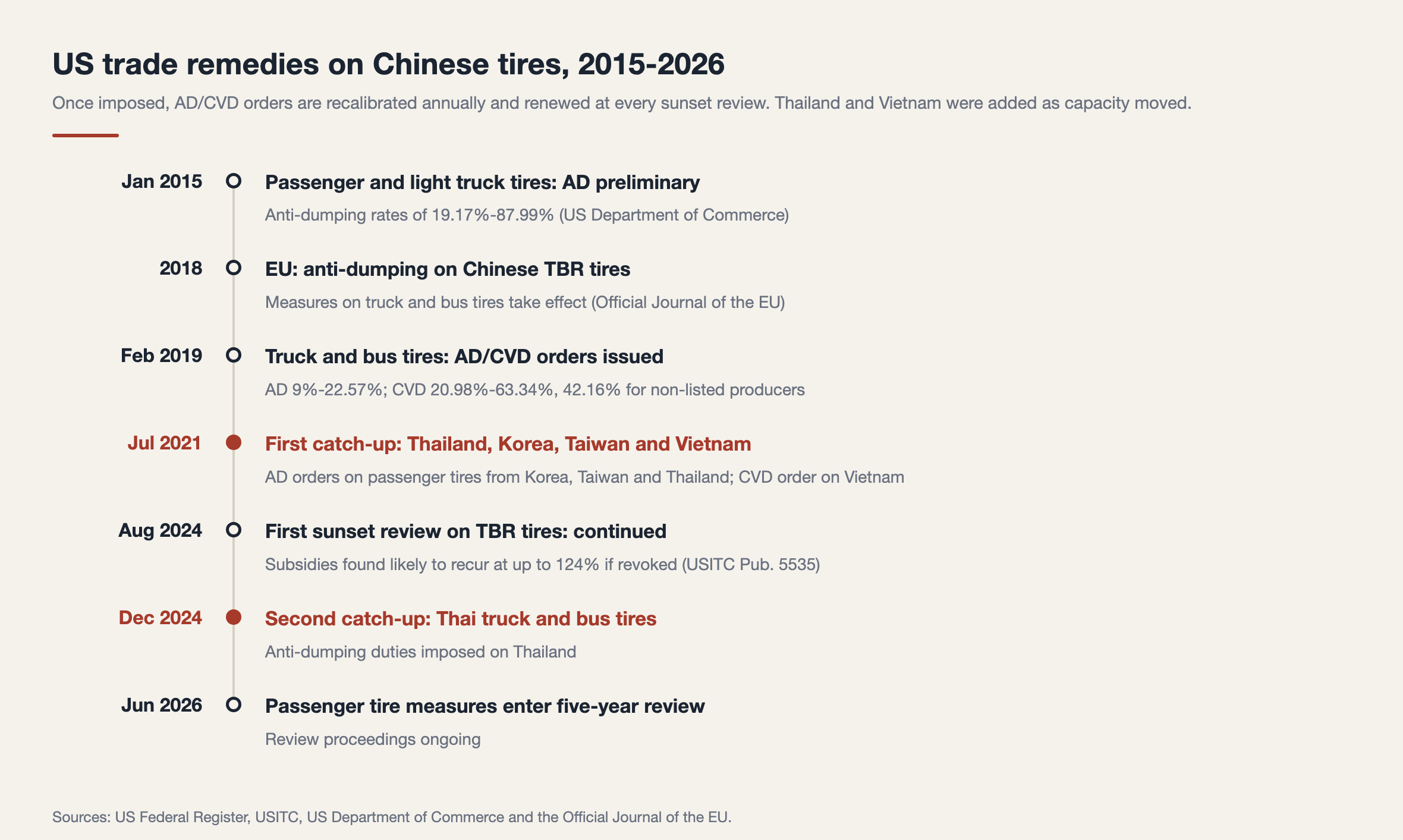
Figure 1: US trade remedies on Chinese tires, 2015-2026, compiled from the US Federal Register and USITC public records.
Beyond AD/CVD duties, Chinese tires also carry general tariffs. That layer is time-sensitive, and the current band applying to each origin, along with the record of changes, is tracked in the US tariff monitor for Cambodia. For companies with heavy exposure to the North American market, shipping to the US directly from a Chinese plant should be treated as unavailable for the foreseeable planning horizon, not as a short-term fluctuation.
3. Why could Thailand and Vietnam not hold? The catch-up effect in trade remedies
Trade remedies follow capacity: wherever exports to the US scale up, investigations arrive. Thailand and Vietnam each demonstrated this in turn, and the pattern is structural rather than speculative.
The first wave of relocation came after the duties on China. Sailun built the Chinese tire industry’s first overseas plant in Vietnam in 2011; Sentury and Linglong both entered Thailand in 2014, after which Chinese producers built there in quick succession and Thailand became the largest source of US tire imports (Yicai, 2023). Then the pursuit began. In July 2021 the US issued anti-dumping orders on passenger tires from Korea, Taiwan and Thailand, and a countervailing order on Vietnam (US Federal Register, 2021). In December 2024, Thai truck and bus tires were also subject to anti-dumping duties (US Federal Register, 2024). In June 2026, the multi-country passenger tire measures entered five-year review proceedings, which are ongoing (US Federal Register, 2026).
That capacity-follows-investigation reading is not an outside inference. In its 2024 review filings, the US industry stated explicitly that Chinese producers had responded to the orders by rapidly building plants in Thailand, Indonesia and elsewhere (USITC, 2024). In other words, relocation of production is already inside the petitioners’ field of view. Trade remedies are counted by country of origin, so a shift in production is a shift in import source, which makes it the next candidate for a case.
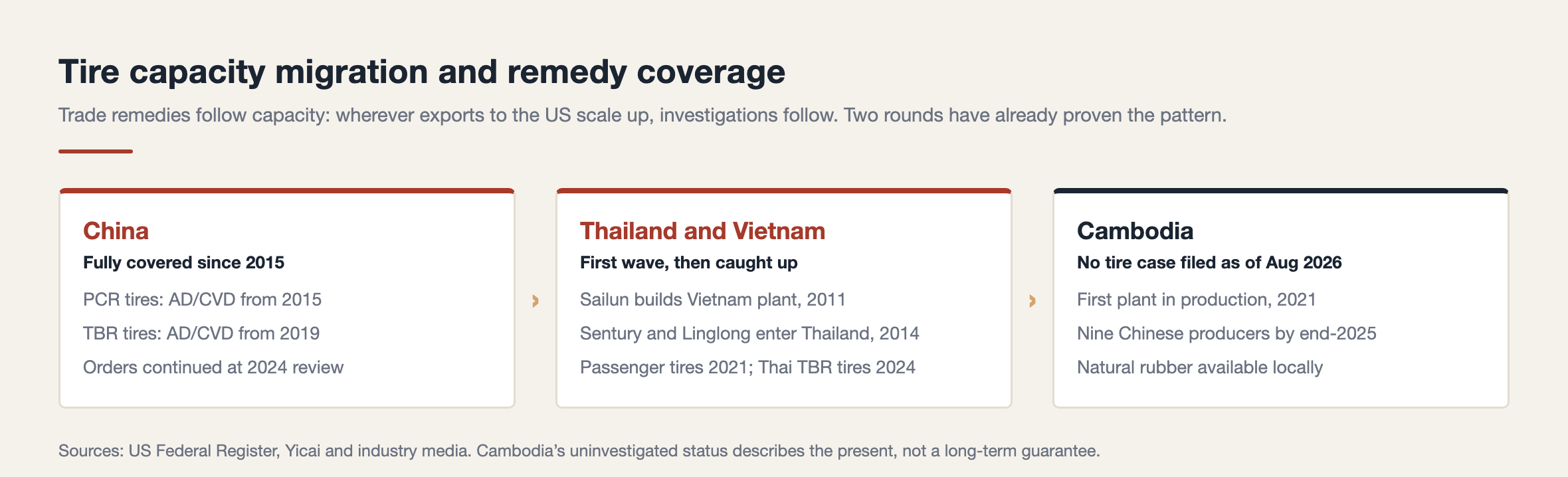
Figure 2: tire capacity migration and the sequence of remedy coverage, compiled from US Federal Register records.
An executive at General Science Technology once described the chain plainly: after China was hit with duties, companies built in Thailand to escape them; once the same approach was applied to Thailand, Cambodia became the new destination of choice (Yicai, 2023). For the tire industry, two rounds have now settled the point. A single backup origin is a buffer, not a destination; what companies need is a multi-origin logic, and the full method is set out in from China+1 to China+N.
4. What qualifies Cambodia to take tire capacity? Rubber, no case filed, and a cluster
Cambodia’s appeal is not one cheap input but three structural conditions holding at once: local raw material, an open window in trade remedies, and a cluster that has already formed. Remove any one of them and a heavy-asset tire project does not stand up.
The first is raw material. Natural rubber accounts for roughly half of tire production cost, and Southeast Asia produces around 80% of the world’s supply (Yicai, 2023). Cambodia has more than 420,000 hectares under rubber, 78% of it already in tapping, and produced 407,200 tonnes of natural rubber in 2024. Sailun has established a rubber value chain project in Kampot province, which means local sourcing is moving from simply buying rubber on the spot toward genuine value chain integration, a depth few Southeast Asian bases outside Thailand can offer.
The second is the absence of a case. As of the time of writing in August 2026, no US anti-dumping or countervailing investigation has been filed against Cambodian tires, while China, Thailand and Vietnam all have measures on the books, making Cambodia the only major rubber-producing origin not currently subject to tire duties. The general tariff band is also favourable to Cambodia, but that layer is time-sensitive; for current figures and the record of changes, refer to the US tariff monitor for Cambodia. The distinction matters: AD/CVD duties are trade remedies aimed at a specific product from a specific origin, can be applied retroactively once a case is filed, and are set company by company, whereas general tariffs cover all goods and are banded by economy. Cambodia’s present advantage is that neither layer constrains it, but the two layers move for entirely different reasons and should not be treated as one. This describes the current state, not a long-term guarantee.
The third is the cluster. Later entrants do not have to carry the cost of opening the road. By the end of 2025, nine Chinese tire companies were in production or under construction in Cambodia. By mid-2025 national annual capacity had passed 23 million units, with 65 million forecast for 2026. Cambodian tire exports reached USD 1.38 billion in 2025, up 57.9% from USD 874 million in 2024, and in the Ministry of Economy and Finance figures for the first half of 2025, tire exports grew 80.4% year on year, second only to wire and cable among non-garment categories. Cambodia tire manufacturing has moved from an alternative to one of the main routes for capacity transfer, and the question for later entrants is no longer whether to go, but how and where.
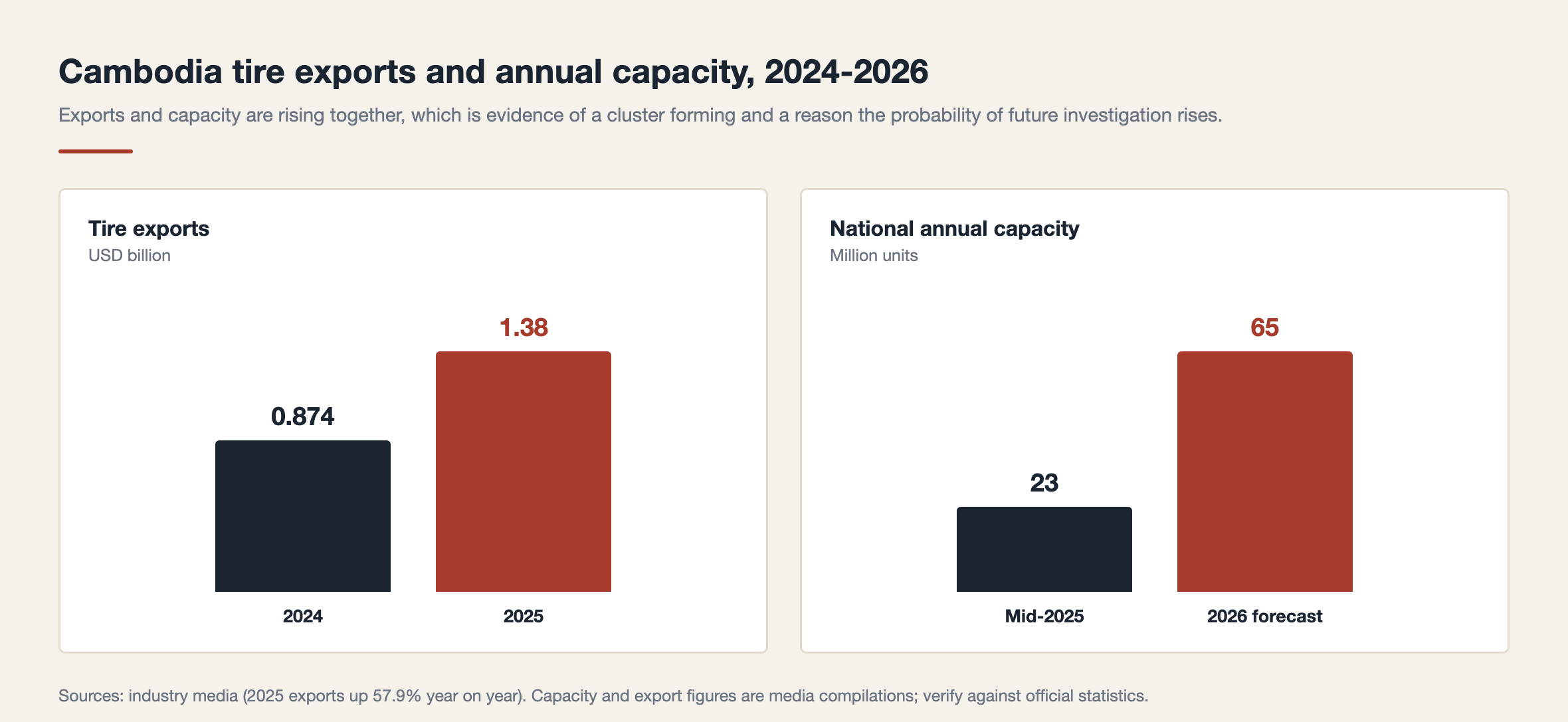
Figure 3: Cambodian tire exports and annual capacity, 2024-2026, compiled from industry media data.
5. Which Chinese tire plants are in Cambodia? Nine companies and the current cluster
The nine companies are spread across Svay Rieng, Preah Sihanouk, Kratie and other provinces rather than concentrated in one zone, but the density of peers is already producing spillovers, and the supply radius for equipment, consumables, contractors and skilled labour is shortening.
| Company | Entry date and status | Capacity (public information) | Location |
| Sailun Group | In production since 2021 (first mover) | Svay Rieng base: 21 million passenger radials and 1.65 million truck and bus tires a year, with truck and bus capacity planned to reach 3.3 million; cumulative investment above USD 1 billion, plus a rubber value chain project in Kampot | Svay Rieng, Kampot |
| General Science Technology | Construction 2022, production from May 2023 | Phase 1: 5 million passenger and 900,000 truck and bus tires; Phase 2 adds 3.5 million passenger and 750,000 truck and bus tires; ten millionth tire produced within two years, profitable in its first year of operation | Preah Sihanouk |
| Double Star | Groundbreaking May 2023 | Agreed investment of USD 138 million | Kratie (Snuol SEZ) |
| Wanli Tire | First tire produced | Phase 2 under way | — |
| Zhengdao Tire | Phase 2 filed | Expanding | — |
| Xindalu Rubber | Plant announced 2026 | Investment of CNY 3.1 billion | — |
| Fumax, Huasheng Rubber and others | In production or under construction | Nine Chinese tire companies in total as of end-2025 | — |
Table 1: publicly reported Chinese tire projects in Cambodia as of the first half of 2026. An em dash indicates that public sources do not specify; company announcements should be treated as authoritative.
Three points deserve separate mention. First, producing and turning a profit within the same year is not a promotional line: it says something about both demand and supply, namely that North American demand for non-Chinese origin is already there and that the ramp-up bottleneck can be compressed. Second, the level of policy attention is high; Deputy Prime Minister Men Sam An has visited Sailun (Cambodia) for an on-site review, and tires are now regarded locally as a flagship of manufacturing upgrading. Third, the largest base sits next to the Vietnamese border: Sailun’s project in the Qilu SEZ in Svay Rieng represents roughly USD 350 million of investment, in the same province as the Bavet crossing and on the same Asian Highway 1 corridor. For later entrants and their component suppliers, the Svay Rieng area has accumulated skilled workers, engineering contractors and a direct logistics line to the Ho Chi Minh City port complex, which makes it the better developed of the available locations, while Preah Sihanouk leads on deep-water port access. The two suit different project types. The industrial conditions, border traffic and land situation around Svay Rieng are covered in the complete guide to Bavet, Svay Rieng.
6. How does a tire plant land in Cambodia? Three entry paths and a three-step process
Building a full tire plant is not the only way in. Depending on a company’s resources and time horizon, the real choice is among three paths, and they differ completely in what they demand of capital, energy and compliance.
| Path | What it involves | Suited to | Where it is won or lost |
| Passenger tire contract entry | Lease an existing standard factory building, import carcass materials, and bring passenger radial lines up quickly to take transferred orders | Companies holding North American orders that must show non-Chinese origin within a short window | Speed to production and yield during ramp-up: every quarter of delay adds a quarter of idle cost and order risk |
| Full tire base | Passenger radials first, then truck and bus tires, on a large land parcel, deepening compounding and local rubber procurement over time | Companies treating Cambodia as a ten-year base with the capital and engineering capability to match | Energy and emissions conditions, and whether local content can withstand tightening origin scrutiny |
| Component supplier follow-on | Tire cord fabric, rims, moulds and chemical compounding agents relocating alongside the tire plants | Suppliers already serving major domestic tire makers | Certainty of the anchor customer and local delivery radius: nine tire plants are demand that already exists |
Table 2: trade-offs among the three entry paths, compiled from public information on companies already established and from general industry practice.
Whichever path is taken, the landing process breaks into three steps. Step one is site selection and confirmation of basic conditions: a tire plant has hard requirements for electrical load, water supply, wastewater treatment and large land area, and all four should be settled at the site selection stage, so that infrastructure shortfalls do not later add investment or delay start-up. Step two is the qualified investment project application and the environmental impact assessment; tire production involves rubber compounding and wastewater, which usually places it in the category requiring a full assessment, though the actual grading rests with the competent authority. The grading rules and filing process are covered in Cambodia’s tiered EIA system, and the administrative process as a whole, including how the various approval tracks depend on one another, is set out in the Cambodia factory setup process and SEZ one-stop service. Step three is construction and start-up: established cases suggest one year to eighteen months from groundbreaking to production (General Science Technology broke ground in 2022 and began production in May 2023), with the schedule driven mainly by EIA progress and equipment delivery.
The sequence companies already on the ground have converged on is passenger radials first, truck and bus tires second: passenger volumes are high and automation is greater, which suits validating operations and channels, while truck and bus lines carry higher energy intensity and capital intensity and are better added by expansion once phase one is running. Supply chain design is the core of path planning. Natural rubber can be bought locally, but tire cord fabric, steel cord, carbon black and most chemical compounding agents still have to be imported. Local content has to be calculated at the design stage: the share of rubber purchased locally, the share of value added by compounding and vulcanisation on site, and the cost share of imported carcass materials. Those three numbers determine what a product can prove under origin scrutiny. The paths themselves have been validated by those who went first; what separates outcomes is the depth of the feasibility work on energy, environmental compliance and local content.
7. What are the risks in Cambodia? Catch-up, energy and five feasibility line items
The largest risk in Cambodia tire manufacturing is not the country’s own conditions but the fact that trade remedies follow capacity. The pace of expansion from 23 million toward 65 million units a year itself raises the probability of a future investigation.
The manageable response to that risk is not hope but substance: use local rubber to the fullest, deepen the real content of compounding and vulcanisation carried out on site, and maintain traceable compliance records so that the product can withstand any origin or transshipment check. In the shadow of AD/CVD measures, compliance is a floor rather than a bonus. Any circumvention-style arrangement will not survive retrospective review, and it damages the credibility of the entire origin. One further medium-term variable: Cambodia is scheduled to graduate formally from least developed country status in December 2029. Tire exports to the US do not depend on preferences tied to that status, so the direct effect is limited, but it shapes Cambodia’s broader trade arrangements and business environment and belongs in long-range planning. The timetable and mechanics are covered in apparel supply chain restructuring: Cambodia’s three-year window and the road after 2029.
Every other risk can be priced at the feasibility stage. The table below sets out the five line items a tire project must settle, each with a specific action, and each answer belongs in the feasibility report rather than in an estimate:
| Line item | Why it matters | Action required |
| Power capacity and tariff | Compounding and vulcanisation are energy-intensive; the electricity tariff rewrites the cost model directly | Obtain a current quotation and supply guarantee terms from the zone or the utility; tariffs are time-sensitive, so use the latest quotation |
| Wastewater and EIA category | Determines approval timing and construction milestones; retrofitting approvals afterwards is the most expensive route | Anticipate the EIA category from the process design and confirm effluent connection and acceptance milestones with the zone |
| Landed cost of carcass materials | Tire cord fabric, steel cord and carbon black are largely imported | Model sea freight, inland haulage and customs clearance on a full-container basis, and allow generous inventory and working capital for the first 12 to 18 months |
| Origin value-added structure | The evidentiary basis if measures catch up | Establish three sets of records covering raw material traceability, cost allocation and processing steps, maintained continuously from start-up |
| Funding and foreign exchange | Cambodia’s economy is heavily dollarised, and funding spans renminbi, US dollars and riel | Confirm lending, settlement and profit repatriation routes with your banks, and build exchange costs into the model |
Table 3: feasibility study line items for a tire project, compiled from industry practice and this site’s existing research.
All of these risks are manageable, but they have to be priced during feasibility work. Costs discovered once detailed design has started are the most expensive costs there are.
8. How to test whether an SEZ can carry a tire project: checking Manhattan SEZ against heavy-asset requirements
What separates a tire project from a light industrial one is that its requirements for land area, electrical load and emissions permits are hard requirements.
Industrial land and assistance with qualified investment project applications are common to most Cambodian special economic zones. A one-stop administrative window is not universal: according to the Council for Development of Cambodia, 28 zones are operational nationwide, of which 23 have a special administrative centre offering one-stop import and export services. What actually separates zones is whether those conditions match the real load of a heavy-asset project.
So when comparing zones, rather than asking whether a one-stop service exists, ask more specific questions: how much allocable power capacity is available and can supply guarantee terms be issued; what is the designed wastewater treatment capacity and the allocable quota; how much room is there to expand the land and can it be locked in at signing; can an existing standard factory building serve as an interim facility before equipment arrives; and is customs and logistics capacity for heavy container departures already running. These questions apply to any special economic zone, including Manhattan SEZ.
Measured against them, Manhattan Special Economic Zone (MSEZ) offers existing operating conditions rather than a plan on paper. The zone sits in Bavet, Svay Rieng province, about 6 km from the Vietnamese border and about 90 km from the Ho Chi Minh City port complex. It covers roughly 600 hectares and can provide industrial land at a scale that supports an integrated phase one and phase two plan, with both lease and purchase options to match different capital structures and amortisation arrangements.
The zone has built independent power, water and wastewater systems, including dual-circuit high-voltage supply, 80 MW of capacity, 5,000 tonnes of daily water supply and 5,000 tonnes of daily wastewater treatment. Power connection, water use and effluent discharge for a new plant can be planned by the zone as a package, without coordinating external infrastructure from scratch. For a tire project that is energy-intensive, water-intensive and involves emissions-generating steps such as compounding, these existing conditions bear directly on the pace from land acquisition through construction to start-up.
Standard factory buildings inside the zone can serve as storage and light-process space before equipment arrives, allowing civil works for the compounding shop and installation of production lines to proceed in parallel. On the outbound side, the zone ships more than three thousand containers a month, so customs and logistics capacity for heavy containers is an operating capability rather than a projection, connected via Asian Highway 1 to the Bavet crossing and the Ho Chi Minh City port complex. Skilled labour spillover from the tire base already in the province is available, and the zone provides matching recruitment support and training coordination, handling qualified investment project applications, EIA filings and origin documentation end to end in Chinese.
The nature of these conditions should also be stated plainly. Manhattan SEZ offers efficiency in getting established, not preferential treatment outside the law. Locating in the zone does not change the tariffs, rules of origin or trade remedy rules that apply to a product, and it does not change whether a given product faces anti-dumping or countervailing investigations. What MSEZ can genuinely reduce is the coordination cost between securing investment approval, completing construction preparation, and moving equipment in for trial production, and it can shorten the time needed to obtain power, water, wastewater treatment and related infrastructure. If your company is evaluating a location for a tire or tire component project, you are welcome to learn about the overall conditions for investing in Cambodia, or contact the Manhattan SEZ advisory team with your product structure (passenger, truck and bus, or components), planned capacity and electrical load, emissions-generating processes, equipment arrival dates and target production date. The zone will respond with the allocable power and wastewater quotas, land and building options, customs arrangements, the boundaries of responsibility on each side and the expected key milestones.
9. Cambodia tire manufacturing FAQ: site selection, AD/CVD duties, rubber and time to production
Q1: For a tire plant going overseas, how should Cambodia, Thailand and Vietnam be compared?
| Read the trade remedy map first, then compare costs. Thai passenger tires (2021) and truck and bus tires (2024) both carry US anti-dumping duties, and Vietnamese passenger tires are subject to a countervailing measure. As of August 2026 no tire AD/CVD case has been filed against Cambodia, making it the only major rubber-producing origin without tire duties. For the current general tariff band, refer to the tariff monitor on this site. This is precisely why nine Chinese companies have established plants in Cambodia. |
Q2: Could Cambodia face duties as well?
| It cannot be ruled out, and rapid capacity expansion itself raises the probability of a case being filed. Thailand is the precedent, and the US industry has already named Chinese producers building overseas as a response to the orders. The manageable answer is to make value added real: use local rubber to the fullest, deepen compounding and vulcanisation on site, and from day one maintain three sets of records covering raw material traceability, cost allocation and processing steps, so that the product withstands origin and transshipment checks. Compliance should be budgeted as a cost line, not left to the hope of not being examined. |
Q3: Can Cambodian rubber supply support a tire industry?
| Natural rubber accounts for roughly half of tire production cost, and Southeast Asia supplies around 80% of world output. Cambodia has more than 420,000 hectares under rubber with 78% in tapping, produced 407,200 tonnes in 2024, and Sailun has established a rubber value chain project in Kampot. Tire cord fabric, steel cord and chemical inputs still have to be imported, but local supply of the core raw material is sufficient to support cluster-scale tire production. |
Q4: Should passenger radials or truck and bus tires come first?
| The path taken by companies already established is passenger radials first, truck and bus tires second: passenger volumes are high and automation is greater, which suits validating operations and channels, while truck and bus lines carry higher energy and capital intensity and are better added by expansion once phase one is running. Both Sailun and General Science Technology configured capacity in that order. One caution: reserve power capacity and emissions quota for the truck and bus phase at the site selection stage, or phase two expansion will be constrained by infrastructure, which is why energy heads the list of feasibility line items. |
Q5: How long does it take from groundbreaking to production, and is it still early enough to enter?
| Established cases suggest one year to eighteen months: General Science Technology broke ground in 2022 and began production in May 2023, reaching profitability in its first year of operation. On that basis, a company starting feasibility work in 2026 has a chance to build shipping capability before measures reach Cambodia. The key variables are EIA progress and equipment delivery, and buffer should be allowed. This window is measured in quarters: each quarter a decision slips is a quarter of shipments that will not fall inside the favourable period. |
10. Sources and references
- US Federal Register | AD/CVD orders on truck and bus tires from China (15 Feb 2019): anti-dumping 9%-22.57%, countervailing 20.98%-63.34%, 42.16% for producers not individually named; continuation of the orders (29 Aug 2024).
https://www.federalregister.gov/documents/2019/02/15/2019-02656/truck-and-bus-tires-from-the-peoples-republic-of-china-antidumping-duty-order - US International Trade Commission (USITC) | Truck and Bus Tires from China, five-year review (Aug 2024, Pub. 5535): subsidies found likely to recur at up to 124% if the orders were revoked; the US industry stated that Chinese producers responded to the orders by rapidly building plants in Thailand, Indonesia and elsewhere.
https://www.usitc.gov/sites/default/files/publications/701_731/pub5535.pdf - US Department of Commerce | Preliminary anti-dumping determination on passenger and light truck tires from China (Jan 2015): rates of 19.17%-87.99%.
https://www.aftermarketnews.com/commerce-dept-declares-anti-dumping-duties-on-tires/ - US Federal Register | Passenger tires: anti-dumping orders on Korea, Taiwan and Thailand and countervailing order on Vietnam (19 Jul 2021); initiation of five-year reviews of the related measures (1 Jun 2026).
https://www.federalregister.gov/documents/2021/07/19/2021-15270/passenger-vehicle-and-light-truck-tires-from-the-republic-of-korea-taiwan-and-thailand-antidumping - US Federal Register | Anti-dumping order on truck and bus tires from Thailand (17 Dec 2024).
https://www.federalregister.gov/documents/2024/12/17/2024-29606/truck-and-bus-tires-from-thailand-antidumping-duty-order - Yicai, republished by the MOFCOM trade remedy information service | Will Cambodia be the new safe harbour for Chinese tire investment? (May 2023): Southeast Asia accounts for around 80% of world rubber output and natural rubber for around half of tire cost; Sailun built the Chinese tire industry’s first overseas plant in Vietnam in 2011, with Sentury and Linglong entering Thailand in 2014; a General Science Technology executive describes the move to Thailand after the China duties, the repetition of the same approach against Thailand, and Cambodia as the new destination.
https://cacs.mofcom.gov.cn/article/flfwpt/jyjdy/cgal/202305/176761.html - Sina Finance | CNY 3.1 billion committed: another Chinese tire company builds in Cambodia (Mar 2026) and related coverage: nine Chinese tire companies in production or under construction as of end-2025; national capacity above 23 million units by mid-2025 and 65 million forecast for 2026; 2025 tire exports of USD 1.38 billion, up 57.9%; Deputy Prime Minister Men Sam An’s visit to Sailun (Cambodia); more than 420,000 hectares under rubber with 78% in tapping; capacity configurations at the Sailun and General Science Technology bases. Capacity and export figures are media compilations and should be verified against official statistics.
https://finance.sina.com.cn/stock/relnews/cn/2026-03-23/doc-inhrynrq1163707.shtml - MOFCOM Economic and Commercial Office in Cambodia | Ministry of Economy and Finance half-year report (Aug 2025): tire exports grew 80.4% year on year in the first half of 2025, the second fastest among non-garment categories.
http://cb.mofcom.gov.cn/jmdt/art/2025/art_7c831c097ef14a5a8dd520908ebf92b4.html - Triangle Tyre Co., Ltd. | Feasibility study for a 7 million unit high-performance radial tire project in Cambodia (Jan 2026): Cambodian natural rubber output of 407,200 tonnes in 2024.
https://stockmc.xueqiu.com/202601/601163_20260116_0TNC.pdf - China Overseas Development Association | General Science Technology’s Cambodia base (2024): construction began in 2022 with production from May 2023; the Sailun Cambodia plant entered production in 2021; Double Star broke ground in May 2023.
http://www.ciodpa.org.cn/index.php?m=content&c=index&a=show&catid=18&id=15561 - Manhattan SEZ industry knowledge base | Related articles: the US tariff monitor for Cambodia (current general tariff bands and change log), the Cambodia factory setup process and SEZ one-stop service, apparel supply chain restructuring, from China+1 to China+N, Cambodia’s tiered EIA system, and the complete guide to Bavet.
https://www.manhattansez.com/