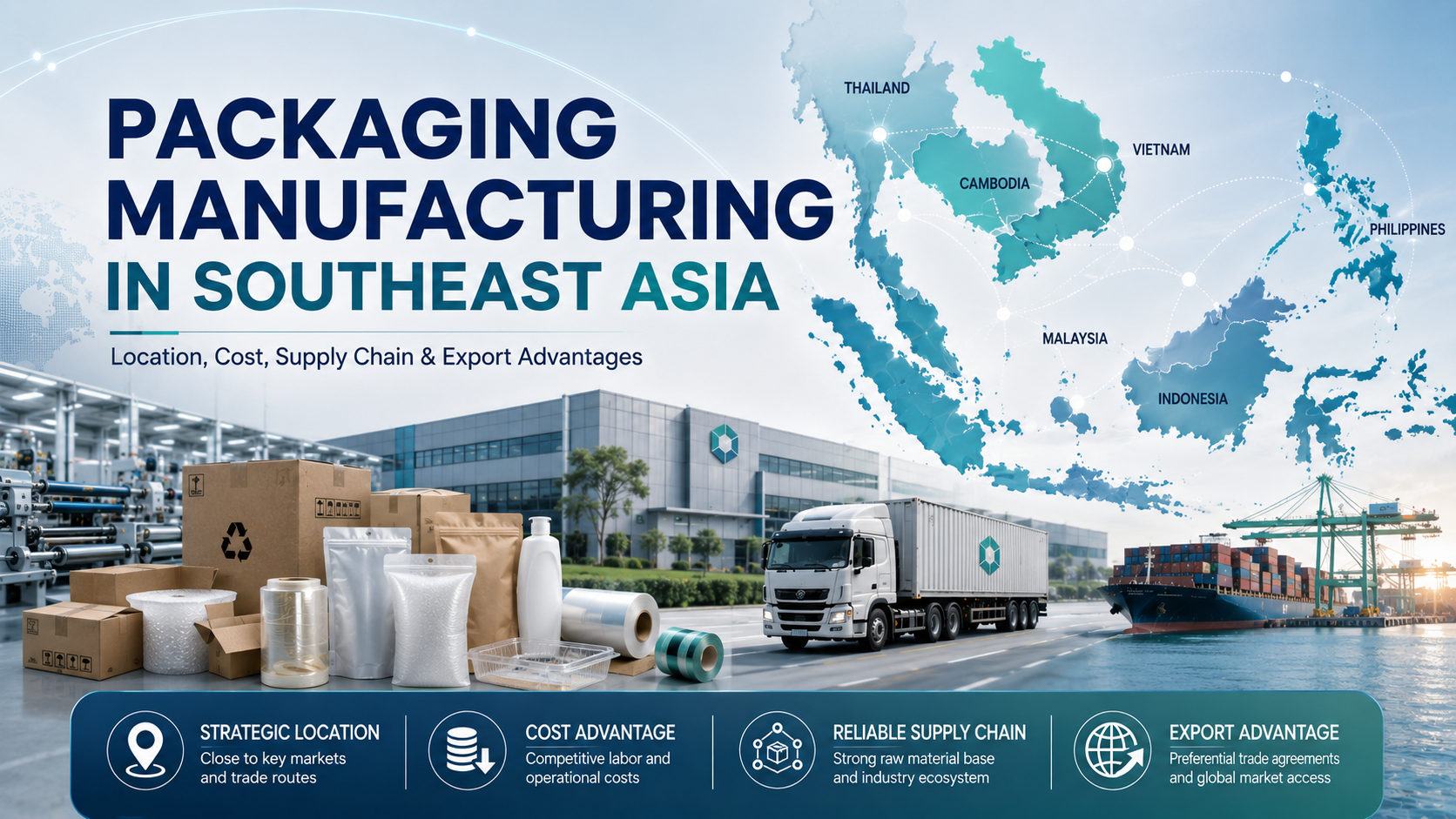
Summary:
Packaging in Southeast Asia is not, first of all, a question of comparing wages or factory rent — it is about confirming whether downstream orders form a stable service radius. Cartons, color boxes, hang tags, labels, inserts, PE/PP bags, stretch film and cushioning materials build near-field value through fast proofing, revisions, reorders and short lead times; food-contact, high-barrier, pharmaceutical and medical packaging can also be evaluated, but only once orders, cleanroom conditions, testing, traceability and certification are in place.
For packaging companies, the value of MSEZ lies in bringing park and surrounding demand, the southern Vietnam supply circle, Bavet customs clearance, in-park production services and export delivery into a single execution system. This article walks through order judgment, the demand mechanism, product mix, cost, compliance and landing steps — so you validate the business first, then configure equipment and plant.
Packaging in Southeast Asia: validate the order radius before adding capacity
Whether a packaging project in Cambodia can stand up depends first on whether downstream orders form a stable service radius.
The competitiveness of cartons, color boxes, hang tags, labels, inserts, PE/PP bags, stretch film and cushioning materials rarely comes from unit material price alone — it comes from proofing speed, version management, urgent reorders, inventory coordination and on-time delivery. Once garment, luggage, footwear, electronics, lighting and outdoor-goods production reach scale in Cambodia, packaging firms that move processing and service forward can cut the wait for cross-border order changes and reduce the risk that downstream plants miss shipment windows for want of a box, a label or a corrected version.
Investment order should therefore run backward from orders, not forward from land or wages: confirm target companies, SKUs, monthly volume and delivery frequency first; then material supply, equipment, quality documentation and environmental conditions; and only then decide on renting, building and scale-up pace. If the order radius is unclear, low rent and labor still will not produce sustained capacity utilization.
Core judgment: a Cambodian packaging project should start from confirmed downstream orders, connect regional materials to local processing, and create value through short lead times, version management, inventory and compliance services; equipment, plant and high-barrier products should all be phased in as order certainty grows.
Packaging materials in Cambodia: validate customers and delivery with four pieces of evidence
The setup discussion should start from verifiable business data, not from a national cost ranking.
The first is order structure: which downstream firms already produce in Cambodia or on the Cambodia–Vietnam border, and their common packaging specs, monthly volume and seasonal swings. The second is service intensity: how often revisions, reprints, small batches, multi-language work or urgent delivery occur. The third is supply conditions: whether kraft paper, resin, film master reels, ink, glue, molds and spares can be imported reliably, with sensible safety stock. The fourth is market access: what documents and tests brand audits, food-contact materials, paper traceability, environmental rules and destination-market regulations require.
Together these four determine product mix and capital: with stable orders and high service frequency, prioritize on-site processing and fast delivery; where materials are volatile, certification is long or demand is unconfirmed, first validate with a rented plant, general-purpose equipment and trial orders. The table below turns assessment questions into evidence to obtain before building.
| Decision question | Evidence to obtain before building | Threshold to move to the next stage |
| Do orders form a service radius? | Target firms, SKUs, monthly volume, delivery frequency and change-order records | High-frequency demand can cover base capacity and fixed service cost |
| Do product and compliance thresholds match? | Specs, materials, testing, traceability, brand audits and destination requirements | The current team and budget can complete approval before production |
| Is regional restocking controllable? | Suppliers, MOQ, clearance time, safety stock and spare-parts plan | Key-material outage risk and inventory hold are within acceptable range |
| Does MSEZ improve execution? | Park demand, Bavet clearance, Vietnam restocking, utilities/environment and Chinese-language coordination | Park conditions shorten the production and delivery chain with quantifiable gains |
Southeast Asia packaging supply chain: near-field production cuts revision, reorder and delay cost
Packaging demand moves with manufacturing orders, but what truly drives local sourcing is the time cost and error cost in the delivery chain.
Main materials can usually be scheduled ahead, but packaging often changes with brand, language, barcodes, warning text, environmental marks, loading method or last-minute orders. If all packaging is sourced centrally from abroad, a low unit price can be offset by reprints, expedited freight, line stoppages and container delays; a late outer box or label affects the inspection and shipment window of the entire finished batch, not just the packaging itself.
The value of a local packaging firm is moving proofing, version confirmation, inventory and emergency reorders close to the production site, and connecting brands and manufacturers with stable quality documentation. What companies really sell is three kinds of certainty: correct specs, controllable lead time, verifiable compliance. As long as these services reduce shortages, wrong versions and inventory hold, near-field supply has commercial value independent of low wages.
Judgment formula: project value = line-stoppage, container-delay and inventory cost avoided by near-field delivery + service revenue from proofing, revisions and reorders − regional materials, equipment depreciation and compliance investment. All four should be measured with order data, not substituted by low labor cost.
Cartons and plastic packaging in Southeast Asia: phase investment by orders and compliance thresholds
Cambodia is not limited to one technical tier of packaging; the sounder approach is to sequence investment by order certainty, on-site service value and compliance threshold.
Stage one can build base capacity around high-frequency industrial packaging — general cartons, color boxes, hang tags, labels, inserts, protective bags, stretch film and cushioning. Upstream materials for these can be sourced regionally, and the local edge comes from multiple specs, small batches, fast revisions and short lead times. Once capacity is stable, add fine printing, die-cutting, inkjet coding, automatic gluing, a lab and digital traceability as orders require — rather than buying all equipment up front.
Food-contact, high-barrier laminate, pharmaceutical or medical packaging can equally be evaluated, but the premise differs: a clear order scale, cleanroom environment, migration testing, supplier declarations, batch traceability, a validation cycle and continuous quality management. The point is not to sort categories simply into “can” or “cannot,” but to confirm whether the project already has the matching customer commitments, testing resources, engineering capability and compliance budget.
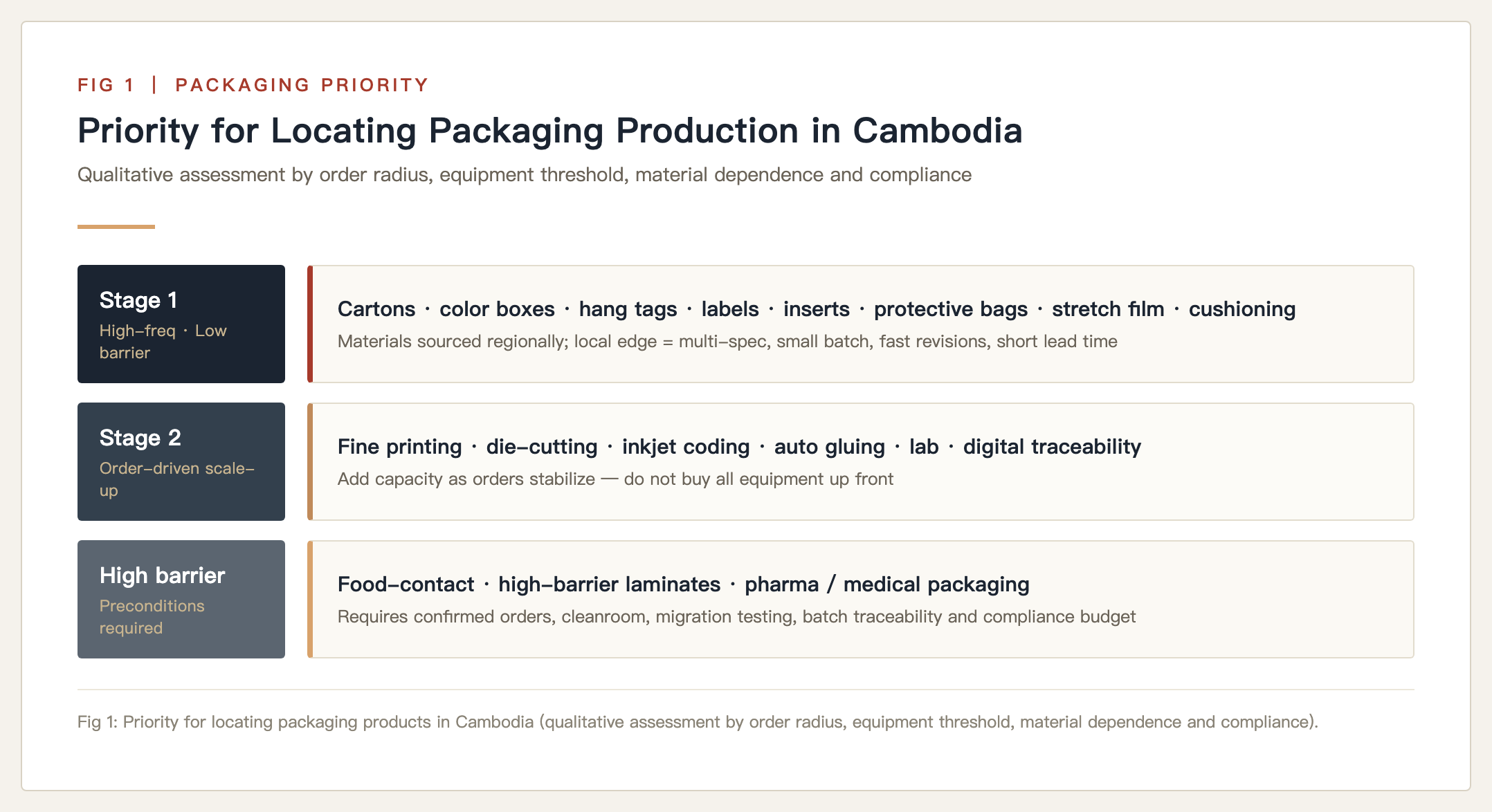
Fig 1: Priority for locating packaging products in Cambodia (qualitative assessment by order radius, equipment threshold, material dependence and compliance).
Packaging factory cost in Cambodia: book materials, processing, service and compliance together
Whether a packaging project is profitable depends on total delivered cost and service revenue holding together — not on labor compared in isolation.
The materials account should cover kraft paper, board, resin, film reels, ink, glue, additives, freight, exchange rate, MOQ and safety stock; the equipment account should match target specs, color management, barcode readability, carton compression, bond strength, testing and batch traceability. Too little equipment brings rework and complaints; too much adds depreciation and idle time, so configuration must align with confirmed SKUs and the capacity ramp.
The service account covers proofing, order changes, reorders, on-site communication, managed inventory and frequent delivery; the compliance account covers environmental review, fire safety, waste paper and offcuts, ink and VOC management, social responsibility, material declarations, testing and brand audits. A quote should split into at least four columns — materials, processing, service, compliance — each with its own margin and liability boundary, so rising volume is not eroded by scattered service and compliance spending.
| Cost item | Measurement focus | Confirm before investing |
| Materials | Kraft, resin, ink, glue, freight, FX, MOQ and inventory | Suppliers, lead time, substitute materials, clearance and safety stock |
| Equipment | Capacity, color and barcode, testing, spares, repair and idle depreciation | Customer specs, machine takt, yield targets and scale-up triggers |
| Environment | Wastewater and emissions, ink/glue, offcuts, fire safety and storage | Environmental permits, park treatment capacity, recycling routes and ongoing cost |
| Audit | Material declarations, testing, social responsibility, batch records and brand audits | Liability boundary, document list, certification cycle and annual upkeep budget |
Packaging export compliance: build PPWR and EUDR into design, sourcing and pricing
For export-oriented packaging firms, regulation and brand requirements have already become part of product design, supplier selection and pricing.
The EU Packaging and Packaging Waste Regulation (PPWR, Regulation (EU) 2025/40) entered into force on 11 February 2025 and generally applies from 12 August 2026, covering all packaging placed on the EU market. Projects should check material composition, minimization, recyclability, recycled content, labeling, restricted substances and documentation item by item; a plant serving both EU and non-EU orders should also build a distinguishable control method across materials, labels and records.
Pulp, paper, wood- or rubber-related goods may further be affected by EUDR’s deforestation-free, legality and traceability requirements. The current timeline applies to large and medium operators from 30 December 2026 and, in principle, to micro and small operators from 30 June 2027. Food-contact packaging additionally requires checks on material safety, migration, declarations and process control. All of these should be confirmed at supplier onboarding and quoting — not left to be filed in just before mass production.
| Regulation / customer requirement | Packaging affected | Practical meaning for a Cambodia project |
| PPWR | All packaging entering the EU market | Materials, design, recyclability, labeling and documentation affect market access |
| EUDR | Pulp, paper, wood- or rubber-related goods | Sourcing must obtain traceable data and prepare by operator size and applicable date |
| Food-contact materials | Food and beverage packaging and related materials | Material safety, migration, declarations and process control must be validated |
| Brand audit | Cartons, labels and inserts serving EU/US brands | Labor, environment, batch records and restricted substances must form a document system |
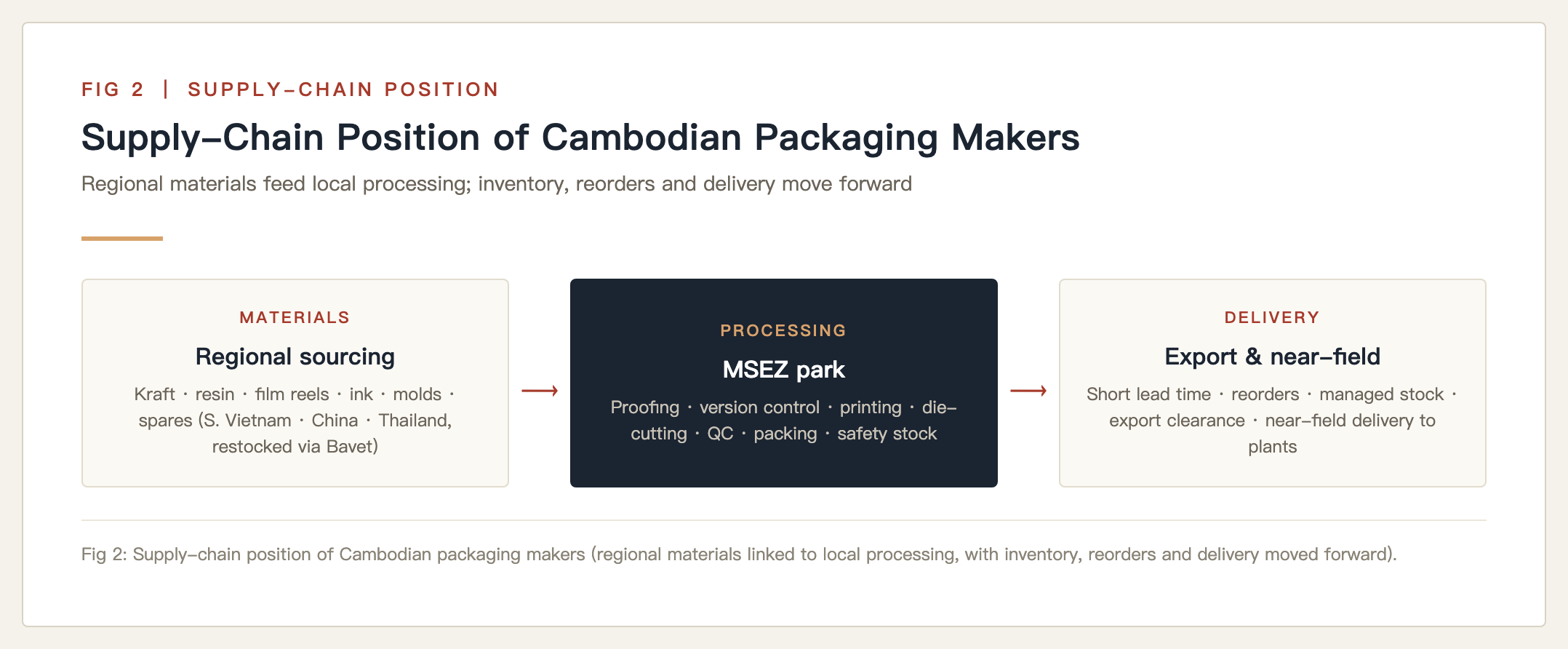
Fig 2: Supply-chain position of Cambodian packaging makers (regional materials linked to local processing, with inventory, reorders and delivery moved forward).
MSEZ packaging value: integrate orders, restocking, production and export delivery
For packaging firms, the value of MSEZ is connecting potential demand, cross-border restocking, production services and export delivery into a manageable business radius.
On the demand side, the park and its surroundings already host garment, luggage, footwear, electronics and lighting clusters, extending to home and building materials, outdoor goods, sanitaryware, hardware and supporting services. Packaging firms can build a target-company list from this and confirm, one by one, the specs and delivery frequency for cartons, labels, inserts, protective bags and cushioning. On the supply side, Bavet is close to the southern Vietnam supply circle and the Ho Chi Minh City port group, so kraft, resin, ink, equipment, molds and spares can be planned for restocking and safety stock by cross-border lead time.
On execution, MSEZ has operated for over twenty years since 2005, spans about 600 hectares, and its administrative and customs teams work in Chinese, with the Bavet crossing convenient for nearby clearance and power, water and wastewater infrastructure in place. For a packaging project, the meaning of these conditions is not a generic “park incentive” but reduced interface loss among setup, import, environment, audits and daily communication. It should still be validated item by item against target orders, park quotes, environmental conditions and the clearance plan.
Cambodia packaging setup path: let trial orders decide equipment, plant and scale-up
The steadier way to land is to let fixed assets grow with order certainty.
Step one: build a target-company and SKU list, recording monthly volume, seasonal swings, change-order frequency, quality standards, audit requirements and payment terms. Step two: break each product into material source, MOQ, machine takt, labor, loss, waste, testing and delivery cost to form per-item margin and cash flow. Step three: choose a standard rented plant, a custom plant or self-build. While orders are still being validated, serve high-frequency specs with general-purpose equipment; once orders stabilize, add color boxes, fine printing, automation, a lab and traceability. Each stage should set a pass standard, avoiding equipment ahead of orders.
| Stage | Core action | Pass standard |
| 0–30 days | Build the target-company and SKU list; interview delivery frequency, change orders and audit requirements | Confirm high-frequency demand and trial-order intent that cover base capacity |
| 31–60 days | Model materials, equipment, plant, utilities/environment, staffing and cash flow | Per-item margin, capacity utilization and cash gap all have explainable assumptions |
| 61–90 days | Decide rent/self-build, equipment batches, training, compliance documents and production schedule | Trial orders, supply plan, permit route and scale-up triggers all hold together |
Investment note: US tariffs, EU packaging rules, EUDR, food-contact materials and Cambodia’s QIP eligibility may all keep changing; tariff codes, origin and declaration for packaging exported directly or with goods must be re-checked against the specific HS code, transaction structure, customer destination and customs rules.
Packaging in Southeast Asia FAQ: key questions on investing in Cambodia
Q1: For a packaging firm landing in Cambodia, how should the first batch of products be chosen?
| Prioritize products with confirmed orders, high delivery frequency, standardizable specs and clear on-site service value — for example general cartons, color boxes, hang tags, labels, inserts, protective bags, stretch film and cushioning. The first batch should share equipment and materials and cover base capacity. |
Q2: Upstream materials must be imported — can the project still stand?
| Yes. A Cambodia project need not assume full localization; the key is designing regional sourcing, clearance timing, safety stock and local processing into a stable system. If near-field production materially shortens reorders, lowers inventory and cuts container delays, imported materials can still form a complete business model with local service. |
Q3: Can food, pharmaceutical or medical packaging be invested in Cambodia?
| It can be evaluated, but only on the premise of clear orders and a quality system. A firm should first confirm cleanroom conditions, migration or performance testing, material declarations, batch traceability, the validation cycle, regulatory liability and ongoing upkeep cost before investing in dedicated equipment and environment. |
Q4: What should a packaging project prepare before applying for QIP?
| Prepare an investment-activity description, product and process, investment amount, equipment and material lists, plant and environmental plan, employment plan, financial projections and follow-up reporting. Whether incentives apply must be re-checked with the CDC or a professional adviser against the specific activity, scale and latest rules — the tax-holiday years are not an automatic gain. |
Q5: What conditions should a packaging firm check first when evaluating MSEZ?
| Check four sets of conditions: whether real, serviceable demand exists in and around the park; whether the southern Vietnam supply circle and Bavet clearance can support materials and spares; whether plant, utilities, wastewater, fire safety and waste handling match the process; and whether Chinese-language administration, clearance and daily coordination can shorten production and delivery. The answers should feed a project-level cost and lead-time model. |
Packaging in Southeast Asia: references and data sources
- Council for the Development of Cambodia (CDC) | QIP incentives and eligible sectors: income-tax holidays of 3/6/9 years by activity category; qualifying construction materials, production equipment and production inputs may enjoy import-duty exemption.
https://cdc.gov.kh/incentives-and-schemes/ - Council for the Development of Cambodia (CDC) | Special Economic Zones: as of H1 2024, about 26 operating SEZs, 745 investment projects, around US$8.9bn invested and over 180,000 employees; SEZs typically provide border gates, infrastructure and on-site administration.
https://cdc.gov.kh/sez-smart-search/ - Council for the Development of Cambodia (CDC) | Open investment climate: equal treatment for foreign and local investors, generally no local-equity requirement, and few restrictions on currency exchange and profit repatriation.
https://cdc.gov.kh/why-cambodia/conducive-investor-climate/ - Council for the Development of Cambodia (CDC) | Trade infrastructure: Cambodia is an ASEAN and RCEP member on the southern economic corridor linking Thailand and Vietnam, with border SEZs close to regional markets.
https://cdc.gov.kh/why-cambodia/connected-trade-infrastructure/ - European Commission, DG Environment | PPWR (Regulation (EU) 2025/40): in force 11 Feb 2025, generally applicable from 12 Aug 2026, covering all packaging and packaging waste placed on the EU market; no general SME exemption; packaging purely exported outside the EU may be exempt from labeling and registration where provable.
https://environment.ec.europa.eu/topics/waste-and-recycling/packaging-waste_en - European Commission, DG Environment | EUDR (Regulation (EU) 2023/1115): relevant goods must be proven deforestation-free, legal and traceable; large/medium operators from 30 Dec 2026, micro/small operators from 30 Jun 2027.
https://environment.ec.europa.eu/topics/forests/deforestation/regulation-deforestation-free-products_en - European Commission, DG Health and Food Safety | Food-contact materials: must meet material-safety, migration and declaration requirements, with production under relevant good manufacturing practice.
https://food.ec.europa.eu/food-safety/chemical-safety/food-contact-materials_en - World Bank | Cambodia country overview: 2024 growth estimated at about 5–6%, with manufacturing exports still a key support for the formal sector amid rising external trade-policy uncertainty.
https://www.worldbank.org/en/country/cambodia/overview - US Supreme Court | Learning Resources, Inc. v. Trump (20 Feb 2026): IEEPA does not authorize the President to impose tariffs unilaterally.
https://www.supremecourt.gov/opinions/25pdf/24-1287_4gcj.pdf - US Court of International Trade ruling (7 May 2026) | The provisional 10% Section 122 global tariff was ruled unlawful and the government is appealing; subsequent trade tools still bring uncertainty.
https://www.washingtonpost.com/business/2026/05/07/tariffs-trade-court-ruling-trump/