
In Cambodia, the US dollar flows freely, without foreign exchange controls, export quotas, or differential treatment for foreign investment… Here, both foreign investors and speculative capital are welcomed, as it boasts the most liberal economic policies. Emerging from the era of the Khmer Rouge’s human hell, Cambodia has transformed into an investment paradise teeming with speculative capital. Among the nations of Southeast Asia, Cambodia stands as the freest economy.
Many people’s impression of Cambodia still lingers on the terrifying history of the ‘Khmer Rouge’ or the timeless splendor of the ancient Angkor Wat temple complex. However, in reality, Cambodia has undergone tremendous changes and is transforming into a promising emerging nation with great potential.
Despite being one of the poorest countries in Asia with a per capita income of only one thousand US dollars and significant wealth disparity, Cambodia’s economy has been growing at a steady pace of seven percent annually for the past four years, making it one of the fastest-developing nations in Asia.
What sets Cambodia apart from other Southeast Asian countries is its open policy of ‘unrestricted and wholehearted welcome to foreign investment.’ ‘The greatest advantage of doing business and investing here is freedom,’ says an experienced Taiwanese expatriate who has worked and lived in Cambodia for seventeen years, succinctly capturing the economic characteristics of Cambodia.
Despite the absence of natural resources and a population of only fifteen million, Cambodia emerged from the nightmare of the Khmer Rouge just over thirty years ago and abandoned communism as late as 1991. However, it has now become the freest economy in Southeast Asia.
Among the ten ASEAN countries (Singapore, Malaysia, Thailand, Philippines, Indonesia, Brunei, Vietnam, Laos, Myanmar, Cambodia), Cambodia has the least restrictions on foreign investment, allowing unhindered capital flow. Moreover, transactions in Cambodia are primarily conducted in US dollars, while the local currency, the Cambodian riel, is mainly used for small-scale transactions or as change at roadside stalls.
Here, there are no foreign exchange controls, no export quotas, no restrictions on repatriating profits to home countries. There are also no differential treatments for foreign investment, no limitations on foreign currency exchange, and no restrictions on investment ratios… Offering absolute freedom to foreign investors, it can be considered the last investment paradise within the ASEAN region.
But the downside of freedom is the lack of regulations. In Cambodia, all laws and rules are still in the process of being established, creating a lucrative opportunity during this policy vacuum. It is often the businessmen and investors who are the first to sniff out these opportunities.
What advantages does Cambodia have compared to other Southeast Asian countries in terms of setting up factories and investments?
In terms of manpower, Cambodia has the youngest workforce with an average age of only 24. Regarding wages, Cambodian workers earn an average monthly salary of around $128, which is much lower compared to Vietnam ($200), Thailand ($390), and Malaysia (approximately $600)… When it comes to land costs, they are relatively lower in Southeast Asia. For instance, land prices in Ho Chi Minh City, Vietnam, are two to three times higher than those in the Cambodian capital, Phnom Penh… As for business opportunities, Cambodia offers vast untapped potential. Taiwanese businesspeople even say that one can make a profit by selling popsicles here.
Local Taiwanese businessmen often liken Cambodia to China a decade ago or Taiwan twenty years ago, and it has now become a new hotspot for Taiwanese real estate investors. ‘CommonWealth Magazine’ conducted on-site visits in Cambodia, exploring its development and future from south to north, prior to the establishment of the ASEAN Economic Community.
First Stop: Cambodia-Vietnam Border, Bavet – Probing into the Taiwanese Business Stronghold near Vietnam
We cleared customs at Ho Chi Minh Airport in Vietnam and drove towards the border, arriving at the Cambodia-Vietnam border junction in about an hour and a half. Within a mere 500 meters, we passed through the adjacent customs of both countries and entered Bavet, a border city in Svay Rieng Province, Cambodia. It’s an unwritten rule here that a one-dollar bill is inserted into the passport for clearance.
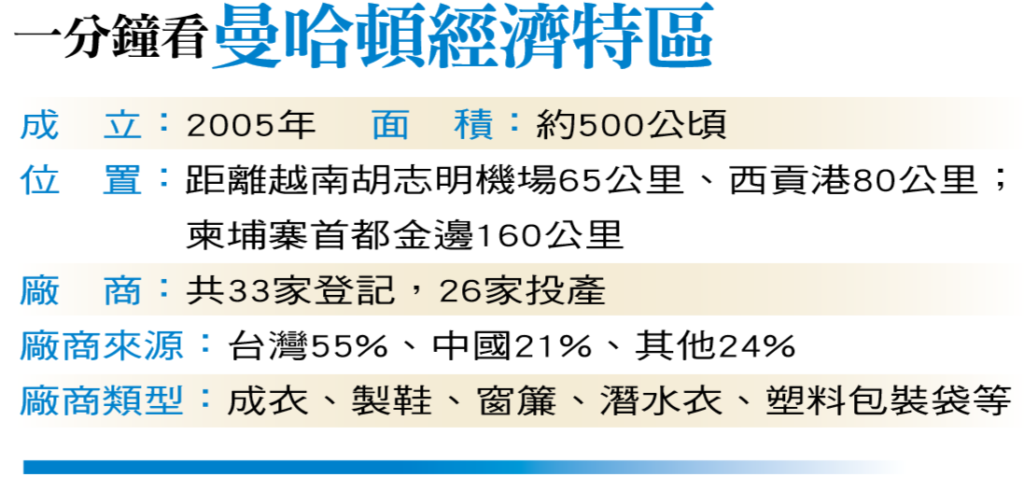
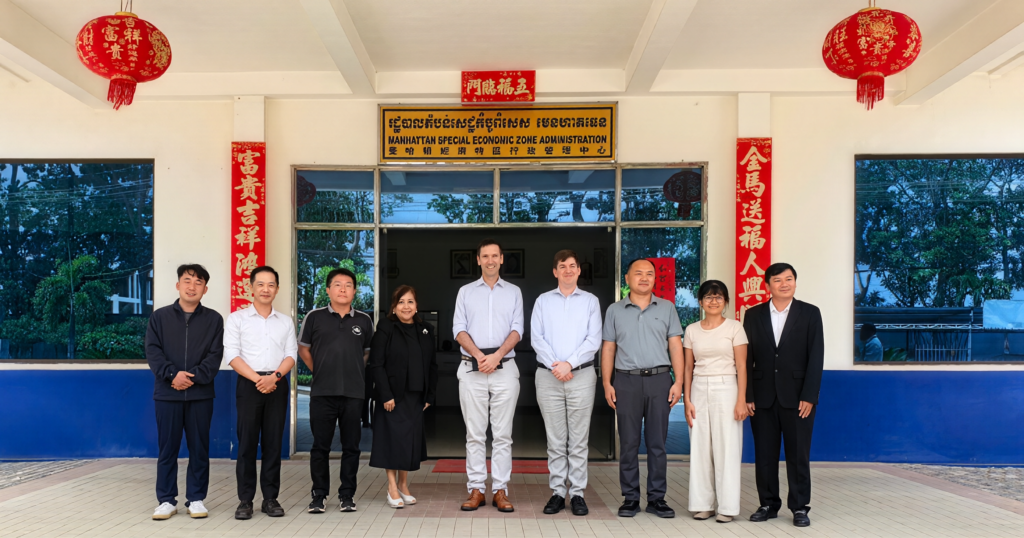
Just six kilometers away from the Vietnam border, we arrived at Cambodia’s first economic zone, the Manhattan Special Economic Zone, spanning approximately 500 hectares. It was created by Taiwanese entrepreneur and President of Medtecs International Corporation Ltd., William Yang, and is among the top-performing out of the 33 approved economic zones in Cambodia.
Every day at 4:30 PM, one truck after another, filled with workers, slowly drives out through the massive archway of the Manhattan Special Economic Zone, stretching for one kilometer. The young faces standing on those trucks appear tired yet carry a hint of smiles.
They start work at 7:00 AM, and their departure time is divided into two shifts. For those who don’t have to work overtime, they eagerly board the transport vehicles at 4:30 PM. A single asphalt road must evacuate over thirty thousand workers at the same time, leading to traffic congestion, creating a spectacle. As twilight sets in at 6:30 PM, it’s time for the overtime workers to head home, marking yet another remarkable scene.
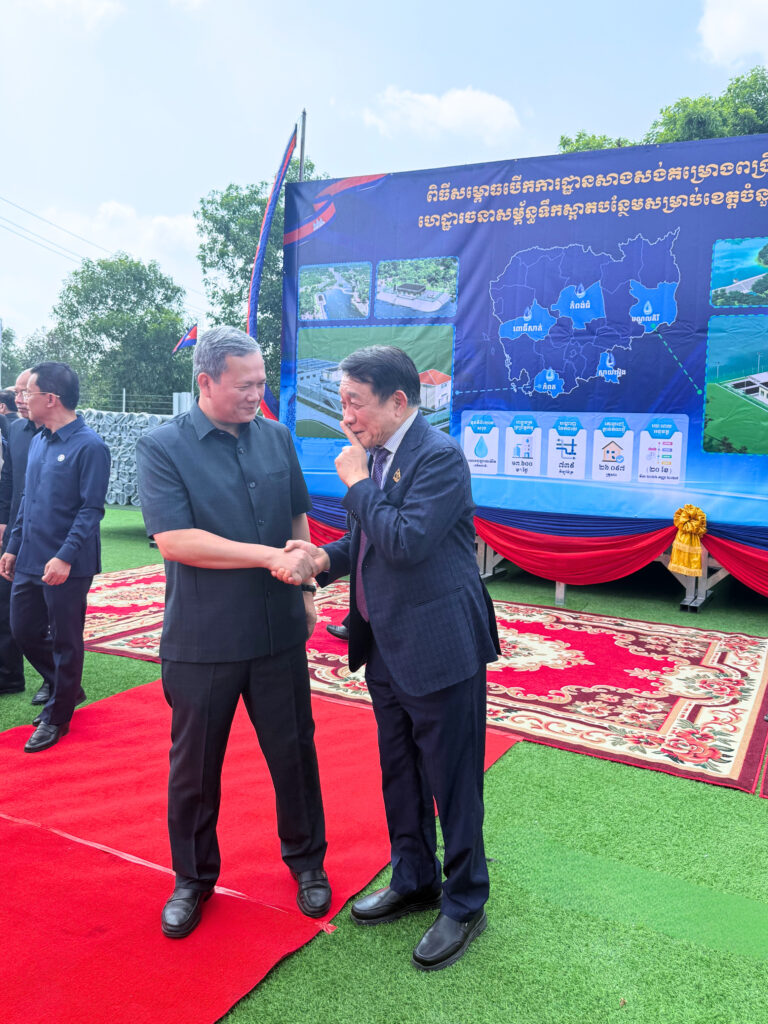
William Yang’s main business is in medical textile products. He set up factories in the Philippines and listed his company in Singapore. In 2005, Yang took over a textile factory in Cambodia and, through a series of fortuitous events, became involved in special economic zone development. It was primarily due to an invitation from Cambodian Prime Minister Hun Sen that unexpectedly led him onto the path of land development.
Bavet, where the Manhattan Special Economic Zone is located, benefits from its proximity to Vietnam and enjoys favorable lease and tax incentives. It is just 65 kilometers away from Ho Chi Minh City Airport and 160 kilometers from Phnom Penh, making it an industrial zone that attracts Taiwanese and foreign businesses alike.
According to William Yang, initially, it was industries affected by anti-dumping measures in China and Vietnam, such as bicycles and hardware screws, that started relocating their factories to the Manhattan Special Economic Zone. Additionally, industries like textile garments, umbrella manufacturing, and footwear, which sought low-wage labor, also opted to set up factories in the vicinity.
“After the riots in Binh Duong, Vietnam, last May, Taiwanese, mainland Chinese, and Korean businessmen who had factories in Vietnam started exploring opportunities in Cambodia. They either planned to relocate to Cambodia or move some of their production lines here to diversify their risks,” explained William Yang.

Ten years ago, Taiwanese businessman William Yang spearheaded the establishment of the Manhattan Special Economic Zone. At the end of each workday, a procession of trucks carries away the thirty thousand workers from this area, creating a remarkable spectacle as the line of vehicles stretches over one kilometer. Prominent players, including the world’s largest wetsuit manufacturer and other top-tier companies, have chosen to set up their factories here.
Liu Huaye, Deputy General Manager of Manhattan International, pointed out that the currently established companies in the zone include the world’s largest wetsuit manufacturer, Xue Changxing Industrial, one of the top three bicycle manufacturers globally, Best Way, a major leather goods factory from Korea, as well as thirty-three other companies, including a high-end umbrella manufacturer, Toyo Higa Umbrella, exporting to Japan.
In addition to the industrial zone, William Yang also plans to build a four-star hotel, a shopping center, and other facilities here, targeting the consumer opportunities presented by the over thirty thousand workers within the zone. Cathay United Bank also established a branch here on June 26th this year, providing services to the businesses and workers in the special economic zone.
In fact, Taiwanese businessmen have been investing in Cambodia for over 20 years. From 1994 to 2011, Taiwan’s investments in Cambodia amounted to over $830 million. China, on the other hand, emerged as the largest foreign investor in Cambodia during the same period, with a staggering investment of $8.9 billion. Following China, other major investing countries include South Korea, Malaysia, and more.
According to William Yang, ‘Setting up factories in Cambodia has advantages such as low wages, a young workforce, and low corporate income tax. However, the disadvantages include a smaller population and inadequate electricity supply.’ In addition to the cost advantage, Cambodia’s favorable geographical location in the middle of the Indochinese Peninsula, along with its deep-water port at Sihanoukville, has earned it the title of one of the ‘New Three Indochina Manufacturing Countries’ by Nikkei Business.
With the establishment of the ASEAN Community, borders have dissolved, allowing visa-free travel and duty-free goods exchange between the people of Cambodia and Vietnam. As a result, Bavet, a border city in Cambodia, has attracted a large number of Vietnamese businessmen, serving as a major supply base for Ho Chi Minh City and a bustling trade gateway for Cambodia.
Compared to other Southeast Asian countries, Cambodia’s continuously rising property prices and transactions in US dollars have made it a new favorite among Taiwanese investors.