The Prospects of Development in Cambodia
Cambodia has emerged as one of the most prominent countries in Southeast Asia in recent years. Its open economic policies, adoption of the US dollar and a free exchange system, coupled with the advantage of a young population, have attracted significant attention from overseas investors and businesses, positioning it as one of the emerging economic powerhouses in Asia. In addition to the traditional observations on global economic development, let us now explore Cambodia’s prospects for the next decade from a demographic perspective.
Population Structure Changes
1. Rapid Population Growth, Projected Population of 20 Million in the Next Decade
According to data from the World Bank, Cambodia, as an ancient nation in the Indochina Peninsula, experienced slow and steady population growth in its early years. However, the Khmer Rouge regime and the subsequent wars resulted in a significant population decline. Since its rebirth in 1980, Cambodia has witnessed rapid population growth. Currently, the population of Cambodia has reached 16.5 million, with a relatively young population structure, where 75% of the population is below the age of 35.
In a public event, Prime Minister Hun Sen stated that it is projected that Cambodia’s population will reach 20 million in the next decade (by 2030), and potentially reach 25 million by 2050. The population increase will have significant implications for various aspects of society, such as daily life, real estate, and healthcare. This rapid growth trend underscores the need to closely monitor Cambodia’s development over the next decade, particularly in relation to the challenges and opportunities arising from population growth.
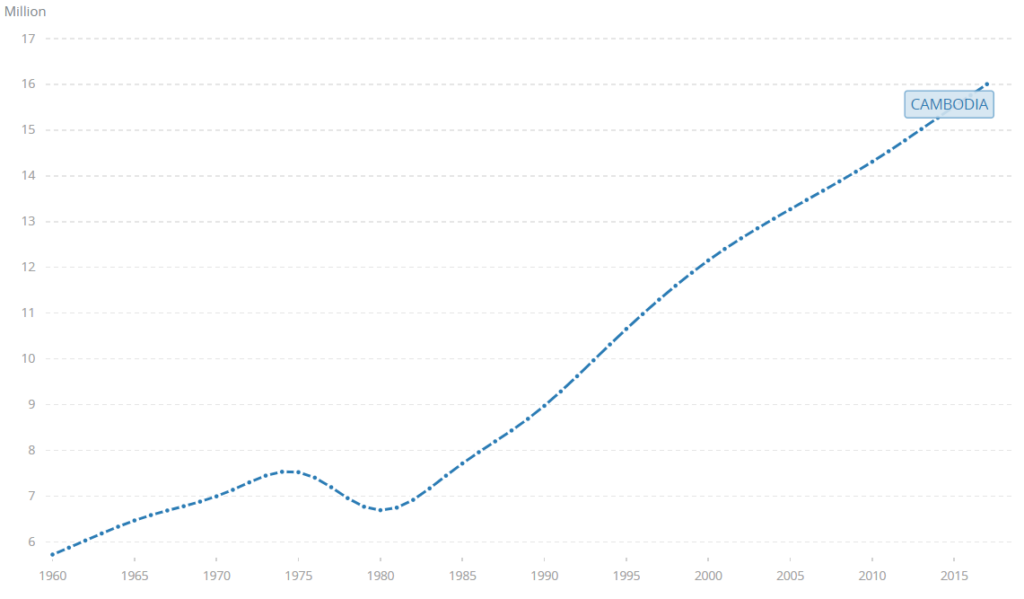
Population Changes in Cambodia Across Different Years (Data Source: World Bank)
2. Increase in the Young Adult Population Driving Steady Growth in Real Estate Demand
The young adult population, aged between 30 and 44 years old, in Cambodia holds significant economic capability and represents the main demographic group for homebuying. Based on current data, the young adult population in Cambodia is estimated to be around 3.42 million people, and it is projected to increase to 7.7 million people over the next decade. The growth of the young adult population will stimulate the rise in demand for real estate.
According to a report from Cambodia’s Ministry of Land Management, Urban Planning and Construction, population growth will drive an increase in housing demand. It is projected that by 2030, the demand for residential housing will reach 850,000 units, which means that 50,000 housing units will be needed annually to accommodate residents. By then, at least 7,000,000 people will be concentrated in major cities across the country. This substantial housing demand indicates the potential of the real estate market, particularly in highly sought-after markets such as the capital city, Phnom Penh.
Therefore, the future prospects for Cambodia’s real estate market are highly promising, especially in major cities. With the growth of the young adult population and increasing demand for housing, this will bring about more opportunities for the real estate market in Cambodia.
3. With the Expansion of the Middle Class, Cambodia’s Domestic Demand Significantly Increases
In recent years, Cambodia has demonstrated remarkable economic performance, attracting a significant influx of foreign investors and driving the country’s development. With an average annual economic growth rate of 7%, Cambodia is positioned as a leader globally. This has resulted in improved living standards for its people and a steady increase in income.
According to data from the International Monetary Fund (IMF), Cambodia’s average Gross Domestic Product (GDP) per capita was $1,508 in 2018, which is over five times higher than that of the year 2000. However, when evaluating Cambodia’s per capita income based on purchasing power parity (PPP), the performance is even more impressive. As countries have varying living standards and price levels, using purchasing power parity allows us to better assess a nation’s consumer purchasing power.
Since 1986, Cambodia’s per capita income, measured by purchasing power parity, can be seen as experiencing a ‘leapfrog’ growth, with a rapid surge particularly by the year 2000. The International Monetary Fund (IMF) predicts that by 2024, Cambodia’s per capita income will reach $6,516 international dollars, indicating a significant increase in people’s purchasing power and consumer capabilities over the next decade, surpassing the current levels by far. This showcases the country’s tremendous potential for economic development.
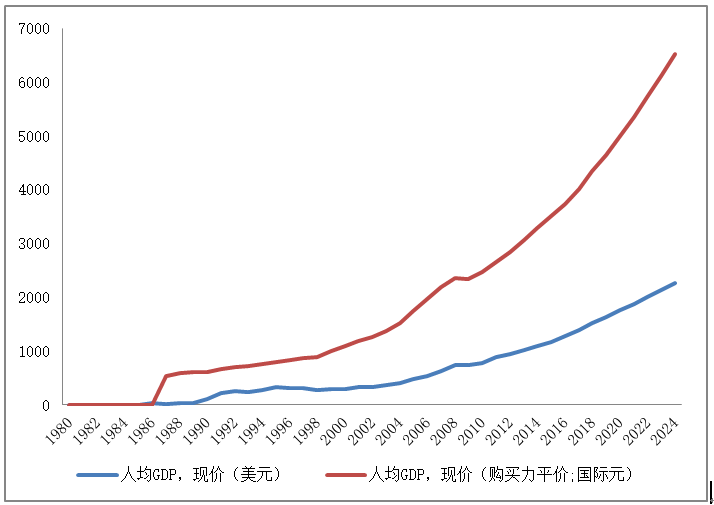
Comparison of Cambodia’s Per Capita GDP in Nominal and Purchasing Power Parity (PPP) Terms in Recent Years (Data Source: IMF)
In addition, according to the assessment by the International Labour Organization (ILO), Cambodia has experienced a significant increase in the proportion of the middle class within the labor force since 2004. At that time, the middle class accounted for approximately 9.8%, equivalent to around 642,000 people. By 2008, the proportion of the middle class had risen to 16.1%, encompassing around 1,200,000 people. In 2017, it was estimated that about 31.6% of the labor force belonged to the middle class, with a total of approximately 2,800,000 individuals. As part of the government’s plan, Cambodia aims to become a middle-income country by 2030, which would result in a significantly larger middle class with increased purchasing power and aspirations for improved quality of life. This will greatly drive the growth of domestic demand in Cambodia.
4. Emerging Affluent Population Driving Expansion of the Healthcare Service Market
The healthcare market in Cambodia has surpassed USD 1 billion and is experiencing double-digit annual growth rates. With social development, the country’s demand for advanced medical equipment has been steadily increasing. In the past, the Ministry of Health in Cambodia was the primary procurement entity for drugs, equipment, and medical supplies. However, the rise of private hospitals in recent years has led to an upward trend in the demand for advanced medical equipment. The emerging affluent population, supported by their financial capabilities, seeks high-quality medical services, thereby driving progress in Cambodia’s healthcare sector. It is expected that in the next decade, the people of Cambodia will have access to advanced treatments within the country, reducing the need to seek medical care abroad in destinations like Singapore or Thailand.
5. Increased Life Expectancy in Cambodia Fuels Significant Growth in Insurance Demand
In recent years, the average life expectancy of the Cambodian population has reached 69 years, an increase of 11 years compared to 20 years ago. According to estimates by the Cambodian government, the current population of individuals aged 60 and above is approximately 1.2 million, accounting for 8% of the total population, and is projected to increase to 11% by 2030. With the extension of life expectancy and the growth of the elderly population, there will be a corresponding increase in demand for insurance and caregiving services.
Currently, Cambodia does not have a mandatory social health insurance system in place, with only 5% of the population having private health insurance, primarily among the middle class. Considering the high healthcare costs in Cambodia, the middle class aims to avoid financial burdens resulting from medical expenses. As a result, life insurance and health insurance will become increasingly popular in the future, presenting immense market potential. Additionally, there will be significant business opportunities in products and services targeting the elderly population, such as elderly care services and health foods.
The population growth, increase in the middle class, and extended life expectancy will fundamentally transform the landscape of Cambodia. The next decade will be the “Explosive Period of Demographic Dividend”for Cambodia.
Here are the trends that will fundamentally transform the business environment in Cambodia:
| Field | Description |
| Real Estate Demand Strong | The real estate market has entered a phase of strong demand, driven by the growing housing needs of the middle class. |
| Vibrant Consumerism | The domestic consumer vitality is gradually increasing, providing significant market opportunities for various consumer goods and services. |
| Enhanced Healthcare Quality | The quality of healthcare continues to improve, and the domestic medical industry is experiencing robust growth, driving advancements and developments in the healthcare sector. |
| Expansion of the Insurance Market | The concept of insurance is gradually becoming more widespread in Cambodia, with a continuously expanding market. Life insurance, health insurance, and other types of insurance will witness broader development opportunities in the Cambodian market. |
| Expanded Market Potential in Aging Population | With the average life expectancy of the Cambodian population increasing and the rise in the elderly population, there are significant business opportunities in the market for products and services targeting the elderly. There will be a substantial increase in demand for elderly care services, health foods, and other related products and services, presenting new opportunities for market exploration. |
Conclusion
In the future, Cambodia will no longer be the Cambodia of 30 years ago but an emerging country with immense economic vitality and business opportunities. The nation is gradually making its mark and attracting the attention of numerous investors and businesses. Over time, it will bring about significant transformations in the economic and business sectors, emerging as a remarkable new market. This will bring forth more opportunities and challenges while improving the quality of life for the people of Cambodia.
References
By 2030, with a population of 20 million, Cambodia will offer enormous business opportunities in the following two industries for the future:https://www.titanstonegroup.com/zh/tsr/cambodias-big-business-opportunities-in-two-industries-in-the-future/