Summary: Cambodia natural rubber plantations cover 448,051 hectares, about 80% of which are being tapped. In 2025 natural rubber exports fell 12.3% to 343,762 tonnes, while domestic use rose 146% to 124,321 tonnes; a tire maker operating in Cambodia says factory expansion is driving local demand.
Local natural rubber does not help every downstream product equally: tires use dry rubber and benefit most directly; latex gloves depend on a stable nearby supply of concentrated latex; nitrile gloves and products made mainly from synthetic rubber gain almost nothing. For exports to the EU, the EU Deforestation Regulation (EUDR) requires traceability to the plantation plot from 30 December 2026, and smallholders, who produce about 44% of the rubber, are the main traceability challenge; conveyor belts and other vulcanized rubber articles (HS 4010 and 4016) were removed from its scope by a delegated regulation published in September 2026. How much local rubber is worth to each product depends on whether the raw material math, compliance requirements and site conditions fit together.
1. How Much Natural Rubber Does Cambodia Have? Output, Exports and Domestic Use Are Shifting
As of July 2026, Cambodia’s rubber plantations covered 448,051 hectares, of which 357,483 hectares, about 80%, had reached tapping age; in 2025 natural rubber exports were 343,762 tonnes, down 12.3% year on year, while domestic use rose 146% to 124,321 tonnes. A tire maker operating in Cambodia says factory expansion is driving domestic demand.
Companies assessing rubber products manufacturing in Cambodia usually ask three questions first: is there enough local rubber, what form is it in, and can the product be sold into the EU. The answers vary by product. Tires, latex gloves, rubber parts and footwear all use natural rubber, yet the benefit each gets from local supply differs widely.
The fall in exports and the rise in domestic use coincide with the expansion of tire capacity. Cambodia’s natural rubber was historically sold mostly abroad; according to an October 2026 report in The Phnom Penh Post, the chief executive of Sailun Tire Cambodia said domestic demand for natural rubber keeps rising as the plant expands. According to the General Department of Customs and Excise, tire exports in the first nine months of 2026 were about US$1.723 billion, up 77.46% year on year.
| Item | Value | Period | Source |
| Rubber plantation area | 448,051 ha (357,483 ha tapped, about 80%) | July 2026 | Ministry of Agriculture, Forestry and Fisheries (via The Phnom Penh Post) |
| Natural rubber output | 307,332 tonnes (+3.92% year on year) | January–October 2025 | General Directorate of Rubber (via Khmer Times) |
| Natural rubber exports | 343,762 tonnes (−12.3% year on year) | Full year 2025 | General Directorate of Rubber (via Xinhua) |
| Domestic use | 124,321 tonnes (+146% year on year) | Full year 2025 | Ministry of Agriculture, Forestry and Fisheries (via AKP) |
| Average rubber price | US$1,756 per tonne | Full year 2025 | General Directorate of Rubber (via Xinhua) |
| Smallholder share of output | About 44% | Reported March 2025 | Forest Trends researcher (via Vietnam News) |
| Tire exports | US$1.38 billion (+57.86% year on year) | Full year 2025 | Ministry of Commerce (via The Phnom Penh Post) |
| Tire exports | US$1.723 billion (+77.46% year on year) | January–September 2026 | General Department of Customs and Excise (via The Phnom Penh Post) |
Table 1: Key natural rubber and tire data for Cambodia (the coverage and timing of each figure follow the sources listed).
For tariffs and capacity shifts in the tire industry, see 〈Cambodia Tire Manufacturing: Capacity Transfer Under US AD/CVD Duties〉. How much each downstream product gains from local rubber has to be assessed item by item: the form of the rubber, the product’s compound and EU traceability rules.
2. What Form Does Cambodia’s Natural Rubber Take? Dry Rubber and Concentrated Latex Decide Downstream Use
After primary processing near the plantations, natural rubber falls into two groups: solid dry rubber such as technically specified rubber (TSR) and ribbed smoked sheets, used for compounding in tires and rubber products; and concentrated latex, a liquid raw material used to dip-mould gloves, balloons and catheters.
TSR is graded by impurity content and plasticity and is the grade tire plants use most; concentrated latex is made by centrifuging fresh field latex and needs preservatives, so processing sites are mostly close to plantations.
For product manufacturers, the form determines how much “local sourcing” is worth. Products made from dry rubber can bring material by road from Cambodia’s growing areas, saving the sea freight and transshipment of imported rubber; products made from latex depend on whether stable concentrated latex capacity and quality testing exist nearby.
3. Why Can Tires Make the Most of Cambodian Natural Rubber? Dry Rubber Inputs and the Materials Still Imported
Tires are the largest downstream user of natural rubber and rely mainly on dry rubber such as TSR, which makes them the product that benefits most directly from Cambodia’s local rubber supply.
Cambodia’s tire exports have grown quickly in two years: US$1.38 billion in 2025, up 57.86%, and already US$1.723 billion in the first nine months of 2026. Tire plants are spread across Svay Rieng, Preah Sihanouk and Kratie provinces rather than concentrated in one area; as capacity comes on stream, local rubber has started to appear on tire makers’ purchasing lists.
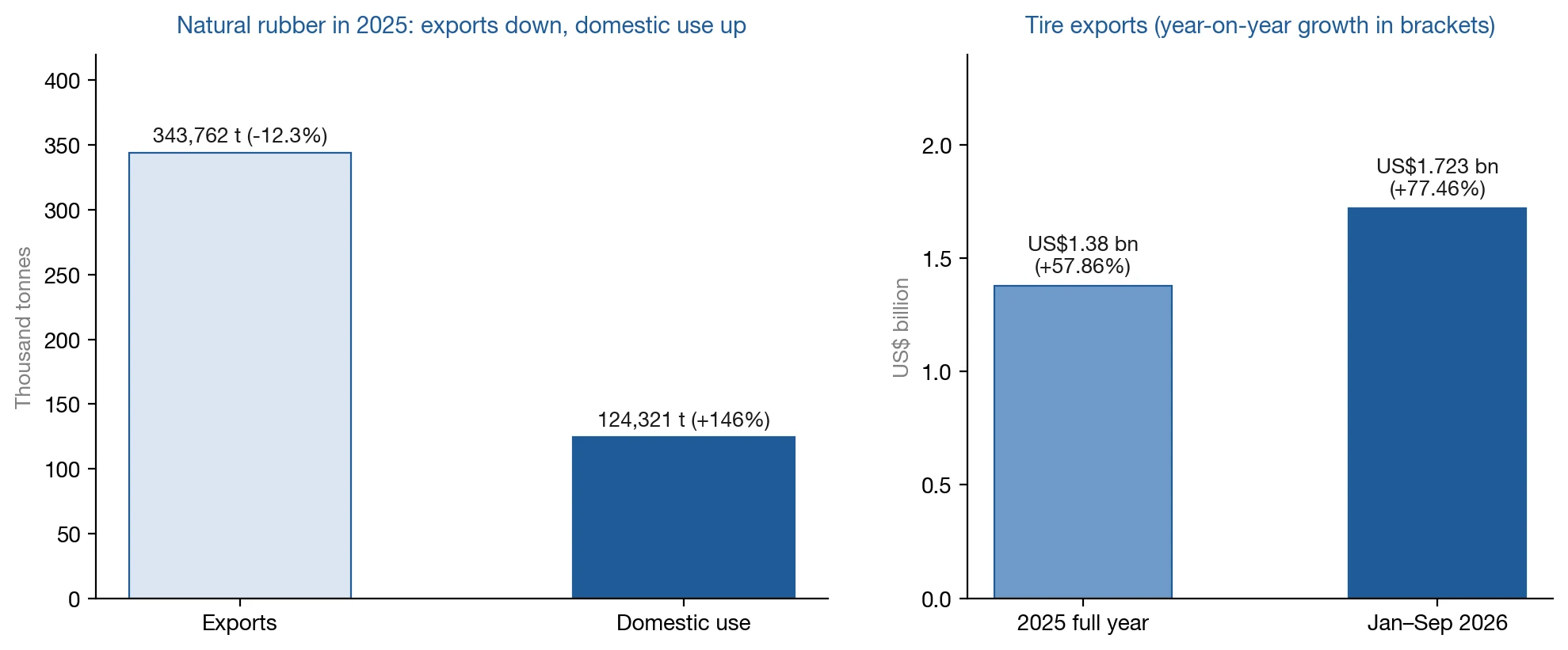
Figure 1: Cambodia’s 2025 natural rubber exports and domestic use, and tire exports (compiled from public data of the General Directorate of Rubber, the Ministry of Commerce and the General Department of Customs and Excise).
Local rubber solves only the rubber itself. Tire cord fabric, steel cord, carbon black and chemical additives are still mostly imported, and a tire plant’s origin content depends on its local rubber sourcing ratio and on how much of the mixing and vulcanizing is done in Cambodia.
4. Can Latex and Nitrile Gloves Use Cambodian Natural Rubber? Concentrated Latex vs Synthetic Rubber
Latex gloves are dip-moulded from concentrated latex, so whether they benefit from local rubber depends on a stable supply of concentrated latex nearby; nitrile gloves are made from synthetic nitrile latex, which has nothing to do with natural rubber, so the case for making them in Cambodia lies outside raw materials.
As of November 2026, no public statistics on Cambodia’s concentrated latex capacity or production locations could be found: the General Directorate of Rubber and the Ministry of Agriculture, Forestry and Fisheries publish plantation area, output, exports and domestic use, without a separate figure for concentrated latex. Whether nearby latex supply and quality can meet a glove plant’s needs has to be confirmed with individual processors.
Dip moulding means dipping formers into compounded latex, then coagulating, vulcanizing, washing and stripping them to make gloves. The latex’s dry rubber content, stability and protein content directly affect yield and product grade, and medical examination gloves require more consistent raw material. Whether a concentrated latex source can be contracted long term, its monthly volume and how it is tested are key factors when companies planning to use local latex assess a site.
Nitrile latex is synthesized from butadiene and acrylonitrile and is a petrochemical product. For nitrile glove plants, the assessment centres on energy, water and wastewater treatment, labour and target markets. Under the Ministry of Environment’s Prakas No. 3591 (EIA classification), medical device manufacturing projects fall into the Initial Environmental Impact Assessment (IEIA) class; the actual classification of medical glove projects, latex and nitrile alike, is subject to the Ministry’s review.
The two types of gloves are also treated differently under the EUDR: vulcanized natural rubber gloves are covered products, while nitrile gloves are synthetic rubber products and fall outside its scope.
5. How Much Local Natural Rubber Goes into Rubber Parts and Footwear? Compound Ratios and Nearby Supply
Rubber parts and shoe soles are usually made by mixing natural rubber, synthetic rubber and fillers to a compound formula; natural rubber is only part of the compound, and its share is set by customer specifications. Local rubber can reduce part of the material cost but is usually not the main reason to set up a plant.
Demand for both products is already in Cambodia. According to Cambodia’s Ministry of Commerce, footwear exports in 2025 were about US$2.09 billion, up 24.5% year on year, and auto parts exports were US$294 million, up 11.34%; shoe factories need outsoles and footwear materials, and auto parts plants need seals, anti-vibration parts and hoses.
For rubber component makers, following downstream customers to Cambodia shortens delivery distances and helps meet customers’ lead time and origin requirements; local natural rubber is the one ingredient in the compound that can be sourced nearby, while synthetic rubber, carbon black and additives are still mainly imported.
| Product | Main rubber type | Role of local rubber | EUDR coverage |
| Tires (part of 4011) | Natural dry rubber such as TSR, with synthetic rubber | Direct: dry rubber can be bought nearby | Natural rubber tires are covered |
| Latex gloves (part of 4015) | Concentrated natural latex | Depends on a stable concentrated latex supply | Vulcanized natural rubber gloves are covered |
| Nitrile gloves | Nitrile latex (synthetic) | None: the raw material is a synthetic petrochemical | Not covered (synthetic rubber) |
| Rubber parts (4016) | Natural and synthetic rubber mixed to a formula | Partial: share set by customer specifications | Removed from scope by (EU) 2026/2102 |
| Soles and footwear materials | Natural rubber, synthetic rubber, EVA and others | Partial: formulas are flexible | Footwear is not a covered product |
Table 2: Rubber types, role of local rubber and EUDR coverage for five downstream rubber products (numbers in brackets are HS codes; compiled from Annex I of Regulation (EU) 2023/1115, Delegated Regulation (EU) 2026/2102 and industry sources).
6. Exporting Cambodian Rubber Products to the EU: How Far Back Must EUDR Traceability Go? Plot Geolocation and Covered Products
The EU Deforestation Regulation (EUDR) applies from 30 December 2026 to large and medium operators, and from 30 June 2027 to micro and small operators established before the end of 2024. When natural rubber and products such as tires, inner tubes and vulcanized natural rubber gloves enter the EU, operators must show that the raw material is not linked to deforestation after 31 December 2020, complies with the laws of the country of production, and can be traced to the geolocation of the plantation plot.
The current application dates were set by amending Regulation (EU) 2025/2650, in force since 26 December 2025. Size here refers to the operator placing the product on the EU market, not the Cambodian manufacturer itself; micro and small operators established after the end of 2024 also apply the rules from 30 December 2026. Smaller manufacturers may therefore be asked by EU buyers for plot data from that day. In its report of 4 May 2026, the European Commission said it did not see a need to amend the basic act again; as of 29 October 2026, the EU had not proposed any new change to these application dates.
On product scope, the EUDR covers only natural rubber from the Hevea brasiliensis tree; synthetic rubber products are outside it. Delegated Regulation (EU) 2026/2102, published on 17 September 2026 and in force the next day, amended Annex I on the grounds of low natural rubber content, removing conveyor and transmission belts (4010) and other articles of vulcanized rubber (4016) from scope; under 4012 only tread (4012 90 30) remains, and retreaded tires are no longer listed. Natural rubber tires and gloves remain in scope.
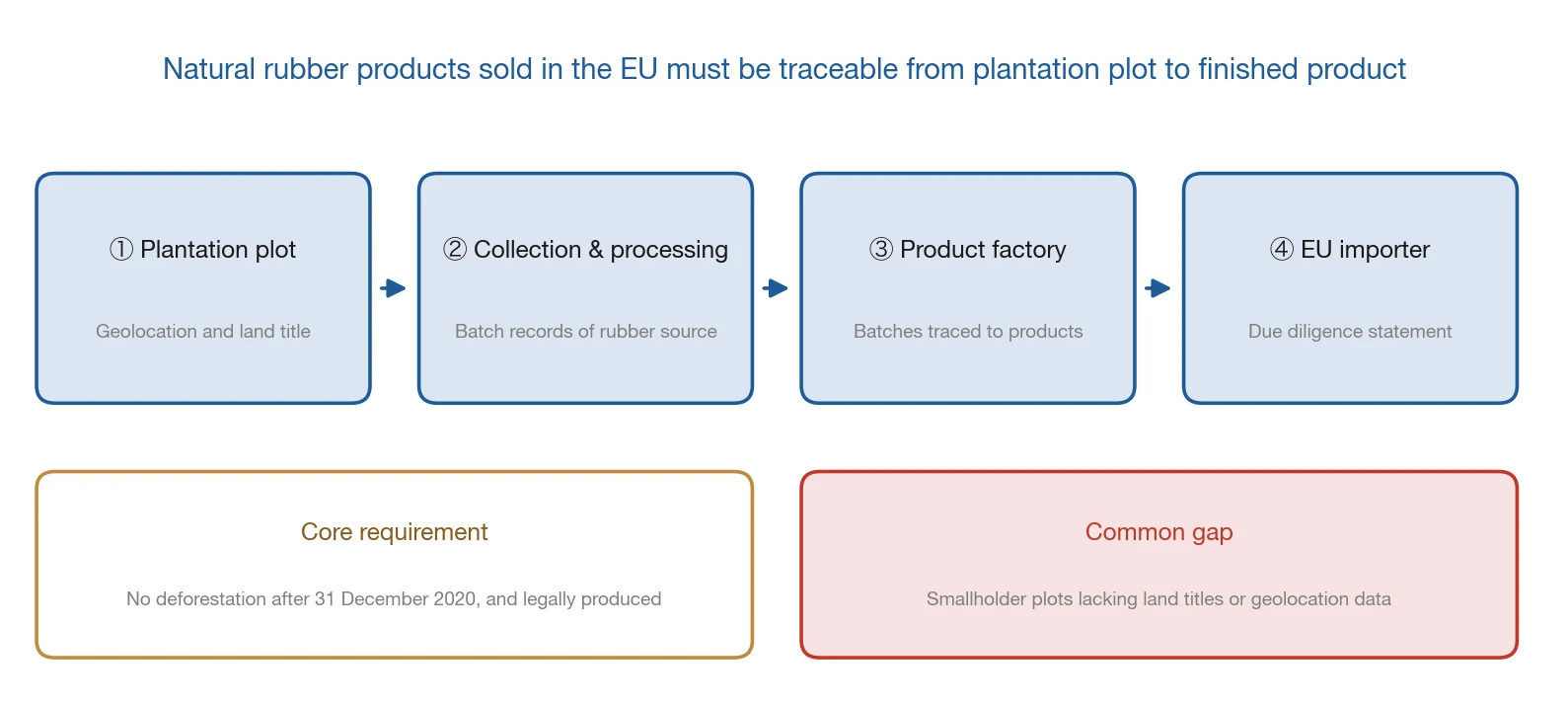
Figure 2: The traceability chain for natural rubber products exported to the EU (compiled from Regulation (EU) 2023/1115 and amending Regulation (EU) 2025/2650).
The results of due diligence are submitted to the EU information system as a due diligence statement, which must give the product’s HS code and quantity, the country of production and the geographic coordinates of every plantation plot; where production land exceeds 4 hectares, the plot boundary must be marked with a polygon. Importers must give the statement’s reference number in their customs declaration, so if a manufacturer cannot provide this data to its EU buyer, the buyer will struggle to complete the declaration.
In Cambodia the difficulty lies with smallholders. Researchers at Forest Trends estimate that about 44% of Cambodia’s rubber is produced by smallholders (about 50% in Vietnam), and these plantations often lack complete land tenure documents. Whether a manufacturer exporting to the EU can complete due diligence also depends on whether its rubber comes from plantation companies that can provide plot data or from collection channels without batch records. On penalties, the EU requires member states to set maximum fines at no less than 4% of a company’s annual EU turnover.
7. When Does Cambodia’s Local Rubber Supply Not Help? Synthetic Rubber, Special Grades and Traceability Gaps
In three situations local rubber is no reason to set up a plant: the product is made mainly from synthetic rubber, the product specification needs a rubber grade that cannot be reliably supplied nearby, or the product is exported to the EU but plot-level traceability data cannot be obtained.
Products made mainly from synthetic rubber, such as nitrile gloves and chloroprene products, have nothing to do with natural rubber; if medical latex products need latex of special grades such as low-protein latex and no matching processing and testing capacity exists nearby, the raw material still has to be imported. For EU-bound products within the EUDR’s scope, if the rubber cannot be traced to the plot, due diligence cannot be completed even if the raw material was grown in Cambodia.
These limits are not fixed. If Cambodia’s concentrated latex capacity and plantation traceability improve markedly in the coming years, the conclusions for latex products and EU-bound rubber products will change accordingly.
8. What Should a Rubber Products Plant in Cambodia Look for in a Site? Linking Rubber Supply, Imported Inputs and Export Routes
Siting a rubber products plant means linking three lines at once: local rubber supply, imported inputs and export ports. Manhattan Special Economic Zone (MSEZ) is a special economic zone in Bavet on the Cambodia–Vietnam border that serves export manufacturers; imported inputs and exported products connect through the Bavet–Moc Bai border crossing and the ports of Ho Chi Minh City, and local rubber arrives by road: based on the OpenStreetMap road network, the zone is about 130 km from Suong, the capital of Tbong Khmum province, and about 155 km from Kampong Cham city.
From a batch of dry rubber entering the plant to finished goods shipping out, several accounts apply at plant level: the distance and number of truck trips for rubber from growing areas or primary processors to the plant; which port and border crossing imported inputs such as carbon black and curing agents use; which port finished goods leave from; and the EIA class of the mixing and vulcanizing processes (Prakas No. 3591 lists tire factories as IEIA, while other rubber products are classified by project type), together with wastewater treatment requirements.
Manhattan SEZ is about 6 km from the Bavet–Moc Bai international border crossing and about 90 km by road from Cat Lai Port in Ho Chi Minh City, and Vietnamese container trucks can drive straight into factories to load and unload; inputs such as carbon black and additives imported through Ho Chi Minh City ports use the same overland route as exported goods. Import and export customs clearance is handled at the in-zone customs office, and certificates of origin are processed by the Ministry of Commerce window at the zone’s one-stop service office. Footwear and auto parts companies already operate in the zone, and they are also downstream users of rubber components. Power for mixing and vulcanizing equipment comes from the zone’s dedicated 115 kV substation, with dual high-voltage supply and total capacity of 80 MW; the zone’s wastewater treatment plant handles 5,000 cubic metres a day with 24/7 online monitoring, and the conditions for discharging latex processing wastewater are confirmed according to the project’s EIA and the treatment plant’s influent requirements.
Rubber traceability and product formulation are part of a company’s own procurement and process management; what Manhattan SEZ provides is the plant-level import and export, administrative and infrastructure conditions. Companies assessing a rubber products operation in Cambodia can use the Manhattan SEZ advisory team contact form to share the product and HS code, rubber type and monthly volume, target markets and whether they export to the EU; the advisory team can then check whether the import and export routes for inputs and finished goods, the EIA class, and plant conditions such as power and wastewater fit the project.
9. Cambodia Natural Rubber Downstream FAQ: Rubber Supply, Gloves, Tires and EUDR
Q1: How much natural rubber does Cambodia export and use at home?
| According to the General Directorate of Rubber and the Ministry of Agriculture, Forestry and Fisheries, natural rubber exports in 2025 were 343,762 tonnes, down 12.3%, and domestic use was 124,321 tonnes, up 146%; according to the Ministry of Agriculture, Forestry and Fisheries, plantations covered 448,051 hectares nationwide as of July 2026, about 80% of them tapped. |
Q2: Can latex gloves made in Cambodia use local latex?
| It depends on securing a stable supply of concentrated latex. As of November 2026, no public statistics on Cambodia’s concentrated latex capacity could be found, so supply has to be confirmed with individual processors; latex gloves are dip-moulded from centrifuged concentrated latex, and raw material quality affects yield. Nitrile gloves use synthetic rubber and have nothing to do with local natural rubber. |
Q3: How much does Cambodia export in tires?
| According to the General Department of Customs and Excise, tire exports in the first nine months of 2026 were about US$1.723 billion, up 77.46% year on year; the full-year 2025 figure was US$1.38 billion. Tires are the downstream product that benefits most directly from local natural rubber. |
Q4: When does the EUDR start applying to rubber?
| Large and medium operators on the EU market apply it from 30 December 2026, and micro and small operators established before the end of 2024 from 30 June 2027. Covered products must provide plantation plot geolocation and show no link to deforestation after the end of 2020. |
Q5: Do synthetic rubber products also have to comply with the EUDR?
| No. The EUDR covers only natural rubber from Hevea brasiliensis and products made from it; even where they contain natural rubber, conveyor belts and other vulcanized rubber articles (HS 4010 and 4016) were removed from the covered products by a delegated regulation published in September 2026. |
Q6: What should a rubber products plant in Cambodia look for in a site?
| Rubber supply, imported inputs and export routes need to connect, and the EIA class needs to be confirmed. Taking Manhattan SEZ as an example: it is about 130 km by road from Suong, the capital of Tbong Khmum, about 6 km from the Bavet–Moc Bai border crossing and about 90 km from Cat Lai Port in Ho Chi Minh City, with imported inputs such as carbon black and exported goods using the same overland route; tire factories are classed as IEIA under Prakas No. 3591. The product, rubber type and monthly volume can be sent through the Manhattan SEZ advisory team contact form, and the advisory team will check the import and export routes and plant conditions. |
10. Sources and References
📚 References
- The Phnom Penh Post via Asia News Network (2026-10-15) | Rubber meets the road: tire exports of US$1.723 billion in January–September 2026, up 77.46%; tire exports of US$1.38 billion in 2025, up 57.86%; 448,051 ha of rubber plantations as of July 2026, 357,483 ha tapped; a tire maker in Cambodia says domestic demand for natural rubber keeps rising.
https://asianews.network/?p=307988 - General Directorate of Rubber, via Xinhua (2026-01-13) | 2025 natural rubber exports of 343,762 tonnes, down 12.3%; domestic use up 146%; average price US$1,756 per tonne; plantation area 448,051 ha.
https://english.news.cn/20260113/32e087fec8a040dcba6a8bc404ad40b5/c.html - Vietnam News (2025-03-28) | Forest Trends researcher Tô Xuân Phúc: about 44% of Cambodia’s rubber is produced by smallholders, who often lack complete land tenure documents.
https://vietnamnews.vn/economy/1694795/eu-deforestation-rules-pose-challenges-for-rubber-production-in-viet-nam-cambodia.html - Vietstock, from Khmer Times (2025-11-14) | General Directorate of Rubber: output of 307,332 tonnes in January–October 2025, up 3.92%.
https://en.vietstock.vn/2025/11/kingdom-earns-over-636m-from-rubber-exports-114-624482.htm - Official Journal of the European Union (2023-06-09) | Regulation (EU) 2023/1115 on deforestation-free products: rubber items in Annex I; covers only natural rubber from Hevea brasiliensis; Article 25 requires member states to set maximum fines of at least 4% of annual EU turnover.
https://eur-lex.europa.eu/eli/reg/2023/1115/oj - Official Journal of the European Union (2026-09-17) | Delegated Regulation (EU) 2026/2102: amends Annex I, deleting conveyor and transmission belts (4010) and other articles of vulcanized rubber (4016), and limiting 4012 to tread (4012 90 30); published 17 September 2026, in force the next day.
https://eur-lex.europa.eu/legal-content/EN/TXT/PDF/?uri=OJ%3AL_202602102 - EY Tax News (2026-01-20) | Amending Regulation (EU) 2025/2650: applies to large and medium operators from 30 December 2026 and to micro and small operators from 30 June 2027.
https://taxnews.ey.com/news/2026-0237-eu-deforestation-regulation-application-postponed-to-30-december-2026 - Coolset (2026-09-25) | (EU) 2025/2650 entered into force on 26 December 2025; the Commission’s report of 4 May 2026 saw no need to amend the basic act again.
https://www.coolset.com/academy/the-eu-deforestation-regulation-eudr-what-businesses-need-to-know-and-do - Polygon (checked 2026-10-29) | EUDR current status: as of 29 October 2026, EUR-Lex listed no proposal changing the 30 December 2026 and 30 June 2027 dates; micro and small operators established before the end of 2024 apply 30 June 2027, those established later 30 December 2026.
https://polygon-one.com/en/eudr-current-status - Cambodia Investment Review (2026-01-23) | Ministry of Commerce: garment, footwear and travel goods exports of about US$15.5 billion in 2025, including footwear of about US$2.09 billion, up 24.5%.
https://cambodiainvestmentreview.com/2026/01/23/cambodias-garment-footwear-and-travel-goods-exports-hit-15-5-billion-in-2025-as-regional-trade-drives-growth/ - Vietstock, from Ministry of Commerce data (2026-01-28) | Auto parts exports of US$294 million in 2025, up 11.34%.
https://en.vietstock.vn/2026/01/cambodias-electrical-goods-exports-surge-in-2025-52000-628834.htm - Ministry of Environment of Cambodia (2025-05-06) | Prakas No. 3591 on the EIA classification of development projects: item 48 tire factories and item 168 medical device manufacturing are both IEIA.
https://data.opendevelopmentcambodia.net/laws_record/prakas-no-3591-on-the-classification-of-development-projects-for-environmental-impact-assessm - Agence Kampuchea Presse (2026-01-13) | Domestic Consumption of Rubber Latex Records New High: according to the Ministry of Agriculture, Forestry and Fisheries, domestic use of 124,321 tonnes in 2025, up 146%; natural rubber exports of 343,762 tonnes worth about US$644 million; 448,051 ha planted, of which 346,842 ha can be tapped.
https://akp.gov.kh/post/detail/358869 - OpenStreetMap road network, calculated with OSRM (2026-11-05) | About 131 km from Suong (capital of Tbong Khmum) to Manhattan SEZ and about 156 km from Kampong Cham city (passenger car route).
https://www.openstreetmap.org/directions?engine=fossgis_osrm_car&route=11.9115%2C105.6533%3B11.0464%2C106.1189 - Manhattan SEZ Industry Knowledge Base | Related articles: 〈Cambodia Tire Manufacturing: Capacity Transfer Under US AD/CVD Duties〉.