Summary: Cambodia company registration cost starts with government fees: registering a private limited company through the government’s Single Portal completes Ministry of Commerce, tax and labour registration in one application, with government fees of about US$400 to US$600 and processing in about 7 to 15 working days. The most fixed annual cost afterwards is the patent tax: a company is classed at least as a medium taxpayer, paying KHR 1.2 million a year, while QIP holders and subsidiaries of multinational groups are large taxpayers paying KHR 3 million or 5 million, renewable by 31 March.
Hiring foreign staff involves a separate quota and work permit process; 2027 quotas must be applied for by 30 November 2026 (businesses that start operating after the notification was issued can apply when they start). The statutory review period for a Qualified Investment Project (QIP) registration certificate is 20 working days, but since August 2026 the Council for the Development of Cambodia has required manufacturing projects to reach the actual investment threshold within three years: existing projects count from the instruction’s issue date, new projects from receiving the registration certificate. The Ministry of Commerce has postponed the company secretary requirement for limited companies to January 2027, and it does not apply to SMEs and start-ups. Government fees are the same nationwide, regardless of where a factory is located.
1. What Is the Cambodia Company Registration Cost? 2026 Government Fees at a Glance
Registering a private limited company in Cambodia costs about US$400 to US$600 in government fees (official fees) paid through the Single Portal; in the first year the company also pays the patent tax. A company is classed at least as a medium taxpayer, paying KHR 1.2 million a year (about US$300), while QIP holders and subsidiaries of multinational groups are large taxpayers paying from KHR 3 million (about US$750), renewable by 31 March each year. Together, the first year comes to about US$700 to US$900 (medium) or US$1,150 to US$1,350 (large), excluding registered capital, work permits and service fees.
A set-up budget usually has five parts: one-off registration fees, the annual patent tax, minimum registered capital, quotas and work permits for foreign staff, and the actual investment threshold when applying for investment incentives. Agency and accounting service fees are set by the service providers and are not government fees; quotes usually list them separately. Cambodianess estimates that the total cost of using a consultant is about US$2,000 to US$4,000.
| Item | Amount (2026) | When paid | Basis |
| Company registration on the Single Portal (Ministry of Commerce, tax and labour registration combined) | About US$400–600 | At set-up | Third-party 2026 summaries; the portal’s payment page prevails |
| Patent tax: medium taxpayer (companies are at least medium) | KHR 1.2 million (about US$300) | At set-up; renew by 31 March each year | Sub-Decree No. 47; Prakas No. 009 |
| Patent tax: large taxpayer (including QIPs, subsidiaries of multinational groups and branches of foreign companies) | KHR 3 million (about US$750); KHR 5 million (about US$1,250) for turnover above KHR 10 billion | Same as above | Same as above |
| Minimum registered capital of a private limited company | Commonly stated as KHR 4 million (about US$1,000); some sources say there is no longer a statutory minimum | Paid in after opening a bank account | Law firm and consultancy summaries; Ministry of Commerce and General Department of Taxation requirements prevail |
| Annual work permit and employment card fee | KHR 520,000 per person per year (about US$130) | Apply within 90 days of entry; renew by 31 March each year | DFDL 2026 annual compliance summary |
Table 1: Main costs and capital requirements for setting up a private limited company in Cambodia (converted at about KHR 4,000 to US$1; compiled from the sources listed; the authorities’ current announcements prevail).
For a comparison of registration procedures and company types, see 〈Business Registration in Cambodia (2026): 5 Steps, Costs & Required Documents〉; for how the patent tax is filed, see 〈Business license in Cambodia〉. The costs, timelines and penalties are broken down below in the order of setting up.
2. How Long Does Company Registration in Cambodia Take and What Are the Fees? Ministry of Commerce, Tax and Labour Registration on the Single Portal
Company registration is applied for in one go through the government’s online Single Portal (registrationservices.gov.kh, built on the CamDX system), which completes Ministry of Commerce registration, tax registration with the General Department of Taxation and the business opening declaration with the Ministry of Labour at the same time; fees are paid online, and with complete documents the process takes about 7 to 15 working days.
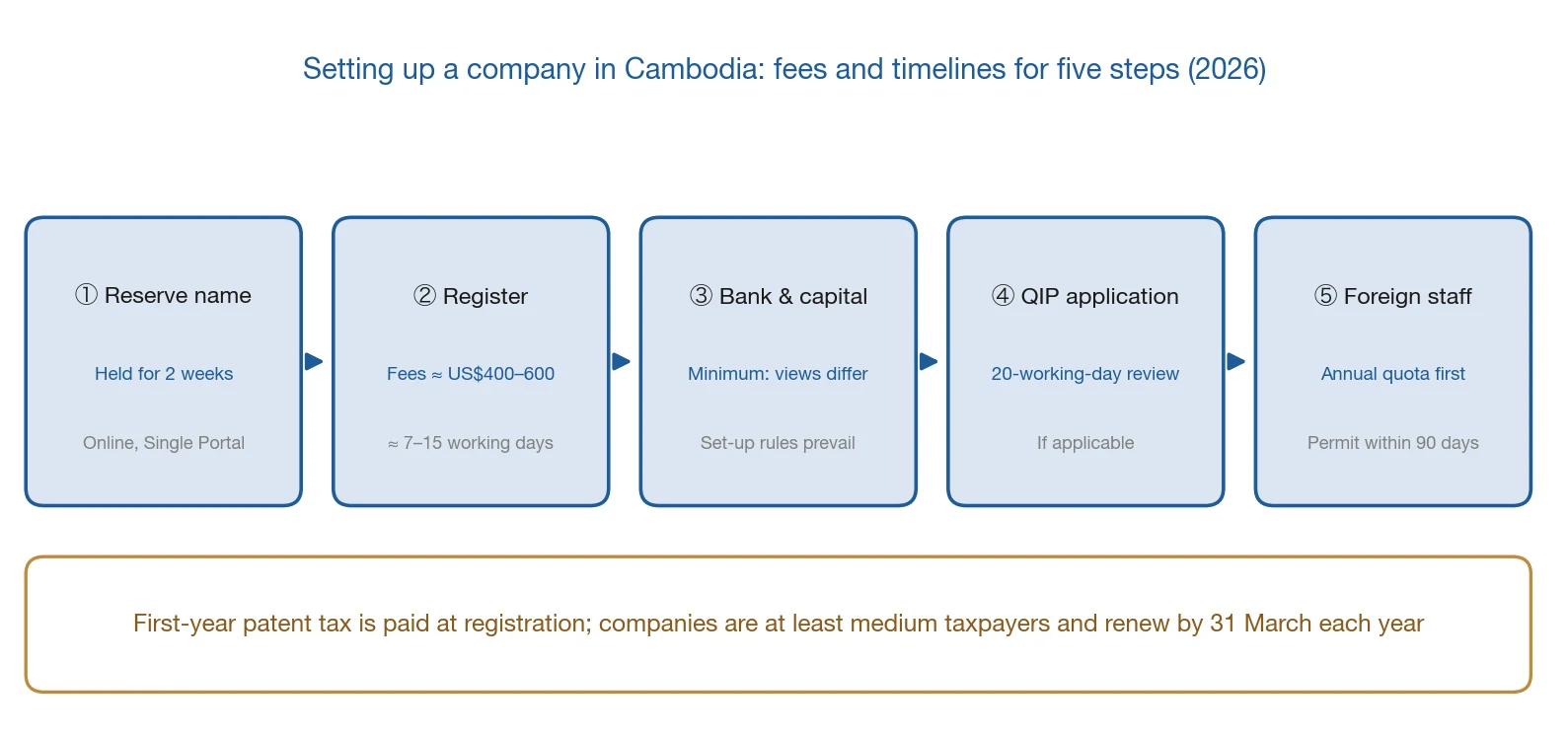
Figure 1: Five steps for setting up a company in Cambodia with the matching fees and timelines (compiled from 2026 materials by Cambodianess, Kreston Cambodia, DFDL and KPMG).
The application begins with reserving a company name, which is held for two weeks once approved. The formal application requires uploading the passports of shareholders and directors, a registered address in Cambodia and its lease, the company name in Khmer and English, and the articles of association. Fee figures vary slightly between sources: Cambodianess’s July 2026 guide lists about US$200 for basic Ministry of Commerce registration and about US$400 to US$600 for full registration including tax registration; Emerhub lists about US$400, plus the annual patent tax for each business activity. The portal’s payment page gives the actual amount.
Emerhub says the Single Portal issues the registration certificate in about 8 to 10 working days; with bank account opening, sector licences and employer registration, it estimates the whole set-up takes about three to five weeks.
Registration rules also changed in 2026. Ministry of Commerce Prakas No. 117 (issued 9 December 2025, effective 8 January 2026) simplified company registration, amendment and deregistration procedures; Prakas No. 044 of 26 May introduced the second phase, making articles of association electronic documents certified by the Ministry of Commerce through verify.gov.kh instead of carrying paper stamps. The Ministry has postponed the requirement for limited companies to appoint a company secretary to January 2027, and it does not apply to sole proprietorships, start-ups or SMEs; where the company appoints its own staff member, that person does not need professional service qualifications, and registering the company secretary’s details in the system is free.
3. How Much Is Cambodia’s Patent Tax in 2026? Tiers and Renewal by 31 March
The patent tax is an annual tax on each registered business activity. In 2026 it is KHR 400,000 for small taxpayers, KHR 1.2 million for medium taxpayers and KHR 3 million for large taxpayers, rising to KHR 5 million for large taxpayers with turnover above KHR 10 billion; the first year is paid at set-up, and it is renewed by 31 March each year.
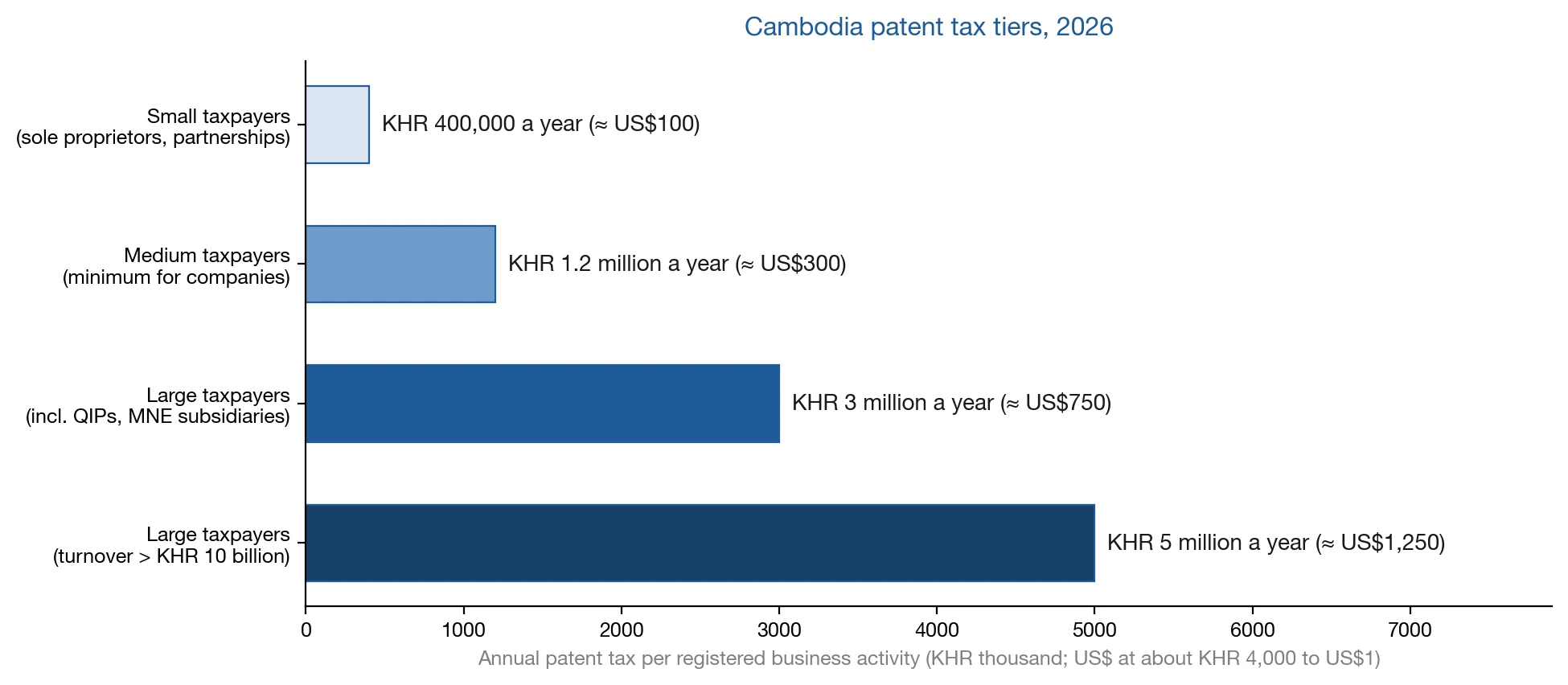
Figure 2: Cambodia’s patent tax tiers for 2026 (amounts from Sub-Decree No. 47 and tiers from Ministry of Economy and Finance Prakas No. 009, as summarized by PwC and DFDL; US$ figures are approximate).
These amounts were set by Sub-Decree No. 47, effective 11 March 2024; taxpayers that start business in the last six months of a calendar year pay half for that year. Taxpayer classification follows Ministry of Economy and Finance Prakas No. 009 of January 2021: enterprises set up as companies (legal entities) or representative offices are at least medium taxpayers; QIP holders, branches of foreign companies and subsidiaries of multinational groups are large taxpayers; and turnover above the thresholds also moves a taxpayer up (according to DFDL’s 2021 summary, annual turnover above KHR 8 billion for industry and above KHR 6 billion for services and commerce means large). A private limited company set up in Cambodia therefore never pays the small taxpayer rate of KHR 400,000; foreign-invested factories whose parent is overseas should budget from the large taxpayer rate of KHR 3 million if they are subsidiaries of multinational groups or hold QIP status. According to PwC, large taxpayers with business premises, offices, branches, warehouses, factories or workshops in other provinces or cities pay a further KHR 3 million.
31 March is also the deadline for annual income tax returns. Administrative penalties for tax violations under Article 231 of the Law on Taxation include additional tax of 10% to 40% of the underpaid tax, interest of 1.5% a month, fines of KHR 5 million to 10 million (about US$1,250 to US$2,500), and licence suspension or revocation or temporary business closure, depending on the nature and severity of the offence (as summarized by Andersen in 2024).
4. How Much Registered Capital Does a Cambodian Company Need? Two Views on Minimum Capital, and Paying It into a Bank
There are currently two views on the minimum registered capital of a private limited company. A guide written by Tilleke & Gibbins for Multilaw in 2024 states KHR 4 million (about US$1,000) under the Law on Commercial Enterprises and notes that in practice the General Department of Taxation may require KHR 20 million (about US$5,000); Expanship’s April 2026 explanation holds that private limited companies no longer face a statutory minimum at registration, although they must still declare their registered capital. According to Rajah & Tann, the 2022 amendment to the Law on Commercial Enterprises deleted paragraph 1 of Article 144 on the minimum number of shares. With both views in circulation, the actual amount follows the requirements of the Ministry of Commerce and the General Department of Taxation at the time of set-up. Foreign investors can hold 100% of most sectors but cannot own land; shareholders’ liability is limited to their subscribed shares.
Capital is paid in after the company opens a corporate bank account in Cambodia. Cambodianess’s July 2026 guide notes that consultants often advise declaring at least US$5,000; profits and capital can be remitted abroad through authorized banks.
5. How Long Does a QIP Application Take in Cambodia and How Is the Threshold Calculated? The 20-Working-Day Review and the New Actual Investment Rule
The review period for a Qualified Investment Project (QIP, a registration status that qualifies for investment incentives) registration certificate is 20 working days; but since 27 August 2026 the Council for the Development of Cambodia has required manufacturing QIPs to bring actual investment above the minimum threshold within three years (existing projects counting from the instruction’s issue date, new projects from receiving the registration certificate), failing which the certificate may be revoked.
Sub-Decree No. 139, effective 26 June 2023, shortened the issuance period for QIP registration certificates from 31 working days to 20; applications can be filed on paper or online and are handled by the Council for the Development of Cambodia or the provincial and municipal investment sub-committees depending on investment size. A registration certificate does not exempt the project from applying for other business licences and permits.
The 2026 rule matters more for budgeting. Council for the Development of Cambodia Instruction No. 1555/26 requires the actual investment of manufacturing QIPs to reach the minimum threshold listed in the negative list of Sub-Decree No. 139, excluding land and working capital; projects registered before 27 August 2026 must meet it within three years of the instruction’s issue date, and later projects within three years of receiving their certificate. The negative list of Sub-Decree No. 139 lists activities that may not apply for QIP status or may apply only under specific conditions; Sub-Decree No. 86 of 6 June 2025 amended Annex 1 of the list, adding the manufacture and assembly of electronic cigarettes and similar devices (item C.12.15). Thresholds depend on the activity listed and are not a single amount, so companies should first match their products to the relevant item and follow the current amended version. As for which spending counts as actual investment, KPMG’s note on Instruction No. 1555/26 only states that land costs and working capital are excluded and does not itemize what is included; the Council for the Development of Cambodia makes the final determination, and the pace of investment also affects whether QIP status can be kept.
6. What Does a Work Permit for Foreign Staff in Cambodia Involve? Annual Quotas and the 30 November 2026 Deadline
Hiring foreign staff requires an annual quota first, followed by a work permit and employment card for each employee; quotas for 2027 must be applied for by 30 November 2026 through the Foreign Workers Centralized Management System (FWCMS).
Notification No. 025/26, issued by the Ministry of Labour and Vocational Training on 31 August 2026, sets the application period for 2027 quotas from 1 September to 30 November 2026 and requires all businesses to link the Labour Automation Central Management System (LACMS) with FWCMS; businesses that start operating after the notification was issued can apply immediately when they start. The standard quota is 10% of local headcount, and anything above that requires a separate application. Businesses that fail to apply on time can be fined KHR 12.2 million to 18 million (about US$3,050 to US$4,500).
The 10% standard quota is split into three categories: office staff 3%, skilled workers 6% and unskilled workers 1%; businesses that need more foreign staff can apply for an increase under Prakas No. 277/20, subject to Ministry of Labour approval. For a factory with 500 local employees, the standard quota is at most 50 people: 30 skilled workers, 15 office staff and 5 unskilled workers; if seconded production supervisors and technicians exceed these proportions, an increase must be applied for.
Foreign employees must apply for a work permit through FWCMS within 90 days of first entry; permits are valid until 31 December of that year and are renewed by 31 March each year. According to DFDL’s January 2026 summary, the annual fee for the work permit and employment card is KHR 520,000 per person (about US$130), and years not paid may have to be paid retroactively. Under Joint Prakas No. 498 of 2023, businesses employing foreign staff without work permits can be fined per person, up to KHR 12.6 million (about US$3,150) each; Ministry of Labour Guideline No. 517 further caps the fine at KHR 63 million (about US$15,750) where five or more foreign employees lack permits.
7. What Does a Cambodian Company Pay Every Year? An Annual Calendar for Tax, Audit, Work Permits and Social Security
Once a company is set up, its fixed annual costs and filings cluster on a few dates: social security contributions and monthly reports on the 15th and 28th of each month, monthly tax returns on the 20th (including the 1% prepayment of income tax and withholding taxes), annual tax returns, patent tax and work permit renewals on 31 March, and financial statement submissions in April and July; in addition, next year’s foreign staff quota is applied for between September and November, and the annual declaration of commercial enterprise is due before the registration anniversary.
| Date | Obligation | Consequence of lateness or breach |
| 15th / 28th of each month | National Social Security Fund (NSSF) contributions / monthly social security report | The cited sources do not specify penalties |
| 31 March | Annual income tax return; patent tax renewal; work permit and employment card renewal | Tax violations: additional tax, interest or fines of KHR 5–10 million under Article 231 of the Law on Taxation; employing foreign staff without permits: fines per person of up to KHR 12.6 million each, up to KHR 63 million for five or more |
| 20 April | Submit unaudited financial statements (Accounting and Auditing Regulator, ACAR) | Unaudited enterprises with a financial reporting identification number (FIN): KHR 2 million a month, capped at KHR 12 million (Prakas No. 063) |
| 20 July | Submit audited financial statements (enterprises meeting the audit criteria or holding QIP status) | Failure to submit audited financial statements: fine of KHR 60 million (Sub-Decree No. 102, 25 May 2026) |
| 1 September – 30 November | Apply for next year’s foreign staff quota (FWCMS) | KHR 12.2–18 million (2027 quotas; Notification No. 025/26) |
| Within three months before the registration anniversary (plus a 15-day grace period) | Annual declaration of commercial enterprise (filed through the Ministry of Commerce Business Registration System, businessregistration.moc.gov.kh) | Penalties must be paid (amount not specified in the cited sources); Notification No. 2463 of July 2026 extended by six months the relief limiting penalties to the most recent year, and businesses that do not comply may be classified as inactive |
Table 2: Annual compliance calendar for companies in Cambodia (financial statement deadlines use fiscal year 2025 as an example; compiled from Lochan & Co. 2025-12-23; DFDL 2026-01-09, 2026-06-24, 2026-08-27 and 2026-09-07; KPMG 2026-09-15; Andersen 2024-02-09 and 2026-07-29; Rajah & Tann 2026-06-09; the authorities’ rules prevail).
Audit thresholds changed in 2026. ACAR’s Prakas No. 063 of 18 August 2026 provides that from fiscal year 2026 an audit is required when two of three criteria are met: annual turnover of KHR 20 billion for commerce, KHR 30 billion for manufacturing or KHR 8 billion for services; total assets of KHR 10 billion; and an average of 100 or more employees a year. QIP holders and branches of foreign companies must submit audited financial statements regardless of size.
These amounts and deadlines are 2026 rules. Once a taxpayer’s classification changes, the patent tax changes with it; the General Department of Taxation, the Ministry of Labour and the accounting regulator may also adjust fees and penalties, and the authorities’ current announcements give the actual amounts and deadlines.
8. Setting Up a Company in Manhattan SEZ: What Differs in Costs and Procedures? Registered Address, Investment Application and Labour Formalities
Government fees are the same nationwide regardless of factory location; setting up a company in Manhattan SEZ adds factory or land lease costs and utility costs such as water and power, quoted according to factory type, area and lease term, while the lease documents for the registered address, the investment application and annual labour formalities can be handled in one place.
Manhattan Special Economic Zone (MSEZ) is located in Bavet, Svay Rieng province, Cambodia; it was established in 2005, covers about 600 hectares and is about 90 km by road from Cat Lai Port in Ho Chi Minh City. Several documents at the set-up stage relate directly to the site: the registered address and lease in Cambodia required by the Single Portal, the project information needed for the QIP application, and the site information needed later for work permits and labour filings.
The Council for the Development of Cambodia, the Ministry of Commerce, customs and the Ministry of Labour and Vocational Training all station staff at Manhattan SEZ’s one-stop service office, so companies can learn on site what investment registration, QIP applications, certificates of origin and labour matters require. Factory or land leases signed in the zone can serve as address documents for company registration and later filings. For practical notes on the one-stop window, see 〈The Cambodia Factory Setup Process and the SEZ One-Stop Window: Time Is Cost〉.
Registration and annual fees are paid by companies according to the authorities’ standards, and each department’s current announcements give the amounts. Companies assessing a factory in Manhattan SEZ can use the Manhattan SEZ advisory team contact form to share their company type, expected investment, factory or land needs and number of foreign staff; the advisory team will provide a lease quote and help check the applicable taxpayer class, QIP threshold and quota application timeline.
9. Cambodia Company Registration Cost FAQ: Government Fees, Patent Tax, Work Permits and Annual Filings
Q1: How much does it cost to register a company in Cambodia?
| Government fees paid through the Single Portal are about US$400 to US$600, plus the first year’s patent tax: companies are at least medium taxpayers paying KHR 1.2 million a year (about US$300), while QIP holders and subsidiaries of multinational groups pay from KHR 3 million (about US$750). Agency and accounting service fees are charged separately. |
Q2: How much is Cambodia’s patent tax a year, and when is it paid?
| Companies are at least medium taxpayers at KHR 1.2 million; QIP holders and subsidiaries of multinational groups are large taxpayers at KHR 3 million, or KHR 5 million for turnover above KHR 10 billion. It is charged per registered business activity and renewed by 31 March each year. |
Q3: How long does it take to register a company in Cambodia?
| With complete documents, registration on the Single Portal takes about 7 to 15 working days; including bank account opening, sector licences and employer registration, the whole set-up takes about three to five weeks. |
Q4: What formalities do foreign employees need to work in Cambodia?
| Businesses must apply for next year’s quota between September and November, and employees must apply for a work permit and employment card through FWCMS within 90 days of first entry, renewing by 31 March each year; the deadline for 2027 quotas is 30 November 2026, and businesses that start operating after the notification was issued can apply when they start. |
Q5: What are the new rules for applying for QIP status?
| Council for the Development of Cambodia Instruction No. 1555/26 of 27 August 2026 requires manufacturing QIPs to reach the negative list threshold within three years (existing projects counting from the instruction’s issue date, new projects from receiving the certificate), excluding land and working capital; certificates of projects that fall short may be revoked. |
10. Sources and References
📚 References
- Cambodianess (2026-07-15) | Register a Business in Cambodia: A Practical Guide for 2026: integrated Single Portal registration about US$400–600, basic Ministry of Commerce registration about US$200; about 7–15 working days; minimum capital about KHR 4 million, with consultants often advising at least US$5,000; total cost using a consultant about US$2,000–4,000.
https://cambodianess.com/article/register-a-business-in-cambodia-a-practical-guide-for-2026 - Emerhub (undated page, accessed 2026-10-18) | Company registration in Cambodia: Single Portal government fees about US$400, plus the annual patent tax for each business activity; registration certificate in about 8–10 working days, three to five weeks overall.
https://emerhub.com/cambodia/company-registration-cambodia/ - Kreston Cambodia (2026-05-18) | Online Business/Company Registration in Cambodia: company names are held for two weeks after approval; fees are paid online through the platform.
https://www.krestoncambodia.com/2026/05/18/online-business-company-registration-in-cambodia/ - KPMG (2026-02-03) | Ministry of Commerce Prakas No. 117 (issued 2025-12-09, effective 2026-01-08) simplifies business registration procedures, covering company registration, amendment, deregistration, annual declarations, company secretaries and service fees.
https://kpmg.com/us/en/taxnewsflash/news/2026/02/tnf-cambodia-simplified-business-registration-procedure.html - Rajah & Tann (2026-03-02) | Ministry of Commerce clarification of Prakas No. 117: the company secretary requirement for limited companies is postponed to January 2027; staff appointed by the company are not subject to professional qualification requirements; sole proprietorships, start-ups, informal economy groups and SMEs are exempt.
https://kh.rajahtannasia.com/?p=66994 - Rajah & Tann (2026-06-09) | Ministry of Commerce Prakas No. 044 (2026-05-26): articles of association are certified electronically through verify.gov.kh and company secretary details are registered free of charge; limited companies, branches of foreign companies and representative offices must file the annual declaration within three months before the registration anniversary, with a 15-day grace period.
https://www.rajahtannasia.com/?p=192562 - KPMG Cambodia (2024-05) | Sub-Decree No. 47 (2024-03-11): patent tax of KHR 400,000 (small), 1.2 million (medium) and 3 million or 5 million (large), applicable from 11 March 2024; taxpayers starting business in the last six months of a calendar year pay half.
https://assets.kpmg.com/content/dam/kpmgsites/kh/pdf/technical-update/2024-/eng/kpmg-plt-vat-patent-and-salary-threshold.pdf - PwC Worldwide Tax Summaries (reviewed 2026-04-02) | Cambodia – Other taxes: patent tax of KHR 400,000 (small), 1.2 million (medium) and 3 million (large), or 5 million for turnover above KHR 10 billion; large taxpayers with premises in other provinces or cities pay a further KHR 3 million; renewal within three months after year end.
https://taxsummaries.pwc.com/Cambodia/Corporate/Other-taxes - Lochan & Co., via B2B Asia News (2025-12-23) | Annual compliance obligations: annual tax return and patent tax renewal by 31 March; ACAR deadlines of 20 April and 20 July; work permits renewed by 31 March; social security contributions on the 15th and monthly reports on the 28th.
https://b2b-asianews.com/news/legal-update-annual-compliance-obligations-in-cambodia-tax-acar-and-labour-with-lochan-co - KPMG Cambodia (2026-09-15) | Ministry of Labour Notification No. 025/26 (2026-08-31): 2027 foreign employee quota applications from 1 September to 30 November 2026 through FWCMS, which must be linked with LACMS; foreign employees apply for work permits within 90 days of first entry; late applications fined KHR 12.2–18 million.
https://kpmg.com/kh/en/insights/2026/09/mlvt-notification-no–025-26-dated-31-august-2026-on-the-applica.html - KPMG Cambodia (2026-09-09) | Council for the Development of Cambodia Instruction No. 1555/26 (2026-08-27): actual investment of manufacturing QIPs must reach the negative list minimum, excluding land and working capital, within three years, or the registration certificate may be revoked.
https://kpmg.com/kh/en/insights/2026/09/requirements-for-actual-investment-capital-of-manufacturing-qual.html - DFDL (updated 2026-06-02) | Sub-Decree No. 139: QIP registration certificate issuance period cut from 31 to 20 working days; paper or online applications; a registration certificate does not exempt other business licences and permits.
https://dfdl.com/insights/legal-and-tax-updates/cambodia-adopts-implementing-regulation-for-the-2021-investment-law-part-one - DFDL (2026-09-01) | Cambodia: 2027 Foreign Employee Quota Application Window Now Open: standard quota of 10% of local staff, split into office staff 3%, skilled workers 6% and unskilled workers 1%; increases may be requested under Prakas No. 277/20, subject to Ministry of Labour approval.
https://www.dfdl.com/insights/legal-and-tax-updates/cambodia-2027-foreign-employee-quota-application/ - DFDL (2026-01-09) | 2026 Annual Compliance: 2026 patent tax amounts; annual work permit fee of KHR 520,000 (about US$130), expiring 31 December and renewed by 31 March; Joint Prakas No. 498 (2023-07-31) fines of up to KHR 12.6 million for employing foreign staff without permits; Guideline No. 517 (2023-01-17) cap of KHR 63 million for five or more; fiscal year 2025 financial statements due 20 April (unaudited) and 20 July (audited).
https://www.dfdl.com/publication/2026-annual-compliance/ - DFDL (2021-02-02) | Ministry of Economy and Finance Prakas No. 009 (2021-01-12) on taxpayer reclassification: enterprises set up as legal entities or representative offices are medium; QIPs, branches of foreign companies and subsidiaries of multinational groups are large.
https://www.dfdl.com/insights/legal-and-tax-updates/cambodia-revision-of-taxpayer-classification/ - DFDL (2026-08-27) | ACAR Prakas No. 063 (2026-08-18): from fiscal year 2026, an audit is required when two of three criteria are met, turnover of KHR 20 billion (commerce), 30 billion (manufacturing) or 8 billion (services), total assets of KHR 10 billion, an average of 100 employees; QIPs must be audited regardless of size; late filing by unaudited enterprises KHR 2 million a month, capped at KHR 12 million.
https://www.dfdl.com/insights/legal-and-tax-updates/cambodia-prakas-063-financial-statement-filing-audit-framework/ - Tilleke & Gibbins, Multilaw Global Business Entities Guide (2024) | Cambodia – Private Limited Company: minimum share capital of KHR 4,000,000 (about US$1,000) under the Law on Commercial Enterprises; in practice the GDT may require KHR 20,000,000 (about US$5,000).
https://multilaw.com/Multilaw/Multilaw/Global_Business_Entities_Guide/Cambodia_-_Private_Limited_Company.aspx - Expanship (2026-04-12) | Incorporation Requirements in Cambodia: no statutory minimum capital for private limited companies at registration, but registered capital must still be declared.
https://www.expanship.com/kh/blog/incorporation-requirements-in-cambodia - Rajah & Tann (2022-02) | Amendment to the Law on Commercial Enterprises: deletes paragraph 1 of Article 144 on the minimum number of shares.
https://rajahtannasia.com/wp-content/uploads/2024/10/2022-02-commercial-rules-registers1.pdf - Andersen Cambodia (2024-02-09) | Penalty Free Correcting Past Tax Returns: administrative penalties under Article 231(1) of the Law on Taxation include additional tax of 10% to 40% of the underpaid tax, interest of 1.5% a month, fines of KHR 5 million to 10 million, and licence suspension or revocation or temporary business closure depending on the nature and severity of the offence.
https://kh.andersen.com/?p=438 - Rajah & Tann (2025) | Sub-Decree on the Amendment to the Negative List of Investment Activities: Sub-Decree No. 86 (2025-06-06) amends Annex 1 of Sub-Decree No. 139, adding the manufacture and assembly of electronic cigarettes and similar devices (C.12.15), which cannot be registered as QIPs.
https://www.rajahtannasia.com/?p=175761 - DFDL (2026-06-24) | Cambodia: New Sub-Decree on Penalties for Violations of Accounting and Auditing: Sub-Decree No. 102 (2026-05-25) fines enterprises that fail to submit annual financial statements to ACAR KHR 60 million (audited) or KHR 50 million (unaudited).
https://www.dfdl.com/insights/legal-and-tax-updates/cambodia-new-sub-decree-on-penalties-for-violations-of-accounting-and-auditing/ - Andersen Cambodia (2026-07-29) | The MOC Extends Penalty Relief for Failure to File Annual Declarations: Ministry of Commerce Notification No. 2463 (2026-07-10) extends penalty relief by six months, on condition of paying the penalty for only the latest unfiled declaration and the annual public service fee for each year; businesses that do not comply may be classified as inactive.
https://kh.andersen.com/publications/the-moc-extends-penalty-relief-for-failure-to-file-annual-declarations/ - DFDL (2026-09-07) | Cambodia: The Ministry of Commerce Transitions Access to the Business Registration System to CamDigiKey: a Ministry of Commerce notification of 23 August 2026 moves system login to CamDigiKey; post-registration filings such as the annual declaration of commercial enterprise go through the system.
https://www.dfdl.com/insights/legal-and-tax-updates/cambodia-business-registration-camdigikey/ - Manhattan SEZ Industry Knowledge Base | Related articles: 〈Business Registration in Cambodia (2026): 5 Steps, Costs & Required Documents〉, 〈Business license in Cambodia〉, 〈The Cambodia Factory Setup Process and the SEZ One-Stop Window: Time Is Cost〉.