Summary: Cambodia is a predominantly Theravada Buddhist country. The National Institute of Statistics’ 2024 survey found that about 96.5% of the population is Buddhist, 2.6% Muslim and 0.3% Christian. Article 43 of the constitution states that “Buddhism shall be the religion of the State” while guaranteeing freedom of belief. Most Muslims are ethnic Cham, and highland minorities in the northeast keep their own traditional beliefs.
Using the 2019 census and the 2024 survey, this article sets out religion nationally and by province, how Buddhism was nearly destroyed under the Khmer Rouge and re-declared the state religion in 1989, and what to know about pagodas, monks, religious holidays and visiting a temple.
(Last updated: 27 October 2026)
1. Religion in Cambodia at a glance
About 96.5% of Cambodians are Buddhist (2024), mostly Theravada, and Buddhism is the state religion. Islam is the second-largest religion at about 2.6%, and most Muslims are ethnic Cham.
| Item | Details |
|---|---|
| Largest religion | Buddhism, about 96.5% (2024 survey), mainly Theravada |
| State religion | Yes. Article 43: "Buddhism shall be the religion of the State"; the same article guarantees freedom of belief |
| Second-largest | Islam, about 2.6% (2024); mostly ethnic Cham |
| Christianity | About 0.3% (2024) |
| Pagodas | 5,146 (2024, Ministry of Cults and Religion) |
| Monks | 70,905 (announced by the ministry in 2022) |
| Monastic orders | Mohanikay and Thammayut |
| Main religious holidays | Visak Bochea and Pchum Ben; in 2026 on 1 May and 10–12 October |
| Where MSEZ is | Svay Rieng Province, about 99.8% Buddhist (2019 census) |
2. What religion are Cambodians? Shares in 2019 and 2024
National Institute of Statistics figures: in 2024, Buddhism 96.5%, Islam 2.6%, Christianity 0.3% and other 0.5%; the 2019 census recorded Buddhism at 97.1% and Islam at 2.0%.
| Religion | 2019 census | 2024 survey |
|---|---|---|
| Buddhism | 97.1% | 96.5% |
| Islam | 2.0% | 2.6% |
| Christianity | 0.3% | 0.3% |
| Other | 0.5% | 0.5% |
Figures differ by source. The US State Department’s 2023 International Religious Freedom Report cites 2022 Ministry of Cults and Religion data putting Buddhists at about 93% of the population, 95% of them Theravada, and Muslims at about 2%; it also notes one Muslim leader’s estimate of at least 800,000 Muslims, almost 5% of the population. The census counts households directly, while ministry and community estimates use other methods, so it is worth citing the source and year.
Many Cambodian Buddhists also honour their ancestors and local guardian spirits, so “Buddhist” in the statistics does not exclude these folk practices (see section 6).
3. Is Buddhism the state religion of Cambodia?
Yes. Article 43 of the 1993 Constitution (as revised in 2008) states that “Buddhism shall be the religion of the State.” The same article guarantees freedom of belief and worship, provided it does not affect other beliefs or violate public order and security.
According to the US State Department, the constitution establishes Buddhism as the state religion and provides for government support of Buddhist education; the government officially designates Buddhist holidays and provides Buddhist training for monks and laypeople in pagodas.
4. Where does Cambodian Buddhism come from? From Angkor to rebuilding after the Khmer Rouge
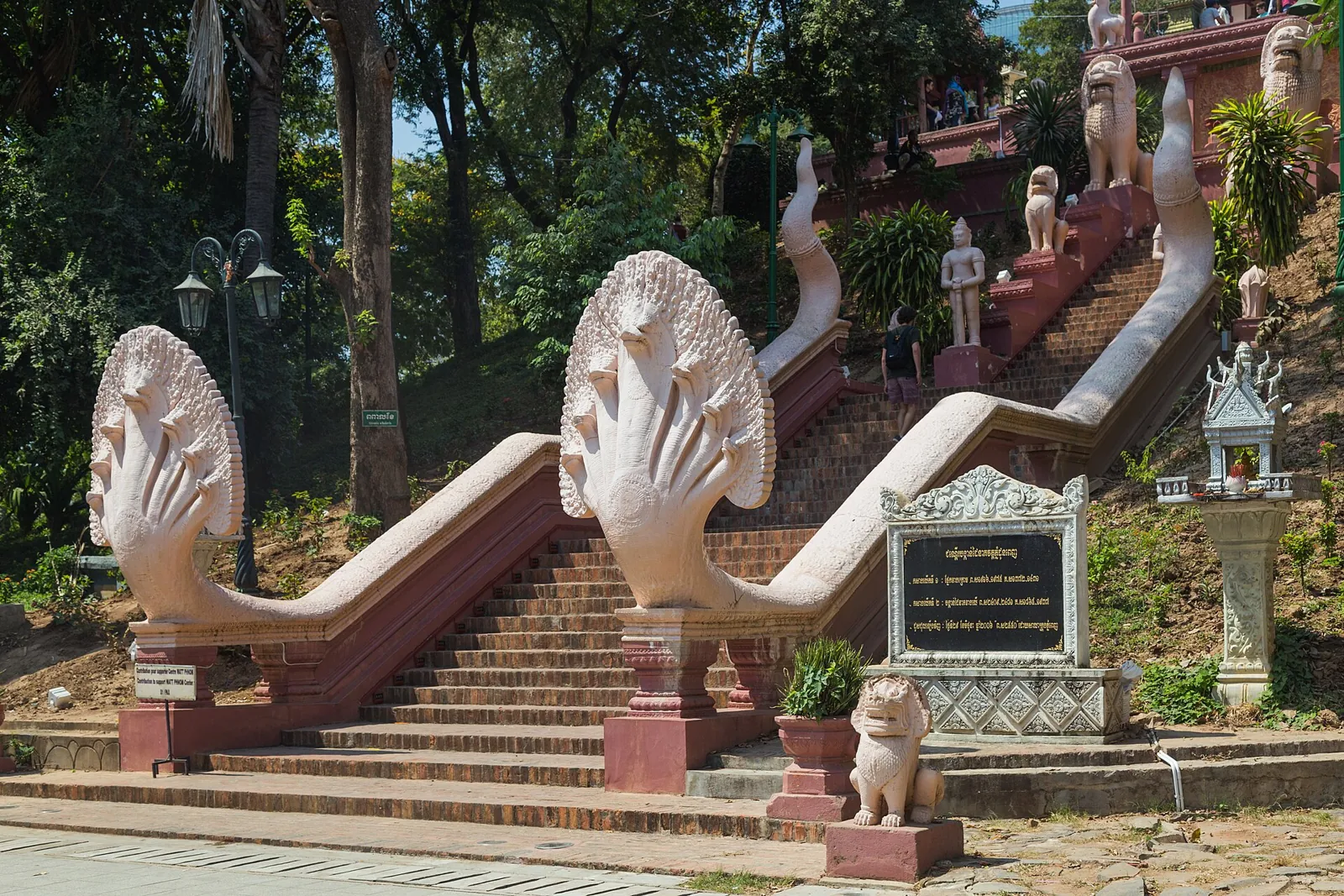
Buddhism has been present in Cambodia for well over a thousand years. Mahayana dominated early on, and Theravada became dominant after the 13th century. Under the Khmer Rouge (1975–1979) Buddhism was nearly destroyed; it recovered gradually after 1979 and was re-declared the state religion in 1989.
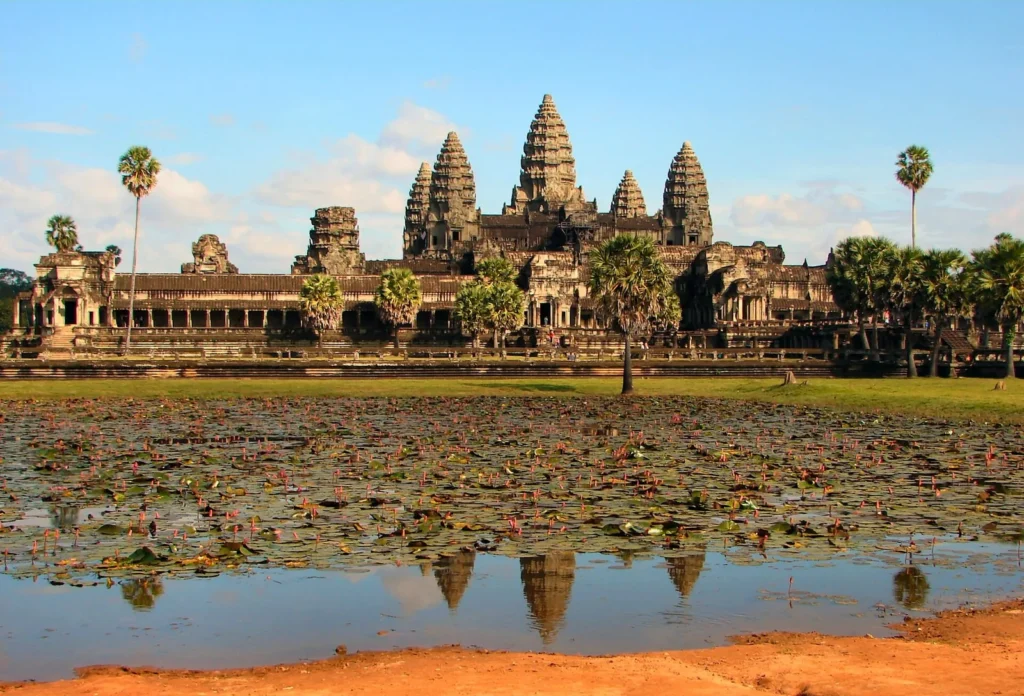
Wikipedia’s summary of the history notes that Cambodia’s earliest Buddhism was Mahayana. Under the Mahayana king Jayavarman VII in the 12th century, Angkor Wat became a Mahayana temple, and under Ang Chan I in the 16th century it became a Theravada one. Angkor Wat was first built as a Hindu temple to Vishnu; see Angkor Wat and Zhou Daguan.
After taking power in 1975, the Khmer Rouge set out to eradicate Buddhism. Monks were forced to disrobe, and those who refused could be executed. Many pagodas were blown up or turned into warehouses, clinics and prisons, Buddha images were smashed or thrown into waterways, and texts were burned. One researcher estimated that more than 80% of temple texts did not survive.
| Period | Monks | Notes |
|---|---|---|
| Before 1975 | About 65,000–80,000 | Estimates vary; a 1969 count found 53,400 monks and 40,000 novices in more than 3,000 wats |
| 1985–1989 | About 6,500–8,000 | Under the People's Republic of Kampuchea only men over 50 could ordain; the limit was lifted in 1988–89 |
| 1991 | About 20,000 | |
| 1998–1999 | 50,081 | |
| 2022 | 70,905 | Announced by Secretary of State Seng Somony; 5,104 pagodas at the time |
After 1979 the People’s Republic of Kampuchea allowed a partial restoration: pagodas could be rebuilt, but the government provided no funding, and monks from southern Vietnam were brought in to restart ordination lines. When the state became the State of Cambodia in 1989, Buddhism was re-declared the national religion, and the 1993 Constitution kept that status.
5. How many pagodas and monks are there, and what are the two orders?
Ministry figures show 5,146 pagodas in 2024, and the ministry put the number of monks at 70,905 in 2022. The sangha is divided into the Mohanikay and Thammayut orders, and the large majority of monks belong to the Mohanikay.
The Mohanikay is the older and far larger order. The Thammayut came from Thailand in the mid-19th century, first spreading among the royal and ruling circles, and has always been small. In 1961 the Mohanikay had more than 52,000 monks in about 2,700 wats, while the Thammayut had 1,460 monks in just over 100 wats; ministry data for 2024 list 272 Thammayut pagodas. Both are Theravada orders. They were merged between 1981 and 1991 and then separated again, each with its own supreme patriarch.
6. Beyond Buddhism: Muslims, Christians and local beliefs
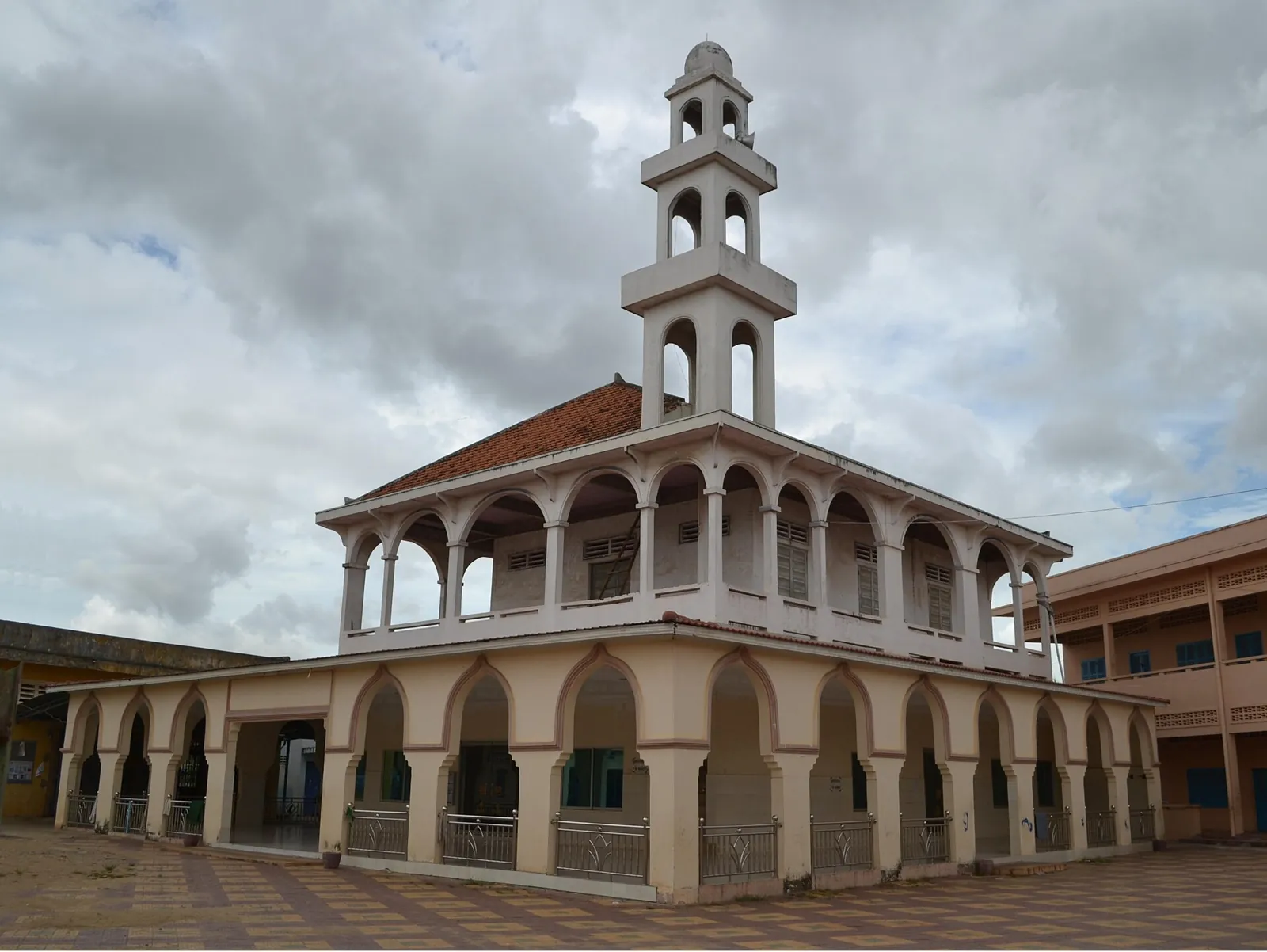
Most Cambodian Muslims are ethnic Cham, about 2.6% of the population in 2024; most Catholics are ethnic Vietnamese, about 0.4%; and highland minorities in the northeast keep their own traditional beliefs. Many Buddhists also honour Neak Ta, the guardian spirits of a place.
The US State Department notes that most Muslims are ethnic Cham, although not all Cham are Muslim, and that most Catholics are ethnic Vietnamese, about 0.4% of the population. In the 2019 census, Tbong Khmum had the highest share of Muslims (11.8%), followed by Kratie (6.6%) and Kampong Chhnang (5.8%).
In the northeastern provinces of Ratanakiri and Mondulkiri, “other” religions made up 23.2% and 21.2% of the population in the 2019 census, mainly the traditional beliefs of highland groups, which often have their own spirits associated with rice, soil and water.
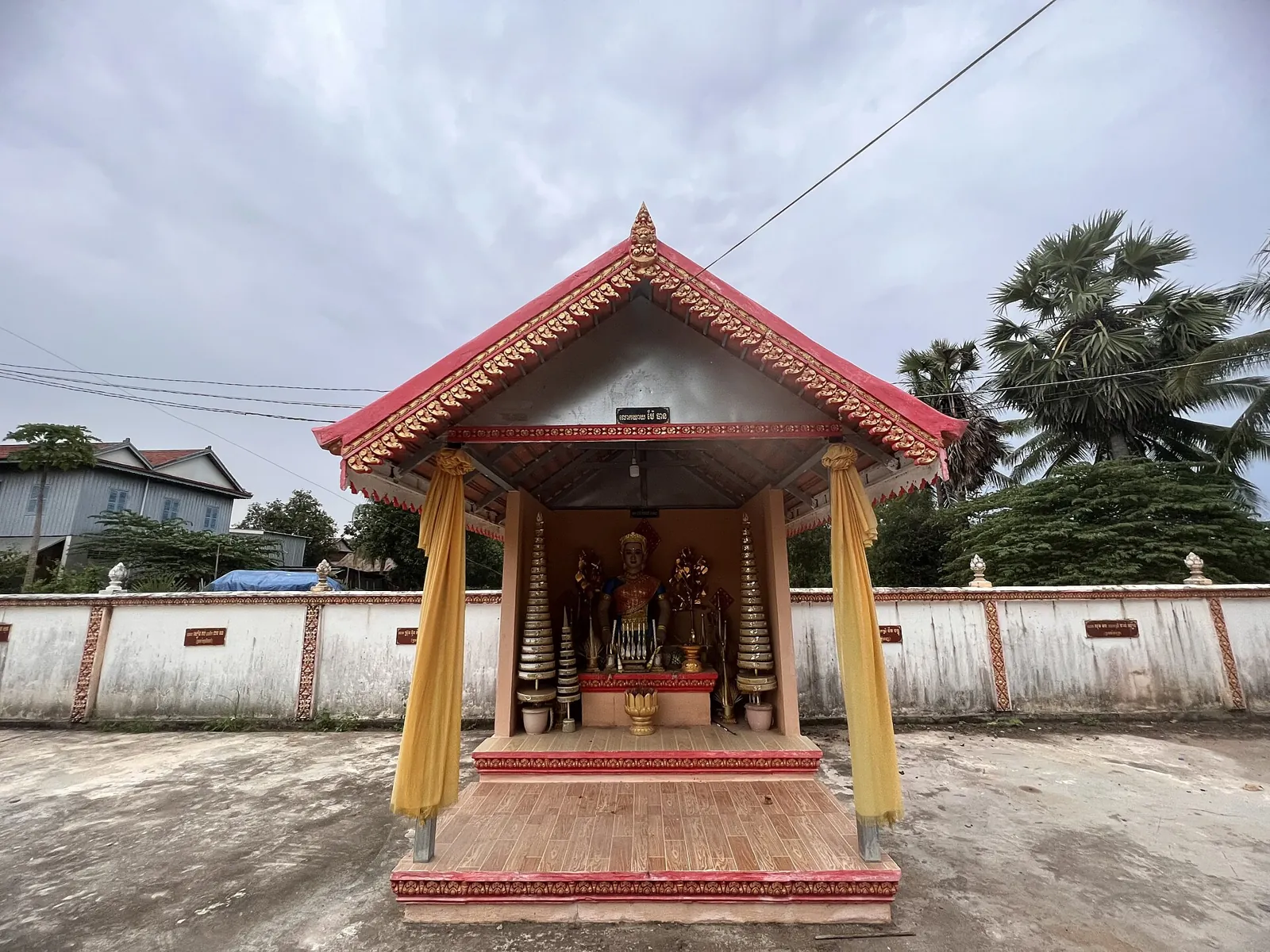
Across the country many people also honour Neak Ta, guardian spirits who protect a place and its people. UNESCO notes in its description of a traditional Cambodian theatre form that many rituals are held to ask Neak Ta to protect villages and bring good harvests. Brahmanic traces also survive in royal ceremonies such as the annual Royal Ploughing Ceremony.
7. Religion by province: where are Muslims more common?
In the 2019 census most provinces were more than 95% Buddhist. The highest Muslim shares were in Tbong Khmum, Kratie and Kampong Chhnang, and traditional beliefs were most common in Ratanakiri and Mondulkiri in the northeast.
| Province | Buddhist | Muslim | Christian | Other |
|---|---|---|---|---|
| Cambodia | 97.1% | 2.0% | 0.3% | 0.5% |
| Phnom Penh | 97.8% | 1.6% | 0.5% | 0.1% |
| Svay Rieng | 99.8% | 0.1% | 0.1% | 0.1% |
| Tbong Khmum | 88.1% | 11.8% | 0.1% | 0.0% |
| Kratie | 93.1% | 6.6% | 0.2% | 0.1% |
| Kampong Chhnang | 93.1% | 5.8% | 0.3% | 0.9% |
| Koh Kong | 95.1% | 4.6% | 0.2% | 0.0% |
| Ratanakiri | 73.4% | 1.3% | 2.1% | 23.2% |
| Mondulkiri | 70.4% | 4.4% | 4.0% | 21.2% |
Svay Rieng, home to the Manhattan Special Economic Zone, is among the most Buddhist provinces in the country. Its city of Bavet sits on the Cambodia–Vietnam border; see our Bavet guide.
8. How does religion shape daily life and holidays?
Most religious festivals follow the Khmer lunar calendar, so dates change every year. In 2026 the religious public holidays are Visak Bochea (1 May, the same day as Labour Day) and Pchum Ben (10–12 October). Meak Bochea has not been a public holiday since 2020.
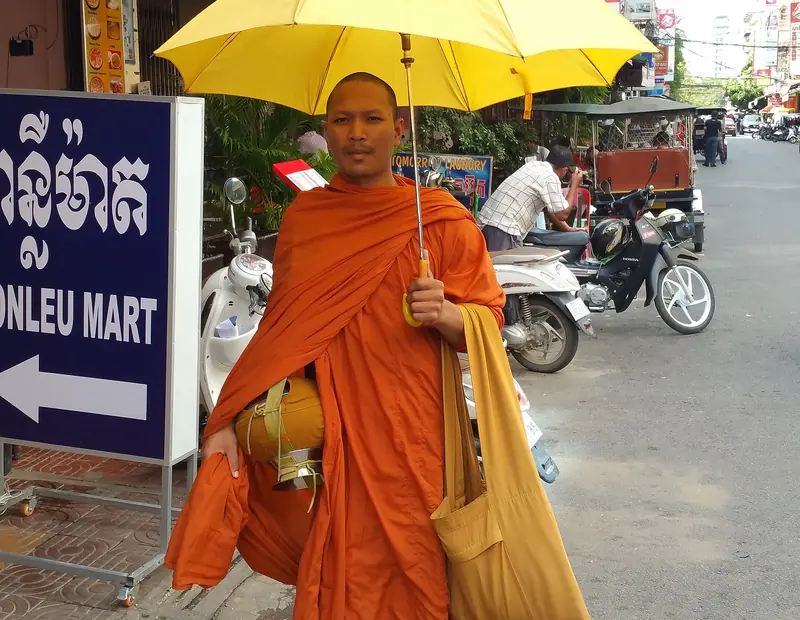
Theravada monks do not farm, and lay people provide their food, which forms the basis of the relationship between monks and the community. Putting a spoonful of rice into a monk’s bowl is called “dak bat”, and the merit it brings can be dedicated to deceased relatives.
Pchum Ben is one of Cambodia’s most important religious festivals. It lasts 15 days, the last three of which are public holidays, and is held at the end of the Buddhist rains retreat; during the festival many families bring food to the pagoda before dawn for the monks and the spirits of the dead. In 2027 the Pchum Ben holiday falls on 29 September–1 October.
| Festival | 2026 date | Notes |
|---|---|---|
| Visak Bochea | 1 May | Marks the Buddha's birth, enlightenment and passing; the same day as Labour Day in 2026 |
| Pchum Ben | 10–12 October | The last three days of a 15-day observance; offerings to monks and ancestors |
| Meak Bochea | Not a public holiday | An August 2019 sub-decree cut public holidays from 28 to 22 days, removing Meak Bochea from 2020 |
For the full 2026 calendar, see Cambodia public holidays 2026.
Religious holidays also affect people working in the cities. In a 2026 Cambodianess report, an interviewee working in Phnom Penh returns to the family home in Svay Rieng every Pchum Ben, and many families see their grown children only at Pchum Ben and Khmer New Year.
Khmer New Year is not a Buddhist festival, but pagodas build sand mounds during the holiday: a central mound represents the Valuka stupa in Tavatimsa heaven, surrounded by four smaller mounds for the Buddha’s disciples, and on the second day many people attend ceremonies at the pagoda for their ancestors. For the Water Festival, see Cambodia Water Festival.
9. What should you know before visiting a Cambodian pagoda?
Cover your shoulders and knees, take off your shoes before entering a shrine hall, and ask before photographing monks. Women should not touch monks or their robes; to hand something to a monk, ask a man to pass it or place it on a cloth or tissue.
| Situation | What to do |
|---|---|
| Clothing | Cover shoulders and knees; avoid sleeveless tops and shorts |
| Entering a hall | Remove your shoes and keep quiet |
| Photos | Ask before photographing monks or people praying |
| With monks | Women do not touch monks or their robes; pass items through a man or on a cloth or tissue |
| Sitting | When seated in a pagoda, do not stretch out or cross your legs |
For more on Cambodia’s festivals, history and customs, see our Cambodian Culture section.
10. FAQ
Q1: What is the main religion in Cambodia?
Buddhism. About 96.5% of Cambodians are Buddhist (2024 National Institute of Statistics survey), mostly Theravada; Islam is about 2.6% and Christianity about 0.3%.
Q2: Is Buddhism the state religion of Cambodia?
Yes. Article 43 of the constitution states that Buddhism shall be the religion of the State, and the same article guarantees freedom of belief.
Q3: Is Cambodian Buddhism Theravada or Mahayana?
Mainly Theravada. Mahayana was common in early Cambodia, and Theravada became dominant after the 13th century; ethnic Vietnamese communities mostly follow Mahayana.
Q4: Are there Muslims in Cambodia?
Yes. Islam made up about 2.6% of the population in 2024, mostly ethnic Cham; in the 2019 census Tbong Khmum had the highest share, 11.8%.
Q5: How many pagodas and monks are there in Cambodia?
Ministry data show 5,146 pagodas in 2024, and the ministry announced 70,905 monks in 2022.
Q6: What did the Khmer Rouge do to Buddhism?
Between 1975 and 1979 monks were forced to disrobe, many pagodas were destroyed or repurposed and texts were burned. Buddhism recovered after 1979 and was re-declared the state religion in 1989.
Q7: What are Cambodia's religious public holidays?
In 2026, Visak Bochea (1 May) and Pchum Ben (10–12 October). Meak Bochea has not been a public holiday since 2020.
Q8: What should I wear to a Cambodian temple?
Clothing that covers your shoulders and knees. Remove your shoes before entering a hall and ask before photographing monks.
References
- National Institute of Statistics (2025) | Cambodia Inter-Censal Population Survey 2024, Table 2.5.1 | https://data.opendevelopmentcambodia.net/km/dataset/555b11f8-9f9a-47cc-8104-7324ff624fb3/resource/a30ed4aa-8e47-4ed8-8803-6a7002fbe106/download/cambodia-inter-censal-population-survey-2024.pdf
- National Institute of Statistics (October 2020) | General Population Census of the Kingdom of Cambodia 2019, Table 2.5.1 | http://nis.gov.kh/nis/Census2019/Final%20General%20Population%20Census%202019-English.pdf
- Constitute Project (accessed 27 October 2026) | Cambodia's Constitution of 1993 with Amendments through 2008, Article 43 | https://www.constituteproject.org/constitution/Cambodia_2008
- US Department of State, via ecoi.net | 2023 Report on International Religious Freedom: Cambodia | https://www.ecoi.net/de/dokument/2111837.html
- Le Petit Journal (5 November 2025) | Le Cambodge pense à ouvrir ses pagodes aux touristes | https://lepetitjournal.com/cambodge/le-cambodge-pense-ouvrir-ses-pagodes-aux-touristes-426029
- Le Petit Journal (30 September 2022) | Le Cambodge, pays aux 5 000 pagodes | https://lepetitjournal.com/cambodge/cambodge-pays-5-000-pagodes-347288
- Northern Illinois University SEAsite (accessed 27 October 2026) | The Rebirth of Buddhism (summarising Charles F. Keyes) | https://seasite.niu.edu/khmer/Ledgerwood/buddhism.htm
- Wikipedia (accessed 27 October 2026) | Buddhism in Cambodia | https://en.wikipedia.org/wiki/Buddhism_in_Cambodia
- Wikipedia (accessed 27 October 2026) | Religion in Cambodia | https://en.wikipedia.org/wiki/Religion_in_Cambodia
- UNESCO (accessed 27 October 2026) | Lkhon Khol Wat Svay Andet | https://ich.unesco.org/en/USL/lkhon-khol-wat-svay-andet-01374
- The Cambodia Daily (16 October 2015) | The Cycle of Rice: Rice for the Spirits | https://english.cambodiadaily.com/cycleofrice3/
- The Cambodia Daily (12 August 2019) | Cambodia Reduces Number of Public Holidays to Attract Jobs | https://english.cambodiadaily.com/2019/08/12/cambodia-reduces-number-of-public-holidays-to-attract-jobs-but-activists-express-concern-it-could-undermine-democracy/
- Andersen Cambodia (8 October 2025) | Cambodia Sets Official 2026 Public Holiday Schedule | https://kh.andersen.com/publications/cambodia-sets-official-2026-public-holiday-schedule/
- helloangkor (accessed 27 October 2026) | Pchum Ben | https://helloangkor.com/events-festivals-and-holidays/pchum-ben/
- Cambodianess (27 September 2026) | Cambodians Begin Pchum Ben Celebrations: What Is It? | https://cambodianess.com/article/cambodians-begin-pchum-ben-celebrations-what-is-it
- Cambodianess (11 October 2026) | Pchum Ben Holds Different Meanings Across Generations and Circumstances | https://cambodianess.com/article/pchum-ben-holds-different-meanings-across-generations-and-circumstances
- Cambodianess (September 2026) | Cambodia Has 22 Public Holidays in 2027 | https://cambodianess.com/article/cambodia-has-22-public-holidays-in-2027
- Wikipedia (accessed 27 October 2026) | Cambodian New Year | https://en.wikipedia.org/wiki/Cambodian_New_Year
- Cambodge Mag (5 May 2026) | Royal Ploughing Ceremony in Cambodia: An Ancient Sacred Rite | https://www.cambodgemag.com/en/post/royal-ploughing-ceremony-in-cambodia-an-ancient-sacred-rite
- IPS Cambodia (24 October 2021) | Cambodian Etiquette and Customs | https://ips-cambodia.com/cambodian-etiquette-and-customs/