Summary: A cambodia factory setup evaluation should not begin with cost. It begins with market access: the tariffs and rules of origin that apply to the product in the destination market decide whether this origin can be used at all. Only once that is settled do the comparison against Vietnam and Thailand, the total cost model, the administrative sequence and the annual obligations after production starts come into play. The common failure is to compare land prices and wages without first checking which measures apply to the company’s own tariff code – in the wrong order, even a meticulous cost table can be discarded whole.
This article organises the checks into those five stages. The point is not to restate each mechanism – each has its own article – but to say how far each item must be confirmed before it counts as cleared, where the evidence comes from, and which way to adjust when something fails. It closes with a list of fields only a zone can fill in, and what to require when asking.
1. The Most Common Mistake in a Cambodia Factory Setup Evaluation
A packaging manufacturer had already built a tidy comparison table across four Southeast Asian countries – land, wages, electricity, ocean freight – until legal review asked one question during contract stage: when this item ships to the United States with Cambodia as the country of origin, do the applicable measures change? The table was set aside and rebuilt.
This is not an isolated case. When the order of evaluation is reversed, every careful calculation upstream can be discarded at once, because what decides whether an overseas base is viable is not the cost level but the product’s access conditions in the destination market. The same product made in a different country can face entirely different tariff and origin determinations, routinely differing by ten percentage points or more – far beyond the spread in land prices and wages – and this layer cannot be negotiated.
A cambodia factory setup evaluation therefore has a fixed order: confirm the origin can be used, then confirm why Cambodia rather than Vietnam or Thailand, and only then move to cost, schedule and operating obligations. This article follows that order, listing the checks and the standard for clearing each. The mechanisms themselves are covered in dedicated articles; here the question is only how far each item must be confirmed.
2. Confirming Market Access: Tariffs, Rules of Origin and Product-Specific Measures
Market access is confirmed from the product, not the country: start from the customs tariff code, then work through country-level additional duties, product-specific trade remedies, and whether the applicable rules of origin match the company’s actual processing.
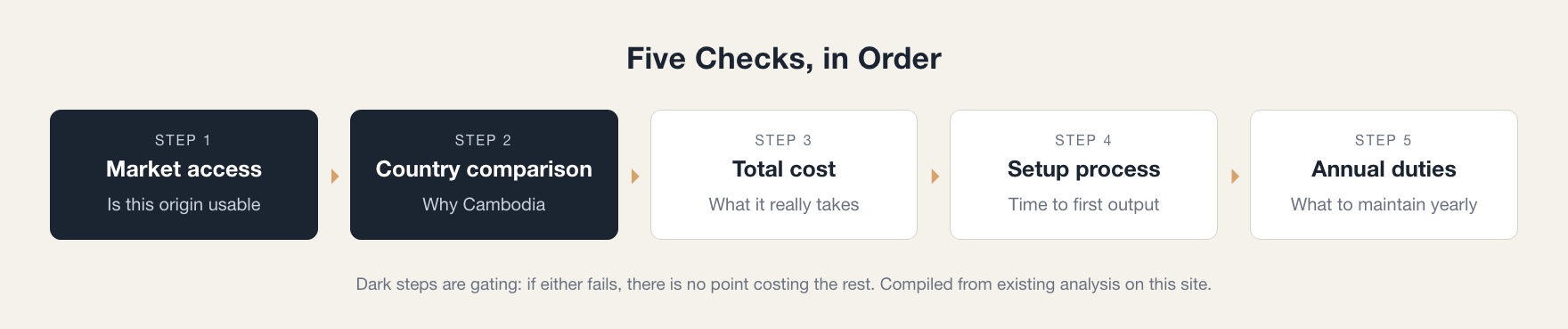
Figure 1: The five checks and the order they must follow (compiled from existing analysis on this site).
The first step is to establish the tariff code. Measures are published against code lists, not product names, and treatment can differ entirely between codes within one category; get this wrong and everything after it is wasted. The second step is the country-level additional duty rate for that code in the destination market – for current rates on Cambodian exports to the United States and the record of changes, see the continuously updated US tariff observatory for Cambodia. The third step is to search, by product and country of origin together, for anti-dumping, countervailing or safeguard measures in force, including any case already in five-year sunset review, since the review decides whether a measure continues or ends. The fourth step is to confirm the rules of origin that apply in the destination market and check them against the company’s actual processing steps.
Several outcomes mean this stage has not been cleared and the direction needs to change rather than the arithmetic continuing. Material-based measures such as those on steel, aluminium and copper apply globally, so relocation does not alter the duty. Anti-dumping measures on mattresses already cover Cambodia, and Chinese subject components processed in Cambodia remain within scope. Solar panels face both anti-dumping and countervailing duties, and Cambodian exports of that category to the United States fell 98.9 percent in the first half of 2025. Products in this position can still use Cambodia as a supply base for non-US markets and as risk diversification, but not as a tariff solution. For the European Union, Cambodia benefits as a least developed country from the Everything But Arms initiative, with single transformation applying to garments, although that treatment has been partially withdrawn since August 2020 and Cambodia formally graduates from the category in December 2029; the timeline and the choices around it are set out in Cambodia versus Vietnam for manufacturing.
3. Cambodia, Vietnam or Thailand: What Actually Differs Beyond Cost
Across the three countries, wage and land differences tend to be overstated while differences in rules of origin, product-specific measures and industrial ecosystem tend to be understated – and the latter three are usually the larger numbers.
| Comparison | Where Cambodia stands | How to confirm it |
| Rules of origin | Garments to the EU qualify on single transformation, so garments made from imported fabric qualify; Vietnam applies double transformation, requiring production from fabric within the agreement area | Check the agreement text for the destination market against your own processing steps, rather than judging by country |
| Product-specific measures | Tyres are covered by anti-dumping and countervailing duties in China, Thailand and Vietnam but no case has been initiated against Cambodia; mattresses and solar are the reverse | Search measures in force and review status by product and country of origin, one at a time |
| Country-level rates | Additional duty rates are below China, Vietnam and Thailand; the effective rate is now below Vietnam and Thailand as well | Use the current figures on the tariff observatory page; do not commit them to long-run assumptions |
| Industrial ecosystem | Garments, footwear and bags have the most complete supply base; tyres and automotive wiring harnesses are forming; upstream inputs such as fabric are still imported | Check peer density, the radius for sourcing trims, and whether repair and inspection are available locally |
| Labour | Wages and employer social security costs are below Vietnam; labour availability varies markedly by area | Look at the labour pool where the zone actually is, rather than national statements |
Table 1: Comparison checks and how to confirm each (compiled from existing analysis on this site).
Clearing this stage means being able to explain why Cambodia rather than Vietnam or Thailand, with a reason that is not simply cheaper. If cost is the only reason, it may not survive a few percentage points of tariff change or a wage adjustment; if the reason rests on a structural difference in rules of origin or product-specific measures, it is far more durable. The full comparison is in Cambodia versus Vietnam for manufacturing, and the industrial cluster and sourcing radius in Bavet city guide: the manufacturing corridor on the Cambodia-Vietnam border.
4. Total Cost: Land, Utilities, Labour and Administrative Time
The usual problem in cost evaluation is not that a line is calculated wrongly but that a whole category was never budgeted – administrative time, the cost of tied-up capital and utility connection charges all belong to that group.
| Line | What to obtain | Source of evidence |
| Land and buildings | Full cost per sqm per year on an aligned basis, including one-off charges and escalation | The zone’s formal quote; the method for comparing them is in the article on negotiating factory space |
| Utilities and wastewater | Allocated power capacity, tariff, water volume, discharge quota and connection terms | Current quotes and supply guarantees from the zone and the power utility |
| Labour and social security | Actual pay structure including overtime and allowances, plus employer social security | Wage figures from the continuously updated pages on this site |
| Inbound materials and packaging | Ocean, inland and customs costs on a full-container basis; the share available locally versus imported | The zone’s supplier list and actual quotations |
| Administrative time | How the tax holiday starts to run, the expected programme, and the effect of delay on delivery commitments | The stage owners and expected timings provided by the zone |
| Cost of capital | Spend committed before production multiplied by your own cost of capital and the expected months | The company’s own financial model |
Table 2: Total cost lines and how to evidence each (compiled from existing analysis on this site).
Administrative time has no receipt and no invoice, so it is never budgeted, yet it erodes the tax holiday, the capital and the order book at once: the tax exemption period of a qualified investment project (QIP) begins when the start-up phase ends, not when the company becomes profitable; land and equipment are paid for before production, so every month of delay adds a month of carrying cost; and where a brand’s transfer of orders carries a fixed timetable, the loss from delay can be the qualification to supply that item at all. The method for comparing the land and buildings line is in how to negotiate factory buildings and industrial land in Cambodia, and wage and labour cost figures are in Cambodia minimum wage 2026 and total labour cost.
5. Sequencing the Setup: Registration, QIP, Construction Permits and Pre-Operation
Getting established is not one queue but four parallel lines that are preconditions for each other: company formation, investment status, construction permits and pre-operation registrations.
Company formation runs in three stages: incorporation with the Ministry of Commerce, tax registration with the General Department of Taxation, and labour registration with the Ministry of Labour and Vocational Training. Investment status means applying for qualified investment project status, in the course of which two certificates are issued – the conditional registration certificate is the authority’s list of what the project still needs, naming each permit and the responsible department, while the final registration certificate is the formal confirmation of status, issued within 28 working days of the conditional certificate. Many companies treat the conditional certificate as clearance to start construction, when building permits, environmental assessment and the various registrations are all still on the list.
Construction permits cover notarisation of the land contract, the building permit and environmental impact assessment; the land contract is a required document for the investment application, so this line starts before the investment application does. Pre-operation registrations cover social security, customs registration and the duty-free import list – equipment and construction materials can only be imported duty free once the list is approved, otherwise goods sit at the port or duty is paid. Clearing this stage does not mean knowing what has to be done; it means being able to say who connects each stage to the next and how long it should take from signing to trial production. The full dependency map is in Cambodia factory setup process and the SEZ one-stop window.
6. Annual Obligations After a QIP: Compliance Certificate, Duty-Free List and Origin Records
Completing the setup does not end the administrative work: the benefits of a qualified investment project are a continuing annual obligation – something usually felt for the first time in year two.
At least three things have to be completed each year: obtaining a certificate of compliance from the Council for the Development of Cambodia, without which investment incentives cannot continue; refiling the duty-free import list, with items matching actual production – the Council and customs check periodically, and a mismatch can mean back duties, fines or, in serious cases, loss of status; and the annual corporate income tax return. VAT, withholding tax and payroll tax are filed monthly, and nil returns are still required during the exemption period. On employment, registration with the National Social Security Fund is required from the first employee, and companies with more than eight employees must adopt internal regulations compliant with the labour law and file them within three months of incorporation.
One continuing task is consistently underestimated: origin documentation. Rules on transhipment and origin determination have tightened, the burden of proof sits with the company, and the essence is that material sourcing, processing steps and cost allocation must reconcile with each other. Those records have to accumulate through daily operations; a version assembled afterwards rarely survives comparison. One threshold is also worth noting: companies exporting more than 80 percent of output can obtain permanent import duty and VAT relief, while those below that generally receive exemption only in the first year of operation – which makes the export share not merely an operating metric but a variable in long-run tax exposure.
7. Turning the Checklist Into a Feasibility Study Input
Once the five stages are complete, what goes into the investment decision is not a list of open questions but a table where every line carries a value, a source and an owner.
Three principles govern the write-up. First, every conclusion carries its evidence source and the date it was obtained – particularly for time-sensitive data such as duty rates, wages and quotes, since an undated figure cannot be re-verified three months later. Second, separate confirmed from outstanding: an outstanding item states who will obtain it and by when, rather than being left blank or filled with an estimate. Third, list failed items separately with the direction of adjustment – where a product-specific measure fails, whether the response is to change the destination market, the product mix or the combination of origins.
The completed table serves two purposes: internally it is the input to the feasibility study, and externally it is the common template when requesting information from zones, banks and advisers – everyone filling in the same form is considerably more efficient than repeated verbal enquiries. The fields can be built directly from the stages above; the next section sets out the ones only a zone can complete.
8. Fields Only the Zone Can Fill: What to Request from MSEZ
Most items in the five stages can be settled from public sources and professional advisers. The parts that involve allocable resources, delivery timing and actual pricing can only come from the zone, and only those figures can go into a feasibility study.
| Field | What to require | Why it must come from the zone |
| Allocable power capacity | The capacity figure available to this project, whether a supply guarantee is issued, and the terms and timing of upgrades | It determines whether energy-intensive processes can run, and project-level figures are not in public sources |
| Water and discharge quota | Allocable water volume, discharge point and effluent standard, wastewater treatment capacity | It determines the environmental assessment category and whether operations are constrained later |
| Building delivery specification | Floor loading, clear height, column spacing, fire rating, delivery date and acceptance method | A mismatch found after equipment arrives is rectified at the company’s cost |
| Land and room to expand | Available plot area, whether an adjacent plot can be reserved for phase two, form of title and transfer timing | It determines whether phase two is feasible and when capital can safely be committed |
| Complete pricing fields | Area basis, currency, billing period, tax treatment, one-off charges, connection fees, escalation | Missing any one makes conversion against another zone’s quote impossible |
| Recruitment and training | Recruitable headcount nearby, recruitment lead time, skills training and support for Chinese-speaking roles | The speed of the production ramp depends on hiring experienced workers quickly |
| Administration and customs | Who connects each stage, when the duty-free list is prepared, who receives equipment at the port | The programme depends on the handovers, not on the days taken by any single permit |
Table 3: Fields to request from the zone (compiled from the stages in this article).
Most of what Manhattan Special Economic Zone (MSEZ) can enter on this list is an existing condition rather than a plan. The zone is in Bavet, Svay Rieng province, about 6 km from the Cambodia-Vietnam border and about 90 km from the Ho Chi Minh City port area, covering roughly 600 hectares with over 40,000 workers on site and more than 4,000 containers exported each month. On infrastructure, it has built independent power, water and wastewater systems – dual-circuit high-voltage supply, 80 MW of power capacity, 5,000 tonnes per day of water supply and 5,000 tonnes per day of wastewater treatment – so allocable capacity and discharge quota can be stated as figures during evaluation and written into the contract. On buildings and land, the zone offers standard units for immediate lease alongside land on lease or for sale, matching either a short route to production or a long-term base; how to read and convert the pricing fields is covered in how to negotiate factory buildings and industrial land in Cambodia.
On administrative handovers, the zone has operated since 2005 with its administrative and customs teams in the same execution chain, working in Chinese as one of their main languages: the land contract can be confirmed in form before the investment application, the subsequent permits listed on the conditional registration certificate can be handled in sequence by units stationed in the zone, the duty-free list can be checked while it is being compiled, and equipment arriving at port is picked up by the customs team. For the evaluation table, this means administrative time can be entered as named stage owners and expected working days rather than left blank.
The nature of these conditions should be stated plainly: MSEZ offers execution efficiency and verifiable existing conditions, not treatment outside the law. The tariffs, rules of origin and trade remedies that apply to a product do not change with the zone a company enters. If you are working through a cambodia factory setup evaluation, you are welcome to contact us and ask the MSEZ advisory team to answer the table above line by line – provide the product category and tariff code, destination markets, investment scale, floor area and electrical load, equipment arrival date and target production date, and the zone will complete each field, stating the boundaries of responsibility and the expected key dates.
9. FAQ: Market Access, Cost Lines, Setup Process and Annual Compliance
Q1: Where should a Cambodia factory setup evaluation start?
| With the product’s customs tariff code, not with a country cost comparison. Check the country-level additional duty for that code in the destination market, then search by product and country of origin for anti-dumping, countervailing or safeguard measures in force, and finally confirm that the rules of origin match your own processing. The origin only stands if all three clear; where they do not, adjust the destination market, the product mix or the combination of origins rather than continuing to calculate costs. |
Q2: Which industries cannot solve a tariff problem by moving to Cambodia?
| The method matters more than a list. First, see whether the measure is levied by material or by origin – material-based measures such as steel, aluminium and copper apply everywhere, so the country makes no difference. Then see whether measures are already in force against that product from Cambodia; mattresses and solar panels both fall into this group, and Chinese components processed in Cambodia may still be found within scope. If either holds, Cambodia is not the tariff answer, though it can still serve as a supply base for non-US markets. |
Q3: Which cost line is most often missed?
| Administrative time, because it has no supporting document and is never budgeted. A rough estimate is total investment multiplied by your own cost of capital and by the expected months of delay, plus the exemption value that lapses unused over the same period; the two together often exceed anything that could be negotiated off the land price. To make the line calculable, obtain named stage owners and expected working days from the zone during evaluation. |
Q4: How long does it take from signing to production?
| It depends on the building type and on how the documents are handed over. Leasing a ready-built unit with utilities and discharge connected by the zone can compress this to around six months; acquiring land, building, and handling each step in-house often takes more than two years. What decides the programme is not the days taken by any single permit but whether anyone is responsible for the handovers between the four administrative lines – the point most worth clarifying when comparing zones. |
Q5: What has to be done every year after obtaining investment status?
| Treat the annual obligations as standing work rather than a one-off formality: the compliance certificate, the duty-free list and the income tax return are all filed annually, and missing any one year can affect the continuation of the incentives; the monthly VAT, withholding and payroll filings continue even during the exemption period. In practice, appoint a responsible contact and build an annual calendar before production starts, rather than reacting as deadlines approach. |
10. Sources and References
📚 References
- MOFCOM | Guide to Foreign Investment and Cooperation by Country (Region): Cambodia – investment and land systems, restrictions on foreign holdings; 2,425 large factories in operation in 2024.
https://12335.mofcom.gov.cn/gbmyzn/jianpuzhai.pdf - China Textile Network / China National Textile and Apparel Council, citing GMAC | Cambodia’s fabric self-sufficiency is about 5 percent with roughly 60 percent imported from China; a three-year transition follows LDC graduation in December 2029; labour availability varies by area, and siting a plant 50-60 km outside Phnom Penh eases it.
https://info.texnet.com.cn/detail-1076322.html - Economic and Commercial Office of the Chinese Embassy in Cambodia, reprinting the Ministry of Economy and Finance half-year report (August 2025): solar panel exports fell 98.9 percent in the first half of 2025 following US tariff increases.
http://cb.mofcom.gov.cn/jmdt/art/2025/art_7c831c097ef14a5a8dd520908ebf92b4.html - European Commission | Everything But Arms: duty-free, quota-free access for least developed countries, with single transformation applying to garments; partially withdrawn for Cambodia since August 2020.
https://policy.trade.ec.europa.eu/development-and-sustainability/generalised-scheme-preferences_en - Zhihu (Cambodia investment practice) and CTILS | Qualified investment project procedure: the final registration certificate is issued within 28 working days of the conditional registration certificate; an annual certificate of compliance from the Council for the Development of Cambodia is required to continue receiving incentives.
https://zhuanlan.zhihu.com/p/100846705 - Yingtian Overseas Consulting | Cambodian company registration: incorporation with the Ministry of Commerce, tax registration with the General Department of Taxation and labour registration with the Ministry of Labour; companies with more than 8 employees must file internal regulations within 3 months of incorporation; social security registration applies from the first employee.
https://www.yingtianbus.com/article/218/detail/109.html - Manhattan Special Economic Zone | Guide to business licences in Cambodia: companies exporting more than 80 percent of output may receive permanent import duty and VAT relief; otherwise exemption generally applies only in the first year of operation.
https://www.manhattansez.com/business-license-in-cambodia/ - Council for the Development of Cambodia (CDC) | Qualified investment project incentives: income tax exemption periods by activity type, with duty, special tax and VAT exemption available on imports of construction materials, production equipment and production inputs.
https://cdc.gov.kh/incentives-and-schemes/ - Manhattan Special Economic Zone knowledge base | Related reading: the US tariff observatory for Cambodia, the Bavet city guide, Cambodia versus Vietnam for manufacturing, how to negotiate factory buildings and industrial land in Cambodia, and the Cambodia factory setup process and SEZ one-stop window.
https://www.manhattansez.com/en/