

Article Summary:
Cambodia factory rental costs and industrial land are among the most direct cost items for manufacturers evaluating a factory setup. Due to constitutional restrictions, foreign investors cannot directly own land in Cambodia. Instead, they may secure land through legal channels such as special economic zone leases, landholding companies, or trusts. For most manufacturers, the most straightforward route is to locate inside a special economic zone and either lease industrial land on a long-term basis or lease ready-built factory space.
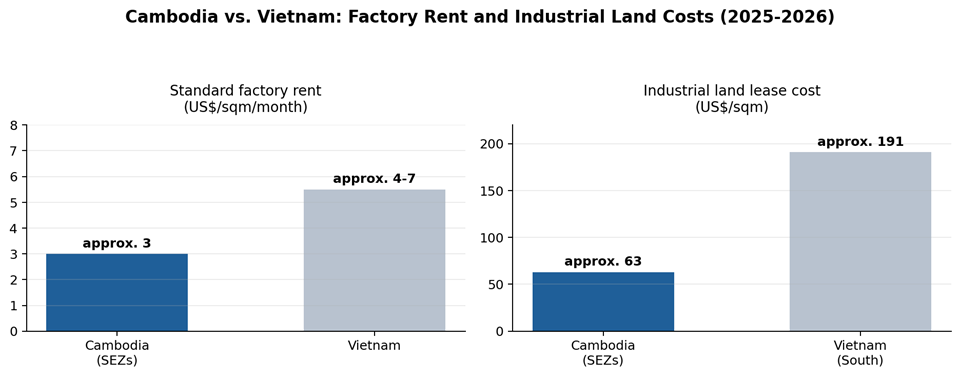
In terms of cost, the average monthly rent for ready-built factories in Cambodian special economic zones is about US$3 per sqm, while the average industrial land lease cost is about US$63 per sqm. These levels are significantly below Vietnam, where ready-built factory rent is generally US$4-7 per sqm per month and industrial land in the south is about US$191 per sqm. This article explains legal land access routes for foreign investors, the cost structures of three operating models – ready-built factory rental, build-to-suit factory, and land lease plus self-built plant – as well as supporting services, hidden costs, and the value-for-money comparison with Vietnam, helping companies evaluate factory and land options in Cambodia.
Why factory and land cost comes first
Once a company chooses Cambodia as a manufacturing base, the first cash-flow question is practical: where will the factory be, how fast can production start, and what is the total cost per square meter. Rent alone is not enough; investors need to calculate utilities, wastewater, compliance, customs, logistics, and administrative speed.
Can foreign investors buy land in Cambodia?
Foreign investors cannot directly own Cambodian land. The usual legal routes are long-term leases, land-holding companies, or trust structures. For export manufacturers, leasing factory space or industrial land inside an SEZ is usually the clearest and lowest-friction route because the zone can support registration, permits, QIP incentives, and import-export procedures.
| Route | Best For | Advantages | Key Checks |
| SEZ long-term land lease | Export manufacturers | Clearer process, QIP and one-stop service support | Term, renewal, registration, infrastructure responsibility |
| Ready-built factory rental | Fast launch and standardized lines | Lowest upfront capex and fastest move-in | Height, floor load, power, fire safety |
| Built-to-suit factory | Special layout or process needs | Balances speed and specification | Design responsibility, delivery timeline, lease commitment |
| Land-holding company / trust | Large or special long-term projects | Greater control in some cases | Higher legal cost and structure risk |
Cambodia Factory Rental Costs three setup models and cost logic
Manufacturers entering Cambodia generally choose one of three operating models: leasing a ready-built factory, commissioning a build-to-suit factory, or leasing land and constructing their own facility. Speed to production moves from fast to slow, while initial capital investment increases from low to high. Companies should choose based on production-line requirements and project timing.
| Operating model | Speed to production | Initial investment | Best-fit scenario |
| Lease a ready-built factory | Fastest (weeks to months) | Low (mainly monthly rent) | Companies needing rapid production, standardized production lines, or trial-scale manufacturing |
| Commission a build-to-suit factory | Medium (several months) | Medium (deposit/rent structure or shared construction cost) | Companies with specific factory requirements that do not want to self-build |
| Lease land and self-build | Slowest (more than half a year) | High (construction cost paid upfront) | Long-term manufacturing plans, complex lines, and companies seeking the best long-term unit cost |
In terms of pricing, CBRE data indicates that the average monthly rent for ready-built factories in Cambodian SEZs is about US$3 per sqm, while average industrial land lease cost is about US$63 per sqm. Leasing a ready-built factory offers the advantage of fast production start-up without major upfront construction capital, making it suitable for companies that need to take orders quickly. A build-to-suit factory provides a balance between specifications and speed. Leasing land and self-building requires the highest initial investment and the longest timeline, but it often delivers the lowest long-term unit cost after capital is amortized, especially for complex production lines or long-term operations.
It is also important to clarify the meaning of “acquisition” in Cambodia. Because foreign investors cannot own land directly, what is often described in practice as acquiring a facility usually means leasing land long term and owning the factory building on that leased land, rather than purchasing the land outright.
Supporting Services and Hidden Costs: Power, Water, Wastewater, Customs, and One-stop Service
Land and factory space are only the first visible cost items. The true operating cost is also shaped by supporting services such as power, water, wastewater treatment, customs clearance, and administrative efficiency. These hidden costs often influence long-term operations more than rent alone.
Power cost deserves particular attention. Electricity tariffs in Cambodia have historically been relatively high within the region, although they have declined in recent years as grid connections expanded and reliance on high-cost imported electricity decreased.
In September 2025, residential electricity cost was about US$0.152 per kWh, while industrial and medium-voltage large-user rates are generally lower. Because actual industrial tariffs vary by consumption, voltage level, and time-of-use conditions, companies should request the latest industrial power quotation from the park and incorporate it into the cost model.
Beyond electricity, stable water supply and compliant wastewater treatment facilities have become hard requirements for industries with high water consumption or stricter discharge standards, such as garments, dyeing and finishing, and sanitary ware. Building these facilities independently can be capital-intensive. If an industrial park already has such infrastructure in place, companies can significantly reduce capital expenditure and environmental compliance risk.
Cost Comparison with Vietnam: Value for Money in Land and Factory Space
For land and factory space, Cambodia has a clear value-for-money advantage compared with Vietnam. Ready-built factory rent is roughly half of the Vietnam level, and SEZ industrial land lease cost is also significantly lower.
As shown in Figure 1, average monthly rent for ready-built factories in Cambodian SEZs is about US$3 per sqm, roughly half of Vietnam’s US$4-7 per sqm. For industrial land, the Cambodian SEZ average is about US$63 per sqm, while southern Vietnam is about US$191 per sqm. The statistical bases and lease-term assumptions may differ between sources, and land prices are time-sensitive, so these figures should be treated as indicative and verified through first-hand quotations.
The price gap reflects different stages of market maturity. Industrial land in southern Vietnam, especially around Ho Chi Minh City, already has high occupancy and rising land prices. Some popular areas are even seeing the rise of multi-story factories.
Cambodia, by contrast, still has more available industrial land and relatively lower costs, which is particularly favorable for labor-intensive manufacturers that require larger land areas and standardized production lines, such as garments, footwear, and furniture. In other words, Cambodia’s advantage in unit land cost matches the cost-sensitive nature of industries that occupy large sites and operate with margins heavily affected by production costs.
Decision Framework: How to Choose an Entry Model and Industrial Park
Companies should first decide on the operating model based on production timing, production-line characteristics, and long-term plans, and then select an industrial park that can support the chosen model.
- Set the timeline first: companies that must start production within a few months should prioritize ready-built factories; companies with more flexible timelines and complex lines can evaluate build-to-suit or land lease plus self-build options.
- Calculate total cost rather than rent alone: power, water, wastewater treatment, customs clearance, and administrative efficiency should all be included in the total landed cost assessment.
- Check hard infrastructure requirements: industries with high water consumption or strict discharge standards should confirm whether the park has stable water supply and compliant wastewater treatment facilities.
- Choose a compliant path: for most foreign manufacturers, the preferred route is locating inside an SEZ and signing a long-term lease, avoiding the complexity and risk of handling landholding or trust structures independently.
- Review term and renewal conditions: long-term leases should be checked carefully for duration, renewal rights, and registration status to ensure alignment with the company’s long-term manufacturing plan.
Land and Factory Solutions at Manhattan Special Economic Zone (MSEZ)
The cost advantage of land and factory space ultimately has to be realized at the park level. Manhattan Special Economic Zone (MSEZ) offers relatively complete options across land, factory buildings, and supporting services.
MSEZ is located in Bavet on the Cambodia-Vietnam border and covers about 600 hectares. It can provide long-term industrial land leasing, ready-built factory leasing and building-purchase options, as well as build-to-suit factory solutions based on company drawings and specifications.
These options support both rapid production start-up and specification-driven factory planning. The park already has more than 40,000 workers in operation, and supplier clusters in textiles, footwear, bags and luggage, and electronics assembly have begun to take shape.
In terms of supporting services, the park provides stable power supply, a complete water supply network, and modern wastewater treatment facilities. These can meet the high water-use and discharge standards of different manufacturing sectors, help companies comply with international environmental requirements, and avoid the large capital expenditure of building such infrastructure independently.
The difference in one-stop administrative service lies in execution. MSEZ stands out in three areas.
First, its administrative and customs teams primarily use Chinese as a working language, supported by English and Khmer. Chinese companies can coordinate land and factory matters, QIP applications, utility connections, and NSSF registration without translation loss.
Second, the park has operated since 2005 and has more than two decades of experience; its landing process has been repeatedly validated by multiple batches of incoming companies and is based on execution experience, not only a written promise.
Third, the park is adjacent to the Bavet border gate, and its customs team has long handled Cambodia-Vietnam cross-border transit declarations, giving it practical familiarity with border-gate rhythms and documentation requirements.
If your company is evaluating land and factory options for setting up a manufacturing operation in Cambodia, the MSEZ team can conduct an initial assessment based on your required land area, production line, and production timeline, and propose the most suitable implementation strategy.
FAQ
Q1:Can foreign investors buy land in Cambodia to build a factory?
| No. Under Article 44 of the Cambodian Constitution, foreigners cannot own land in Cambodia directly. However, they can secure land through legal routes such as long-term leases of up to 50 years with one possible renewal, landholding companies with Cambodian shareholding of at least 51%, or trusts, which have been available since 2019. For manufacturers, the simplest approach is to locate inside a special economic zone and lease land or factory space long term, with compliance assistance from the park’s one-stop service. In practice, “acquisition” usually means long-term leased land plus a self-owned factory building. |
Q2:How much are factory rent and industrial land lease costs in Cambodia?
| According to CBRE, average monthly rent for ready-built factories in Cambodian SEZs is about US$3 per sqm, while average industrial land lease cost is about US$63 per sqm. These levels are significantly lower than Vietnam, where ready-built factory rent is about US$4-7 per sqm per month and southern industrial land is about US$191 per sqm. Actual prices vary by location, specification, and lease term, and should be confirmed through first-hand quotations from the park. |
Q3:How should a company choose between a ready-built factory, build-to-suit factory, and land lease plus self-build?
| The choice depends on production timing and production-line characteristics. If production must begin within a few months and the line is standardized, leasing a ready-built factory is the fastest option and requires the lowest initial investment. If the factory must meet specific requirements, a build-to-suit facility may be suitable. If the production line is complex and the company plans to operate for the long term, leasing land and self-building requires more upfront investment but can provide the lowest unit cost over time. The decision should be based on total landed cost, not rent alone. |
Q4:Beyond rent, which costs are most often underestimated?
| The most commonly underestimated costs are power, wastewater treatment, and administrative/customs efficiency. Industrial power prices in Cambodia have historically been high but are decreasing; companies should request the latest industrial tariff quotation from the park. Industries with high water use or discharge requirements should confirm whether the park already has stable water supply and compliant wastewater treatment, as self-building these systems can be expensive. One-stop administrative and in-park customs efficiency also affects setup timing and delivery schedules. |
Q5:What are the advantages of an SEZ compared with a general industrial area?
| An SEZ allows companies to delegate much of the compliance complexity related to land access to the park. Companies can lease land long term or lease factory buildings, obtain QIP tax incentives, receive assistance with licensing, and access in-park or nearby customs clearance. They do not need to independently manage landholding companies or trust structures. This is especially suitable for foreign manufacturers seeking fast, compliant market entry. |
References
- CBRE Cambodia, Fearless Forecast 2025: average SEZ industrial land lease cost of about US$63.3 per sqm and ready-built factory rent of about US$3 per sqm per month (January 2025).
https://www.harbor-property.com/news/detail/2895/industrial-real-estate-drives-cambodias-market-outlook - Savills Vietnam, 2026 Industrial Market: Vietnam ready-built factory rent of about US$4-7 per sqm per month; southern industrial land of about US$191 per sqm for the full lease term; Ho Chi Minh City occupancy around 92% (March 2026).
https://www.savills.com.vn/research_articles/226576/234917-0 - KPMG – Investing in Cambodia 2025 and beyond
https://kpmg.com/kh/en/insights/2025/04/investing-in-cambodia-2025-and-beyond.html - Cambodia 2001 Land Law and Ministry of Land Management, Urban Planning and Construction (MLMUPC): long-term leases for foreign investors may be up to 50 years and renewed once; leases must be registered; landholding companies require Cambodian shareholding of at least 51%.
https://cambodiacounsel.com/long-term-lease/ - GlobalPetrolPrices: Cambodia residential electricity price of about US$0.152/kWh (September 2025).
https://www.globalpetrolprices.com/Cambodia/electricity_prices/ - Asian Development Bank, Cambodia Energy Sector Assessment: electricity prices have declined as grid connections expanded and reliance on imported electricity decreased.
https://www.adb.org/sites/default/files/linked-documents/54430-002-ssa.pdf