Summary:
Cambodia’s statutory minimum wage in the garment sector is US$210/month in 2026, and recent increases have clearly moderated (only about 1% in 2026), giving manufacturers a rare degree of labor-cost predictability. In regional terms, Cambodia’s minimum wage is clearly below China, Thailand and Indonesia, and on a par with Vietnam’s Region I; its employer statutory social burden of only about 5.4% — far below Vietnam’s roughly 21.5% — is a key hidden cost advantage.
On supply, Cambodia Manufacturing has a young labor force of about 9.9 million, and its garment, footwear and travel-goods sector already operates at the scale of about 1,800 factories and roughly 1.1 million workers. Supported by charts, this article analyzes Cambodia’s workforce conditions across wage history, regional comparison, cost structure, social burden and labor supply.
Wage history: cost predictability from moderating increases
Cambodia’s statutory minimum wage in the garment sector has risen step by step from about US$100/month in 2014 to US$210 in 2026. Recent increases, however, have clearly moderated — from US$204 to US$210 between 2024 and 2026, with the 2026 rise only about 1%. For manufacturers this is a key advantage: labor-cost predictability has improved markedly, without the large jumps of earlier years, which helps medium- and long-term capacity and cost planning.
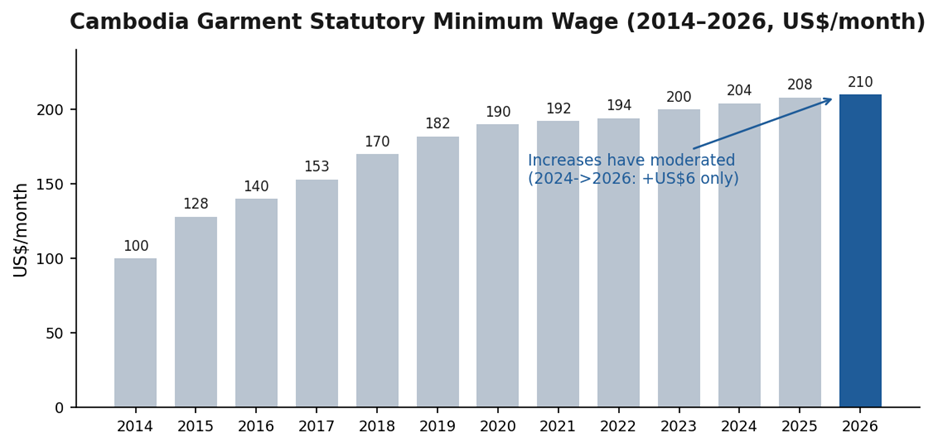
Figure 1: Cambodia garment-sector minimum wage over time (Sources: MLVT, KPMG, Open Development Cambodia).
Regional comparison: where Cambodia’s labor cost sits
In manufacturing monthly minimum wage, Cambodia (about US$210) is clearly below China, Indonesia and Thailand, on a par with Vietnam’s Region I, and sits in the lower-middle of the regional range.
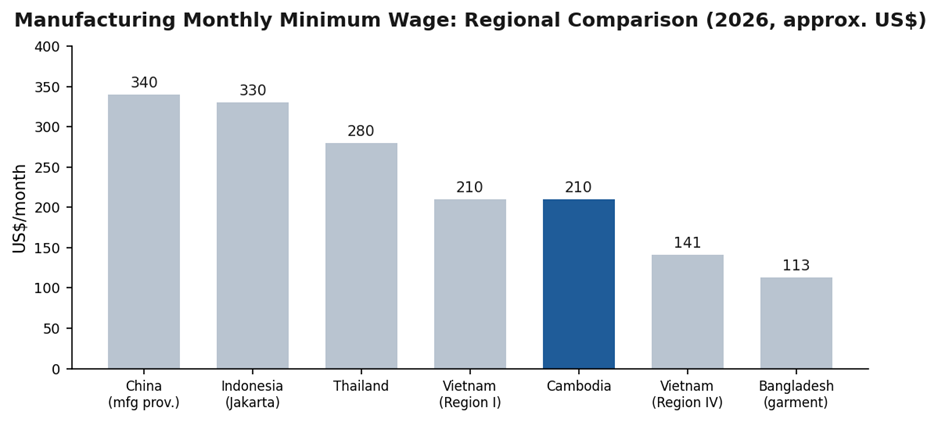
Figure 2: Manufacturing monthly minimum wage, regional comparison (2026 approximate, US$; national bases and coverage differ).
A fuller reading: compared with the destinations companies actually weigh as alternatives (China, Thailand, Indonesia, Vietnam), Cambodia’s wages are clearly competitive; compared with lower-wage locations such as Bangladesh, Myanmar and Laos, Cambodia has the edge on export-trade channels (EBA, RCEP), a US-dollar operating environment, and political and supply-chain stability. In other words, Cambodia’s value lies not in being “the cheapest” but in “competitive cost combined with usable market access and stability.”
The full cost structure: base wage, allowances, social security, seniority
The statutory minimum wage is not the employer’s actual labor cost. In 2026, the labor cost in Cambodia’s garment, footwear and travel-goods sector comprises the base wage, statutory allowances, social security and seniority payments.
| Item | Amount / rate | Notes |
| Statutory minimum wage (regular) | US$210/mo | Probationary US$208 (Prakas 214/25) |
| Attendance bonus | US$10/mo | Statutory, paid on attendance |
| Transport & housing allowance | US$7/mo | Statutory |
| Meal allowance | US$0.5/day | For overtime, or one meal provided |
| Seniority bonus | US$2–11/mo | Years 2 to 11 of service |
| Worker take-home incl. allowances | ~US$227–238/mo | Industry estimate (varies by seniority/attendance) |
| Employer NSSF contribution | ~5.4% | Occupational 0.8% + health 2.6% + pension 2% (rising to 4% from 2027) |
| Seniority payment | 15 days’ wages/year | Paid twice (June and December) |
The employer’s all-in labor cost is higher than the headline minimum wage; however, the National Social Security Fund (NSSF) contribution base is capped (roughly US$100–300/month), so the overall unit labor cost remains competitive. Companies should budget on an “all-in labor cost” basis.
Employer social burden: Cambodia’s hidden cost advantage
Cambodia’s real hidden cost advantage is its low employer statutory social burden — about 5.4%, clearly below Vietnam’s roughly 21.5%, and also below the Philippines and Indonesia.
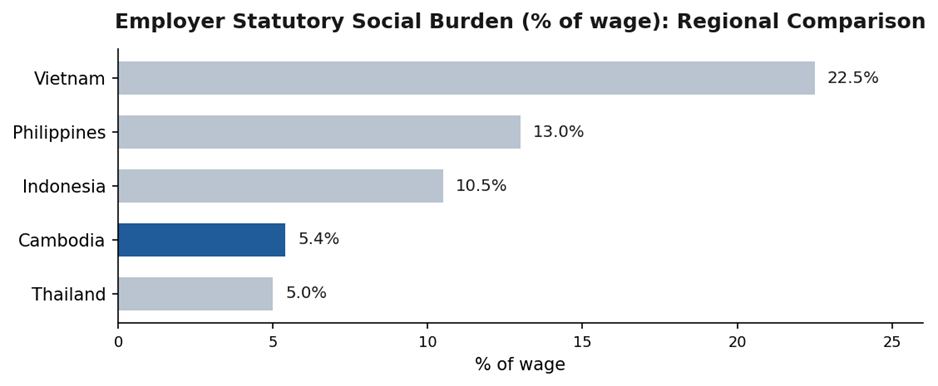
Figure 3: Employer statutory social burden as a share of wage, regional comparison (Sources: national social-security systems, PwC, Gini Talent).
Cambodia’s employer NSSF burden comprises occupational risk (0.8%), health care (2.6%, fully employer-funded since 2018) and pension (2%, rising to 4% from 2027), totaling about 5.4%. In factories employing several thousand workers, this burden gap scales with headcount and has a material effect on overall labor cost.
Workforce supply: a young and abundant labor force
Cambodia’s workforce supply is characterized by volume, youth and a high participation rate, providing a solid labor base for labor-intensive manufacturing.
On supply, Cambodia’s total labor force is about 9.9 million (2024, World Bank), with a national population of about 17.4 million, a young age structure, a labor-participation rate among the region’s highest, and low youth unemployment. The garment, footwear and travel-goods sector currently has about 1,800 active factories and roughly 1.1 million workers (mostly women), accounting for over half of national exports — a substantial base of employment and skills transfer.
On skills, line workers are plentiful, while mid- and senior-level technical, quality-control and production-management talent is an area companies should plan to train in advance. For reference, senior supervisors earn around US$320/month, QC managers around US$360, and production managers up to US$420 — still clearly below comparable roles in neighboring countries. The government has also been strengthening vocational training in recent years through measures such as a new vocational-education law.
Labor-law essentials: hours, overtime and compliance
Cambodia’s labor-law framework is broadly in line with regional norms; the key points are working hours, overtime rates and seniority payments. New overtime procedures issued in 2025 make compliant attendance and payroll management important.
| Item | Provision |
| Normal hours | 8 hours/day, 48 hours/week (usually a 6-day week) |
| Overtime rate | Daytime weekday 150%; night (22:00–05:00) and weekly rest day 200%; public holidays carry a premium |
| Overtime cap | 2 hours/day (with consent; beyond that requires prior MLVT approval) |
| Annual leave | 18 days/year (+1 day every 3 years) |
| Maternity leave | 90 days at 50% pay (after 1 year of service) |
| Seniority payment | 15 days’ wages/year, paid in June and December |
Note that in 2025 the Ministry of Labour issued new rules on overtime, paid-holiday work and suspension of weekly rest (Prakas 112/25), requiring employers to file in advance through a designated system; such compliance is also a prerequisite for passing international buyers’ ESG audits. Companies are advised to establish complete working-hour and payroll records from the start of operations.
MSEZ’s workforce support
Workforce conditions ultimately depend on park-level support; Manhattan Special Economic Zone (MSEZ) has the corresponding capacity in employment base and HR-management support.
MSEZ is located at Bavet on the Cambodia–Vietnam border, covering about 600 hectares with over 40,000 workers on-site; supplier clusters in textiles, footwear, bags and electronics assembly are already developed, providing a substantial employment base and skills transfer. The zone has a multilingual (Chinese, English, Khmer) administrative and compliance team that can help companies with NSSF registration, working-hour and payroll compliance, MLVT filings, and recruitment and training, lowering the HR-management threshold for new entrants.
To round out local living amenities and business convenience, the zone also provides a full set of supporting facilities — retail outlets, banking points and a comprehensive shopping mall. These meet the daily needs of the tens of thousands of workers on-site, improving workforce stability, while also offering tenant companies convenient financial-transaction and procurement services.
Country-level wage figures are only a starting point; what really determines stable output is park-level employment base, HR-management support and compliance capability. If your company is evaluating Cambodia’s workforce conditions, the MSEZ team is glad to provide an initial assessment based on your industry profile and headcount.
FAQ
Q1. What is the actual labor cost in Cambodia’s garment sector?
| The 2026 statutory minimum wage is US$210/month (regular) and US$208 (probationary). Adding the attendance bonus (US$10), transport/housing allowance (US$7), meal and seniority bonuses, worker take-home is about US$227–238; on the employer side there is also NSSF (about 5.4%) and the seniority payment (15 days’ wages/year). Budget on an “all-in labor cost” basis rather than the headline base wage alone. |
Q2. How does Cambodia’s labor cost compare with neighboring countries?
| Cambodia’s monthly minimum wage (about US$210) is clearly below China, Thailand and Indonesia, and on a par with Vietnam’s Region I; more importantly, the employer statutory social burden is only about 5.4%, far below Vietnam’s roughly 21.5%. Against lower-wage locations such as Bangladesh and Myanmar, Cambodia has the edge on EBA/RCEP export channels, a US-dollar environment and stability. |
Q3. Is Cambodia’s labor supply sufficient?
| Line-worker supply is ample: a total labor force of about 9.9 million, a young population and a high participation rate, with the garment sector already at about 1.1 million workers. Mid- and senior-level technical, QC and production-management talent should be planned for through training or expatriate staff; the government has also been strengthening vocational education in recent years. |
Q4. What are Cambodia’s overtime and working-hour rules?
| Normal hours are 8/day and 48/week (usually a 6-day week). Overtime is 150% on weekday daytime, and 200% at night (22:00–05:00) and on the weekly rest day, with a premium on public holidays; overtime is capped at 2 hours/day and requires consent. In 2025 new overtime procedures (Prakas 112/25) introduced an advance-filing requirement. |
Q5. What social-insurance costs does the employer bear?
| Employers contribute to NSSF for occupational risk (0.8%), health care (2.6%, fully employer-funded since 2018) and pension (2%, rising to 4% from 2027), totaling about 5.4%; the contribution base is capped (roughly US$100–300/month). This is clearly lower than Vietnam’s employer burden of about 21.5%. |
References
- Cambodia Ministry of Labour and Vocational Training | Prakas 214/25: 2026 garment/footwear/travel-goods minimum wage US$210 (regular), US$208 (probationary), effective 1 Jan 2026 (DFDL, ASEAN Briefing, Xinhua, Sep 2025)
https://www.dfdl.com/insights/legal-and-tax-updates/cambodia-increase-in-minimum-wage-for-2026-for-the-garments-textiles-footwear/ - Playroll / KPMG / Open Development Cambodia | Cambodia garment-sector minimum wage history (2014 ~100, 2016 140, 2018 170, 2020 190, 2023 200, 2024 204, 2025 208, 2026 210 US$)
https://www.playroll.com/minimum-wage/cambodia - DFDL / ASEAN Briefing | Statutory allowances: attendance US$10, transport/housing US$7, meal US$0.5/day, seniority US$2–11; worker take-home incl. allowances ~US$227–238 (Sourcing Journal, Sep 2025)
https://www.dfdl.com/insights/legal-and-tax-updates/cambodia-increase-in-minimum-wage-for-2025-for-the-garments-textiles-footwear-travel-products-and-bags-sectors/ - PwC Worldwide Tax Summaries / EuroCham (Prakas 449) / Gini Talent | NSSF employer rate ~5.4%; neighboring employer burdens (Vietnam ~21.5%, Philippines 13%, Indonesia 10–11%, Thailand 5%)
https://taxsummaries.pwc.com/cambodia - Trading Economics / Statista / USITC | Regional minimum wages (Vietnam Region I ~210 / Region IV ~141, Bangladesh garment ~113, Thailand ~280, Indonesia Jakarta ~330, China mfg provinces ~300–370 US$)https://tradingeconomics.com/country-list/minimum-wages
- World Bank | Cambodia total labor force ~9.9 million (2024); CamboJA | GFT sector ~1,800 factories, ~1.1 million workers, over half of exports (2025–2026)
https://data.worldbank.org/country/cambodia - Cambodia CDC / Acclime / Tilleke & Gibbins | Labor-law hours, overtime, annual leave, seniority payments; MLVT Prakas 112/25 new overtime rules (May 2025)
https://wageindicator.org/en-kh/work-in-cambodia/labour-law/compensation-and-working-time/