Summary
Khmer classical dance, also known as the Royal Ballet of Cambodia, has been tied to the Khmer court for over a thousand years. Dancers tell myths through hand gestures, poses and fixed character types. UNESCO proclaimed it a Masterpiece of the Oral and Intangible Heritage of Humanity in 2003 and inscribed it on the Representative List in 2008.
The walls of Angkor Wat carry nearly 1,800 carved goddesses, and they look like evidence of a dance frozen in stone. Yet the best-known piece on today’s stage, the Apsara dance, was re-created from those reliefs only in the mid-20th century. The art as a whole, meanwhile, was pieced back together from survivors’ memories after the Khmer Rouge.
Last updated: 2 November 2026
1. What is Khmer classical dance? Key facts
Khmer classical dance is Cambodia’s court dance drama, once performed at royal ceremonies such as coronations, weddings, funerals and festivals. It has four role types (woman, man, giant and monkey), is accompanied by a pinpeat orchestra and a female chorus that narrates the plot, and its most often performed pieces are the Blessing Dance and the Apsara Dance.
| Item | Details |
|---|---|
| Names | Khmer classical dance, Royal Ballet of Cambodia |
| UNESCO | Proclaimed a Masterpiece of the Oral and Intangible Heritage in 2003; on the Representative List since 2008 |
| Roles | Neang (woman), Neayrong (man), Yeak (giant), Sva (monkey) |
| Hand gestures | Kbach: hand and arm positions that express feelings, things and situations |
| Music | Pinpeat orchestra (xylophones, drums, oboes, gongs) and a female chorus |
| Most performed | Robam Chuon Por (Blessing Dance), Robam Tep Apsara (Apsara Dance) |
| Main school | Royal University of Fine Arts, Phnom Penh |
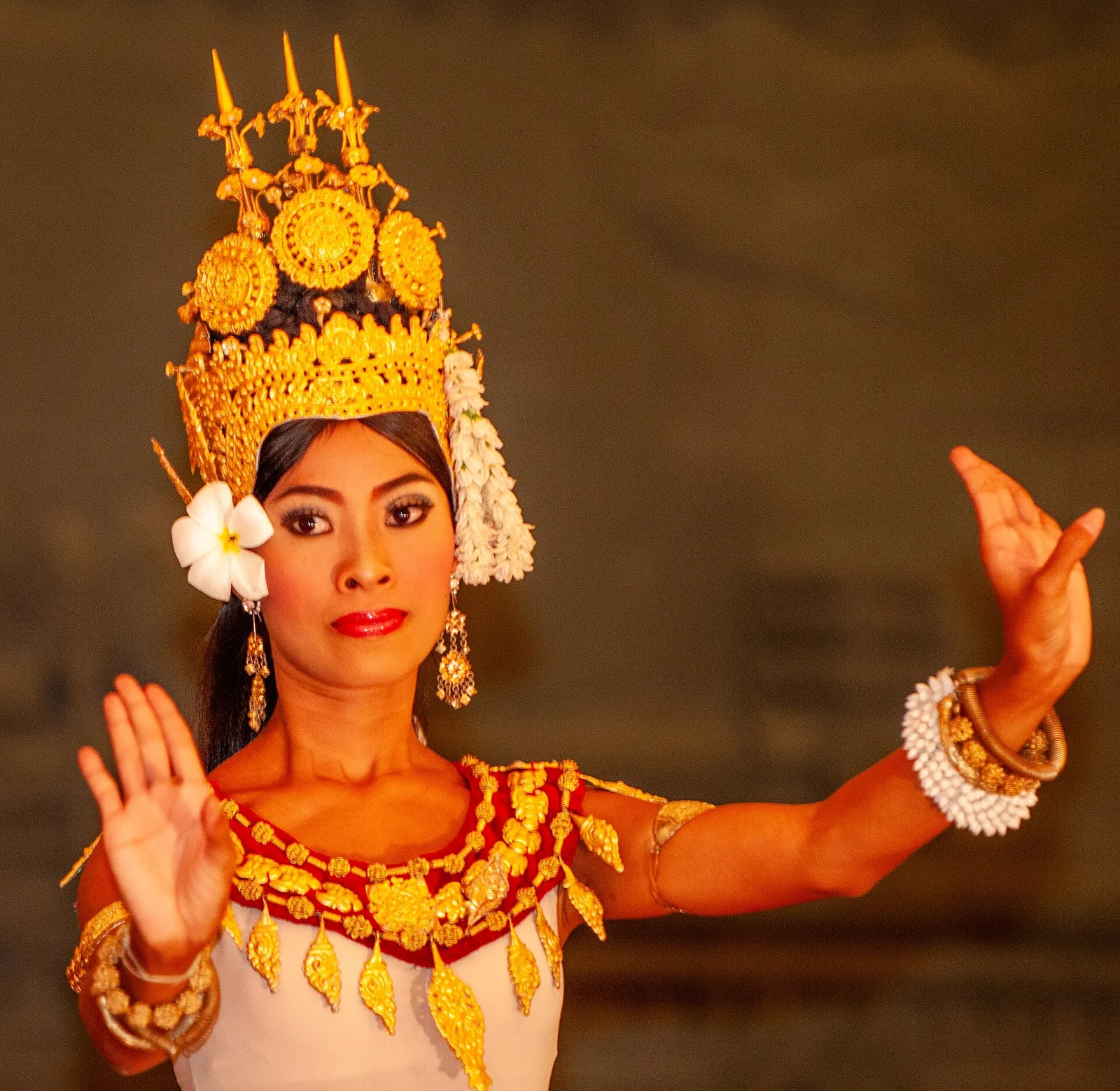
The dancer’s fingers bend back into an arc and the knees stay slightly bent. Watch long enough and you notice that the real storytelling is done by the hands.
One foreign artist who was captivated by those hands, and drew them seriously, first saw them in Paris.
2. Why did a French sculptor follow Cambodian dancers to Marseille?
In 1906 Cambodia’s dancers accompanied their king on an official visit to France. The sculptor Auguste Rodin first saw them perform in Paris in July, followed them to Marseille, and made about 150 drawings of the dancers in a single week, saying they made the antique live in him.
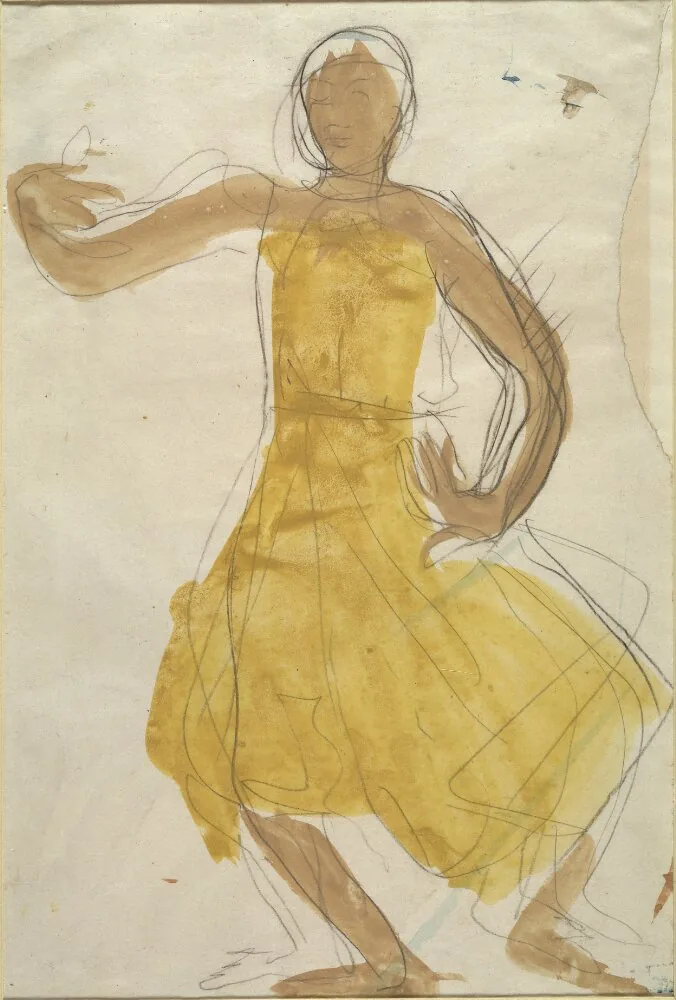
That year Marseille was hosting a Colonial Exhibition, and the Cambodian dancers even made the cover of the French paper Le Petit Journal. Rodin was 65, a man who had spent his life studying nature and the human body and who revered ancient art. What he drew were the held poses: a lifted elbow, fingers bent backwards, a knee in a half crouch.
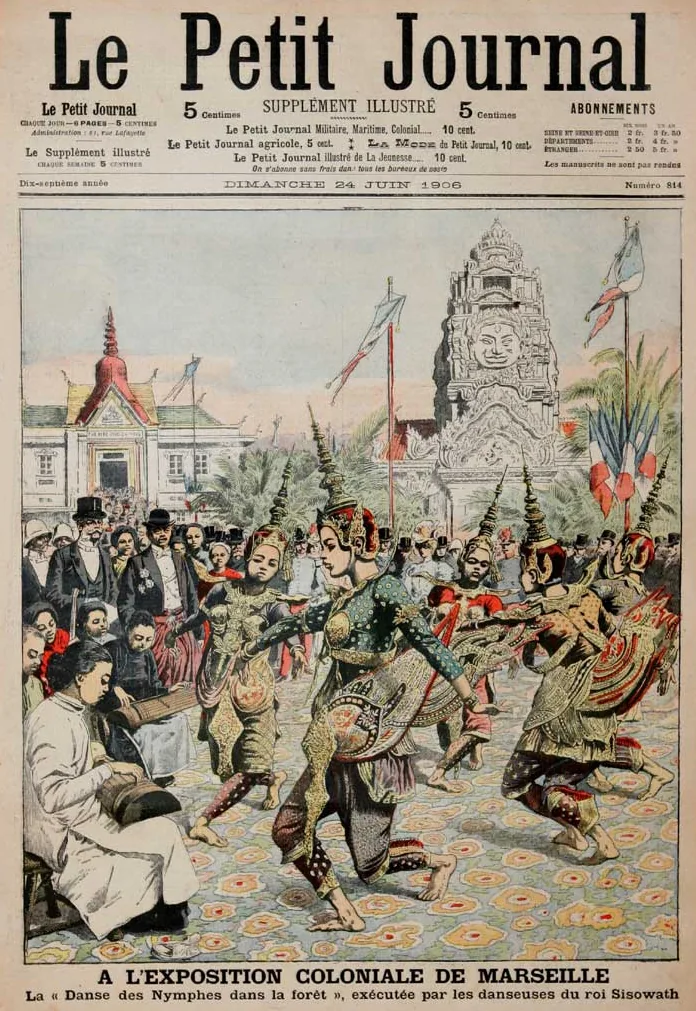
Those poses have a name in Cambodia.
3. What do the dancers’ hand gestures mean? Kbach and years of training
The hand gestures of Khmer classical dance are called kbach, roughly meaning “style”. They form a kind of alphabet representing things from nature such as flowers, leaves and fruit, and together with arm, leg and body positions they express situations, thoughts and feelings.
The same gesture can mean something different at a different height or with a different arm position.
An observer in 1937 described dancers helping one another before practice, flexing each other’s fingers, wrists, elbows and toe joints. A dancer who studied and later taught at the Royal University of Fine Arts says a student must learn 4,500 movements to master the form. UNESCO puts it more simply: the gestures and poses are mastered only after years of intensive training.
If the gestures are the language, the roles are the speakers.
4. What are the four roles? Woman, man, giant and monkey
Khmer classical dance has only four role types: Neang (woman), Neayrong (man), Yeak (giant) and Sva (monkey). Each has its own colours, costume, make-up and masks, so the audience can tell who is who at a glance.
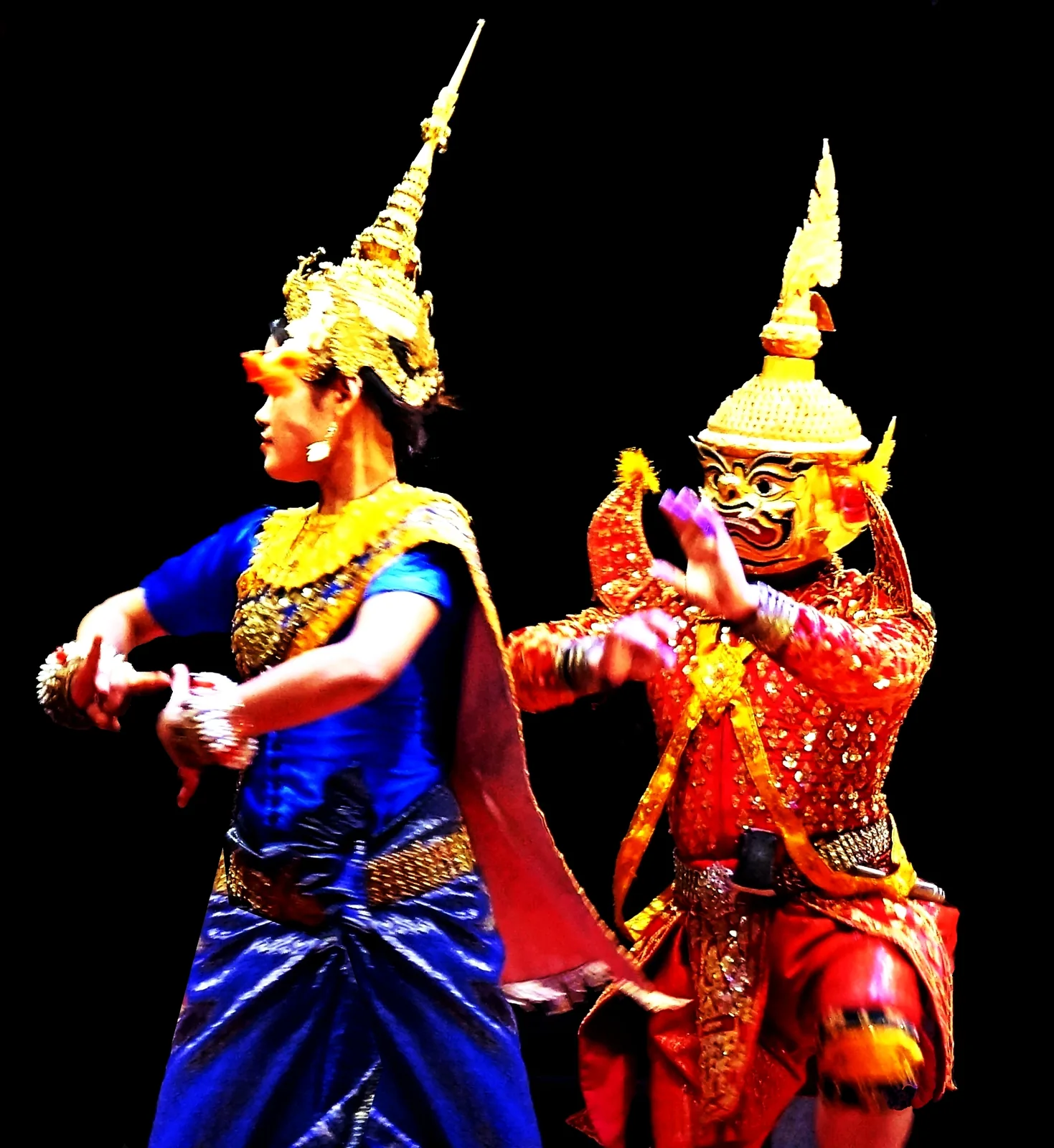
The repertory carries legends tied to the origins of the Khmer people and often draws on the Reamker, the Khmer Ramayana. In Mekhala and Ream Eyso, for example, Mekhala drives off the giant Ream Eyso with the light of her crystal sphere, a story of good overcoming evil.
Of all these figures, the one most often used to represent Cambodia is the apsara. And she is carved into the walls of Angkor Wat.
5. Was the Apsara dance really passed down from Angkor?
The costumes and poses of the Apsara dance are taken from the goddesses (devata) carved at Angkor Wat, but the version performed today was re-created in the mid-20th century, when the court gathered dance teachers to rebuild it from the reliefs. It was first performed in Siem Reap for a film in the early 1960s.
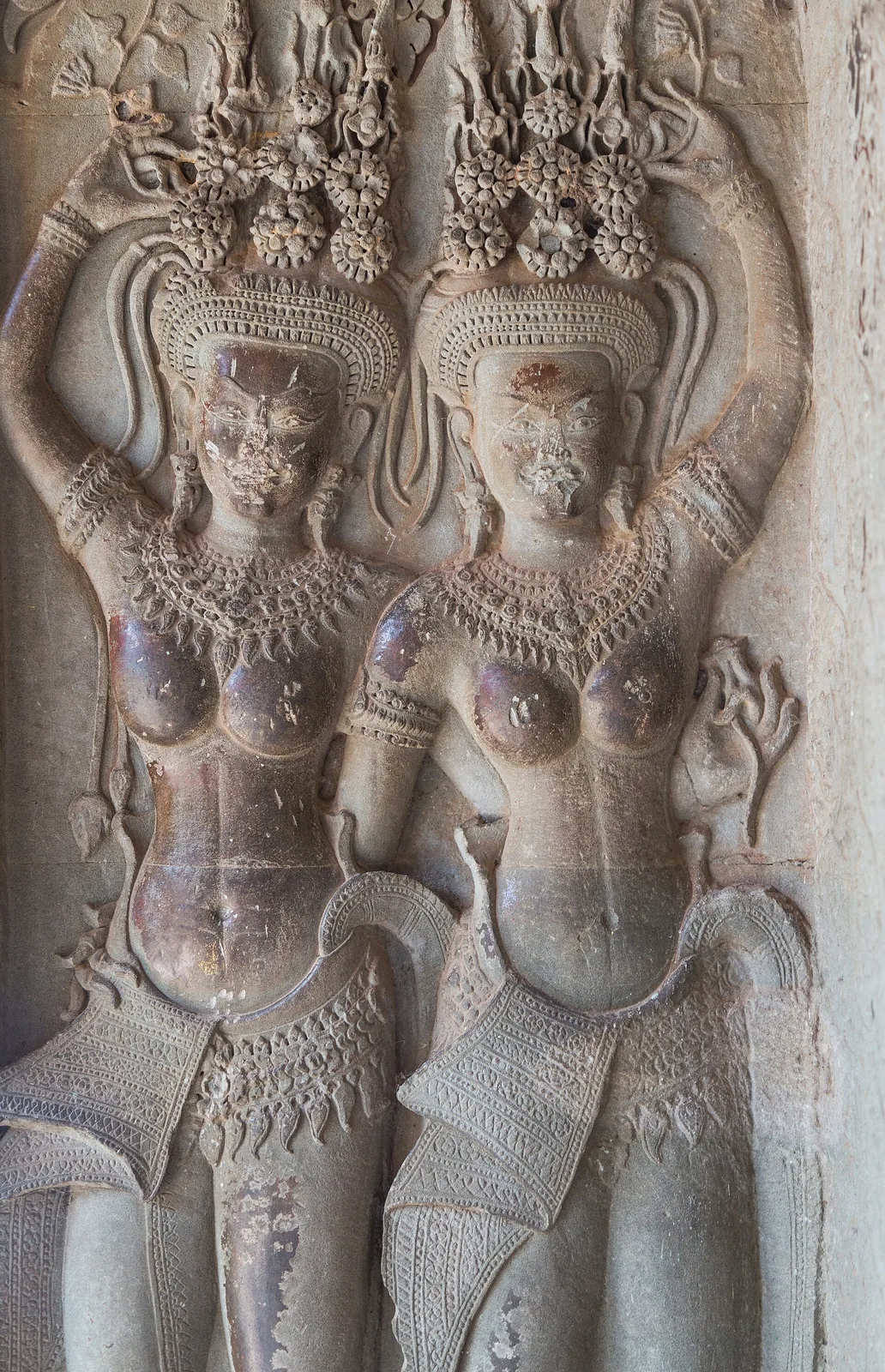
Angkor Wat is covered in goddesses. One inventory that counted them one by one found nearly 1,800 across the temple, not including those on the high towers. With their tall crowns and flowers in hand, each in a different pose, they look like a dance held still in stone.
A study published by Cambodia’s Ministry of Culture records that a school created a dance called “Apsara” in 1958, with crowns made of hard paper sewn onto cloth and cut into shape. After seeing it, the court invited dance teachers to discuss creating a new Apsara dance. In 1961 or 1962 the new dance was first performed in Siem Reap for a film, and the lead dancer wore a specially made costume, close to the one lead dancers wear today. Researchers disagree on exactly who created the modern dance.
So rather than a dance handed down unbroken from Angkor, the Apsara dance is a new dance that modern teachers created with the reliefs of Angkor Wat as their reference. For the history of Angkor Wat itself, see Angkor Wat and Zhou Daguan.
6. What does the Apsara dancer wear? Costumes sewn on the body
Before every performance, Khmer classical dancers are sewn into their costumes, which can take two to three hours depending on how many dancers are being dressed at once. The Apsara costumes and jewellery are based on the devata reliefs of Angkor Wat.
The lead Apsara dancer wears a white silk sampot pleated at the front over a skin-toned silk bodice. Her crown has three points and two rows of round ornaments; supporting dancers usually have one row. Around the neck is a round collar of copper ornaments and beadwork, the earrings hang almost to the shoulders, and matching pieces are worn at the wrists and ankles.
Because the costume is stitched on piece by piece, every performance really begins hours before the curtain rises.
7. How was the dance saved after the Khmer Rouge?
During the Khmer Rouge years (1975–1979) almost all master dancers and musicians were killed; a widely cited estimate is that about 90 percent of Cambodia’s classical artists died. After 1979, surviving dancers gathered and reconstructed the repertory together from memory.
Classical dance is passed from teacher to student, one movement at a time. After 1979, dance troupes re-emerged quickly, and the survivors came together to recall and rebuild the old repertory.
Em Theay was one of them. She began dancing at eight and once danced at the palace. Under the Khmer Rouge she was sent to Battambang province; after the regime fell she returned to dance, and in 2015, at 85, she was still teaching at the Royal University of Fine Arts. A 2015 report described the university as the most important school of classical dance in Cambodia.
The Apsara dance was newly created with the reliefs as reference; the art as a whole was rebuilt from survivors’ memories. UNESCO warns of a different risk now: lack of funding and performance spaces, competition from modern media, and the danger of becoming a mere tourist attraction.
8. Where can you see Khmer classical dance in Cambodia?
In Phnom Penh, the Royal Ballet’s venues include the Chenla Theatre and Chaktomuk Conference Hall. In Siem Reap, a number of restaurants and theatres stage the Apsara dance and other classical pieces. Schedules vary, so check each venue for current dates.
To get more out of a performance, keep two things in mind: watch the dancers’ hands, and use the costumes to tell the four roles apart. For Cambodia’s other intangible heritage, such as the two-metre shadow puppets and the masked dance drama, see Cambodian Traditional Arts; pagoda murals often tell the same Reamker stories, see How to Read a Cambodian Pagoda. Manhattan Special Economic Zone is in Bavet, Svay Rieng province; to learn about our factories and facilities, contact our investment team. For more on Cambodian festivals, history and customs, visit our Cambodian Culture column.
9. FAQ
Q1: What is Khmer classical dance?
Also called the Royal Ballet of Cambodia, it has been tied to the Khmer court for over a thousand years and was once performed at coronations, weddings, funerals and festivals, telling myths through hand gestures, poses and fixed character types.
Q2: Is Khmer classical dance UNESCO intangible heritage?
Yes. The Royal Ballet of Cambodia was proclaimed a Masterpiece of the Oral and Intangible Heritage of Humanity in 2003 and inscribed on the Representative List in 2008.
Q3: What are the hand gestures in Khmer classical dance called?
They are called kbach. They form a kind of alphabet representing things from nature such as flowers, leaves and fruit, and with arm, leg and body positions they express situations, thoughts and feelings.
Q4: What roles are there in Khmer classical dance?
There are four: Neang (woman), Neayrong (man), Yeak (giant) and Sva (monkey), each with its own colours, costume, make-up and masks.
Q5: Was the Apsara dance passed down from the Angkor period?
Its costumes and poses come from the devata reliefs of Angkor Wat, but today's version was re-created in the mid-20th century and first performed in Siem Reap in 1961 or 1962.
Q6: How do Khmer classical dancers put on their costumes?
They are sewn into their costumes before every performance, which can take two to three hours depending on how many dancers are being dressed.
Q7: How did the Khmer Rouge affect Khmer classical dance?
Almost all master dancers and musicians were killed, with a widely cited estimate of about 90 percent of classical artists; after 1979 survivors reconstructed the repertory from memory.
Q8: Where can I watch Khmer classical dance in Cambodia?
In Phnom Penh, the Royal Ballet's venues include the Chenla Theatre and Chaktomuk Conference Hall; in Siem Reap, a number of restaurants and theatres stage classical dance. Check each venue for schedules.
References
- UNESCO (accessed 2 Nov 2026) | Royal Ballet of Cambodia | https://ich.unesco.org/en/RL/royal-ballet-of-cambodia-00060
- Wikipedia (accessed 2 Nov 2026) | Royal Ballet of Cambodia | https://en.wikipedia.org/wiki/Royal_Ballet_of_Cambodia
- Wikipedia (accessed 2 Nov 2026) | Apsara Dance | https://en.wikipedia.org/wiki/Apsara_Dance
- Wikipedia (accessed 2 Nov 2026) | Dance in Cambodia | https://en.wikipedia.org/wiki/Dance_in_Cambodia
- Research Committee on Arts and Culture, Ministry of Culture and Fine Arts (Narom Keo, Sisaphanta Prum, 2003) | Apsara Dance (Angkor Database) | https://angkordatabase.asia/books/apsara-dance-របាំអប្សរា
- Musée Rodin (2006 exhibition page, accessed 2 Nov 2026) | Rodin and the Cambodian Dancers | https://www.musee-rodin.fr/en/musee/expositions/rodin-and-cambodian-dancers
- PBS NewsHour / KQED (7 Apr 2015) | Watch the 1,000-year-old dance tradition nearly killed by the Khmer Rouge | https://www.pbs.org/newshour/arts/watch-the-1000-year-old-dance-tradition-nearly-killed-by-the-khmer-rouge
- VOA Khmer (11 Nov 2015) | Photographs Intimately Depict Life of Cambodian Classical Dancer | https://khmer.voanews.com/a/photographs-intimately-depict-life-of-cambodian-classical-dancer/3052123.html
- Devata.org (Kent Davis, 30 May 2013) | Angkor Wat Devata Inventory | https://www.devata.org/?p=670
- Manhattan SEZ (28 Oct 2026) | Cambodian Traditional Arts: 7 UNESCO intangible heritage elements | https://www.manhattansez.com/en/cambodian-traditional-arts/