

Summary: The date for Cambodia LDC graduation is settled: 19 December 2029, under UN General Assembly resolution A/79/L.49 adopted in December 2024. The EU’s Everything But Arms arrangement applies only to least developed countries, so it winds down during a post-graduation transition. If garments then move to standard GSP, the average tariff into the EU rises from zero to about 8.8%; with no GSP eligibility at all, it returns to the MFN rate of roughly 12%. Cambodia is pursuing GSP+, which would hold the rate at zero but requires ratifying and implementing 27 international conventions.
The most common confusion in practice is between two periods that are not the same thing. 2024 to 2029 is the preparatory period granted by the UN, extended to five years for Cambodia as an exception (three is standard). Only after graduation does the EU transition period begin, during which duty-free treatment is phased out. Treating them as one period leads firms to miscalculate how much time they actually have. This page records the full timeline, the routes available after graduation and their respective tariffs, sector exposure ranked by dependence on origin rules, and what firms should complete between now and graduation.
1. When does Cambodia graduate, and how long can EBA still be used?
The graduation date is fixed at 19 December 2029, but that is not the day duty-free access ends. The EU’s Everything But Arms treatment is withdrawn during a transition period that starts after graduation, which means the usable window is somewhat longer than most people assume.
Cambodia was designated a least developed country in 1991, met all three graduation criteria for the first time in 2021, and exceeded all three again at the 2024 review. On that basis the UN General Assembly adopted resolution A/79/L.49 in December 2024, confirming that Cambodia and Senegal will graduate on 19 December 2029, with both granted an exceptional five-year preparatory period.
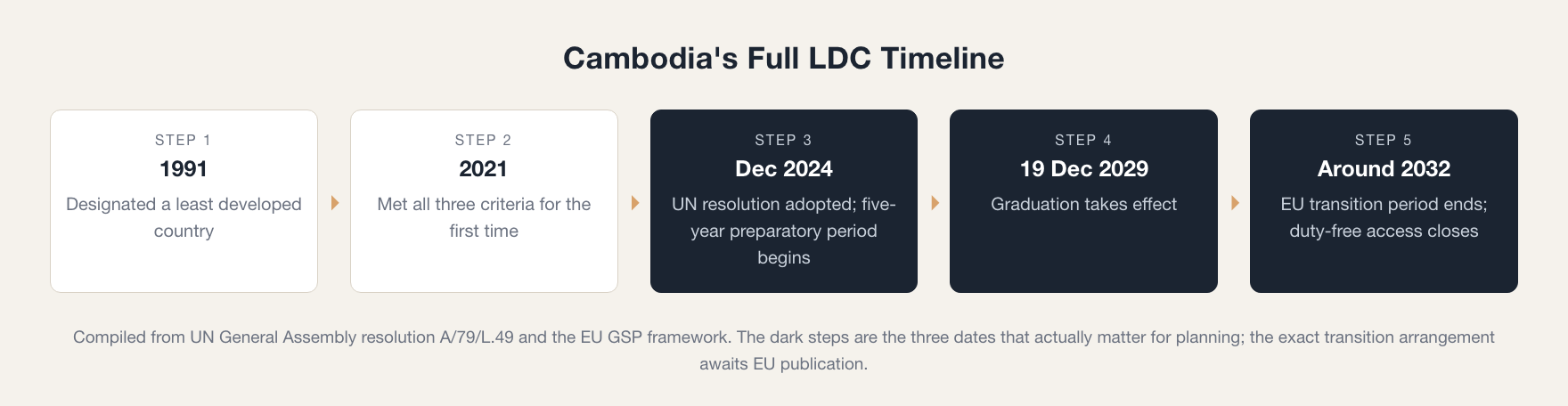
Figure 1: The full timeline for Cambodia LDC graduation, compiled from UN General Assembly resolution A/79/L.49 and the EU GSP framework.
| Item | Detail | Timing and basis |
| Graduation date | 19 December 2029 | UN General Assembly resolution A/79/L.49, adopted December 2024 |
| Preparatory period | Five years (2024-2029); three is standard | Granted exceptionally to Cambodia and Senegal |
| Transition period | About three years after graduation, estimated to around 2032 | EU GSP rules; exact arrangement awaits EU publication |
| Current tariff into the EU | 0%, duty-free and quota-free | Everything But Arms, available to least developed countries |
| Standard GSP rate | About 8.8% on average | Applies once the transition period ends |
| MFN rate | About 12% on garments | Applies with no GSP eligibility |
| GSP+ | 0%, subject to ratifying and implementing 27 conventions | A stated policy objective; progress to be monitored |
| 2020 partial withdrawal | Some garments, footwear, travel goods and sugar, about one fifth of exports to the EU | EU, effective February 2020 |
Table 1: Cambodia’s graduation timeline and EU tariff outlook, compiled from the UN resolution, the EU GSP framework and industry association briefings.
So the answer to “when does Cambodia’s EBA expire” is not 2029. What firms need to watch on this timeline is not the graduation date itself but the moment duty-free access closes. Everything But Arms is available only to least developed countries; after graduation the EU GSP rules provide a transition period during which the treatment is withdrawn, estimated to fall around 2032. The exact arrangement will follow the EU’s own announcement, and this page will be updated as rules are published.
2. Preparatory period or transition period? Two windows that get conflated
Cambodia’s preparatory period is the pre-graduation buffer granted by the UN, running five years from 2024 to 2029. The transition period is the post-graduation wind-down granted by the EU, running about three years from December 2029. They come from different institutions under different rules; splicing them incorrectly shifts a plan by years.
| Preparatory period | Transition period | |
| Dates | December 2024 to December 2029 | From graduation in December 2029, estimated to around 2032 |
| Granted by | UN General Assembly, under resolution A/79/L.49 | The EU, under its GSP rules |
| Basis for length | Three years is standard; Cambodia received an exceptional five | The EU’s wind-down arrangement for graduating countries |
| Treatment during the period | Still a least developed country; Everything But Arms applies in full | No longer a least developed country; duty-free treatment is phased out |
| What firms should do | Use the duty-free window fully while building conditions that survive graduation | Complete the switch: confirm the new tariff treatment and origin evidence |
Table 2: How the preparatory and transition periods differ, compiled from UN and EU rules.
This distinction matters because it changes the payback assumption directly. A garment plant typically needs about a year from signing to stable output. If the usable window is mistakenly read as ending in 2029, any new project after 2027 looks unattractive. Counting the post-graduation transition adds roughly three more years of duty-free access to the same project. For a five-year payback, that is not a marginal difference; it is the line between viable and not. Conversely, reading the transition as five years starting in 2024 understates the time remaining and leads firms to abandon plans prematurely.
The confusion is understandable: both windows are named by a number of years, and press coverage often calls both of them transition periods. The practical test is to look at who granted it. Anything referring to the UN, a resolution or a graduation date concerns the preparatory period. Anything referring to the EU, GSP or the withdrawal of duty-free treatment concerns the transition period. The former is already fixed in a resolution; the latter still awaits detailed EU publication, which is the part this page will keep updating.
3. What routes exist after graduation? GSP+, standard GSP and free trade agreements
Cambodia’s post-graduation garment tariff into the EU depends on which arrangement it secures: GSP+ holds the rate at zero, standard GSP averages about 8.8%, and with no GSP eligibility the rate returns to roughly 12% MFN. The lowest rate comes with governance conditions, not tariff conditions.
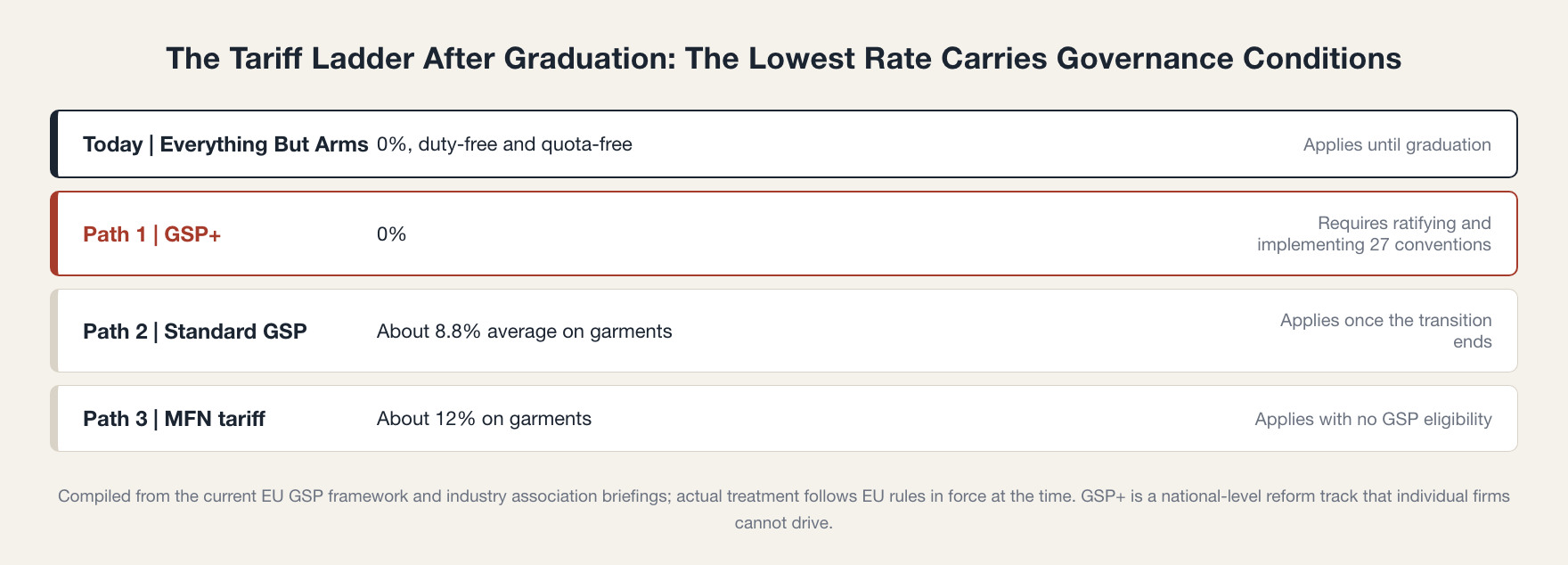
Figure 2: The tariff ladder after graduation, compiled from the current EU GSP framework and industry association briefings; actual treatment follows EU rules in force at the time.
A frequent question is whether Cambodia can simply apply for GSP+. That route holds the rate at zero, but the price is ratifying and implementing 27 international conventions covering human rights, labour rights, environmental protection and good governance, plus accepting ongoing monitoring. Application and review sit with the European Commission; no single firm or sector decides the outcome. Cambodia’s Ministry of Commerce has set an upgrade to GSP+ as a policy objective, but this is national-level institutional reform and firms do not control the pace. This page will be updated as the application progresses. The second route is standard GSP, where the rate rises from zero to about 8.8% on average. The third is the MFN rate of roughly 12% on garments, which applies if no GSP eligibility is available at all.
Cambodia is also using free trade agreements to reduce reliance on any single preference. That route differs in kind from the first two: GSP is a unilateral concession that can be withdrawn, while a free trade agreement is a bilateral commitment and therefore more stable, though the markets and products it covers are set by the agreement and may not substitute for EU access. For firms whose main market is the EU, GSP+ progress should be the primary consideration, with free trade agreements secondary.
If EU orders account for more than half of your revenue, whether GSP+ is secured becomes the single largest variable of the next five years and belongs in the annual review rather than in background reading. If the EU is below twenty percent and your main markets are the United States or the region, the weight of this variable drops sharply. What determines US market access is tariffs and trade remedies, not LDC status; for country rates, product-level remedies and a record of changes, see US Tariffs on Cambodia: Monitor.
4. Where does EBA’s value actually lie? Single transformation and the partial withdrawal
The value of Everything But Arms to Cambodia’s labour-intensive sectors lies less in the zero tariff than in one origin rule: single transformation. Imported fabric made up into garments in Cambodia qualifies as originating, and that is why Cambodia can take EU orders while producing only about 5% of its own fabric.
Garments, footwear and bags fall under single transformation: making up imported fabric into garments in Cambodia satisfies the origin requirement, and the source of the fabric does not affect the determination. By contrast, Vietnam’s exports to the EU fall under the double transformation rule of the EU-Vietnam free trade agreement, which requires production from fabric stage onward inside the agreement area, so Chinese fabric disqualifies the goods. Cambodia produces only about 5% of its fabric locally and imports roughly 60% from China, yet remains a major global garment exporter precisely because of this rule. For what single transformation means for the garment sector and how Cambodia and Vietnam differ on origin rules, see Apparel Supply Chain Restructuring: Planning Before Cambodia’s 2029 LDC Graduation.
It should also be said that the treatment is not universal. In February 2020 the EU partially withdrew it from Cambodia, covering some garments, footwear, travel goods and sugar, amounting to roughly one fifth of exports to the EU. On EU figures, the remaining 70 to 80% still enters duty-free and quota-free. So the first step in assessing your own exposure is to check whether your product’s tariff code already sits on the withdrawn list. If it does, the change after 2029 is relatively limited. If it does not, you are in the group that genuinely faces a change in access.
5. Which sectors are most exposed? Ranked by dependence on origin rules
The sectors most exposed after graduation are garments, footwear and bags: all three combine a high share of EU sales with a high share of imported inputs, and depend most heavily on single transformation. Upstream textiles, tyres and rubber products are markedly less exposed.
| Sector | Dependence on permissive origin rules | Main issue after graduation |
| Garments, footwear and bags | High – heavy use of imported fabric and trims; relies on single transformation | Whether local content can rise above the new threshold during the transition; localising trims and finishing |
| Upstream textiles (weaving, dyeing) | Low – the activity is itself value-adding | A net beneficiary: graduation pressure raises downstream demand for local fabric |
| Tyres and rubber products | Low – natural rubber is sourced locally and value is added locally | Limited impact; the main market is the United States, with product-level trade remedies to watch |
| Electronics assembly, wire harnesses | Medium – components are largely imported, but EU share is usually modest | Depends on target market; limited impact where EU share is low |
| Furniture and wood products | Medium – inputs are largely local, but other EU regulations apply | Beyond tariffs, EU forest-related compliance requirements are rising in parallel |
| Agriculture and food processing | Low to medium – inputs are local | Some lines were already on the withdrawn list, so the change is smaller |
Table 3: Assessing sector exposure, compiled by dependence on origin rules and market structure.
The table reduces to a test you can apply yourself: multiply your EU share of revenue by the share of imported inputs in your cost base; the higher the number, the sooner you should act. It also explains why upstream textiles is one of the few beneficiaries of this shift. To keep origin status under the new rules, downstream factories will move fabric and finishing purchases onshore, and that is exactly the link Cambodia has long been missing.
6. Beyond tariffs, what else does graduation change?
Graduation affects more than EU access: GSP arrangements in Canada, the United Kingdom and elsewhere lapse as well, and WTO obligations increase. For most manufacturers, though, these changes bite less than tariffs do.
GSP arrangements for least developed countries in Canada, the United Kingdom and other economies will lapse with the change in status, so firms with diversified export structures need to take stock across all of them. On WTO obligations, Cambodia will have to notify domestic support under the Agriculture Agreement annually and comply with obligations under the agreement on trade-related aspects of intellectual property rights; these mainly affect government and specific sectors. International support measures such as concessional finance and technical assistance will also be phased out.
7. What should firms complete between now and 2029?
Between now and 2029, preparation splits into two kinds: extracting full value from the existing duty-free window, and building conditions that still hold after graduation. The first has a hard deadline; the second takes longer than most firms estimate, which is precisely why it should start first.
The first task is to establish your own exposure. Using your product’s customs tariff code, check three things: whether it sits on the 2020 withdrawn list, what share of total revenue comes from the EU, and what share of input cost is imported. Only once all three are clear can the scale of impact be assessed; judging by sector alone tends to over- or understate it. For a line-by-line review list, see Cambodia Factory Setup Checklist.
The second task is to use the duty-free window fully during the preparatory period. If EU orders are already in hand, every quarter that production start slips is a quarter of shipments that cannot fall inside the full duty-free window. That makes routes which compress lead time, such as leasing a ready-built factory, more valuable now than usual. For the trade-offs between leasing ready-built space, built-to-suit and leasing land to build, and how to compare quotes, see Cambodia Factory and Industrial Land: Quote Structure, Pricing Bases and Contract Terms.
The third task, and the slowest, is raising local content. Whether GSP+ or standard GSP applies in future, origin rules will be stricter than today’s single transformation, and whether you can stay depends on the real share of value added locally. Practical steps include moving trims, printing and washing onshore through purchasing or in-house capacity, building long-term relationships with local fabric suppliers, and accumulating complete records of input sources, process steps and cost allocation from now on. Records of this kind have to be generated during daily operations; versions assembled afterwards rarely survive an audit. For how local content is calculated and what evidence a certificate of origin requires, see Cambodia Certificate of Origin and Local Content: Does the 35% Threshold Still Apply?.
The fourth task is market diversification. Bringing the EU share down to a level where a single policy change cannot do fundamental damage is itself a hedge, but it requires new channels and certifications, usually measured in years, and should not wait for the transition period to begin.
These four are not equally urgent. Establishing exposure should take weeks, because it determines whether and how far to pursue the other three. Using the duty-free window has a hard deadline, so earlier production start is simply worth more. Raising local content takes the longest: from building supplier relationships to stable process operation is typically measured in years, so although its deadline is the latest, it should start the earliest. Market diversification can run in parallel. If resources allow only one, prioritise local content, because duty-free access will close eventually and local value added is the only condition still in your hands after graduation.
8. How does local content actually grow? What Manhattan SEZ can offer
What decides who stays after graduation is the real share of value added locally, and local content is not a commitment on paper; it needs somewhere to grow. Whether trims can be bought, whether finishing can be done, whether there is room to expand – the answers depend largely on the industrial environment of the zone you are in.
Most special economic zones offer industrial land and help with investment approvals; that is standard in Cambodia. Judging whether a zone can support rising local content requires more specific questions: how many suppliers of trims, packaging, printing and washing sit inside or near the zone, and within what delivery radius; if some processes are to be brought in-house, whether land and buildings have expansion headroom and whether it can be locked in at signing; if new finishing processes involve discharge, whether the zone’s wastewater capacity and discharge allocation still have room; and whether purchasing and processing records can be preserved continuously within the existing customs workflow for later audit.
Manhattan Special Economic Zone (MSEZ) can point to existing conditions on these counts. The zone sits in Bavet, Svay Rieng province, covers about 600 hectares, employs more than 40,000 people and ships over 3,000 containers a month. Textiles, footwear and bags are its most mature clusters, so trims, packaging, printing and equipment maintenance are available nearby, which means moving purchasing onshore does not have to start with finding suppliers. On land, the zone offers both ready-built standard factories for direct lease and land for lease or sale, so expansion space for vertical deepening can be planned in the first discussion. On discharge, the zone’s own water supply and wastewater treatment systems each provide 5,000 tonnes per day, alongside dual-circuit high-voltage power and 80MW of supply capacity, so when adding washing, printing or other discharge-generating processes, the allocable figures can be given during evaluation. The administrative and customs teams sit in the same execution chain and work in Chinese as one of their main languages, so documentation for input imports and finished-goods exports is generated along a single chain and the records needed for origin evidence keep accumulating.
It should be stated plainly what these conditions do and do not do. Manhattan SEZ provides the industrial environment and infrastructure headroom in which local content can accumulate; it does not provide origin status itself. Whether a product ultimately meets the post-graduation rules depends on the firm’s actual purchasing structure and processing depth, and does not change with the choice of zone; nor can any zone influence the GSP+ application. If you are planning a localisation path for the transition period, you are welcome to contact the Manhattan SEZ advisory team with your product structure, current imported input list and shares, the processes you intend to bring in-house or outsource, your EU revenue share and the intended schedule. The zone will set out which supply links inside and near the zone can be connected, what land and discharge allocation is available, and the timeline and division of responsibility for each.
9. Cambodia LDC graduation and EBA FAQ: timeline, tariffs and response
Q1: When does Cambodia’s EBA expire?
| Graduation day is 19 December 2029, but duty-free treatment does not end that day. The EU provides a transition period for graduating countries during which Everything But Arms is withdrawn, estimated to fall around 2032, with the exact arrangement to follow the EU’s own announcement. Plan to the end of the transition period rather than to graduation day; the two are about three years apart, enough to change the payback assumption of an investment. |
Q2: Is Cambodia’s transition period three years or five?
| Both are correct, but they refer to different windows. Five years is the preparatory period granted by the UN, running from the 2024 resolution to graduation in 2029, extended for Cambodia as an exception (three is standard). Three years is the EU transition period after graduation. The first runs before graduation and comes from the UN; the second runs after and comes from the EU. Put together, they are the full usable window. |
Q3: Once Cambodia gets GSP+, is the EU tariff issue settled?
| The rate does stay at zero, but this qualification is not in the hands of individual firms; it depends on whether national-level institutional reform is completed on schedule and survives ongoing monitoring. For financial planning, run two scenarios: use standard GSP at about 8.8% as the base case and treat GSP+ as upside. Budgeting on zero tariffs as a given leaves no recovery if it does not materialise. This page will be updated as the application progresses. |
Q4: How do I tell whether my product is affected by LDC graduation?
| Start by checking whether your tariff code is already on the 2020 withdrawn list. If it is, the change after 2029 is relatively limited and can be lower priority. If it is not, use the test in section five to estimate exposure. Note that judging by sector alone is unreliable: within the same sector, two firms with different market and input structures can be affected by several times the margin, so this assessment has to be done case by case. |
Q5: Is it too late to set up a garment plant in Cambodia in 2026?
| On the current timeline there is still considerable room: full duty-free access runs to graduation, with the transition period as a further buffer. What matters is what that time is used for. Simply expanding contract manufacturing capacity leaves you competing on price once the treatment ends. Moving trims, printing and washing onshore in parallel builds local content that becomes the condition for staying under the new rules. Leasing a ready-built factory compresses lead time and puts more output inside the full duty-free window. |
10. Sources and references
📚 References
- UN LDC Portal | Cambodia graduation status: scheduled to graduate on 19 December 2029, with a smooth transition strategy being prepared.
https://www.un.org/ldcportal/content/cambodia-graduation-status - Phnom Penh Post | UN confirms Cambodia’s graduation date: UN General Assembly resolution A/79/L.49 was adopted on 19 December 2024; Cambodia and Senegal graduate on 19 December 2029, both granted an exceptional five-year preparatory period against the standard three.
https://www.phnompenhpost.com/national/un-confirm-ldc-graduation-date-for-cambodia - UNDP Cambodia | Policy dialogue press release: Cambodia first met the graduation criteria in 2021 and exceeded all three again at the 2024 triennial review; ECOSOC endorsed the Committee for Development Policy recommendation.
https://www.undp.org/cambodia/press-releases/joint-press-release-policy-dialogue-towards-cambodias-ldc-graduation-multi-stakeholder-outlook-smooth-and-durable-transition - Khmer Times | Cambodia eyes new growth path as 2029 LDC graduation nears (June 2026): EU Everything But Arms and GSP arrangements in Canada, the UK and elsewhere lapse on graduation, with MFN rates applying instead; Cambodia is pursuing free trade agreements and an upgrade from GSP to GSP+.
https://www.khmertimeskh.com/501909445/cambodia-eyes-new-growth-path-as-2029-ldc-graduation-nears/ - Khmer Times | Post-LDC: Cambodia aspires to become self-reliant and competitive (July 2026): Cambodia was designated a least developed country in 1991; graduation rests on gross national income, the human assets index and the economic and environmental vulnerability index.
https://www.khmertimeskh.com/501941602/post-ldc-cambodia-aspires-to-become-self-reliant-and-competitive/ - B2B Cambodia | Cambodia’s graduation from LDC pushed back to 2029: duty-free quota-free arrangements including Everything But Arms and GSP are withdrawn after graduation; Cambodia must notify domestic support under the Agriculture Agreement annually and comply with TRIPS obligations.
https://b2b-cambodia.com/articles/cambodias-graduation-from-ldc-pushed-back-to-2029/ - Manhattan SEZ | Is Cambodia’s EBA Still Valid? EU Duty-Free Access and the 2029 Shift (June 2026): single transformation versus the double transformation rule under the EU-Vietnam FTA; the February 2020 partial withdrawal covering some garments, footwear, travel goods and sugar, about one fifth of exports to the EU, with the remaining 70 to 80% still entering duty-free.
https://www.manhattansez.com/en/cambodia-eba-eu-preferences-explained/ - China Textile Network / China National Textile and Apparel Council, citing GMAC: Cambodia produces about 5% of its fabric locally and imports roughly 60% from China; after graduation, preferences taper, with standard GSP averaging about 8.8% and MFN on garments about 12%, and origin rules tighten.
https://info.texnet.com.cn/detail-1076322.html - European Commission | GSP framework: Everything But Arms grants duty-free quota-free access to least developed countries; GSP+ is a special incentive arrangement for vulnerable developing countries that have ratified and implemented 27 international conventions.
https://policy.trade.ec.europa.eu/development-and-sustainability/generalised-scheme-preferences_en