


Summary: Anyone preparing a Cambodia certificate of origin will have heard of the “35% local content rule”. It comes from the origin threshold of the US Generalized System of Preferences (GSP): the cost of Cambodian-produced materials plus direct processing cost must reach at least 35% of the appraised value of the goods, with qualifying ASEAN member materials allowed to be cumulated. But that threshold is not currently the gateway to any preferential tariff. US GSP lapsed at the end of December 2020, Congress has not completed reauthorisation in the years since, and Cambodian goods entering the United States cannot obtain duty-free treatment on that basis today.
What is in force, and what actually determines whether goods clear for the United States, is the Origin Certification Letter (OCL) regime that took effect on 12 May 2025: Ministry of Commerce Prakas No. 047 and No. 379 require exporters in 126 product categories to obtain an OCL, backed by joint inspection and criminal penalties aimed at transshipment fraud. This article separates the two, sets out what evidence an origin claim requires, and why applications are commonly rejected.
1. Why does having a certificate of origin not automatically bring a tariff benefit?
A components manufacturer two years into operations in Cambodia received a question from a customer: could it prepare documentation for the 35% local content rule so the goods could enter the United States duty-free under GSP? The finance team assembled the materials from guidance several years old, submitted them, and only then learned that the preference was not available – not a problem with the documents, but with the preference itself, which had been suspended for more than five years.
This misunderstanding is common, because the figure “35%” has circulated in Cambodia’s trade community for years and a great deal of published material still presents it as a current threshold. The root of the problem is that two separate things get merged: the status of the threshold itself, and the entirely different origin documentation regime Cambodia introduced in 2025. Separating them is what allows the real question to be answered – what do I actually need to prepare to ship to the United States now?
2. What exactly is the 35% local content rule, and how is it calculated?
The figure comes from the US GSP origin rule: the cost of materials produced in Cambodia plus direct processing cost must reach at least 35% of the appraised value of the goods for the goods to be treated as Cambodian in origin.
The calculation has two practical flexibilities. The first is ASEAN cumulation: materials from qualifying ASEAN member states can be treated as a single origin for the purposes of the calculation, so not every input has to be produced in Cambodia itself. The second is the double substantial transformation rule: imported material that undergoes two substantial processing steps in Cambodia, becoming new material with a new name, character and use, can be counted as an originating material input without tracing back to the material’s own origin. Both were designed so that labour-intensive sectors dependent on imported inputs – garments and bags, for instance – would have a realistic path to the threshold.
It is worth being clear that the 35% threshold belongs to US GSP alone. It is a different regime from the single transformation rule under the EU’s Everything But Arms arrangement covered elsewhere on this site: EBA sets no value threshold and requires only that cutting and sewing be completed in Cambodia, regardless of where the fabric came from, while US GSP requires a quantitative 35% local cost threshold. For the difference and the full mechanics of EBA, see Cambodia’s 2029 LDC Graduation: EBA Countdown, Transition Period and Industrial Response. RCEP applies a further set of tests based on change of tariff classification, regional value content or specific process rules, covered in section five.
3. Does the 35% threshold still apply? The real status of US GSP
US GSP expired on 31 December 2020 and Congress has not completed reauthorisation since – which means the 35% threshold currently has no corresponding duty-free treatment to attach to, and Cambodian goods entering the United States cannot obtain tariff relief on that basis.
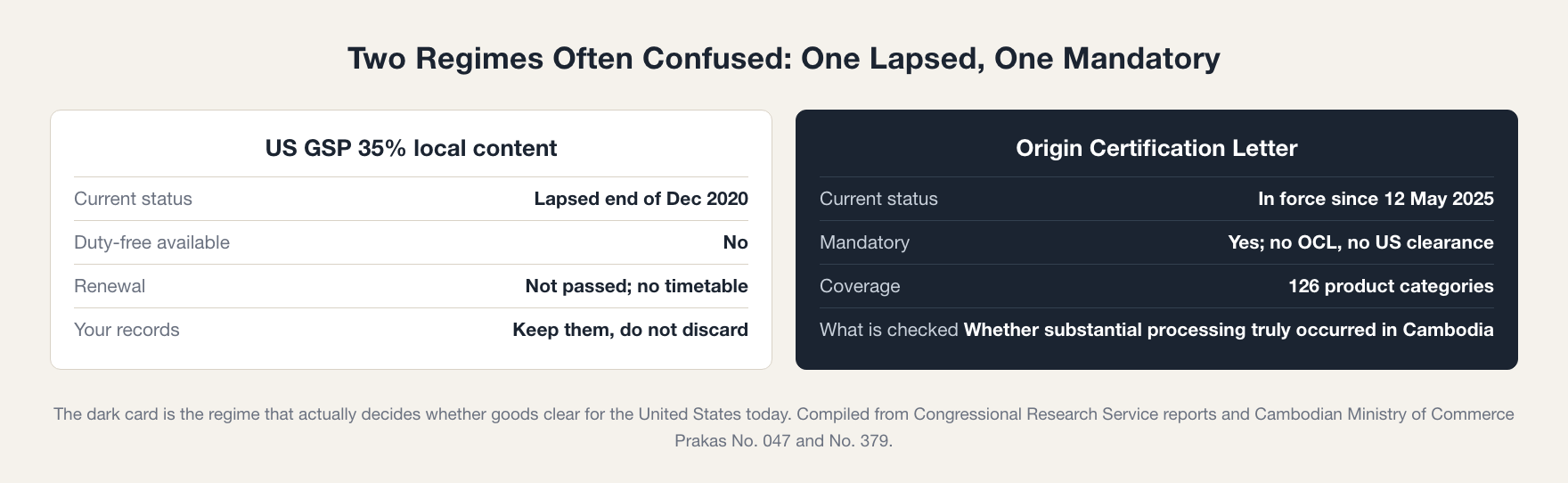
Figure 1: US GSP and the Origin Certification Letter regime compared, compiled from Congressional Research Service reports and Cambodian Ministry of Commerce Prakas.
GSP has been reauthorised more than a dozen times since it was established in 1974, mostly in two- to three-year cycles; of the past fourteen expirations, ten lapsed first and were reauthorised retroactively some time later, with Congress backdating the effective date to the expiry so that importers could reclaim duties paid in the interim. That historical pattern explains why many firms and advisers still prepare documents on the assumption that it will return eventually: it has, repeatedly. But this gap has now run more than five years, the longest lapse in the programme’s history, and although reauthorisation bills have been discussed in Congress in recent years, there is no settled timetable.
The delay is not merely procedural; it reflects disagreement within Congress over the conditions attached to GSP itself. Some members want new eligibility criteria added on reauthorisation, such as digital trade obligations for beneficiary countries, while others have proposed changing how competitive need limitations are calculated – the import value ceilings applied to a single product from a single beneficiary, above which that line loses eligibility. There is no consensus on these questions, so reauthorisation bills have repeatedly stalled; the House Ways and Means Committee held hearings on the subject in 2023 and no vote has followed in the years since. For firms, the practical conclusion is this: if you already hold complete origin cost records, keep them rather than discarding them, because if GSP is reauthorised retroactively in line with past practice those records become immediately useful. But do not treat the 35% rule as the tariff basis for current decisions, and certainly do not promise customers duty-free treatment on it today. Its correct status now is a qualification held in reserve, not a preference in force.
4. What actually applies now? The Origin Certification Letter regime
Since 12 May 2025, exporters shipping 126 product categories from Cambodia to the United States must first obtain an Origin Certification Letter (OCL) and file it with the customs declaration. The regime has nothing to do with GSP; its purpose is to block transshipment fraud, and without one, US-bound clearance cannot be completed.
The regime is set out in Ministry of Commerce Prakas No. 047, which establishes the application and issuance procedure, and Prakas No. 379, which provides the anti-fraud measures; both took effect the same day, responding directly to heightened transshipment concerns after the United States announced reciprocal tariffs in April 2025. Exporters must first register in the Ministry’s automated certificate of origin system; once an OCL application is filed, ministry officials conduct an on-site verification and issue the letter only if production and origin conditions match. No government service fee is charged. If the importer or the US authorities question the origin and request verification, the Ministry’s General Department of Trade Support Services investigates jointly with the General Department of Customs and Excise. Where misdeclared origin or concealed transshipment is established, penalties under the Law on Rules of Origin and the Customs Law range from KHR 10 million to 40 million, with imprisonment of one year or more. For country rates and product-level trade remedies on US-bound goods, see US Tariffs on Cambodia: Monitor.
The relationship between this regime and the 35% threshold deserves to be stated clearly. An OCL review examines whether substantial processing genuinely took place in Cambodia; it does not issue certificates by applying a percentage formula. But a firm that can produce complete cost documentation built on the US GSP 35% logic – local material cost, direct processing cost, evidence of substantial transformation for imported materials – will find that the same file substantially strengthens both the OCL application and any subsequent verification. In other words, the 35% threshold may have no preference attached to it at present, but the evidentiary methodology behind it has not gone out of date; it is precisely the form of evidence an OCL review values most. For how this plays out in tyres and other sectors that have landed in Cambodia recently and face the same transshipment scrutiny, see Chinese Tyre Makers Moving to Cambodia: Capacity Transfer Under Anti-Dumping Duties.
5. Beyond the United States, what else is a certificate of origin for? RCEP and other agreements
Not every Cambodian export shipment needs a certificate of origin – only where preferential tariff treatment is claimed, or where the importer specifically requires one. The tests applied also differ by destination, so a single logic cannot be applied across the board.
Cambodia has been a founding member of the Regional Comprehensive Economic Partnership (RCEP) since January 2022. For exports to Japan, South Korea, Australia, New Zealand and other ASEAN members, an RCEP certificate of origin can be claimed, with three alternative tests: change of tariff classification (the finished goods and the inputs fall under different HS codes), regional value content (value added within the RCEP region reaches the specified proportion), or a specific process rule (the processing steps set out in the agreement text are completed). RCEP also provides for cumulation of originating materials between member states, which particularly benefits sectors using components from several countries, such as automotive parts. Beyond that, Cambodia has bilateral free trade agreements with China and South Korea; in practice, compare the tariff reduction under each agreement first, then apply for the certificate corresponding to the largest reduction.
Cambodia’s Law on Rules of Origin, promulgated in July 2023, is the domestic framework covering origin determination for all products rather than any particular market. It provides that mere storage, simple packaging and simple assembly do not constitute substantial processing, and that goods must be shipped directly to the importing country without processing or modification in a third country, failing which origin status is lost. The law authorises the Ministry of Commerce and the Ministry of Economy and Finance to issue a joint prakas setting the specific threshold for “substantial processing” by change of tariff classification or value-added percentage, but as at the time of writing that implementing instrument has not been published. That means Cambodia does not yet have a single local value-added percentage standard applying to all products, and determinations still have to be made by destination and by the agreement claimed.
6. What documents does an origin claim require? Five common items
Whichever certificate is claimed, the core logic is the same: materials, costs and processing records have to reconcile with one another.
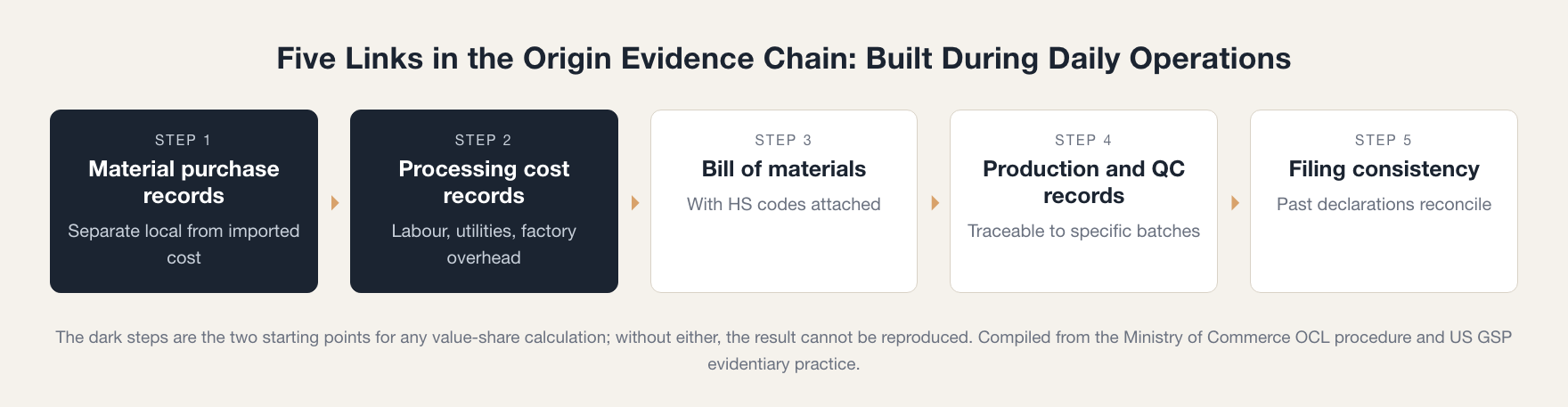
Figure 2: The five links in the origin evidence chain, compiled from the Ministry of Commerce OCL procedure and US GSP evidentiary practice.
| Document | What to record | Why it is needed |
| Material purchase records | Suppliers, quantities and unit prices for local and imported materials, with origin or customs documents attached for imports | Separating local from imported cost is the starting point for any value-share calculation |
| Processing cost records | Labour, utilities, factory overhead allocation and other direct processing cost, collected by product or batch | Local processing cost is the other half of the value share and direct evidence that substantial processing occurred in Cambodia |
| Bill of materials (BOM) | The input list and consumption for each finished product, with HS codes attached | Lets verifiers check that inputs and outputs are consistent; also the basis for the change-of-classification test |
| Production and QC records | Production scheduling, inspection reports and shipping documents traceable to specific batches | Evidence that the goods were genuinely produced in Cambodia rather than merely passing through |
| Filing consistency records | Past customs declarations, certificates of origin and internal cost records retained for comparison | Verifiers routinely compare successive filings; a sudden change in cost structure invites questions |
Table 1: Five documents commonly required for an origin claim, compiled from Ministry of Commerce procedure and practical experience.
7. Why is a Cambodia certificate of origin application rejected? Common causes and prevention
In most rejected or queried cases the goods do genuinely qualify; the documents simply do not reconcile. The way to prevent this is to let the records be generated during daily production rather than assembled just before the application.
The most common first cause is inconsistent cost measurement: the basis for dividing local from imported cost changes between filings, or indirect overhead is wrongly counted as direct processing cost, so the resulting share cannot be reproduced. The second is treating simple assembly as substantial processing: plain cutting, packaging, labelling or simple fitting do not constitute substantial processing under most origin rules, and where a product’s processing depth sits close to that line, fuller process records are needed to demonstrate substance. The third is a break in the origin chain for imported materials: where substantial transformation of an imported material is claimed but no source documentation for that material at import can be produced, the value share cannot be verified. The fourth is inconsistency across filings: where the cost structure declared for the same product varies widely between batches, it reads as constructed after the fact rather than recorded contemporaneously.
One common scenario shows where the risk is highest. If a product’s local processing is shallow – final packaging of an imported semi-finished item, say – then even where the cost share on paper approaches the threshold, the priority should be deepening local processing rather than refining the wording of the file. Conversely, where cutting, assembly and surface treatment are genuinely completed locally, the processing cost share usually has considerable room, and the evidentiary focus for such products should be on making the cost record for each step solid rather than worrying about the threshold itself. Moving more steps onshore is also preparation for the tightening of origin rules after 2029; for that planning, see Apparel Supply Chain Restructuring: Planning Before Cambodia’s 2029 LDC Graduation.
8. How is the origin evidence chain sustained? What Manhattan SEZ can offer
Most special economic zones will help with a certificate of origin application or refer an adviser; that is a basic service across Cambodian zones. What actually determines whether an origin claim holds is whether the zone’s day-to-day customs and production workflow generates the five records in section six continuously, rather than the firm starting to assemble them afterwards.
So when comparing zones, the specific things worth confirming are: whether import declaration records are linked automatically to material issue notes on the production line rather than filed separately; whether the product classification used on export declarations uses the same HS codes as the internal BOM, so the two do not turn out to disagree at application time; whether, when an OCL or other verification requires the complete record for a particular batch, the chain from input receipt to shipment can be retrieved in full within a reasonable time; and whether the zone’s customs team has actually handled OCL applications for similar products and knows what the Ministry focuses on. These questions can be put to any special economic zone, and the answers indicate directly whether that zone’s administrative process was genuinely designed with origin evidence in mind.
What Manhattan SEZ offers on these counts comes from an existing arrangement in which the administrative and customs teams sit in the same execution chain: import declarations for input materials connect to production-line material records through the same team, export classification matches the firm’s internal product structure, and retrieving historical batch records does not require coordination across departments. The zone has operated since 2005 and has supported firms inside it exporting garments, footwear and bags, as well as tyres and auto parts that have landed more recently, through certificate of origin and OCL applications, giving it practical experience of the cost records and process evidence the Ministry examines. The administrative team also works in Chinese as one of its main languages, so firms do not have to translate and reconcile between Chinese-language internal cost records and English filing documents themselves.
The boundary of these conditions should also be stated. Manhattan SEZ cannot determine whether a particular product reaches 35% or any other threshold – that depends on the firm’s own input structure and processing depth. What the zone can do is help ensure records are preserved completely and help the application process run smoothly; it cannot substitute for the firm’s own origin determination, nor can it get a product that does not qualify through verification. If you are preparing origin evidence or an OCL application, you are welcome to contact the Manhattan SEZ advisory team with your product category and HS codes, the local and imported shares of your main inputs, and your target export markets. The zone will set out how the existing customs and record workflow connects, which links need strengthening, and the expected application timeline.
9. Cambodia certificate of origin and local content FAQ: thresholds, evidence and OCL
Q1: Can Cambodia’s 35% local content rule still be used for duty-free entry?
| No. The 35% figure is the origin threshold under US GSP, and GSP lapsed at the end of December 2020. Congress has not completed reauthorisation, so Cambodian goods entering the United States cannot obtain tariff relief on that basis at present. If you already hold complete cost records, keep rather than discard them – if GSP is reauthorised retroactively in line with past practice they remain useful – but do not treat it as a current tariff basis. |
Q2: What documents do I actually need to export to the United States now?
| If your product falls within the 126 categories published by the Ministry of Commerce, you must first register in the Ministry’s automated certificate of origin system, apply for an Origin Certification Letter (OCL), have it issued following on-site verification by officials, and file it with the customs declaration. There is no government service fee. The regime took effect on 12 May 2025, is unrelated to GSP, and exists to block transshipment fraud; without an OCL, US-bound clearance cannot be completed. |
Q3: My certificate of origin application was queried or rejected – where do things usually go wrong?
| In most cases the goods do qualify; the documents do not reconcile. Common causes include an inconsistent basis for dividing local from imported cost, treating simple assembly as substantial processing, missing origin documentation for imported materials themselves, and wide variation in declared cost structure between batches. Prevention means letting material purchase, processing cost, product structure and production records be generated during daily operations rather than assembled before the application. |
Q4: Are an RCEP certificate of origin and a US OCL the same thing?
| No. They apply to different markets and use different tests. An RCEP certificate covers exports to Japan, South Korea, Australia, New Zealand and ASEAN members, with three alternative tests – change of tariff classification, regional value content or a specific process rule – and allows cumulation between member states. An OCL is a mandatory filing document for specified Cambodian exports to the United States, and its review focuses on whether substantial processing genuinely occurred in Cambodia, with no direct correspondence to any percentage threshold. |
Q5: Our local processing is shallow – only final packaging. Can that count as origin?
| The risk is high. Most origin rules list mere storage, packaging and simple assembly as operations that do not constitute substantial processing. Where processing depth sits close to that line, rather than trying to explain it through the wording of the file, the more practical approach is to assess whether cutting, assembly, surface treatment and other steps can be moved onshore. That both strengthens origin status and is the fundamental response to tightening transshipment scrutiny. |
10. Sources and references
📚 References
- Commerce Cambodia | US GSP rules of origin: the cost of materials produced in Cambodia plus direct processing cost must reach at least 35% of the appraised value of the goods; qualifying ASEAN member materials may be cumulated as a single origin; imported materials that undergo double substantial transformation may count as originating material inputs.
https://commerce-cambodia.com/2024/05/17/u-s-generalized-system-of-preferences-gsp/ - Congressional Research Service | Generalized System of Preferences: overview and issues for Congress – GSP expired on 31 December 2020; since its creation in 1974 the programme has been extended 14 times, of which 10 lapsed before being reauthorised, frequently with retroactive refunds.
https://www.congress.gov/crs-product/RL33663 - Andersen in Cambodia | New regulations on exports to the United States (May 2025): Prakas No. 047 of 30 April 2025 sets the application and issuance procedure for the Origin Certification Letter; exporters register in the Ministry system, an on-site verification follows, and no public service fee applies. Origin fraud carries fines of KHR 10 million to 40 million and imprisonment of one year or more.
https://kh.andersen.com/publications/new-regulations-on-exports-to-the-united-states/ - DFDL | Cambodia issues inter-ministerial prakas to combat origin fraud on certain exports to the US: Prakas No. 379 provides the anti-fraud measures; the General Department of Customs and Excise and the General Department of Trade Support Services investigate questioned origin cases jointly.
https://www.dfdl.com/insights/legal-and-tax-updates/cambodia-issues-inter-ministerial-prakas-to-combat-origin-fraud-with-respect-to-the-export-of-certain-goods-to-the-us/ - KPMG Cambodia | Cambodia-US trade developments and legal measures on origin compliance (May 2025): the OCL regime applies to the 126 product categories listed in Annex 1 of the prakas; both instruments took effect on 12 May 2025, responding to the reciprocal tariff measures announced by the United States on 9 April 2025.
https://kpmg.com/kh/en/home/insights/2025/05/corporate-update.html - Tilleke & Gibbins | Made in Cambodia: the new Law on Rules of Origin (promulgated 5 July 2023): EU GSP generally requires at least 40% local content while the US GSP threshold is 35%; substantial processing will be determined by change of tariff classification or value-added percentage under a joint prakas not yet published; mere storage, simple packaging and simple assembly do not constitute substantial processing.
https://www.tilleke.com/insights/made-in-cambodia-new-law-on-rules-of-origin-brings-clarity-to-international-trade/ - Cambodia National Trade Repository | Rules of origin guidance: Cambodian exports do not generally require a certificate of origin; one is needed only where preferential treatment is claimed or the importer requires it.
https://cambodiantr.gov.kh/en/guide-to-trade/rules-of-origin/ - Zhangjiagang Municipal Bureau of Commerce | RCEP certificate of origin in practice: RCEP entered into force on 1 January 2022 for ten countries including China, Brunei and Cambodia; the tests are change of tariff classification, regional value content or a specific process rule; Cambodia may choose between the China-Cambodia FTA, the China-ASEAN agreement and RCEP according to which offers the larger reduction.
https://www.zjg.gov.cn/zjgszwz/ycdgz/202211/87f54fd062c745519e431868beb6f88d.shtml