Summary: The hard part of a cambodia factory lease is not the headline price but the fact that competing quotes cannot be compared at all. One is priced per square metre per month, another per hectare over a 40-year term; one bundles utility hook-up, another bills it separately; one states an annual escalation rate, another is silent. Cambodia has 28 special economic zones in operation, each with its own pricing conventions and contract templates, and the same floor area can differ by tens of percent in annual cost once the bases are aligned.
This article does not repeat the market-level survey of price ranges (see Cambodia Factory Rental Costs). It deals with the next question: how to read a quote, how to convert different bases into a comparable annual cost, which contract clauses matter most, and which of the three routes – ready-built lease, built-to-suit, or land lease and self-build – fits a given lead time and specification. It closes with the fields to request alongside any quote.
1. Why Cambodia Factory Lease Quotes Cannot Be Compared Directly
A packaging manufacturer requested quotes from three special economic zones. The first offered standard factory space at USD 3.5 per square metre per month. The second quoted land use rights at RMB 100,000 per mu for a 40-year term. The third simply said negotiable and attached a site plan. Laid side by side, the obvious question is which one is cheaper.
It cannot be answered from what is on the page, because the three quotes differ in pricing basis, scope of inclusion and term. Market-level figures do exist: data cited at the EuroCham Cambodia industrial zones and SEZ forum in June 2026 put ready-built factory rent at about USD 3.05 per square metre per month in Cambodia against about USD 4.70 in Vietnam, with industrial land on long lease at about USD 69.25 per square metre in Cambodia. Averages of that kind establish the order of magnitude and nothing more, because the differences between actual offers sit exactly where an average cannot see them. With 28 zones in operation and no common template, and with hook-up fees, deposits, title and transfer costs typically absent from a first quote, comparing the printed numbers usually produces the wrong answer.
Price ranges and overall cost levels are surveyed in Cambodia Factory Rental Costs. This article picks up after the quote arrives: how to read it, how to convert it, and what to secure before signing.
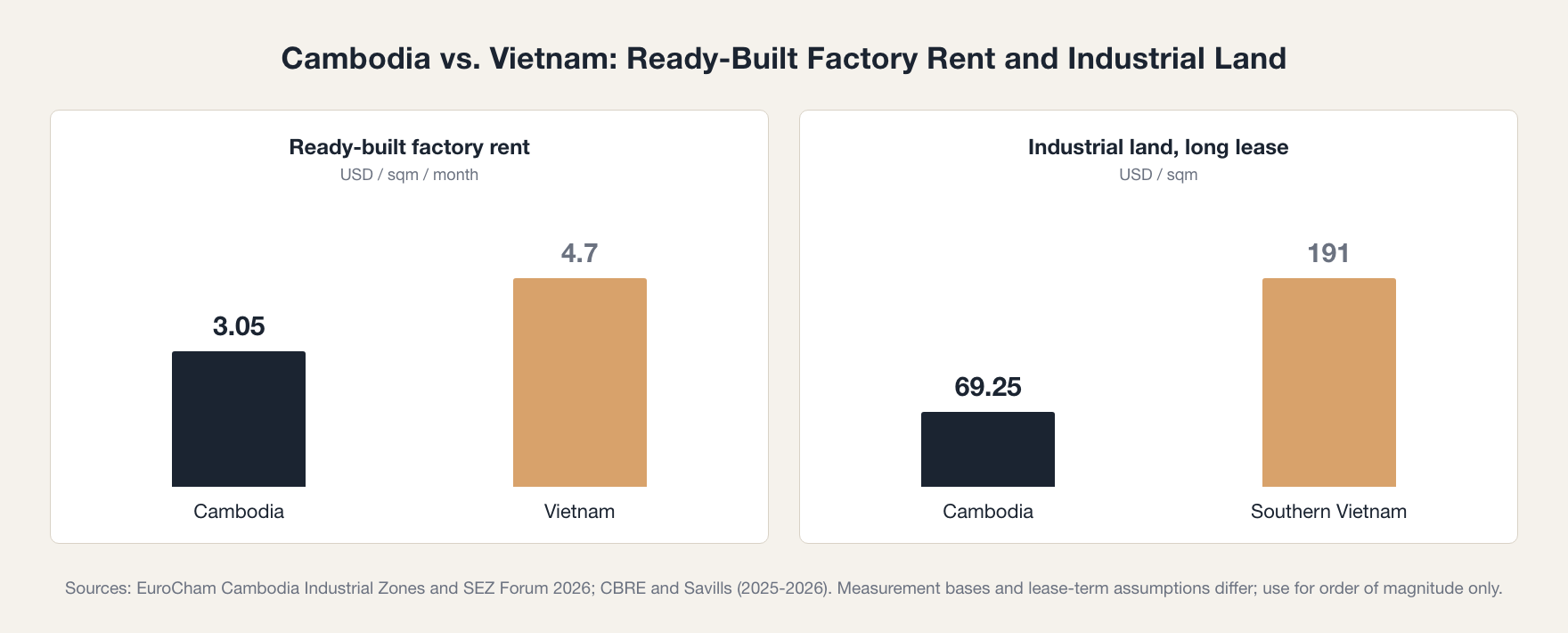
Figure 1: Ready-built factory rent and long-lease industrial land, Cambodia and Vietnam (sources: EuroCham Cambodia Industrial Zones and SEZ Forum 2026; CBRE and Savills, 2025-2026).
2. Three Routes: Ready-Built Lease, Built-to-Suit and Self-Build
Foreign investors cannot hold Cambodian land outright, so every route conveys a time-limited use right; what differs is who builds the factory – lease a ready-built unit, have the zone build to specification, or lease land and build. The trade-off is not only price but upfront capex, time to production and specification freedom.
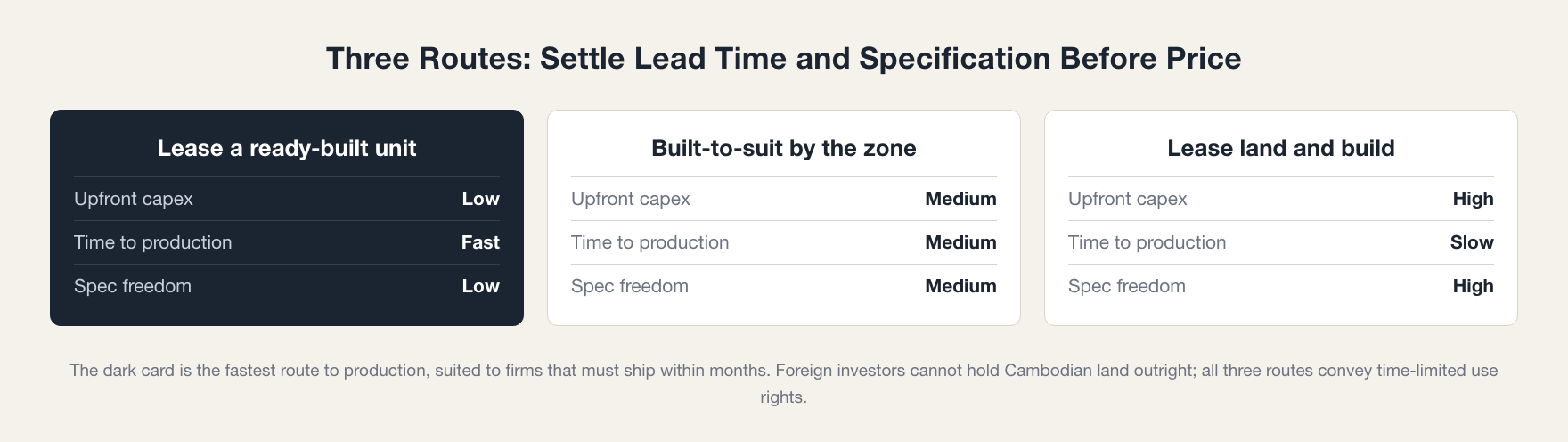
Figure 2: The trade-off between the three routes (compiled from zone marketing materials and Cambodian land law).
A ready-built unit buys time: the building exists, so the company only fits out and installs, and the production date is not hostage to a construction programme. The cost is that the specification is fixed – floor loading, clear height and electrical capacity may not suit heavy equipment, and each must be checked against the equipment list before signing. A built-to-suit unit, constructed by the zone to the tenant’s brief, balances specification against speed and suits firms with particular requirements that would rather not manage the civil works. Leasing land and building yields the greatest specification freedom and room to expand, at the cost of a construction programme and tied-up capital; asset-heavy projects usually take this route.
What has to be settled first is not price but lead time and specification. Where order commitments require output within months, a ready-built unit is effectively the only route. Where a site is meant to last a decade or more, the specification freedom of self-build shows its value at the second phase. A common approach is to stage the move: start in a standard unit while securing the adjacent plot for a later self-build – an arrangement worth raising in the first conversation, not the last.
3. How Factory Rent Is Calculated: Area, Currency and Billing Period
The same building, quoted on a different basis, can differ by more than ten percent. Before converting anything, pin down chargeable area, currency, billing period, tax treatment and lease conditions.
| Item to confirm | Common variations | Why it affects comparison |
| Chargeable area | Gross built area, usable area or with common areas apportioned; whether canopies, loading platforms and office mezzanines count | The same building can differ by over ten percent in chargeable area between bases |
| Currency and FX | Cambodia is heavily dollarised and most quotes are in USD; some are in RMB | RMB quotes require a stated FX reference date and adjustment mechanism |
| Billing period | Per sqm per month, per sqm per year, or a lump sum per building per month | Everything must be converted to one period before comparing |
| Tax treatment | Whether VAT is additional; who bears withholding tax | The gap between inclusive and exclusive pricing lands directly on cash flow |
| Minimum term and renewal | First-term length, renewal rights and how renewal is priced | A cheap first term with no renewal protection leaves long-run cost undefined |
Table 1: What to confirm before comparing factory rent quotes (compiled from published zone marketing materials).
The weight of an escalation clause can be shown with a published historical example: the Kratie province special economic zone once advertised factory rent escalating at 10 percent a year. On that basis a low first-year rate is roughly 50 percent higher by year five and close to double by year ten – which is why a first-year unit price on its own is misleading. Those figures are from an earlier period and should not be read as current pricing; take each zone’s current formal quote as the reference.
4. Industrial Land: Lease Rights, Long-Lease Certificates and Transfer
Foreign investors cannot hold land outright in Cambodia, so a land quote is really a price for a use right over a term; what actually determines risk is the form of title and the transfer timetable, neither of which appears on the quote.
Two arrangements are common. The first is a long lease inside a zone, typically 40 to 50 years, under which the company holds a lease right; such arrangements can usually be registered for a long-lease certificate issued by the Ministry of Land Management, Urban Planning and Construction, which is protected once registered and can support financing. The second is acquiring land through a shareholding structure, which is complex and carries higher compliance risk; it should not be attempted without specialist advice.
When requesting a land quote, confirm three things beyond unit price and term: the form of title and the registering authority, the expected time from signing to holding that title, and who bears the taxes and fees on transfer or registration. None of the three normally appears on a quote, yet together they determine when capital can safely be committed. The published Kratie conditions state a 40-year land use term with pricing adjusted annually from 2018, which serves as a reference for how term and adjustment mechanisms are framed.
5. What Sits Outside the Quote: Deposits, Hook-Up Fees and Escalation
A quote usually shows only the first layer – rent or land price. Three more sit behind it: one-off charges, utility connection, and escalation through the operating period.
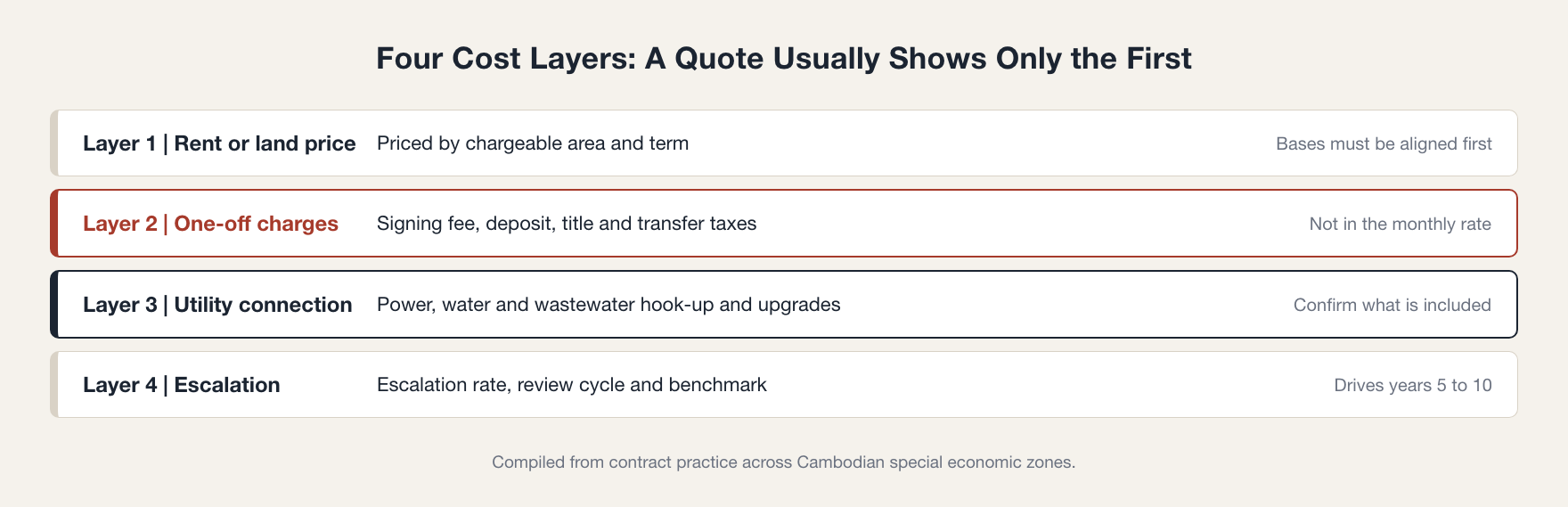
Figure 3: The four cost layers behind a quote (compiled from contract practice across Cambodian special economic zones).
One-off charges include the signing fee, deposit, title and transfer taxes, and in some zones an entry or facilities charge. Utility connection is the layer most often understated: the method of power connection and the capacity that can be allocated, the terms and cost of later upgrades, water volume, and the discharge point and effluent standard all matter, and they matter most to energy-intensive processes or any process with discharge. Some Cambodian zones have built their own power plants, water plants and wastewater treatment and interconnected them with municipal networks, so supply and discharge are planned centrally; others provide only a connection point, leaving pipework and capacity upgrades to the tenant. That difference never shows up in the rent.
The fourth layer is escalation. The rate, the review cycle and the benchmark – a fixed percentage or an index – determine the real burden in years five to ten; the 10 percent annual escalation published by the Kratie zone is one example. A quote that states a first-year rate without an escalation mechanism cannot be used in a ten-year cost model at all.
6. Contract Clauses That Decide Who Carries the Risk
The clauses to confirm before signing do not set the price; they set who carries the risks that sit outside it.
| Clause | What to confirm | Consequence of leaving it open |
| Delivery standard and acceptance | Floor loading, clear height, column spacing, fire rating and delivery date; how a failed inspection is handled | Insufficient loading discovered after equipment arrives, with rectification cost and delay borne by the tenant |
| Infrastructure guarantees | Whether allocated power capacity, water volume and discharge quota are written into the contract; terms and timing of upgrades | Capacity found insufficient at phase two, forcing the investment plan to be reworked |
| Escalation and review | Escalation rate, review cycle and benchmark | Long-run cost cannot be modelled and the financing case has no basis |
| Title and transfer | Form of title, registering authority, timing and who bears taxes | Capital committed while title remains unsettled, restricting financing and disposal |
| Sublease and exit | Whether subleasing and transfer to affiliates are permitted; compensation on early termination | No way out when strategy changes, or an exit cost far above expectation |
| Dispute resolution | Governing law, forum and language | Unclear procedure when a dispute arises and a high cost of remedy |
Table 2: Contract clauses to review for factory and land agreements (compiled from Cambodian investment practice).
7. Converting Quotes Into a Comparable Annual Cost
There is only one way to make quotes comparable: convert every one into a full cost per square metre per year, amortising one-off charges and connection fees over the same term.
The steps are fixed. First, align the area basis and work entirely in usable area. Second, align currency and billing period, converting everything to US dollars per square metre per year. Third, amortise the signing fee, the carrying cost of the deposit, title and transfer taxes and the utility connection fee across the contract term. Fourth, apply the escalation mechanism and calculate the cost in year one, year five and year ten rather than year one alone. Fifth, list the differences separately – if one zone includes wastewater treatment and another requires the tenant to build it, that belongs in the model as an amount, not as a remark about better facilities.
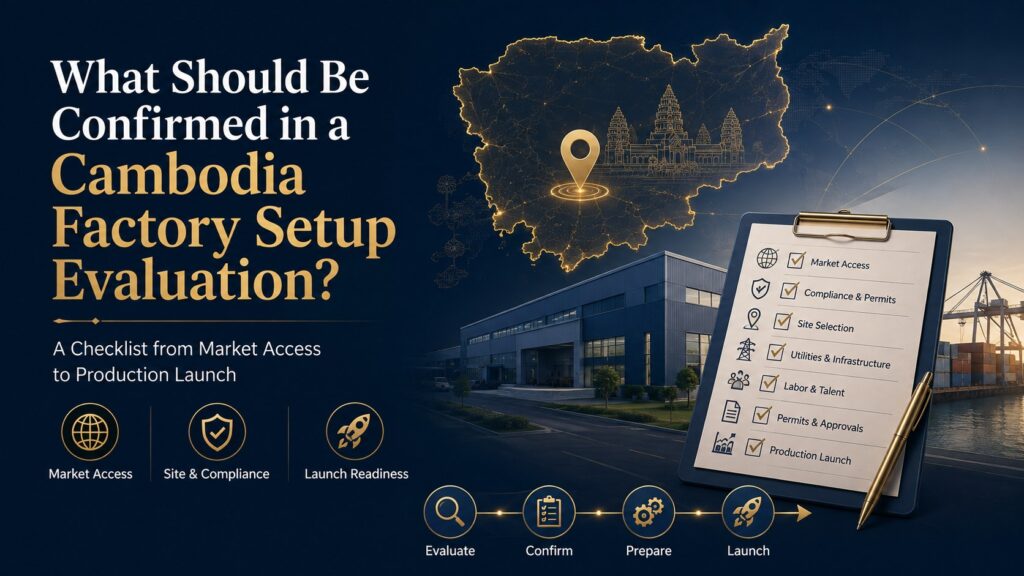
Only after those steps do three incomparable quotes sit on the same scale. The result is also the input for the land and buildings line of a total cost model; the other lines that belong in that model, and where the evidence for each comes from, are set out in Cambodia factory setup evaluation checklist.
8. Manhattan Special Economic Zone (MSEZ): Which Fields Can Be Answered Now
The most practical step when comparing quotes is to ask every zone to fill in the fields listed above. A zone that can complete them in one pass is usually describing conditions that already exist rather than ones still to be built.
Manhattan Special Economic Zone (MSEZ) is in Bavet, Svay Rieng province, about 6 km from the Cambodia-Vietnam border and about 90 km from the Ho Chi Minh City port area, covering roughly 600 hectares with over 40,000 workers on site and more than 4,000 containers exported each month. On acquisition, the zone offers standard units available for immediate lease as well as land on lease or for sale, matching either a short route to production or a long-term base; where a company plans to lease first and expand later, securing the adjacent plot can be discussed at the first meeting.
On infrastructure, the zone has built independent power, water and wastewater systems: dual-circuit high-voltage supply, 80 MW of power capacity, 5,000 tonnes per day of water supply and 5,000 tonnes per day of wastewater treatment. What matters about those figures is that allocated capacity, water volume and discharge quota can be stated as numbers during evaluation and written into the contract, and that connection for a new plant is planned centrally rather than negotiated from scratch with external networks. For energy-intensive or water-intensive processes, this layer moves total cost more than the rent does.
On title, the zone’s long-lease option can be registered for a long-lease certificate issued by the Cambodian land authority, with registration and transfer handled after signing; the timetable and the allocation of taxes can be set out at the quotation stage, so that capital commitments can be scheduled against them. The administrative and customs teams sit in the same execution chain and work in Chinese as one of their main languages, so contract terms, acceptance standards and the later qualified investment project filing run through a single point of contact.
The nature of these conditions should also be stated plainly: MSEZ offers execution efficiency and verifiable existing conditions, not treatment outside the law. Restrictions on land ownership, tax rules and rules of origin do not change with the zone a company enters. What MSEZ can genuinely reduce is the information and coordination cost between first contact, signature and equipment arriving on site. If you are comparing quotes, you are welcome to contact us and request the full set of fields from the MSEZ advisory team – provide floor area and specification, electrical load and water demand, any discharge process, and target signing and production dates, and the zone will return a quote covering pricing basis, one-off charges, utility connection and escalation, structured for line-by-line comparison with other offers.
9. FAQ: Rent, Land Price, Title Transfer and Escalation
Q1: How much does factory rent cost in Cambodia?
| An average tells you the order of magnitude and stops being useful the moment a specific offer is on the table, because zones price on different bases and the figures are not on the same scale. The practical approach is to request a current formal quote and require five things in writing: chargeable area, currency, billing period, tax treatment and escalation mechanism. Once all five are present, convert to full cost per square metre per year; a bare unit price usually means three further layers have not been disclosed. |
Q2: Can foreign companies buy land in Cambodia?
| Not outright – what is acquired is a use right for a fixed term. The negotiation therefore turns on title rather than unit price: confirm the form of title, the registering authority, the expected time from signing to holding it, and who bears the registration taxes. Those points determine when capital can safely be committed, and almost none of them appear on a first quote, so they have to be requested in writing. |
Q3: Which costs are usually missing from a quote?
| Three groups: one-off charges (signing fee, deposit, title and transfer taxes, and in some zones an entry fee), utility connection costs (power connection and upgrades, water, wastewater), and escalation through the operating period. The second group varies most – a zone with its own power, water and wastewater plants differs materially from one offering only a connection point, and none of that difference is visible in the rent. |
Q4: How is the escalation rate normally set?
| Most often as a fixed annual percentage; published material includes examples at 10 percent a year. Others use a review cycle, such as every three years, or index-linked adjustment. What matters is not whether the rate is high or low but whether the contract states all three of rate, review cycle and benchmark. Missing any one of them leaves a ten-year cost model unbuildable and a financing case without support. |
Q5: Should we lease a standard unit or lease land and build?
| It depends on lead time and specification. To ship within months, a ready-built unit is the only real option. Where the specification is particular but the company would rather not manage the civil works, a built-to-suit unit sits in between. For asset-heavy projects or a base intended to last a decade, the specification freedom and expansion room of self-build are the point. If you take a standard unit, check floor loading, clear height, column spacing and electrical capacity against the equipment list first – rectification for any of the four is normally at the tenant’s cost. If you build, write the mechanism for securing the phase-two plot into the contract at signing. |
10. Sources and References
📚 References
- Zhongqi Overseas Group | Kratie province special economic zone investment terms: 2022 land use right at RMB 100,000 per mu for a 40-year term, adjusted annually from 1 January 2018 off a RMB 50,000 per mu base; 2022 factory rent at RMB 13-19 per sqm per month, with earlier terms listed at RMB 8-12 per sqm per month escalating at 10 percent a year; the zone plans its own power, water and wastewater plants.
http://haiwai.zqgroup.cn/business/view/48.html - Department of Commerce of Shandong Province | Qilu (Cambodia) SEZ: located in Svay Rieng city, 450 hectares planned, 95 km from Ho Chi Minh International Airport, 105 km from Saigon Port and 130 km from Phnom Penh; one-stop administration covering investment application, registration, customs clearance, inspection and certificates of origin.
http://commerce.shandong.gov.cn/art/2023/6/5/art_92318_10324670.html - Cambodia Investment Promotion | Sihanoukville SEZ: self-built water, power and wastewater plants interconnected with municipal supply for 24-hour utilities; a one-stop administrative window staffed by the Council for the Development of Cambodia, customs, the Ministry of Commerce, the labour department and provincial government.
https://www.cambodiasez.com/xgjjtq.html - Economic and Commercial Office of the Chinese Embassy in Cambodia | SEZ overview: 28 zones in operation attracting 804 investment projects worth USD 10.2 billion; special administrative centres established in 23 zones providing one-stop import and export services.
https://cb.mofcom.gov.cn/sqfb/art/2024/art_ded0d78827fa44ac85fda6e76b1df4de.html - DHH Law Firm | Cambodia investment series: guidance on establishing zones and admitting enterprises, including the Sub-Decree No. 148 authorisation mechanism and the functions of the SEZ administration.
- MOFCOM | Guide to Foreign Investment and Cooperation by Country (Region): Cambodia – land system, restrictions on foreign holdings and investment incentives.
https://12335.mofcom.gov.cn/gbmyzn/jianpuzhai.pdf - Cambodge Mag | EuroCham Cambodia industrial zones and SEZ forum (9 June 2026, Phnom Penh): ready-built factory rent about USD 3.05 per sqm per month in Cambodia against about USD 4.70 in Vietnam; industrial land on long lease about USD 69.25 per sqm.
https://www.cambodgemag.com/en/post/industrial-zones-cambodia-plays-its-card-ahead-of-the-2029-deadline - Manhattan Special Economic Zone | Cambodia Factory Rental Costs (June 2026): citing CBRE, ready-built factory rent averaging about USD 3 per sqm per month and industrial land on long lease about USD 63 per sqm in Cambodian zones against about USD 191 in southern Vietnam; foreign investors cannot hold Cambodian land outright, with long lease the common lawful route; three entry models are ready-built lease, built-to-suit and land lease with self-build. Measurement bases and term assumptions may differ – verify against a first-hand quote.
https://www.manhattansez.com/en/cambodia-factory-rental-cost/ - Manhattan Special Economic Zone knowledge base | Related reading: Cambodia Factory Rental Costs (market price ranges) and the Cambodia factory setup evaluation checklist (total cost lines and how to evidence each).
https://www.manhattansez.com/en/