Summary:
When landing capacity in Cambodia, a factory usually comes from one of three routes: renting a ready-built standard factory (about USD 2–5 / ㎡ / month, leases commonly 5–10 years), asking the park to build to specification and then leasing it, or long-leasing land and building your own factory. The starting point is to understand the land system—Cambodia’s constitution bars foreigners from owning land, so the mainstream route for foreign investors is a long lease (up to 50 years, renewable once), while investors legally own the buildings and other immovable property they build on the leased land. “Long-lease land + self-build” is therefore entirely viable; and QIP projects’ duty-free import of construction materials and equipment further lowers the cost of building.
The core trade-off between renting and building lies in capital and timeline: renting preserves about 80% of initial capital and can reach production in weeks to months; building requires a large one-off outlay and a timeline measured in years, but has a lower long-run cost and a spec fully tailored to the process. This article breaks down the cost, timeline and flexibility differences across the three routes, explains how QIP and SEZ policy change the maths, and offers a decision framework by company stage and order certainty.
Renting a Factory in Cambodia: Decide Rent vs. Build Before You Land
Once a company decides to place capacity in Cambodia, the first concrete question is usually: where does the factory come from? Rent a ready-built standard factory and start production within months, or take a plot of land and build your own in one step?
On the surface this is a cost comparison; in reality it compares three things: capital tied up, time to production, and operational flexibility. There is no standard answer—a company trialling its first overseas run and one with certain orders planning for ten years may choose the exact opposite. And answering this in Cambodia requires first understanding a premise many overlook: the land system here does not follow the logic of buying land and building a factory at home.
Cambodia’s Long-Lease Land System: Why Foreign Investors Use 50-Year Leases
Cambodia’s constitution bars foreigners from owning land; the mainstream way foreign investors use industrial land is a long lease—up to 50 years, renewable once—while investors legally own the buildings and other immovable property they build on the leased land.
Under Article 44 of Cambodia’s constitution, only Cambodian citizens (including legal entities majority-owned by Cambodians) may own land. Compliant routes for foreign investors include long leases, setting up a locally majority-owned company, or trusts—of which the long lease is the simplest and most common: a maximum term of 50 years, renewable once, with leases over 15 years requiring registration with the land authority to be enforceable against third parties (long-lease rights can also be transferred and mortgaged). International real-estate advisers likewise note that 20–50-year or “50+50” long-lease structures are common arrangements for industrial land.
For the “rent vs. build” question, the key institutional point is this: land cannot be bought, but on compliantly long-leased land, investors legally own the buildings, equipment and other immovable and personal property they construct—this is the standard arrangement in Cambodia’s SEZs. In other words, “long-lease land + self-build” is entirely valid in Cambodia and the factory asset belongs to the company; what truly needs comparing is the capital-and-timeline trade-off between this route and “renting a ready-built factory directly” (for a full discussion of the land system and title risk, see our article on overseas factory-setup risks).
Three Ways to Obtain a Factory: Ready-Built, Build-to-Suit and Self-Build
In practice, there are three routes to obtaining a factory in a Cambodian SEZ: renting a ready-built standard factory, having the park build to suit and then leasing it, and long-leasing land to build your own—differing in “who provides the capital, who sets the spec, and how fast you can produce.”
First, ready-built standard factory rental: the park’s pre-built general-purpose factory can be occupied after simple fit-out once the contract is signed. Cambodian market rents are roughly USD 2–5 / ㎡ / month, leases commonly 5–10 years (shorter can be negotiated), with a deposit of about 2–3 months. The advantages are speed and the lightest asset load; the limitation is that ceiling height, floor loading and column spacing are general-purpose and may not suit special processes.
Second, build-to-suit (built to your requirements, then long-leased): the company specifies ceiling height, span, floor loading, power capacity and so on, and the park funds the construction while the company takes a longer lease. The capital is still borne by the park and the spec fits the process, but it needs a construction period of several months to about a year, and the lease is usually longer with rent slightly above a standard factory.
Third, self-build on leased land: the company long-leases the land (park long leases are usually settled once for several decades) and designs, permits and builds itself. The spec is fully autonomous, the factory asset belongs to the company, and the long-run cost is lowest; the trade-off is the largest one-off upfront capital and the longest timeline (including design, building permits, EIA and construction, often over a year), and the company must manage the works itself (for EIA grading and factory-setup procedures, see our article on Cambodia’s EIA grading system).
Rent vs. Build Costs: Rent, Capital Tied Up and Time to Production
The core difference between renting and building is not unit price but capital structure: renting converts a one-off capital outlay into a predictable monthly rent and preserves about 80% of initial capital; building trades a larger upfront outlay for a lower long-run cost of use.
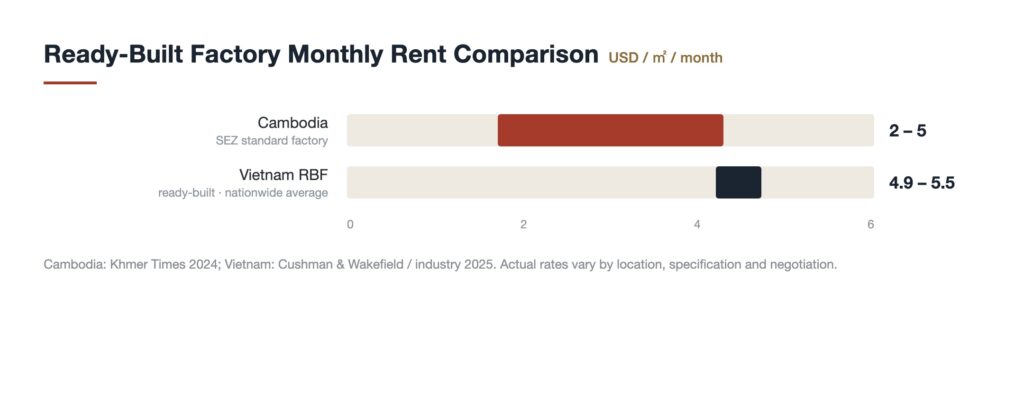
Fig. 1: Ready-built factory monthly rent comparison (sources: Khmer Times 2024 for Cambodia USD 2–5; Cushman & Wakefield / industry 2025 for Vietnam ~USD 4.9–5.5; actual rates vary by location, spec and negotiation).
First, rent levels. Cambodian park standard-factory rents run about USD 2–5 / ㎡ / month, generally below Vietnam’s RBF (ready-built factory) nationwide average of ~USD 4.9–5.5—for labour-intensive, large-footprint industries, that gap flows straight into monthly fixed costs.
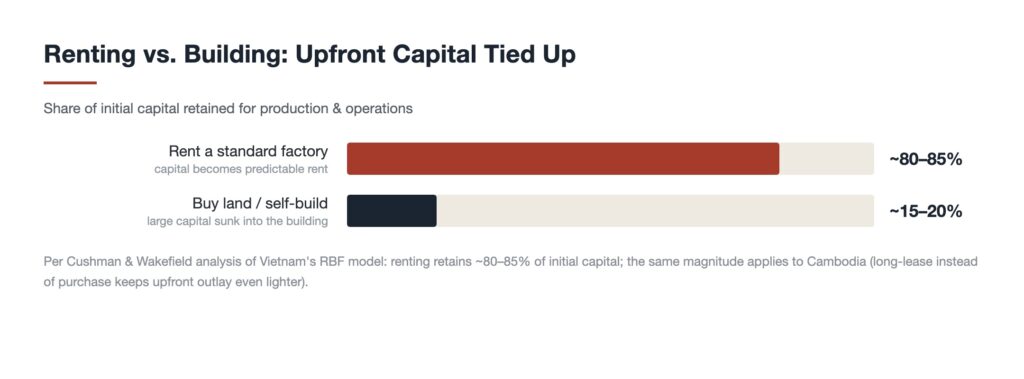
Fig. 2: Upfront capital tied up (per Cushman & Wakefield’s analysis of Vietnam’s RBF model: renting preserves about 80–85% of initial capital; the same magnitude applies to Cambodia).
Next, capital and timeline. International advisers’ estimates give an intuitive sense of scale for “rent vs. build”: rather than a one-off outlay of tens of millions of dollars to buy land and build a 10,000-㎡-class factory, renting only requires a predictable monthly rent and preserves about 80–85% of initial capital to redeploy into production lines, materials and operations—the same logic applies to Cambodia, where long-leasing instead of buying keeps the upfront land outlay even lighter. Comparing the three routes side by side:
| Dimension | Rent ready-built | Build-to-suit | Self-build on leased land |
| Upfront capital | Lowest (deposit + fit-out) | Low (funded by the park) | Highest (one-off construction outlay) |
| Time to production | Weeks to ~2 months | ~Several months to a year | Often over a year (incl. permits & EIA) |
| Spec fit | General-purpose | Built to requirements | Fully autonomous |
| Long-run cost | Ongoing monthly rent | Slightly higher rent, longer lease | Lowest once amortised; factory owned |
| Exit flexibility | Highest | Medium (longer lease) | Lowest (hard to dispose of the asset) |
One caveat: self-build construction unit prices and the one-off price of a land long lease vary widely by location, spec and timing, and the open market lacks a reliable unified benchmark—evaluate against the park’s first-hand quote, and factor in exchange-rate, imported-materials and schedule risk (for the current market prices of industrial land and factories, see our article on Cambodia industrial land and factory costs).
How QIP Incentives Change Self-Build and Equipment-Import Costs
Cambodia’s investment incentives materially change the rent-vs.-build baseline: QIP projects’ construction materials and production equipment are exempt from import duty, directly lowering the cost of building; while the rental route benefits from a lighter asset load and an earlier start to the tax holiday.
Under Cambodia’s new Law on Investment and standard SEZ policy, companies granted QIP (Qualified Investment Project) status can import production machinery, construction materials, components and raw materials free of import duty, with 0% VAT for export-oriented projects and a corporate-income-tax holiday of several years (commonly in the 3–9-year range).
For building, “duty-free materials and equipment” directly lowers construction and equipment outlay; for renting, faster production means the tax holiday starts generating cash flow earlier. Both routes capture the policy, but at different points—which is also why many companies adopt “rent first, build later”: rent to reach production quickly and validate orders and labour, then build to take on certain long-term capacity, using both policy and capital efficiency to the full in two steps (for QIP application and tax-incentive details, see our article on QIP online application).
Rent or Build? Decide by Orders, Process and Capital
Whether to rent or build depends on three variables: order certainty, process specificity, and the opportunity cost of capital. By company situation:
The following favour renting (ready-built or build-to-suit):
- First overseas venture or first time in Cambodia, with orders and labour yet to be validated—use the lowest capital and fastest speed to get going, and keep exit flexibility.
- Volatile orders, or capacity plans that may still change—monthly rent is a variable cost, far easier to scale up or down than disposing of a self-built asset.
- High opportunity cost of capital—the ~80% of capital preserved and put into production lines and working capital usually returns more than money sunk into a building.
The following make self-build (or build-to-suit) more worthwhile:
- Long-term certain orders, planning for ten years—self-build’s amortised annual cost falls below ongoing monthly rent, and the factory is a company asset.
- Special process specs—very high ceilings, heavy floor loading, cleanroom or special effluent needs that general-purpose factories struggle to meet; only build-to-suit or self-build fits.
- Large scale, contiguous land—at large footprints, the unit-cost advantage of long-leasing land and self-building is more pronounced.
In practice the most robust mainstream route is “rent first, build later”: in phase one, rent a standard factory to produce and validate; in phase two, once orders are certain, long-lease land in the same park to self-build or build-to-suit, shifting the production line without interrupting shipments. This is also a hidden indicator when evaluating a park—whether it simultaneously offers “rentable ready-built factories, build-to-suit capability, and contiguous long-leasable land” decides whether a company must relocate when it later upgrades.
MSEZ Factory Rental and Long-Lease Land: Rent to Trial, Scale Steadily
For home-building-materials, furniture-manufacturing and related processing companies, the key to setting up overseas is not doing everything in one step, but first lowering landing risk, then expanding gradually with orders and capacity.
Manhattan Special Economic Zone (MSEZ) sits on the Cambodia–Vietnam border at Bavet, covering about 600 hectares. The park offers both ready-built standard factory rental and long-term industrial-land leasing, helping companies complete the layout from trial to production to later expansion at a steadier pace.
In the early phase, a company can start production quickly in a standard factory, shortening the construction period and upfront outlay; once orders stabilise and capacity grows, it can then evaluate long-leasing land within the park and building its own factory tailored to its process needs—achieving a “rent first, build later, expand within the park” path that reduces the time, management and supply-chain costs of relocating across regions.
The park has built stable power, water-supply and wastewater-treatment infrastructure; for new plants, utility hook-ups, effluent connections and basic support can be coordinated by the park’s administrative and engineering teams. For production steps with certain power, water or environmental-handling requirements—such as spraying, drying, injection moulding and packaging—MSEZ offers relatively complete industrial-support conditions.
On location, MSEZ is about 70 to 140 kilometres from the Ho Chi Minh port cluster, so companies can flexibly choose Vietnamese or Cambodian ports for import and export according to material sources, export destinations and logistics costs; timber, boards, hardware, foam, fabric and equipment can be brought in nearby through neighbouring border gates. Combined with Cambodia’s QIP incentives, eligible companies can further evaluate the tax-cost advantages of importing equipment and materials.
On execution, MSEZ has operated since 2005 and has long helped companies handle QIP applications, land procedures, building permits, EIA approvals and cross-border customs. The park’s administrative team works mainly in Chinese, supplemented by English and Khmer, helping companies connect more smoothly to local approvals, construction and operations. If your company is evaluating setting up in Cambodia, standard-factory rental or a land long-lease self-build plan, you are welcome to contact the MSEZ park team for standard factories, land long-lease and a preliminary landing plan tailored to your capacity plan, process needs and investment pace.
Renting vs. Building a Factory in Cambodia: FAQ
Q1: Can foreign companies buy land and build a factory in Cambodia?
| Not directly—Article 44 of Cambodia’s constitution reserves land ownership to Cambodian citizens (including legal entities majority-owned by Cambodians). The mainstream compliant route for foreign investors is a long lease: up to 50 years, renewable once, with leases over 15 years requiring registration; a locally majority-owned company or trust is also possible. The key point: on compliantly long-leased land, investors legally own the buildings and other immovable property they build, so “long-lease land + self-build” is entirely viable. |
Q2: Roughly how much is factory rent in Cambodia, and how are leases signed?
| Park standard-factory rents run roughly USD 2–5 / ㎡ / month (by location, spec and age), generally below Vietnam’s ready-built average of ~USD 4.9–5.5; leases are commonly 5–10 years with a deposit of about 2–3 months, and terms are negotiable. Build-to-suit rents slightly higher on a longer lease. Rely on the park’s first-hand quote. |
Q3: Should I rent or build?
| It depends on three variables: order certainty, process specificity and the opportunity cost of capital. First-time overseas ventures, unvalidated orders, and capital better spent on production lines favour renting—preserving about 80% of initial capital and reaching production in weeks to two months; ten-year-certain orders, special process specs and large scale favour self-build or build-to-suit—lowest long-run cost with the factory owned. For most companies, “rent first, build later” is the most robust. |
Q4: How does “rent first, build later” work in practice?
| Phase one: rent a standard factory to reach production quickly and validate orders, labour and supply chain. Phase two: once orders are certain, long-lease land in the same park to self-build (or have the park build to suit), shifting the production line without interrupting shipments. When choosing a park, confirm it offers rentable factories, build-to-suit capability and contiguous long-leasable land, to avoid a forced relocation when upgrading. |
Q5: What procedures does self-build involve, and what incentives apply?
| Mainly: signing and registering the land long lease, the QIP investment application, building permits, EIA approval (graded by project scale), construction and acceptance, and utility hook-ups. On policy, QIP projects’ construction materials, production equipment and components are exempt from import duty, export-oriented projects have 0% VAT, and a multi-year corporate-income-tax holiday applies—duty-free materials and equipment materially lower self-build costs. Mature parks can usually help coordinate the above permitting. |
References: Cambodia Factory Rental, Self-Build and Industrial-Land Data
- Khmer Times (2024) | Cambodia warehouse and factory market: monthly rent commonly USD 2–5 / ㎡; leases commonly 5–10 years; deposit ~2–3 months; SEZ infrastructure and customs advantages.
https://www.khmertimeskh.com/501439146/warehouses-and-factories-in-cambodia-what-to-know/ - CBRE, Cambodia Industrial Occupier Guide | Cambodian industrial real-estate norms: long leases commonly 20–50 years or “50+50”; leases over 15 years require registration; general leases from 3–5 years.
https://aps.com.kh/wp-content/uploads/2020/06/Cambodia-Industrial-Guide-2020.pdf - Cushman & Wakefield (Nov 2025, Vietnam RBF analysis) | Leasing converts capex into opex and preserves ~80–85% of initial capital; a 10,000-㎡-class land-purchase self-build needs tens of millions of USD vs. ~USD 50,000 monthly rent; Vietnam RBF average ~USD 5.5 / ㎡ / month, occupancy ~88–92%.
https://www.cushmanwakefield.com/en/vietnam/news/2025/11/vietnams-ready-built-factories-the-fast-lane-for-global-manufacturers - Nam Dinh Vu / KTG (2025) | Vietnam RBF monthly rent: ~USD 4.9 (north), ~USD 5.0 (south) per ㎡ (~2% annual increase); Southeast Asia factory-rental benchmarks.
https://namdinhvu.com/en/vietnam-factory-rental-price-analysis-for-smart-investment-decisions/ - Sailwin (major Cambodian industrial parks) | Standard SEZ policy: production equipment, construction materials, components and raw materials exempt from import duty; 0% VAT for export-oriented projects; income-tax holidays commonly 6–9 years; land used via long lease, with investors legally owning immovable property on the land.
https://www.sailwin.com.cn/hwtz/industrialpark/show-3296.html - Beijing DHH Law Firm | Guide to establishing and locating in Cambodian SEZs (CDC / CSEZB framework, in-zone land and factory leasing arrangements).
- Cambodia Constitution Art. 44 / 2001 Land Law / Civil Code | Foreigners may not own land; long leases up to 50 years, renewable once, with registration required over 15 years.