


Summary
Phnom Penh’s main Water Festival celebration in front of the Royal Palace is suspended in 2026, but the three-day holiday on 23–25 November remains and provinces are holding their own festivities. Eight provinces have announced plans so far: Siem Reap, Kampot, Svay Rieng, Kampong Thom, Pursat, Takeo, Kampong Speu and Mondulkiri, with dates running from 31 October to 25 November.
Heading to the provinces for the boat races may sound like second best. But the races began as village festivals held when monks ended their rainy-season retreat, and only moved to the river in front of the palace in Phnom Penh a little over a century ago. This year, in a sense, the Water Festival is going back to where it started.
Last updated: 29 October 2026
1. Where to see the 2026 Water Festival: 8 provinces, dates and venues
With Phnom Penh’s main celebration suspended in 2026, provinces are holding their own: Takeo goes first on 31 October to 1 November, Svay Rieng (7–12 November) and Siem Reap (20–25 November, along the Siem Reap River) each run for six days, and Kampot races on the Kampot River on 23–25 November.
| Province | Dates (2026) | Venue and activities |
|---|---|---|
| Takeo | 31 Oct – 1 Nov | 10-km run in Doun Keo city on 1 November |
| Kampong Thom | 7–8 Nov | Boat races on the Stung Sen River; evening concerts and local product exhibitions |
| Pursat | 7–8 Nov | Boat races on the Pursat River in the provincial capital; evening concerts and product exhibitions |
| Svay Rieng | 7–12 Nov (races 8–11 Nov) | Longboat races plus canoe, kayak and rowing competitions; product exhibitions and evening entertainment |
| Mondulkiri | 13–15 Nov | Senmonorom Reservoir, surrounded by hills and forest |
| Siem Reap | 20–25 Nov (races 23–24 Nov) | Lights and boat-race-themed displays along the Siem Reap River; designated vendor areas |
| Kampot | 23–25 Nov | Three days of boat races on the Kampot River |
| Kampong Speu | 24 Nov | Boat races; performances prepared by the provincial culture department |
The provinces announced these plans in late October 2026; check each provincial government’s notice in the week of the event for final timings. 23–25 November is the national holiday, and the races in Siem Reap, Kampot and Kampong Speu fall within it. Svay Rieng, Kampong Thom and Pursat race earlier in November, so it is possible to see more than one.
So why do you have to go to the provinces this year?
2. Why has Phnom Penh paused the festival two years running?
The Cambodian government suspended the main Water Festival celebration in front of the Royal Palace in Phnom Penh in both 2025 and 2026. The three-day public holiday is unchanged, and provinces hold boat races, product fairs and concerts according to local customs and capacity.
On 4–6 November 2025 there were no races in Phnom Penh. In Siem Reap, a friendship race for small boats took place on the Siem Reap River, and Cambodia’s state news agency photographed locals and foreign tourists rowing together. The Ministry of Tourism said the provincial events were meant to promote local tourism and encourage people to use Cambodian products. 2026 follows the same approach.
For the official 2026 arrangements and holiday dates, see Cambodia Water Festival. To understand why the provinces can hold the races at all, though, you need to know that the boat races never belonged to Phnom Penh in the first place.
3. What were the boat races originally? The village ‘end of retreat’ festival
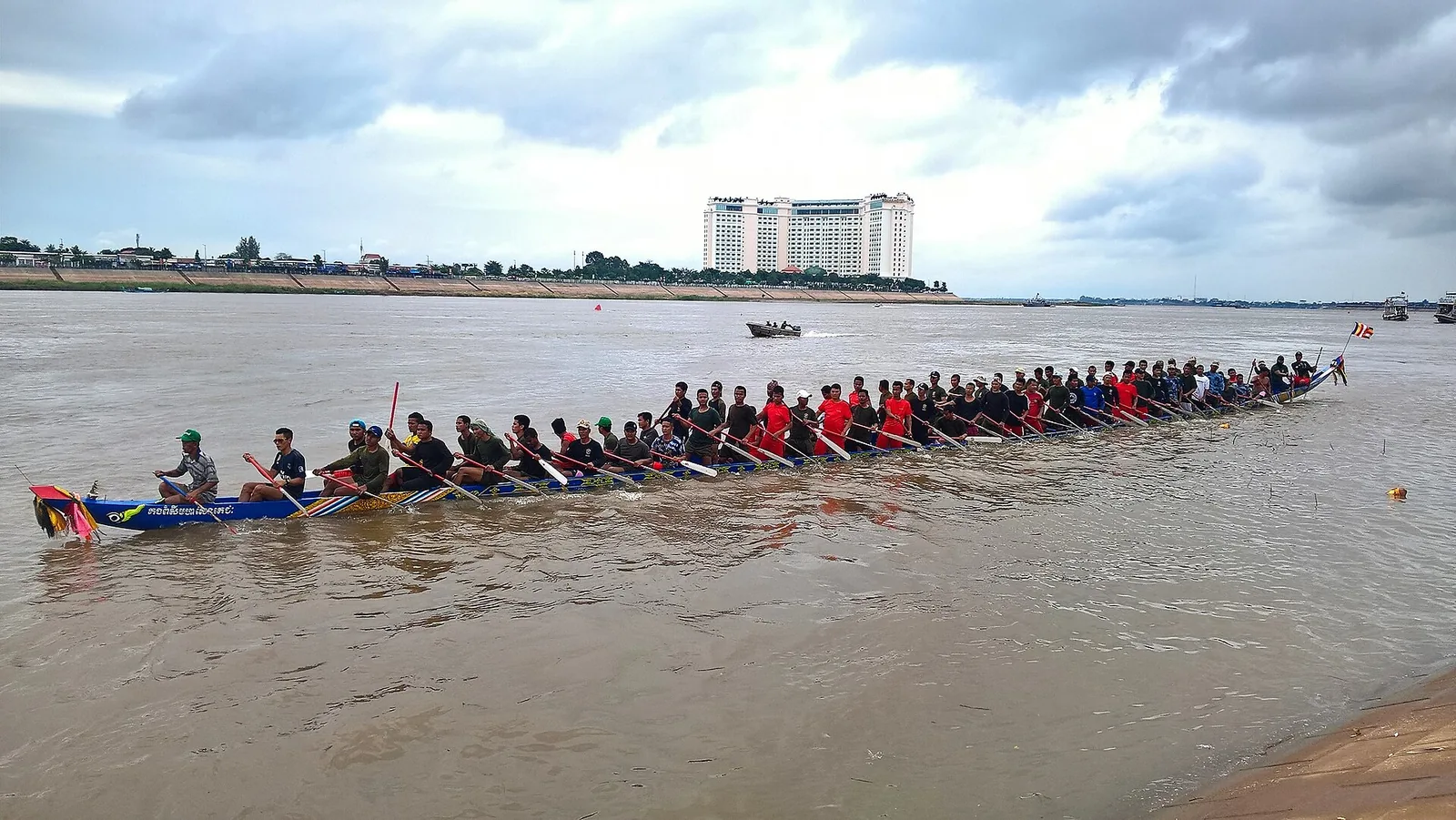
In the Cambodian countryside, the boat races were originally called bon chenh vassa, held when monks finished their three-month rainy-season retreat and left the pagoda. Villagers raced their everyday fishing boats, which was a different event from the royal races later held in front of the palace in Phnom Penh.

During the three months of the rains, monks stay in the pagoda for religious training and do not travel. Many of them are sons of village families, so when the retreat ends the whole village comes to welcome them home, and boats take to the river. The Cambodian ethnologist Ang Choulean notes that villagers did not call it a ‘water festival’ but bon chenh vassa. Exactly a month later came another festival, ok ambok (eating flattened rice), which originally had nothing to do with boats.
How did the two festivals end up combined, in front of the palace in Phnom Penh?
4. How did the Water Festival become a royal celebration? From Udong to Phnom Penh
The royal Water Festival in Phnom Penh is generally thought to have begun after King Norodom (reigned 1860–1904) moved the capital from Udong to Phnom Penh, combining the village boat races with ok ambok, moon worship and floating lanterns into a royal celebration that is a little over a century old.
Phnom Penh sits where four rivers meet, the Tonle Sap reverses its flow each year, and the Royal Palace faces the water: an ideal setting for a grand celebration. Ang Choulean suggests that because the two festivals were only a month apart, the king combined them. The official name has four parts as a result: the royal boat race, floating lanterns, moon salutation and eating flattened rice. In earlier times, on the last day, the palace’s Brahman priests sat in a boat in the middle of the river and ceremonially cut a ribbon, signalling the water’s return to the sea.
| When | What happened |
|---|---|
| 1866 | Phnom Penh becomes Cambodia's capital |
| 1873 | The French magazine Le Magasin Pittoresque publishes an image of a Cambodian racing boat |
| 1953–1970 | In the Sangkum era after independence, the Phnom Penh festival grows; boats then held only a little over 30 rowers |
| 1960s | Twice as many boats take part in the Phnom Penh races as before |
| Civil war | The festival is suspended |
| 1993 | The festival resumes after the general election |
| 2016 | 259 teams with 14,630 rowers compete |
| 2024 | 348 boats and 22,042 rowers register, plus 36 illuminated boats |
| 2025, 2026 | Phnom Penh's main celebration suspended; provinces hold their own |
Another common story traces the races to Angkor-era naval battles against Champa; that version is covered in Cambodia Water Festival. Ang Choulean himself does not see a link between the two, though he says he does not interfere with anyone who believes it.
5. Why do racing boats live in pagodas? Painted eyes, names and the dancer at the bow
Cambodians believe racing boats are inhabited by a spirit called preay, so the boats are kept only in pagodas; their bows are often painted with eyes and the boats given names, and pregnant women are told not to go near them. The dancer at the bow during a race is seen as the soul of the boat’s guardian.
Two weeks before the 2016 Water Festival, rowers at Chamkar Khsach pagoda in Meuntra village, Dangkao district, Phnom Penh, gathered at the pagoda every day at 2 p.m. and pushed their boat into the Prek Thnort River to practise. A few days before the races, the pagoda held a blessing ceremony for the boat and crew before they set off for the city centre. The coach shouted to his crew: ‘Are we going to win?’ ‘Yes!’ ‘Are we going to win three days in a row?’ ‘Yes!’
That boat was backed by the pagoda committee and kept at the pagoda. Racing boats are usually painted with eyes on the bow, so they look like living dragons; some are decorated with hair and given a name. The dancer at the bow keeps the rowers in rhythm and is seen locally as the soul of the boat’s keeper. Where there is no dancer, an elder sits in a fixed position, moving his oar in a particular way while chanting a spell. For Buddhism and pagoda life in Cambodia, see Religion in Cambodia.
6. What the Water Festival means today: family trips, tourism and social media
The Water Festival is one of Cambodia’s biggest celebrations: over three days in 2024 the Ministry of Tourism estimated about 6.2 million domestic visitors and 52,498 foreign tourists. For many people it is the family holiday that marks the end of the rains, and for the provinces a chance to promote local tourism and local products.
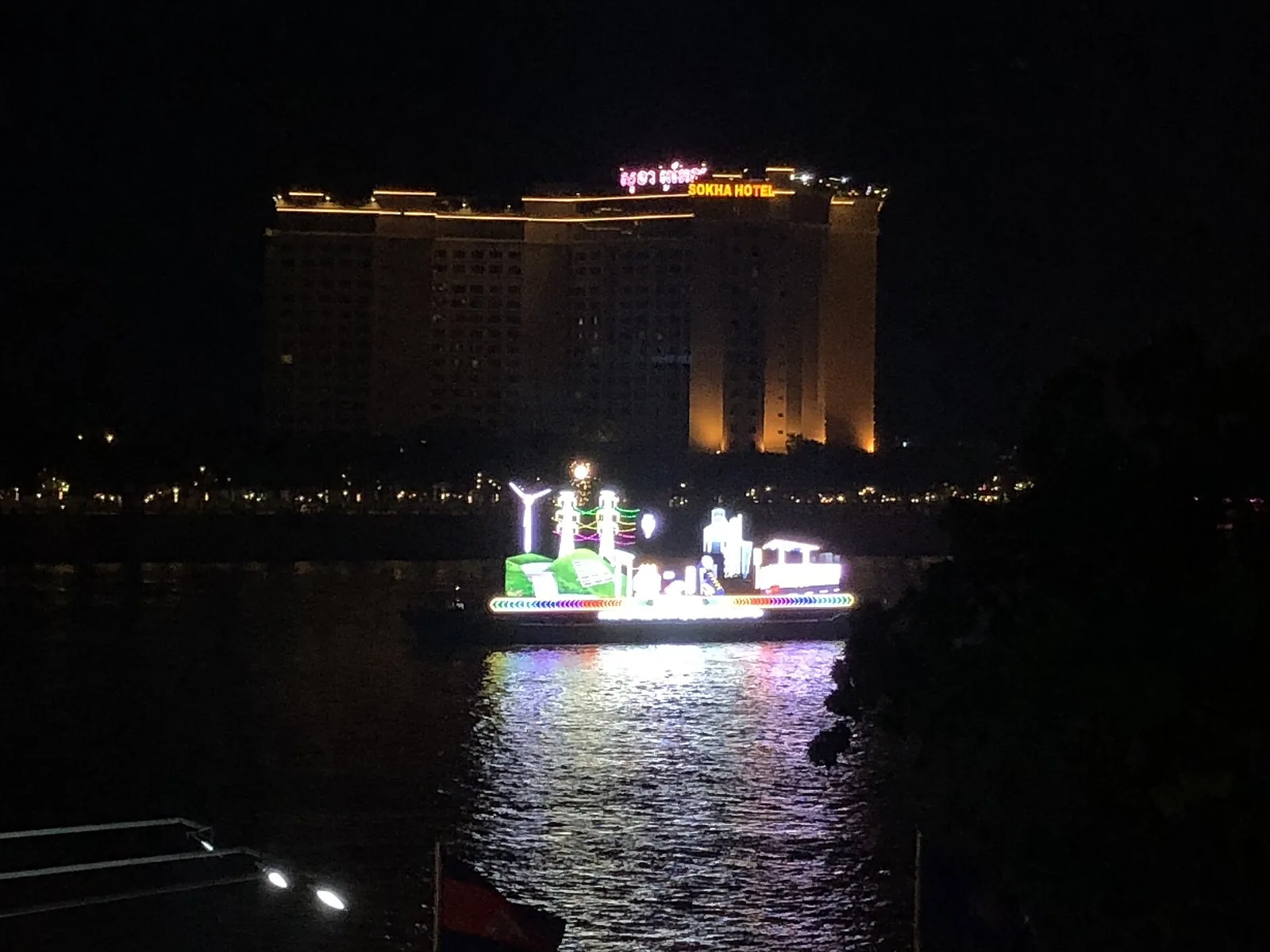
In the past, people from across the country poured into Phnom Penh to watch the races from the riverbank. When Phnom Penh paused in 2025, the Ministry of Tourism promoted provincial celebrations instead and expected large numbers of domestic tourists to head for cultural sites in the north, the southwestern coast and eco-tourism areas in the northeast. The same report said the 2024 festival drew nearly 7.85 million domestic and foreign visitors, with domestic visitors up 21.4% on 2023; this differs from the ministry’s post-festival figure of about 6.2 million domestic visitors, probably because the two cover different scopes.
The festival has also moved onto phone screens. Search for the Water Festival on TikTok and other platforms and you will find plenty of short videos shot by ordinary people, including foreign visitors celebrating it for the first time. This year’s provincial venues are photogenic in their own right: the Siem Reap River will be lined with boat-race-themed lights, Senmonorom Reservoir in Mondulkiri is ringed by hills and forest, and the Kampot River offers a riverside view in a small coastal town.

7. Watching the races in the provinces: practical tips
Kampong Thom, Pursat and Svay Rieng have announced afternoon races followed by evening concerts and product exhibitions. 23–25 November is the national holiday, and the Siem Reap, Kampot and Kampong Speu races fall within it; check each provincial government’s latest notice before you travel.
Siem Reap’s provincial administration has asked for designated vendor areas along the river and stepped-up food hygiene checks, and police will be deployed around venues in the provinces to manage traffic and order. Svay Rieng’s races run from 8 to 11 November; for more on the province and Bavet, see Bavet and Svay Rieng, Cambodia. The Manhattan Special Economic Zone is in Bavet, Svay Rieng. To learn about factories and facilities in the zone, please contact our investment team. For more on Cambodia’s festivals, history and customs, see our Cambodian Culture section.
8. FAQ
Q1: Are there Water Festival boat races in Phnom Penh in 2026?
No. The main Water Festival celebration in front of the Royal Palace in Phnom Penh is suspended in 2026. The three-day holiday on 23–25 November remains, and provinces hold their own boat races and celebrations.
Q2: Where can I see the boat races in 2026?
Announced so far: Siem Reap (23–24 November, Siem Reap River), Kampot (23–25 November, Kampot River), Svay Rieng (8–11 November), Kampong Thom and Pursat (7–8 November), Kampong Speu (24 November), Mondulkiri (13–15 November) and Takeo (31 October–1 November).
Q3: When is the Water Festival in Siem Reap?
In 2026, celebrations along the Siem Reap River run from 20 to 25 November, with boat races on 23 and 24 November.
Q4: What were the boat races originally?
In the countryside they were called bon chenh vassa, held when monks ended their three-month rainy-season retreat. The royal Water Festival in Phnom Penh is generally thought to date from after King Norodom moved the capital to Phnom Penh.
Q5: Why are Cambodian racing boats kept in pagodas?
People believe the boats are inhabited by a spirit called preay that only a pagoda can handle, so they are kept there, and pregnant women are told not to go near them.
Q6: Why does someone dance at the bow of the boat?
The dancer keeps the rowers in rhythm and is seen as the soul of the boat's keeper; without a dancer, an elder moves his oar in a particular way while chanting a spell.
Q7: How many people take part in the Water Festival?
In 2024, 348 boats and 22,042 rowers registered for the Phnom Penh races, and the Ministry of Tourism estimated about 6.2 million domestic and 52,498 foreign visitors over three days.
Q8: Is the Water Festival linked to Angkor-era naval battles?
One story traces the boat races to battles against Champa in the Angkor era, but the Cambodian ethnologist Ang Choulean sees no link; he traces the races to the village bon chenh vassa festival.
References
- Cambodianess (28 October 2026) | Cambodian Provinces Keep Water Festival Alive Despite Phnom Penh Cancellation | https://cambodianess.com/article/cambodian-provinces-keep-water-festival-alive-despite-phnom-penh-cancellation
- Cambodianess (interview with Ang Choulean) | Exploring the Roots of the Water Festival | https://www.cambodianess.com/article/exploring-the-roots-of-the-water-festival
- Agence Kampuchea Presse (5 November 2025) | Provinces Expected to Receive Significant Influx of Domestic Tourists During Water Festival Holiday | https://akp.gov.kh/post/detail/352545
- Agence Kampuchea Presse (5 November 2025) | Domestic and International Visitors Join Boat Race in Siem Reap Province | https://www.akp.gov.kh/post/detail/352538
- Agence Kampuchea Presse (30 June 2026) | 2026 Water Festival arrangements | https://www.akp.gov.kh/post/detail/374510
- The Star / Xinhua (18 November 2024) | Cambodia's famous water festival attracts over 6.2 million visitors | https://thestar.com.my/aseanplus/aseanplus-news/2024/11/18/cambodia039s-famous-water-festival-attracts-over-62-million-visitors-more-than-52000-were-foreign-visitors
- CamboJA (13 November 2024) | All Systems In Place For Annual Water Festival Boat Race in Phnom Penh | https://cambojanews.com/all-systems-in-place-for-annual-water-festival-boat-race-in-phnom-penh/
- The Cambodia Daily (12 November 2016) | Preparing the Boats | https://english.cambodiadaily.com/?p=120487
- Wikipedia (accessed 29 October 2026) | Bon Om Touk | https://en.wikipedia.org/wiki/Bon_Om_Touk
- TikTok (accessed 29 October 2026) | Water Festival in Cambodia | https://www.tiktok.com/discover/water-festival-in-cambodia


